Quick Take
- Six founders behind Zomato, Myntra, boAt, Dunzo, Practo, and Flipkart are building new ventures.
- Most second acts bet on AI or deep tech: brain wearables, coding agents, and disease detection.
- Deepinder Goyal’s Temple raised $54 Mn (Rs 450 Cr) at a $190 Mn valuation in February 2026.
In This Article
India’s startup tycoons who built household names like Zomato, Myntra, and Flipkart are back, this time with bold new ventures in AI, brain tech, and preventive healthcare.
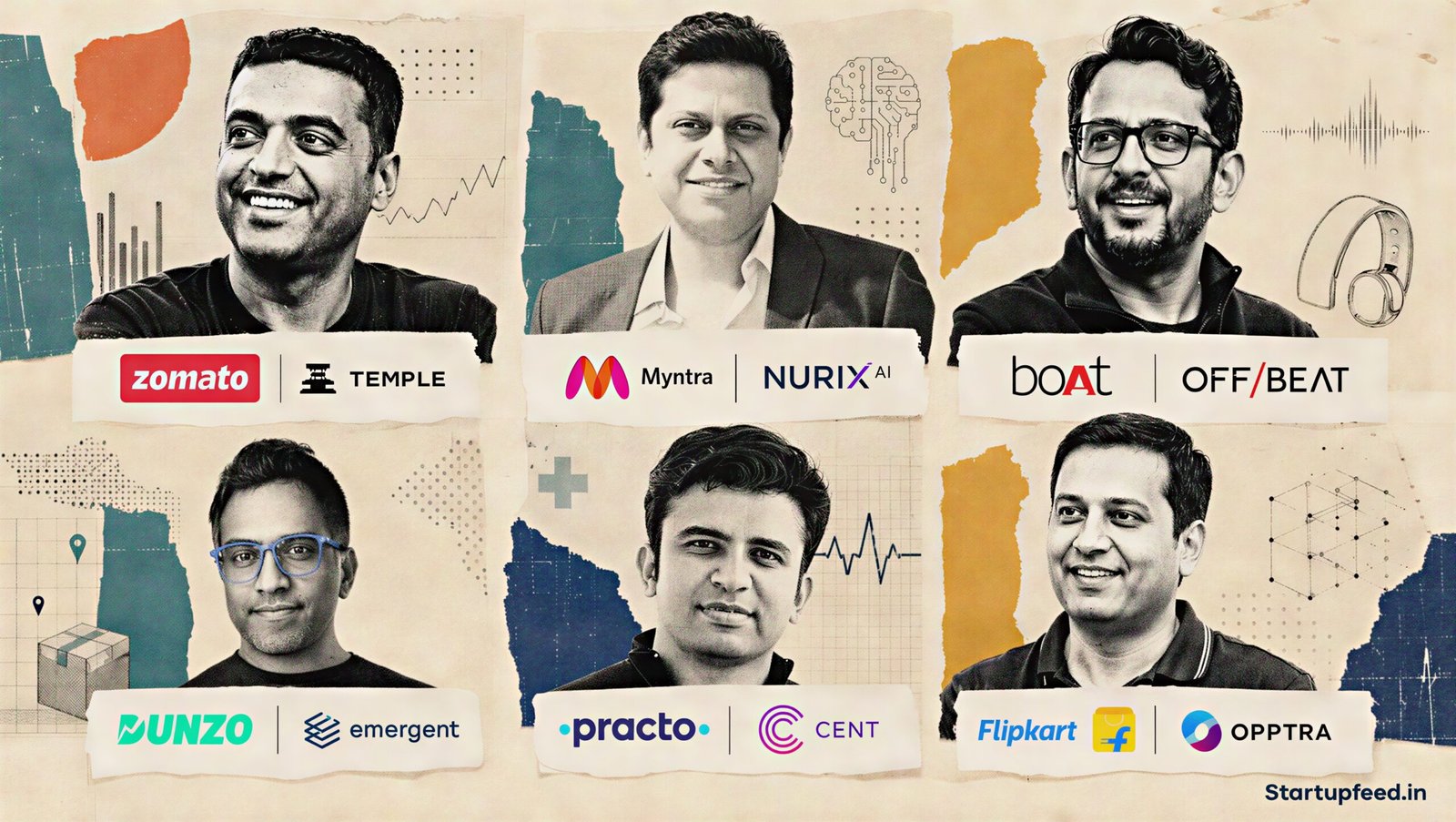
An infographic by E-Cell, IIT Bombay maps six iconic founders and their second acts. Most have left or stepped back from the companies that made them famous. Their new bets share a common thread: deep technology, with five of six leaning on artificial intelligence (AI). The pattern signals where seasoned operators see the next decade of value.
StartupFeed Insight
The signal hiding in these six bets: India’s startup tycoons are no longer chasing the consumer internet that made them rich. Five of six are building AI or deep-tech tools, not the next delivery app. That tells you where smart capital thinks the moat now sits. Watch the founders who self-fund, like Goyal at Temple and Shashank ND at Cent, because personal cheques signal conviction over hype. StartupFeed predicts that by end-2026, at least two of these six ventures cross a $500 Mn valuation, while at least one quietly pivots or stalls as the AI funding cycle cools. By StartupFeed Desk.
The Six New Bets at a Glance
Six founders who built iconic Indian startups have each launched a new venture between 2024 and 2026. The table below pairs each founder’s earlier company with their current focus, verified from company announcements and primary filings.
| Founder | Built Earlier | Building Next | Focus Area |
|---|---|---|---|
| Deepinder Goyal | Zomato | Temple | Brain-health wearables |
| Mukesh Bansal | Myntra | Nurix AI | Enterprise AI agents |
| Aman Gupta | boAt | OFF/BEAT | AI and consumer tech |
| Mukund Jha | Dunzo | Emergent | AI vibe-coding |
| Shashank ND | Practo | Cent | Preventive healthcare |
| Binny Bansal | Flipkart | Opptra | E-commerce enablement |
The most striking fact: four of these ventures, Temple, Nurix, Emergent, and Cent, use AI as their core engine, not a feature. Only Opptra leans on supply chain and franchising as its primary play.
About the Founders
These six are repeat founders from India’s consumer-tech boom of the 2010s. Deepinder Goyal co-founded Zomato in 2008 and stepped down as Eternal CEO in January 2026, according to TechCrunch. Mukesh Bansal co-founded Myntra and Cult.fit. Aman Gupta co-founded boAt. Mukund Jha co-founded Dunzo. Shashank ND co-founded Practo. Binny Bansal co-founded Flipkart, later sold to Walmart for $16 Bn.

Why are India’s startup tycoons building now?
India’s startup tycoons are building now because non-compete clauses have lapsed and personal wealth lets them chase higher-risk ideas. Goyal framed his Eternal exit as a move toward “significantly higher-risk exploration and experimentation,” he wrote on X (formerly Twitter).
“Friends and family. $54m. Post-money valuation of ~$190m. Every investor in this round is a founder friend or early-stage Zomato investor who wanted in,” Deepinder Goyal posted on X on February 27, 2026.
The timing is rarely accidental. Binny Bansal’s five-year non-compete from the Walmart deal expired in 2023, clearing his path back into commerce, per public reporting. Goyal committed $25 Mn (Rs 225 Cr) of his own capital to longevity research before Temple, company filings show. Wealth buys patience that first-time founders cannot afford.
What does the AI tilt tell us?
The AI tilt tells us that India’s most experienced founders see deep tech, not consumer apps, as the next frontier. Five of six ventures use AI at their core. Mukund Jha’s Emergent shows the pace on offer: the vibe-coding startup hit $50 Mn in annual recurring revenue (ARR) within seven months and raised $70 Mn at a $300 Mn valuation, TechCrunch reported.
| Venture | Latest Raise | Lead Investor(s) |
|---|---|---|
| Temple | $54 Mn (Rs 450 Cr) | Deepinder Goyal, Steadview Capital |
| Emergent | $70 Mn (Series B) | SoftBank Vision Fund 2, Khosla Ventures |
| OFF/BEAT | Rs 100 Cr ($10.7 Mn) | Bessemer Venture Partners |
| Nurix AI | $27.5 Mn (seed + Series A) | Accel, General Catalyst |
| Cent | $5 Mn (Rs 45.8 Cr) seed | OneFlow Holdings, South Park Commons |
What sets these apart from younger AI startups is distribution. Aman Gupta scaled boAt to over Rs 3,000 Cr in revenue, per his fundraise statement. That operating muscle, not the technology alone, is what investors like Bessemer are buying into at OFF/BEAT.
What does this mean for the ecosystem?
For India’s ecosystem, the return of these tycoons means more capital, talent, and credibility flowing into deep tech. Each founder pulls a network with them. Goyal’s Temple round drew angels like Kunal Shah of CRED and the Kamath brothers of Zerodha, TechCrunch reported. That gravity is hard for a first-time founder to match.
The risk is concentration. When marquee names crowd into AI, valuations can inflate faster than fundamentals. Emergent reached a $300 Mn valuation in seven months, a pace TechCrunch called one of the fastest in the AI category. Speed cuts both ways. The same founders also know how brutal a down-cycle feels, having lived through Dunzo’s shutdown and boAt’s IPO delay.
What’s Next
Watch the next 12 months for proof points, not just press releases. Cent plans to open its first prevention centre in Bengaluru by April 2026, with Mumbai, Delhi, and Hyderabad to follow. Temple has begun shipping early sample units. The real test is whether these ventures convert founder pedigree into durable products. Which of these six second acts do you think will outgrow the original?
Frequently Asked Questions
Last updated: June 13, 2026 at 09:30 IST
Disclaimer: This article is for informational purposes only and does not constitute investment advice. StartupFeed and its authors are not SEBI-registered investment advisors. The analysis above is based on publicly available information and should not be the sole basis for any investment decision. Please consult a SEBI-registered financial advisor before making investment decisions.
Written by Soumya Verma. Published: June 13, 2026. Updated: June 13, 2026. Have a tip? Write to us at editorial@startupfeed.in.
Liked this story? Follow StartupFeed on Google so our reporting reaches you first.