
Quick Take
- Haryana Industrial Policy 2026 targets Rs 5 Lakh Cr investments and 10 Lakh new jobs.
- CM Saini unveils AI-enabled Single Window 2.0, replacing the old A-B-C-D block classification system.
- Day-one MoUs hit Rs 1.10 Lakh Cr, led by Anant Raj’s Rs 20,000 Cr data centre.
In This Article
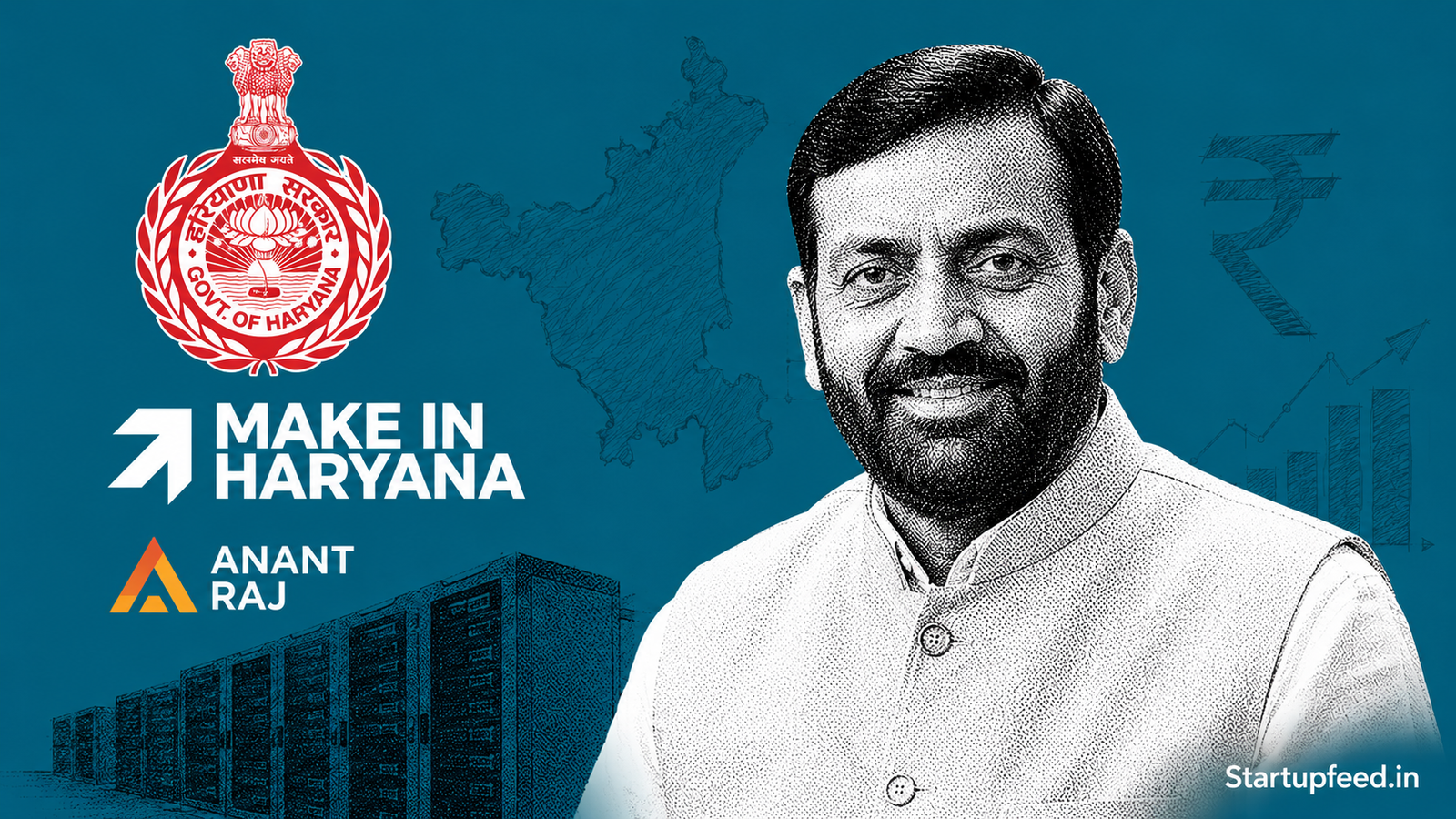
Haryana Industrial Policy 2026 was unveiled by Chief Minister Nayab Singh Saini, with a target of attracting Rs 5 Lakh Cr in investments and creating 10 Lakh new jobs across the state.
The “Make in Haryana” policy, launched at Grand Hyatt Gurgaon alongside nine sector-specific policies, signals a shift from traditional manufacturing towards innovation-led industrial growth. Focus areas include data centres, Global Capability Centres (GCCs, the offshore arms of multinational corporations), electronics, and advanced manufacturing. The state signed MoUs worth Rs 1.10 Lakh Cr on day one, including Rs 30,000 Cr in foreign direct investment (FDI) commitments, according to the Government of Haryana investment portal.
StartupFeed Insight
This is not a routine industrial-policy refresh. Haryana is competing directly with Karnataka and Maharashtra for the next wave of data-centre and GCC capital. Two things stand out. First, the AI-enabled Single Window 2.0 with a GIS-based land-identification system is the kind of operational stack only Karnataka and Telangana have built before. Second, scrapping the old A-B-C-D block classification removes a long-standing complaint from Tier-2 investors. Our view: expect at least three more states to copy the AI-portal template by FY27, and watch Gurugram and Manesar add 1.5 GW of new data-centre capacity over the next four years. By StartupFeed Desk.
What does the Haryana Industrial Policy 2026 include?
| Pillar | Detail | Notes |
|---|---|---|
| Investment Target | Rs 5 Lakh Cr | Over five-year policy lifecycle |
| Job Creation Target | 10 Lakh | Direct and indirect |
| Day-One MoUs | Rs 1.10 Lakh Cr | Includes Rs 30,000 Cr FDI |
| Anchor Project | Anant Raj Rs 20,000 Cr data centre | 6,000 jobs, 307 MW IT load by FY32 |
| Sector Policies | 9 sub-policies | Includes EV, semi, green hydrogen, e-waste |
| Approval Reform | AI Single Window 2.0 | Replaces multi-department clearances |
What stands out: the policy supersedes the older Haryana Enterprises and Employment Policy 2020 and was officially notified on May 26, 2026. It will remain valid for five years or until a fresh policy is introduced.
About the Haryana Industrial Policy
The Haryana Industrial Policy 2026, branded “Make in Haryana”, was launched on June 1, 2026 by Chief Minister Nayab Singh Saini. It targets Rs 5 Lakh Cr in investments and 10 Lakh jobs across the state. The policy introduces an AI-enabled Single Window 2.0 system, a simplified statewide incentive framework, and a focused push on data centres, GCCs, electronics, electric vehicles, and green manufacturing. Nine sector-specific policies were unveiled alongside it, covering toys and sports equipment, textiles, auto components, footwear, renewable energy, green hydrogen, e-waste recycling, chemicals, and EVs and semiconductors.
How will the AI Single Window 2.0 work?
The reform replaces a process that previously required investors to navigate multiple state departments. The new Intelligent Investment Facilitation Portal bundles five tools into one interface. First, a smart AI agent for real-time investor assistance. Second, an AI-powered investment blueprint generator that recommends sector fit and incentive eligibility. Third, a GIS (Geographic Information System, software that maps land and infrastructure) based land identification tool. Fourth, approval pathway guidance that maps clearances end-to-end. Fifth, infrastructure and policy support built into the same interface. Investors can now access approvals, land allocation, incentives, and clearances on one integrated platform.
“Investors now evaluate the overall ecosystem. They ask which state can make faster decisions, provide trust and reliability, and emerge as a long-term growth partner.”
Nayab Singh Saini, Chief Minister of Haryana.
What incentives does the Haryana Industrial Policy 2026 offer?
The policy scraps the older A-B-C-D block classification system, which had ranked districts by industrial readiness, in favour of a simplified statewide incentive framework. Fiscal incentives are now tied to five performance metrics: intra-state sales, employment generation, R&D infrastructure, export turnover, and green initiatives. Key incentive lines include a capital subsidy of up to 30%, net state GST (Goods and Services Tax) reimbursement, and R&D support of up to Rs 50 Cr. The state will also offer a 50% top-up on incentives received under central PLI schemes, where PLI (Production Linked Incentive, a central-government scheme that pays manufacturers based on output) has already pulled in semiconductor and electronics commitments. Green initiatives like zero liquid discharge and carbon credit generation receive specific support, and export-oriented units hit by geopolitical disruptions are eligible for one-time diversification support.
How does the Haryana Industrial Policy compare to peer states?
Haryana’s pitch differs from Karnataka and Maharashtra in three concrete ways. Karnataka’s tech-policy edge still rests on Bengaluru’s talent pool and its older GCC head-start, while Maharashtra leans on Mumbai’s financial-services cluster. Haryana is making a clean play for the data-centre and GCC layer, anchored by Gurugram’s proximity to Delhi-NCR power and fibre infrastructure and the new Rs 20,000 Cr Anant Raj commitment, delivered through its subsidiary Anant Raj Cloud. The AI Single Window 2.0 also gives the state an operational-speed claim that few rival states can match in 2026.
Also Read
- India’s Data Centre Boom: Why Gurugram Is The New Hub
- Global Capability Centres In India: The Rs 100 Bn Opportunity
- Anant Raj Data Centre Expansion: From Manesar To Rai
What’s Next
Watch for the “Happening Haryana” Global Investors Summit in the coming months, where the state plans to convert the day-one MoU pipeline into ground-broken projects. By FY27, Gurugram and Manesar are likely to absorb the bulk of new data-centre and GCC capacity. The bigger question: will Haryana’s AI-portal model become the template for other Indian states racing for the same investor dollar?
Frequently Asked Questions
What is the Haryana Industrial Policy 2026?
The Haryana Industrial Policy 2026, branded “Make in Haryana”, is a five-year industrial policy launched on June 1, 2026 by Chief Minister Nayab Singh Saini. It targets Rs 5 Lakh Cr in investments and 10 Lakh jobs, with a focus on data centres, GCCs, electronics, EVs, and advanced manufacturing.
What is the AI Single Window 2.0 under the new policy?
The AI Single Window 2.0, officially called the Intelligent Investment Facilitation Portal, is an AI-enabled platform that bundles approvals, land allocation, incentives, and clearances on a single interface. It uses a smart AI agent, an AI investment blueprint generator, and a GIS-based land identification tool to reduce procedural delays for investors.
Which companies signed MoUs on day one?
Day-one MoUs hit Rs 1.10 Lakh Cr. Anchor signatories include Anant Raj (Rs 20,000 Cr data centre), National Australia Bank Global Innovation Center, Reliance MET City, India Cellular and Electronics Association, Horizon Industrial Parks, and Sumitomo Corp India. Together they bring Rs 30,000 Cr in FDI commitments.
Written by StartupFeed Desk. Published: June 2, 2026. Updated: June 2, 2026. Have a tip? Write to us at editorial@startupfeed.in.
Liked this story? Follow StartupFeed on Google so our reporting reaches you first.