Quick Take
- India’s first fuel price hike in 49 months hit petrol and diesel on May 15, 2026.
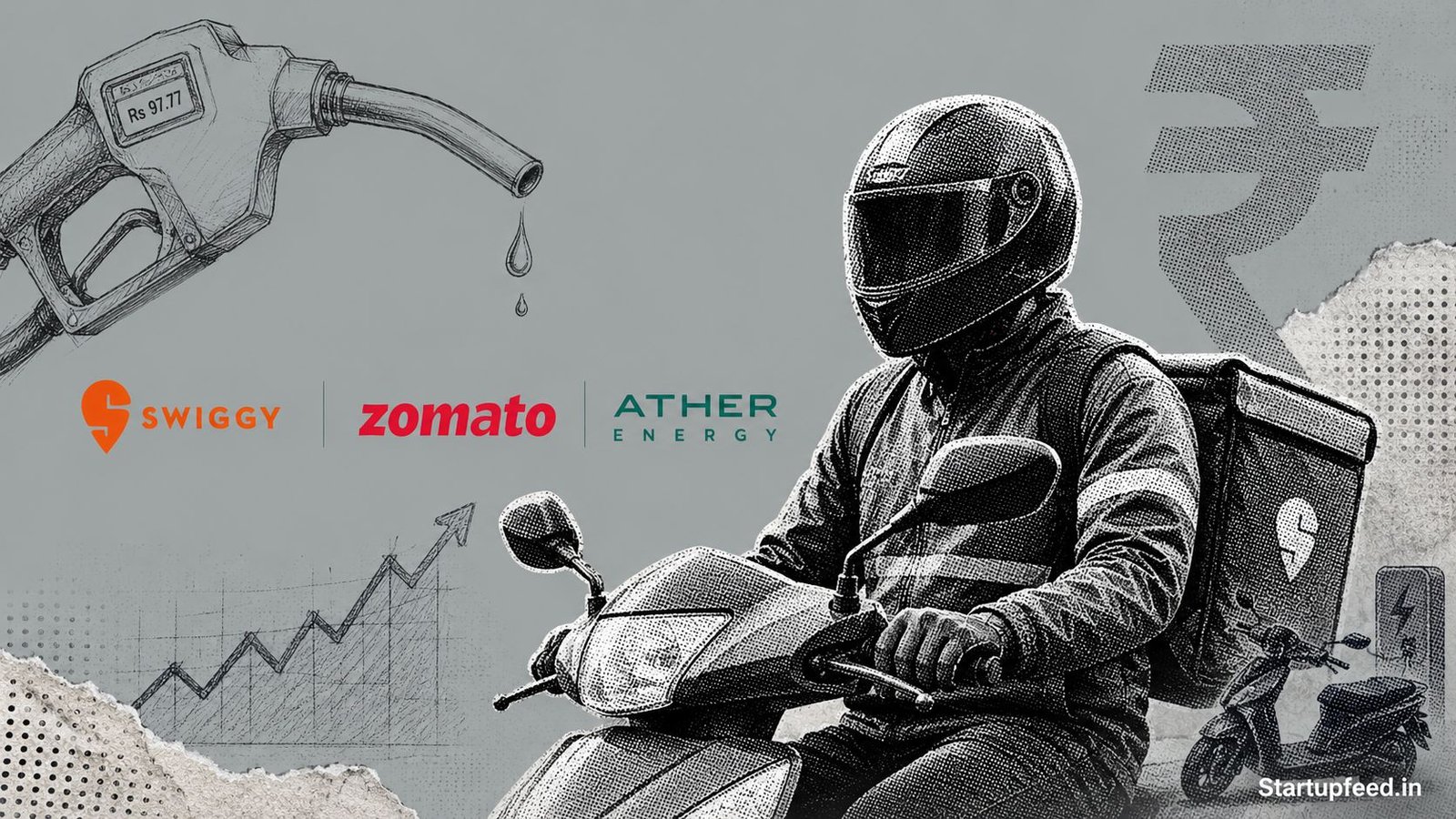
- CNG jumped Rs 2 per kg, triggering a five-hour gig worker strike across India.
- EV startups like Ather Energy and Euler Motors are the unexpected winners of this crisis.
The India fuel price hike of May 15, 2026, raised petrol by Rs 3 per litre and CNG by Rs 2 per kg, the first such increase in 49 months.
The trigger was global. Brent crude surged from roughly $69 per barrel in February 2026 to $113-114 per barrel as the Iran war disrupted the Strait of Hormuz. India’s state-run OMCs (Oil Marketing Companies, the trio of Indian Oil Corporation, BPCL, and HPCL that controls over 90% of India’s 1 lakh-plus fuel stations) absorbed mounting losses for about 11 weeks before passing them on.
StartupFeed Insight
The India fuel price hike of May 2026 is a watershed for India’s startup economy. Every business that depends on a delivery fleet or gig worker network is now in a cost-renegotiation spiral. GIPSWU (Gig and Platform Service Workers Union) has demanded a minimum payout of Rs 20 per kilometre, and platforms will have to move on that or face permanent partner attrition. The clear winners are EV (Electric Vehicle) startups that have spent five years building exactly this case for switching. Expect Ather Energy, Euler Motors, and Yulu to announce fleet-partnership deals with major delivery platforms by Q3 FY27, StartupFeed Desk.
What Are the New Petrol, Diesel, and CNG Rates After the Hike?
State-level VAT (Value Added Tax) means prices differ across cities. The Rs 3 per litre hike was uniform across OMC-run pumps, but final pump prices vary.
| City | Petrol (Rs/litre) | Diesel (Rs/litre) | CNG (Rs/kg) | Petrol Change |
|---|---|---|---|---|
| Delhi | 97.77 | 90.67 | 79.09 | +Rs 3.00 |
| Mumbai | 106.68 | 93.14 | 84.00 | +Rs 3.00 |
| Bengaluru | 106.17 | 94.10 | N/A | +Rs 3.00 |
| Hyderabad | 110.89 | 98.96 | N/A | +Rs 3.00 |
| Chennai | 103.67 | 95.25 | N/A | +Rs 3.00 |
Hyderabad has India’s most expensive petrol among metros at Rs 110.89 per litre. Industry sources say the Rs 3 correction covers only about one-tenth of the adjustment needed to reflect the full crude oil surge since the Iran conflict began. More hikes may follow.
About India’s Fuel Price Mechanism
India’s petrol and diesel prices are set by three state-run OMCs: Indian Oil Corporation, BPCL, and HPCL, which control over 90% of India’s 1 lakh-plus fuel stations. Prices update daily at 6 AM using dynamic pricing, introduced in June 2017. State-level VAT creates city-level differences. CNG (Compressed Natural Gas) is priced by city gas distribution companies and falls outside GST (Goods and Services Tax). LPG (Liquefied Petroleum Gas) cylinder prices are set separately by the government.

How Does the India Fuel Price Hike Hit Logistics and Delivery Startups?
The impact on delivery startups is immediate and direct. Quick-commerce platforms like Blinkit and Zepto rely on petrol-powered or CNG-powered two-wheelers for every order. Higher fuel costs cut rider take-home pay before a platform pays a single rupee more in compensation.
On May 16, 2026, GIPSWU called a five-hour strike from 12 PM to 5 PM. Roughly 1.2 crore (12 million) gig workers logged off their apps across the country. Food delivery platforms saw a 70-80% drop in active riders in Bengaluru, Delhi, and Mumbai. Blinkit and Zepto suspended operations in many city zones. Logistics startups like Porter and BlackBuck face freight cost increases of 4-6%.
GIPSWU President Seema Singh said gig workers “simply cannot bear this additional weight,” and demanded a minimum service rate of Rs 20 per kilometre. Zomato had already raised its platform fee to Rs 2.40 per order before the strike. Analysts expect more fee increases across delivery apps in the weeks ahead.
“They are being squeezed from both ends. Algorithms refuse to adjust compensation to reflect the ground reality.”
Seema Singh, President, Gig and Platform Service Workers Union, May 16, 2026.
Commercial LPG (Liquefied Petroleum Gas) cylinders, which cloud kitchens and food-tech startups use daily, have also crossed Rs 2,100 per cylinder. That adds a separate cost pressure on restaurant kitchens and dark-store operations beyond just rider fuel.
Which Startup Sectors Are Hurt Most by Rising Fuel Costs?
India’s startup economy has unequal exposure to fuel. Sectors with physical delivery operations carry the heaviest load.
| Startup Sector | Fuel Exposure | Severity | Example Startups |
|---|---|---|---|
| Quick commerce | Petrol, CNG (two-wheelers) | Severe | Blinkit, Zepto, Instamart |
| Food delivery | Petrol, CNG (two-wheelers) | Severe | Swiggy, Zomato |
| Ride-hailing | CNG, petrol (cars, autos) | High | Ola, Uber, Rapido |
| Logistics and 3PL | Diesel (trucks, vans) | High | Porter, Delhivery, BlackBuck |
| D2C and e-commerce | Indirect (freight costs) | Moderate | Mamaearth, Boat, Sugar |
| SaaS and B2B tech | Indirect (commuting, DG sets) | Low | Freshworks, Zoho, Chargebee |
| EV startups | None (beneficiary) | Positive | Ather Energy, Euler Motors, Yulu |
D2C (Direct-to-Consumer) e-commerce brands feel the pinch through logistics partners raising rates. Agritech startups running cold chains or farm-to-fork supply lines also face higher diesel costs. The RBI (Reserve Bank of India) has already raised its FY27 inflation forecast to 4.6% and cut its GDP (Gross Domestic Product) growth projection to 6.9%. That macro squeeze makes it harder for startups to raise prices without losing consumers.
According to Business Standard, higher fuel costs could add 0.2-0.4% to India’s headline CPI (Consumer Price Index, the official measure of retail inflation), which already stood at 3.48% in April 2026. FPIs (Foreign Portfolio Investors) have pulled roughly Rs 2.2 trillion from Indian equities in 2026 so far. Sustained fuel inflation will likely keep that exit pressure on.

Who Are the Unexpected Winners of India’s Fuel Price Hike?
Every fuel price spike is a tailwind for EV startups. India’s electric two-wheeler market grew +45% YoY (Year-on-Year) in Q4 2025. Sales surged again in March 2026 directly because of rising fuel costs and Middle East tension.
India’s EV (Electric Vehicle) startup ecosystem now counts 2,018 companies according to Tracxn. Ather Energy’s valuation reached $2.5 Bn (Rs 20,750 Cr) after its latest funding round. Yulu, which operates electric micro-mobility scooters for gig workers, is targeting a $100 Mn (Rs 830 Cr) Series C round to scale its platform. The government’s FAME III (Faster Adoption and Manufacturing of Electric Vehicles, Third Phase) scheme has allocated Rs 12,000 Cr to subsidise EV adoption, making fleet electrification economically rational for any delivery platform operating at scale.
Battery-tech and charging infrastructure startups also benefit. Battery Smart, Exponent Energy, and ElectricPe all gain from accelerated fleet transition demand. Euler Motors, which makes electric cargo three-wheelers for last-mile logistics, becomes more attractive to every logistics startup whose diesel fuel bill just jumped 3.4%.
For SaaS (Software as a Service) startups, the indirect impact is real but manageable. Rising fuel costs push more businesses toward remote work and digital tools. IT companies and SaaS founders are already redesigning satellite-office and flexible-work policies to reduce commuting costs for employees. That pushes more enterprise spend toward collaboration software, HR-tech, and cloud tools.
What’s Next
The first question is whether platforms revise gig worker payouts. GIPSWU has demanded Rs 20 per kilometre as a minimum service rate. Watch that negotiation resolve before July 2026. The second question is whether another fuel hike follows. Industry sources say the Rs 3 correction covers only a fraction of the OMC under-recoveries. A second increase is likely if crude stays above $100 per barrel. Will Indian founders build an EV fleet contingency into their next budget before that second hike arrives?
Frequently Asked Questions
How does the India fuel price hike affect Indian startups?
The India fuel price hike of May 15, 2026, raises operating costs for delivery, logistics, and ride-hailing startups directly. Every petrol or CNG-powered rider pays Rs 3 more per litre. Platforms like Swiggy, Zomato, and Blinkit face pressure to raise worker payouts, raise delivery fees, or absorb margin loss.
Why did India raise petrol and diesel prices in May 2026?
India’s state-run oil companies had frozen petrol and diesel prices for 49 months. Brent crude surged to $113-114 per barrel after the Iran war disrupted the Strait of Hormuz. OMCs absorbed losses for about 11 weeks before raising prices by Rs 3 per litre on May 15, 2026. More hikes are possible.
Which Indian startups benefit from higher fuel prices?
EV startups benefit most from higher fuel prices. India’s electric two-wheeler market grew +45% YoY in Q4 2025 and surged again in March 2026 as fuel costs rose. Startups like Ather Energy, Euler Motors, Yulu, and battery-tech companies like Battery Smart stand to gain as delivery platform fleet electrification accelerates.
Have a tip? Write to us at editorial@startupfeed.in.
Liked this story? Follow StartupFeed on Google so our reporting reaches you first.