


Quick Take
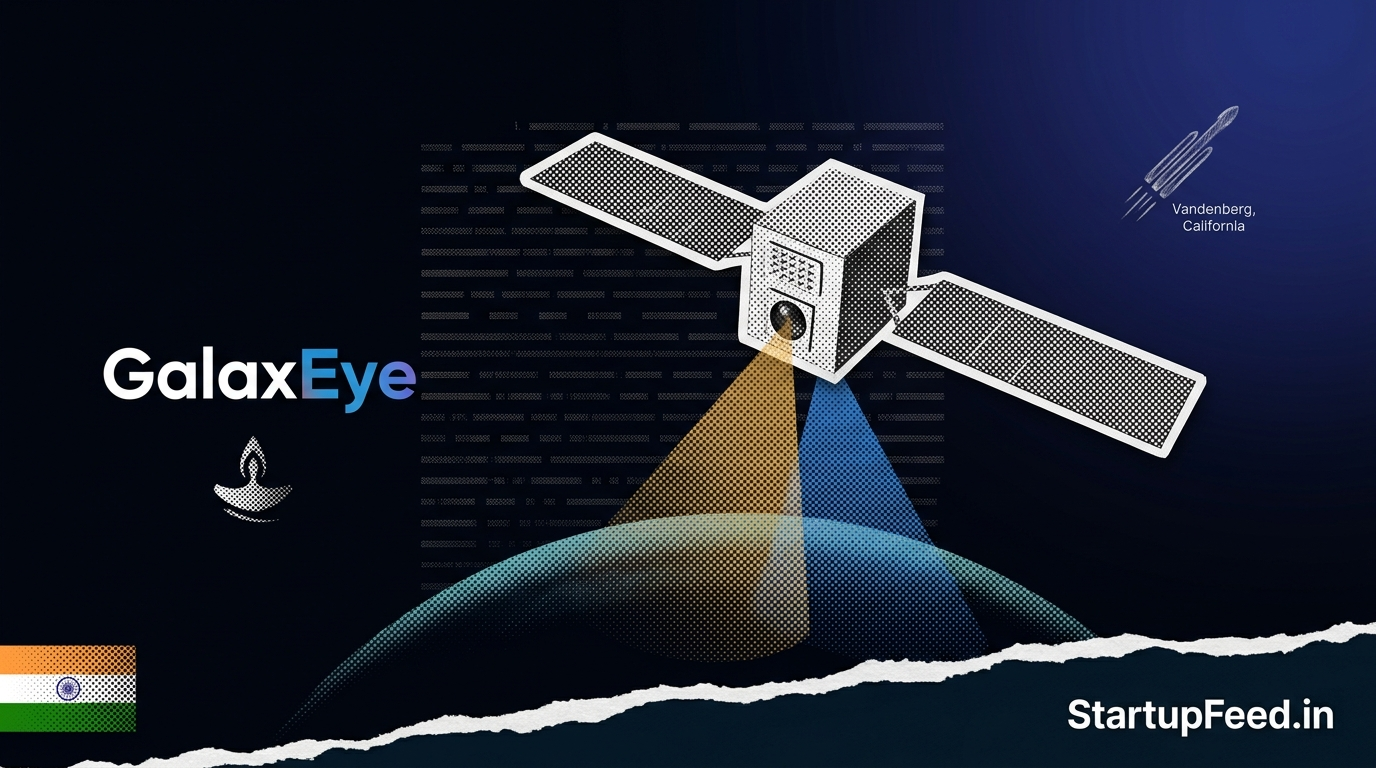
- GalaxEye’s Mission Drishti — the world’s first commercial OptoSAR satellite — was successfully placed into orbit aboard SpaceX’s Falcon 9 rocket from Vandenberg Space Force Base, California, on May 3, 2026, at 12:30 PM IST.
- At 190 kg, Mission Drishti is India’s largest privately built satellite and the first in the world to co-locate a high-resolution SAR sensor and a 7-band multispectral imager on a single platform, capturing both data streams simultaneously in a single pass.
- PM Narendra Modi, EAM S. Jaishankar, MEA, ISRO, and IN-SPACe Chairman Pawan Goenka all publicly hailed the launch. GalaxEye has raised approximately $14.5 million to date and plans to initiate its next funding round following successful commissioning.
GalaxEye Mission Drishti, the world’s first OptoSAR satellite, successfully reached orbit on May 3, 2026 — the culmination of more than five years of indigenous research and development by a Bengaluru-based startup founded by IIT Madras students and alumni who first worked together on a SpaceX Hyperloop student competition. The 190-kilogram spacecraft was one of 45 payloads on SpaceX’s CAS500-2 rideshare mission aboard Falcon 9, lifting off at 12:30 PM IST from Vandenberg Space Force Base in California. Prime Minister Narendra Modi called the launch “a major achievement” in India’s space journey, and External Affairs Minister S. Jaishankar said it “reinforces India’s growing global standing in space technology and innovation.”
The mission is not just a technical achievement — it is a structural signal about where India’s private space sector has arrived. Five years ago, a private Indian company launching a 190-kg satellite with a world-first payload category on a commercial SpaceX rideshare mission would have been speculative. Today, it is documented fact, supported by ISRO testing infrastructure, IN-SPACe regulatory facilitation, a NewSpace India Limited (NSIL) global distribution partnership, and — critically — the company’s own fully indigenous IP.
StartupFeed Insight
The headline — “world’s first OptoSAR satellite” — is technically accurate, but it understates the commercial significance of what GalaxEye has actually built. The deeper story is this: the global satellite imagery market has been functionally split between two inferior data types for decades. Optical satellite data is clear and intuitive but fails completely in cloud cover and at night — a severe constraint for any application in monsoon-heavy geographies, maritime surveillance, or real-time border monitoring. SAR data works in all weather and darkness but produces imagery that requires significant expertise to interpret, limiting its downstream commercial market.
Every customer who wanted both types of data had to buy from two separate satellites at two separate times, then fuse the datasets manually — introducing viewing angle errors and time-delta mismatches that make the fused result unreliable for mission-critical applications. GalaxEye’s OptoSAR payload eliminates that problem architecturally, not just commercially. By co-locating both sensors on a single platform and capturing simultaneously in a single pass, it produces inherently aligned, analysis-ready data with three times the information density of a standalone sensor. That is not a marginal improvement. It is a category redefinition.
For Indian founders in deep-tech: GalaxEye’s trajectory — IIT Madras incubation, Hyperloop team origin, $14.5M raised over five years, world-first payload, PM-level recognition on launch day — is the definitive blueprint for how India’s deep-tech export opportunity gets captured. Patient capital, indigenous IP, sovereign capability narrative, dual-use commercial applications, and a global distribution partnership through NSIL. Every element of that stack is replicable by other deep-tech founders.The question is whether India’s VC ecosystem is willing to provide the 5-year runway that GalaxEye needed to get here. — StartupFeed Desk
What Makes GalaxEye’s Mission Drishti OptoSAR Satellite Different?
The core innovation is the OptoSAR payload — a term GalaxEye coined to describe its proprietary system that co-locates a high-resolution Synthetic Aperture Radar (SAR) sensor and a 7-band multispectral imager (MSI) on a single satellite platform and captures both data streams simultaneously during a single orbital pass. No commercial satellite had previously achieved this combination.
| Technology | How It Works | Limitation Without Fusion |
|---|---|---|
| Electro-Optical (EO) / Multispectral Imager (MSI) | Captures visible and infrared wavelengths; produces intuitive, colour-rich imagery similar to aerial photography | Cannot penetrate cloud cover; fails completely at night; useless during India’s monsoon season for large-scale applications |
| Synthetic Aperture Radar (SAR) | Emits microwave radar pulses and measures the return signal; produces imagery regardless of cloud cover, darkness, or atmospheric conditions | Images are technically complex to interpret; lack the intuitive visual clarity that most commercial and government users require for rapid analysis |
| OptoSAR (GalaxEye’s innovation) | Co-locates both sensors on a single platform; captures simultaneously in a single orbital pass; produces an inherently aligned, fused dataset with no viewing-angle or time-delta error | No prior commercial equivalent — this is the world’s first implementation of this architecture in a production satellite |
The practical implication: a Mission Drishti image of a flooded district in Assam during the monsoon will show both the SAR-derived flood extent (which optical satellites cannot see through monsoon clouds) and the colour multispectral context (which makes the image immediately interpretable by civil defence planners without specialised radar expertise). The same satellite tracking a vessel of interest in the Arabian Sea at 2 AM will produce a SAR identification of the vessel’s position alongside an optical record of its profile from the preceding daylight pass — in a single data product, not two separate datasets requiring manual fusion.
About GalaxEye Space Solutions
GalaxEye Space Solutions Private Ltd is a Bengaluru-based space technology company incubated at the Indian Institute of Technology Madras (IIT-M). It was founded in 2020–2021 by five students and alumni of IIT Madras who had previously collaborated as part of Team Avishkar Hyperloop — one of the top 21 teams globally in SpaceX’s Hyperloop student competition out of over 1,600 participants worldwide. The company is led by CEO and Co-founder Suyash Singh and CTO and Co-founder Denil Chawda, with Co-founder and Advisor Prof. Satya Chakravarthy (IIT Madras). The company develops multi-sensor imaging satellites operating on a Data-as-a-Service subscription model, targeting defence, agriculture, disaster management, maritime monitoring, and infrastructure planning.



GalaxEye has raised approximately $14.5 million in total funding across nine rounds from investors including Speciale Invest, Mela Ventures, Infosys, ideaForge, Rainmatter, Navam Capital, Faad Capital, and Anicut Capital. Its latest funding round was a Series A closed in March 2026. GalaxEye has partnered with NewSpace India Limited (NSIL), the commercial arm of ISRO, for global distribution of Mission Drishti’s satellite imagery.
Mission Drishti: Full Technical and Mission Specifications
| Parameter | Specification |
|---|---|
| Satellite name | Mission Drishti |
| Satellite class | Earth Observation (EO); dual-use (commercial + defence) |
| Mass | 190 kg — India’s largest privately built satellite |
| Primary payload | OptoSAR — co-located SAR sensor + 7-band multispectral imager (MSI) |
| World-first claim | First commercial satellite to combine SAR and MSI in a single platform, capturing simultaneously in a single pass |
| Imaging capability | All-weather, day-and-night; 3x more information density than standalone sensor systems |
| Propulsion | Electric propulsion |
| Launch vehicle | SpaceX Falcon 9 (Vandenberg Space Force Base, California) |
| Mission | CAS500-2 rideshare (45 payloads total) |
| Launch date | May 3, 2026, 12:30 PM IST |
| Orbit type | Low Earth Orbit (LEO) |
| Data distribution partner | NewSpace India Limited (NSIL) — ISRO’s commercial arm |
| Technology testing (pre-launch) | SAR payload tested on ISRO’s PS4 Orbital Experiment Module (POEM); satellite tested at ISRO facilities; IN-SPACe provided regulatory authorisation |
| Next-generation platform | ~300 kg satellite with 0.5-metre resolution imagery; preliminary design underway |
| Applications | Defence surveillance, border monitoring, agricultural crop assessment, disaster response, maritime tracking, infrastructure planning |
How India’s Public-Private Space Ecosystem Made Mission Drishti Possible
Mission Drishti is not solely a GalaxEye story. It is the most concrete demonstration to date of how IN-SPACe — the Indian National Space Promotion and Authorisation Centre, established in 2020 specifically to enable private sector participation in India’s space programme — has changed the enabling environment for Indian space startups. IN-SPACe provided GalaxEye with access to ISRO’s state-of-the-art testing infrastructure and issued the authorisations required for the company’s orbital operations. Without that institutional support, a 5-year-old startup with $14.5 million in total funding could not have met the technical validation requirements for a 190-kg satellite launch.
ISRO provided access to its PS4 Orbital Experiment Module (POEM) for testing GalaxEye’s SAR payload in an actual orbital environment before the full satellite was built — a capability that would otherwise require GalaxEye to fund its own orbital test mission. NSIL’s global distribution partnership gives Mission Drishti’s imagery commercial reach that GalaxEye’s own sales infrastructure could not have achieved as a Series A company. The architecture — startup builds the IP and the hardware, the state provides the testing infrastructure and distribution muscle — is exactly the public-private model that IN-SPACe was designed to enable. Mission Drishti is its flagship proof of concept.
Government Response: PM Modi, Jaishankar, ISRO, and MEA All Weigh In
The political weight behind the Mission Drishti launch signals how seriously the Government of India is treating private space success as a strategic narrative — not just a commercial one. Prime Minister Modi said the launch was “a testament to our youth’s passion for innovation and nation-building,” specifically highlighting that a young Indian startup had delivered a world-first. External Affairs Minister Jaishankar framed it as a demonstration of India’s “growing global standing” and the role of entrepreneurs “strengthening the nation’s technical and innovation ecosystems.” MEA Spokesperson Randhir Jaiswal called it “a proud milestone for India’s growing space innovation ecosystem
” ISRO congratulated GalaxEye on the “significant milestone” and highlighted its own role in providing testing facilities. IN-SPACe Chairman Pawan Goenka said Mission Drishti was “a fine example” of the five-year confidence and capacity-building effort in India’s private space sector showing “tangible results.”
The breadth of government response — spanning PM, EAM, MEA, ISRO, and IN-SPACe — is unusual even by India’s space milestone standards. It reflects the government’s awareness that Mission Drishti is not just a technology achievement but a global positioning event: India now has a private company with world-first intellectual property in a commercially significant segment of the $400 billion projected satellite imagery market.
What Comes After Mission Drishti — and Who Is Watching?
GalaxEye’s post-launch priorities are sharply defined. Immediately: completing the commissioning phase — which involves activating all satellite systems in orbit, calibrating the OptoSAR payload, and validating imagery quality against pre-launch performance targets. In parallel: converting the strong global interest already reported from defence partners in the Middle East, the United States, and Europe into initial data contracts. And within 12–18 months: initiating the next funding round (the company planned to wait until after successful orbital placement before raising again) and beginning hardware development for the second-generation platform — a ~300 kg satellite targeting 0.5-metre resolution imagery, which would place GalaxEye in direct competition with the highest-resolution commercial satellite imagery available globally.



GalaxEye also intends to build out a constellation over the next five years to provide high-cadence, continuous Earth observation coverage — the long-term commercial model that converts a single satellite into a subscription data platform. The NSIL partnership is the commercial infrastructure for that scaling play: NSIL’s existing government and enterprise customer relationships give GalaxEye distribution that would otherwise take years to build independently.
What’s Next
Three milestones to track in the next 90 days. First, the commissioning completion announcement — GalaxEye will release first imagery from Mission Drishti once the OptoSAR payload has been calibrated in orbit. That imagery will be the first public proof of whether the 3x information density claim is validated in practice.
Second, the first data contract announcement — whether the first confirmed paying customer is a defence ministry, an agriculture analytics company, or a disaster management agency will signal which market segment GalaxEye is prioritising for initial commercialisation.
Third, the Series B or growth round announcement — with the launch validated and customer interest confirmed, GalaxEye’s next funding conversation will set the valuation baseline for India’s most technically sophisticated Earth observation company. What is the world’s first OptoSAR dataset worth to a global defence or agricultural intelligence customer? The next six months will provide the answer.
Frequently Asked Questions
What is Mission Drishti and who built it?
Mission Drishti is the world’s first commercial OptoSAR satellite, built by Bengaluru-based startup GalaxEye Space Solutions Private Ltd. It was successfully launched on May 3, 2026, aboard SpaceX’s Falcon 9 rocket from Vandenberg Space Force Base, California. The 190-kilogram satellite is India’s largest privately built spacecraft to date. GalaxEye was founded in 2020–2021 by five IIT Madras students and alumni, is led by CEO Suyash Singh and CTO Denil Chawda, and has raised approximately $14.5 million in total funding since inception.
What is OptoSAR technology and why is Mission Drishti the world’s first?
OptoSAR is a proprietary technology developed by GalaxEye that co-locates a Synthetic Aperture Radar (SAR) sensor and a 7-band multispectral imager (MSI) on a single satellite platform, capturing both data streams simultaneously in a single orbital pass. This is a world-first for a commercial satellite. Previously, producing combined optical and radar imagery required data from two separate satellites at different times, introducing viewing-angle errors and time-delta mismatches. OptoSAR eliminates these errors by capturing simultaneously, producing inherently aligned, analysis-ready data with three times the information density of a standalone sensor system.
What will Mission Drishti’s satellite imagery be used for?
Mission Drishti is designed as a dual-use Earth observation platform with applications across defence and civilian domains. applications include all-weather border surveillance, real-time asset tracking, and maritime monitoring — particularly valuable because the SAR component works through cloud cover and at night. Civilian applications include disaster response and damage assessment (flood mapping during monsoon events), precision agriculture (crop health monitoring and yield forecasting), infrastructure planning and monitoring, and insurance assessment. GalaxEye has partnered with NewSpace India Limited (NSIL), ISRO’s commercial arm, for global distribution of its imagery data.
Written by harshvardhan jain Published: May 4, 2026. Updated: May 4, 2026. Have a tip? Write to us at editorial@startupfeed.in.
Liked this story? Follow StartupFeed on Google so our reporting reaches you first.