
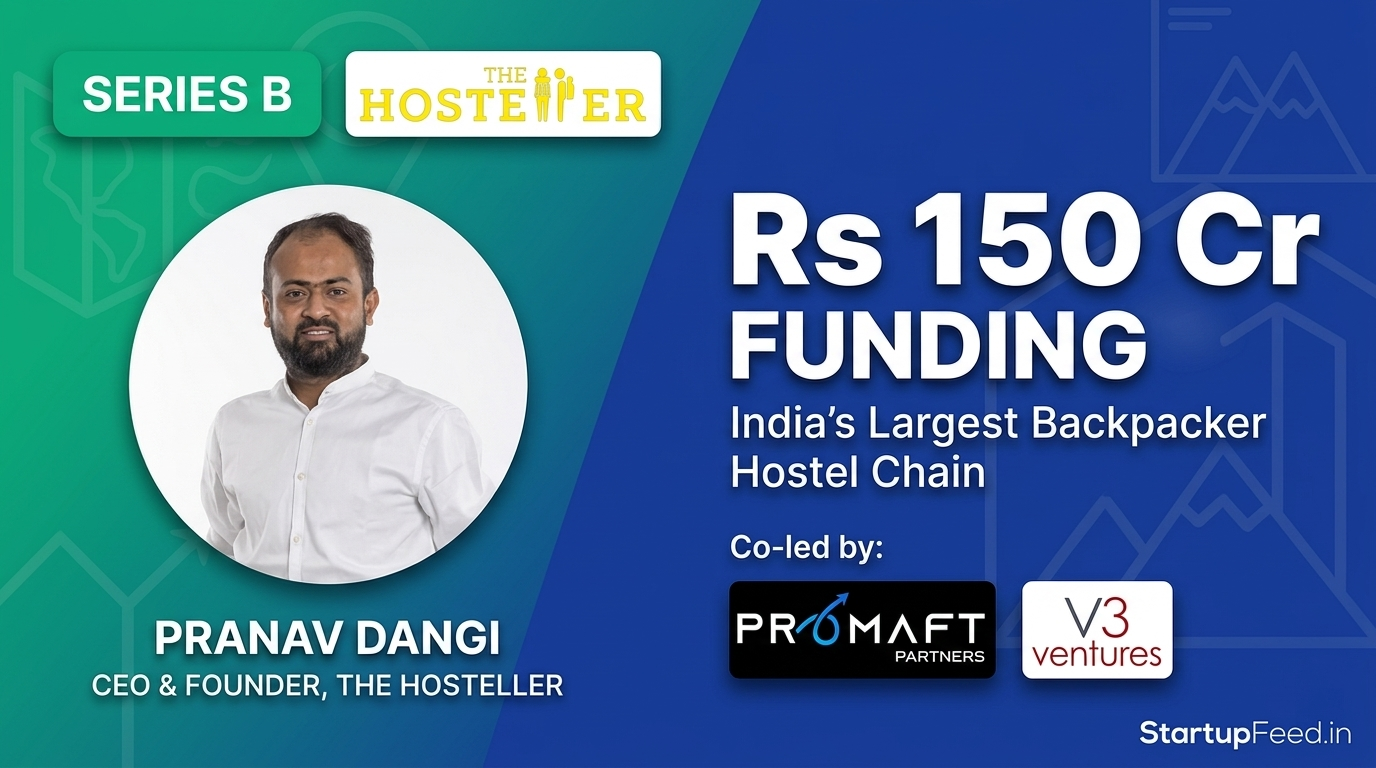
India’s largest self-operated backpacker hostel chain just made its biggest fundraise to date. The Hosteller has closed a Rs 150 crore Series B round co-led by PROMAFT Partners — the Rs 1,000 crore fund backed by ex-Alibaba India Head Raghav Bahl — and V3 Ventures, the returning investor that has backed the company through every major round since 2024. This is a 3x step-up from the Rs 48 crore Series A raised just 18 months ago.
Quick Take
- Round: Rs 150 crore — Series B
- Lead Investors: PROMAFT Partners (new investor) + V3 Ventures (returning — led Series A)
- PROMAFT Profile: Rs 1,000 Cr fund; GPs: Raghav Bahl (ex-Head of Investments, Alibaba India; ex-VP Bessemer Venture Partners) + Soham Avlani (ex-Partner, 9Unicorns); portfolio: Swiggy, Paytm, BigBasket exits; $1 Bn+ cash returns
- Company: The Hosteller — India’s largest self-operated backpacker hostel chain; founded 2014 by Pranav Dangi (CEO)
- Scale Today: 6,500+ beds; 80+ properties; present in major metros + Himalayan/coastal destinations; target: 400-500 properties in 5-6 years
- International Plans: Nepal, Sri Lanka, UAE — H2 2026 launch
- Growth: From 2,500 beds (Sep 2024) → 5,100 beds (Dec 2025) → 6,500+ beds (Apr 2026); FY24 revenue: Rs 55 Cr with positive net margins
- Total Raised: ~Rs 200 Cr+ across all rounds; valuation at Series A: Rs 200 Cr ($25 Mn)
The Hosteller — operated by The Hosteller Hospitality Private Limited and founded by Pranav Dangi in 2014 — has raised Rs 150 crore in a Series B funding round co-led by PROMAFT Partners and V3 Ventures. The round is the company’s largest fundraise to date, coming just 18 months after the Rs 48 crore Series A that V3 Ventures led in late 2024, and signals a sharp acceleration in institutional confidence in India’s organized backpacker hospitality segment.
The capital injection comes at a moment when The Hosteller’s growth trajectory is already steep: the company expanded from approximately 2,500 beds in September 2024 to more than 6,500 beds by April 2026 — nearly tripling its capacity in 18 months. With 2,000 additional beds in the pipeline, the company is on track to reach 80+ properties pan-India, en route to its stated long-term ambition of 400-500 properties across India.
StartupFeed Insight



Why Rs 150 Cr, why now: The Hosteller is entering a 3-5 year expansion cycle that requires more capital than any individual domestic travel season can generate internally. Rs 150 Cr buys approximately 5-7 years of runway at the current pace of property additions (~Rs 2-3 Cr per property fit-out + working capital). The international foray into Nepal, Sri Lanka, and UAE adds a second growth vector that domestic hostel revenue alone cannot fund.
Why PROMAFT is the right investor: PROMAFT’s mandate is specifically to back companies with proven product-market fit — the fund’s name is literally an acronym for this. The Hosteller, with 80+ properties, 6,500+ beds, consistently high platform ratings, 18-35 year-old Gen Z+millennial audience, and FY24 positive net margins, is exactly what PROMAFT looks for. Raghav Bahl’s Alibaba network also opens Middle East distribution channels for the UAE expansion.
The V3 Ventures signal: When a lead investor from a previous round leads again in the next round — as V3 Ventures did here — it is the strongest possible signal of portfolio conviction. V3 Co-Founder Arjun Vaidya publicly stated they believed The Hosteller would reach 150+ locations within 2 years at the Series A. That thesis is playing out.
The international bet: Nepal and Sri Lanka are natural first moves — both are heavily dependent on Indian tourists (the largest source market for both countries), deeply familiar with The Hosteller’s pricing and format, and are undersupplied in the standardised backpacker segment. The UAE addition (Dubai specifically) targets the Indian diaspora and the growing inbound travel-to-India market from the Gulf, creating a bidirectional loyalty loop.
Our prediction: The Hosteller will cross Rs 200 Cr revenue in FY27, hitting 100+ properties by December 2026. The international launch (Nepal first) will happen by September 2026. A Series C of Rs 400-500 Cr is likely by FY28, driven by international footprint and a potential Zostel-like acquisition to consolidate the Indian backpacker market. Watch for a potential IPO signal by FY29.
The Investors — Who’s Backing This Round
| Investor | Type | Key Details |
| PROMAFT Partners | Lead investor (new) — Rs 1,000 Cr sector-agnostic VC fund | Founded by Raghav Bahl (ex-Head of Investments, Alibaba Group India; ex-VP Bessemer Venture Partners) and Soham Avlani (ex-Partner, 9Unicorns). Portfolio of profitable exits includes Swiggy, Paytm, BigBasket, XpressBees, TaxiForSure, PharmEasy — generating $1 Bn+ in profitable cash returns. Fund thesis: back companies with proven Product-Market Fit (hence the name PROMAFT). Makes 10-12 concentrated investments for deep founder engagement. |
| V3 Ventures | Lead investor (returning) — B2B and consumer VC | Led The Hosteller’s Rs 32 Cr equity tranche in September 2024 (first institutional round) and led the Rs 32 Cr equity in the November 2024 Series A extension. Co-Founded by Arjun Vaidya (formerly of Dr. Vaidya’s). Has backed The Hosteller through 3 rounds — the strongest possible signal of investor conviction. Arjun Vaidya quote at Series A: ‘We are proud to support the company as it enters its next phase of growth, with plans to expand to more than 150 locations within the next two years.’ |
The Journey — From Dorm Room Vision to India’s Largest Hostel Chain
| Milestone | Date | Detail |
| Founded | 2014 | Pranav Dangi starts The Hosteller after identifying the gap in India’s backpacker accommodation market — inspired by Europe’s hostel culture during personal travels |
| Early Properties | 2015-2020 | Slow, bootstrapped growth; builds first self-operated properties in Rishikesh, Manali — India’s backpacker hubs |
| Pre-Series A | Nov 2021 | $1 Mn seed raised from Fao Ventures, Sun Capital, Subhkam Ventures and others — first institutional capital |
| Series A (Tranche 1) | Sep 2024 | Rs 32 Cr raised from V3 Ventures, LV Angel Fund, FAO Ventures, Synergy Capital Partners, Ice.VC — valuation ~Rs 200 Cr; 30 properties at time of raise |
| Series A (Tranche 2) | Nov 2024 | Rs 48 Cr total (Rs 32 Cr equity from V3 + Rs 16 Cr venture debt from Blacksoil); total Series A: ~Rs 80 Cr; targets 10,000 beds by Mar 2026 |
| 2025 Expansion | 2025 | Rapidly expands from ~2,300 beds to 5,100 beds; enters 2025 as most aggressive growth year; 80% of customer acquisition organic |
| Beds Today | Apr 2026 | 6,500+ beds across 80+ properties pan-India; 2,000 additional in pipeline; FY24 revenue Rs 55 Cr with positive net margins |
| Series B | Apr 2026 | Rs 150 Cr raised from PROMAFT Partners + V3 Ventures — largest round to date; enables international launch H2 2026 |
The Business Model — What Makes The Hosteller Different
| Dimension | The Hosteller Approach |
| Ownership model | 100% self-operated (not franchise or OTA aggregator) — all properties owned/leased and operated directly. Ensures consistent quality standards across every location |
| Target customer | 18-35 year olds — solo travellers, couples, groups; specifically excludes families and guests below 18 (even with parents) |
| Design philosophy | Single standardised design across all properties — uniform mattress quality, sleep comfort, amenities, interiors. ‘If there is a Hosteller, it will not differ from one city to another’ |
| Community focus | Positions hostels as social hubs — not just beds. Creates ‘aspirational, experiential’ environment for like-minded travellers. Events, experiences, local cultural programming |
| Technology | Proprietary ORM (Online Reputation Management) tool for real-time guest feedback; tech-first operations including centralised booking and property management |
| Pricing | Budget-friendly but premium-quality within the budget segment — competes on standardisation vs. independent hostels |
| Geographic mix | Major metros (Delhi, Bengaluru, Mumbai) + leisure destinations (Rishikesh, Manali, Goa, McLeodganj, Coimbatore) — diversifies occupancy risk across demand patterns |
| Customer acquisition | ~80% organic — driven by word-of-mouth, platform ratings, and the Gen Z social media effect |
The Market — Why This Moment for India’s Backpacker Segment
| Market Driver | Detail |
| Gen Z travel behaviour shift | Gen Z travels multiple times per year — ‘every long weekend’ vs. the previous generation’s once-a-year holiday. This fundamentally changes the total addressable market for budget-friendly, frequent-stay formats |
| India’s domestic tourism boom | India’s outbound and domestic travel is at record levels; post-Covid rebound accelerated, not reversed. Domestic air passengers grew 12%+ in FY25 |
| Infrastructure expansion | 30 km/day of national highways; 100 new airports in next decade — previously inaccessible Tier 2/3 travel destinations opening up rapidly |
| The size of the opportunity | Dangi estimates India alone is a market of 400-500 hostel properties — Hosteller currently operates 80+. The company is at ~16-20% of its stated Indian opportunity |
| Competitive landscape | The Hosteller competes with goSTOPS, Zostel, Backpackers Panda — but is the only fully self-operated standardised chain at scale; Zostel operates a franchise model |
| FY24 revenue performance | Rs 55 Cr revenue with positive net margins — profitability at the Series A stage is rare in India’s startup ecosystem; validates unit economics of self-operated model |
| International hostel market | Nepal, Sri Lanka, UAE — all three have Indian tourists as the #1 or #2 source market; under-penetrated by standardised backpacker chains |
The Competitive Landscape
| Brand | Model | Scale | The Hosteller Advantage |
| The Hosteller | Self-operated | 80+ properties, 6,500+ beds | — |
| Zostel | Franchise + some owned | 200+ locations | Hosteller’s self-operated model delivers more consistent quality; Zostel’s franchise model is harder to standardise at scale |
| goSTOPS | Mix of owned and managed | Limited | Smaller scale; less brand recall among Gen Z |
| Backpackers Panda | Managed | Limited | Regional focus; not pan-India |
| OYO (budget segment) | Franchise / managed | Massive but scattered quality | OYO addresses a different segment; Hosteller’s community + experience layer is differentiated |
What’s Next — The Three-Year Vision
| Horizon | Plan |
| FY26-FY27 (India) | Cross 100 properties; deepen presence in Goa, Bengaluru, Rishikesh, Manali, McLeodganj, Delhi; enter new Tier 2/3 travel destinations; target 10,000+ beds in India |
| H2 2026 (International launch) | Nepal and Sri Lanka first — leveraging Indian tourist base; UAE (Dubai) next — targeting Indian diaspora and inbound India travel planning |
| FY27-FY28 (Scale) | 400-500 properties ambition in India (5-6 year target); international ARR contributing 15-20%; Series C likely to fund international capex and India densification |
| Technology | Deeper investment in proprietary tech stack — booking engine, ORM tool, dynamic pricing, loyalty programme for repeat Gen Z travellers |
| Revenue targets | FY24: Rs 55 Cr; est. FY26: Rs 120-150 Cr; est. FY27: Rs 200 Cr+ (basis trajectory and new properties) |
Pranav Dangi, Founder and CEO of The Hosteller, has said the vision is clear: “India alone, for us, is a market of almost if not more than 400 to 500 properties, and we want to get there in another five to six years.” With Rs 150 crore and two strong institutional co-leads, the runway to execute that vision is now secured.
The backpacker hostel category in India is at a structural inflection point — driven by Gen Z travel frequency, infrastructure growth, and the normalisation of solo and group micro-trips. The Hosteller, with its self-operated model, consistent quality, and community-first culture, is positioned to be the Airbnb of India’s budget experiential accommodation — not in the asset-light sense, but in the brand sense: the name that every young Indian traveller defaults to.


Liked this story? Follow StartupFeed on Google so our reporting reaches you first.