
Quick Take:
|
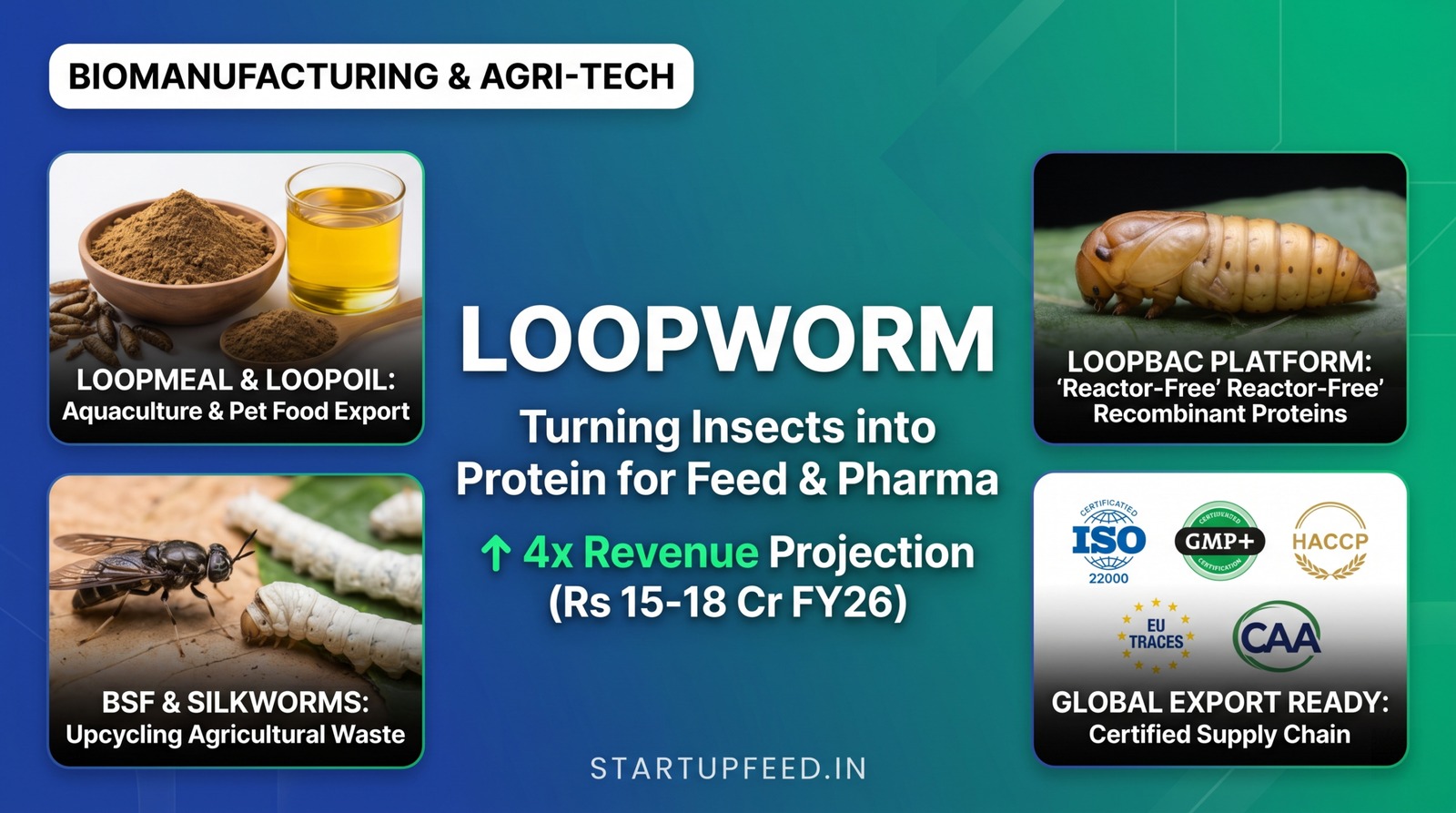
Loopworm occupies a small but strategically important intersection in Indian biotech: it is simultaneously a sustainable animal nutrition company and a biomanufacturing platform play — two businesses that happen to share the same raw material, the same 6,000-tonne processing facility in Bengaluru, and the same founding team of IIT Roorkee graduates who bet, in 2019, that insects were a grossly underexploited biological resource.
The animal nutrition side — insect-derived protein meal and oil sold to aquaculture, poultry, and pet food manufacturers across Europe, South America, and ASEAN — has reached commercial scale and is generating the revenue base that funds everything else. The pharma side — Loopworm’s LoopBac Protein Expression System, which uses gene-edited silkworms as living bioreactors to produce recombinant proteins at a fraction of conventional bioreactor costs — is the strategic bet that, if it commercialises, transforms Loopworm from a sustainable feed company into one of India’s more unusual deep biotech plays.
The revenue trajectory: Rs 4.5 Cr in FY25. A projection of Rs 15–18 Cr in FY26 — a 233–300% increase, led largely by export demand in animal nutrition. A Series A funding round opened in September 2025 to commercialise the recombinant protein platform at scale.
| StartupFeed Insight The two-business architecture: Loopworm’s structure is rare in Indian biotech — a commercial revenue engine (insect protein for animal nutrition) funding the development of a deep technology platform (silkworm bioreactors for pharma). Most Indian deep biotech startups either have the commercial business without the deep tech ambition, or the deep tech without the revenue. Loopworm has built both — and the animal nutrition exports give it the cash flow discipline that most platform biotech companies lack entirely at this stage. What this means for different audiences:
Our prediction: Loopworm will close FY26 at the higher end of its Rs 15–18 Cr projection if European aquaculture demand holds — the salmon feed market’s growth of 12 million MT by 2033 is a structural tailwind. The Series A outcome will be the more telling signal: if Loopworm closes Rs 50+ Cr in Series A, the market is pricing in the LoopBac pharma platform, not just the feed business. That re-rating, if it happens, would position Loopworm as one of India’s most interesting deep biotech companies of the late 2020s. |
The Two Insects — Silkworms and Black Soldier Flies
Loopworm has built its entire platform around two insect species, chosen for complementary biological reasons:
| Insect | Key Properties | Primary Use at Loopworm | Why This Species |
| Silkworm (Bombyx mori) | Fresh-leaf fed; antibiotic-free; high-quality protein (65%+ concentrate achievable); 35% omega-3 oil content; pupae used as recombinant protein bioreactors | LoopMeal (protein concentrate), LoopOil (omega-3 oil), LoopBac recombinant protein platform | Unique genetic tractability — silkworm pupae can be engineered to express foreign proteins (antigens, growth factors); India has existing sericulture infrastructure |
| Black Soldier Fly (Hermetia illucens) | High bioconversion efficiency — converts food and agricultural waste into protein; 40-45% protein meal; high lauric acid fat; grows on organic waste streams | LoopGrubs (whole dried insect), BSF protein meal for poultry and aquaculture | Most globally studied insect for feed; highest waste-to-protein conversion ratio; regulatory approvals in EU, South America, ASEAN |
The sericulture connection: India already has one of the world’s largest silkworm cultivation ecosystems — historically for silk production. Loopworm is repurposing this infrastructure: instead of extracting silk thread from silkworm cocoons and discarding the protein-rich pupae (as the traditional industry does), Loopworm processes those pupae into high-value nutrition and, via the LoopBac platform, recombinant proteins. It is an upcycling play inside an existing agricultural value chain


The Three Core Products
| Product | What It Is | Protein/Nutrient Content | Target Market | Key Certifications |
| LoopGrubs | Whole dried insect — minimally processed, closest to natural insect | High protein; complete amino acid profile; high fat | Specialty pet food, ornamental fish, reptile feed | ISO 22000, HACCP |
| LoopMeal | Partially defatted insect protein concentrate; primary commercial product | Less than 60% crude protein (50% and 65% concentrate versions); rich in bioactive peptides (antioxidative, anti-inflammatory, antimicrobial) | Aquaculture (salmon, shrimp, marine finfish); poultry; pet food manufacturers | ISO 22000, GMP+, HACCP, EU Traces, CAA (India aquaculture) |
| LoopOil | Purified oil from solvent-free LoopMeal production process | 35% omega-3 fatty acids; unique fatty acid profile; top coat for aquaculture feed | Aquaculture feed manufacturers; functional pet nutrition | ISO 22000, GMP+ |
| LoopBac Platform | Recombinant proteins produced inside living silkworm pupae — no bioreactor required | Complex proteins: antigens, growth factors, diagnostic reagents, animal vaccine components | Diagnostics kit manufacturers, animal vaccine producers, industrial enzymes | R&D-scale regulatory approval; multiple patents filed; compliance framework in development |
LoopBac — The Pharma Bet That Changes Everything
Recombinant proteins — proteins made by engineering a host organism to produce a specific protein of medical or industrial importance — are the foundation of modern biologics. They include diagnostic antigens (used in test kits), therapeutic proteins (used in drugs), growth factors (used in cell culture and regenerative medicine), and industrial enzymes. Globally, recombinant proteins are a market worth hundreds of billions of dollars.
The problem: Traditional recombinant protein production requires inserting a gene into yeast, bacteria, or mammalian cell lines, then growing them in stainless steel bioreactors — expensive capital equipment that costs $10–100 Mn+ per facility, requires continuous energy input, skilled operators, and stringent sterile manufacturing conditions. For each new protein target, the process must be re-optimised. This makes recombinant protein manufacturing one of the most capital-intensive and time-consuming processes in biotech.
Loopworm’s answer — LoopBac: Instead of a bioreactor, use a living silkworm pupa. Loopworm engineers silkworm pupae to express the target protein within their bodies using a proprietary gene expression system. The silkworm does the fermenting work — no bioreactor required, no sterile facility required, far lower capital cost, and a production system that scales by simply rearing more silkworms rather than building more fermentation tanks.
LoopBac vs Traditional Bioreactor — The Economics:
|
Revenue and Financial Trajectory
| Metric | FY25 (Actual) | FY26 (Projected) | Direction |
| Revenue | Rs 4.5 Cr | Rs 15–18 Cr | ↑ +233–300% YoY |
| Primary Revenue Driver | Domestic animal nutrition + early exports | Export-led — Europe, South America, ASEAN aquaculture/pet food | Shift: domestic-first → export-led |
| Key Export Market | Initial EU and ASEAN entry | Salmon feed (EU) + aquaculture (ASEAN) + pet food (global) | ↑ Scaling |
| Revenue Mix | ~Animal nutrition 100% | Animal nutrition ~90% + early recombinant protein ~10% (est.) | Diversifying |
| Profitability | Not disclosed | Not disclosed; scaling phase | Pre-profitability |
Why exports are the growth driver: India’s domestic animal feed market still under-indexes on insect protein relative to developed markets — awareness, price sensitivity, and regulatory familiarity are all lower. Europe and ASEAN are ahead on sustainability mandates, regulatory clarity (EU allows insect protein in poultry and aquaculture feed), and willingness to pay premium prices for traceable, certified ingredients. Loopworm’s ISO 22000 / GMP+ / HACCP / EU Traces certification stack was specifically assembled to unlock the European supply chain — and it is working.
Funding — The Full Stack
| Round | Date | Amount | Investors | Use of Funds |
| Seed | August 2022 | $3.4 Mn | Omnivore (lead), WaterBridge Ventures, Titan Capital, Climate9ers + others; Tata Trust + Gates Foundation (grants/pilots) | Build 6,000-tonne/year facility; R&D; commercial animal nutrition launch; team scale-up (5 → 50 people) |
| Pre-Series A | July 1, 2025 | $3.25 Mn | WaterBridge Ventures (existing, lead) + Enrission India Capital (Japanese VC, new) | Commercialise LoopBac recombinant protein platform; diagnostics and animal vaccine targets; IP and regulatory framework |
| Series A | Announced September 2025 | Open (size not disclosed) | In process — seeking institutional biotech/agritech investors | Full commercial scale of LoopBac; global market entry for recombinant proteins; export capacity expansion |
Total raised: $6.65 Mn — a lean capital base for a company that has built a certified 6,000-tonne/year processing facility, launched commercial exports to three continents, and developed a novel recombinant protein platform. The capital efficiency is partly explained by India’s lower manufacturing costs and partly by Loopworm’s use of grant funding (Tata Trust, Gates Foundation paid pilots) to de-risk early R&D.
The Enrission India Capital (Japan) angle: Japan is one of the world’s most advanced markets for insect protein in animal feed — the Japanese government has invested heavily in the sector as part of food security strategy. Enrission’s participation signals that Loopworm’s products are being evaluated for the Japanese aquaculture market, potentially the highest-value distribution channel the company could access outside Europe.
Certifications — Why They Matter More Than Revenue
| Certification | What It Means | Why It’s a Moat |
| ISO 22000 | Food safety management system — international standard for food and feed safety | Baseline requirement for supplying any serious animal feed or pet food manufacturer globally |
| GMP+ (Good Manufacturing Practice) | The European feed safety standard — required for supplying EU-regulated animal feed markets | Without GMP+, Loopworm simply cannot supply European salmon, poultry, or pet food manufacturers — full stop |
| HACCP | Hazard Analysis Critical Control Points — systematic approach to food safety | Validates that manufacturing processes identify and control biological, chemical, and physical hazards |
| EU Traces | European Union’s online platform for official certification of animal products moving in trade | Required for any animal-origin ingredient imported into or moving within the EU — a regulatory gate that most Indian competitors have not crossed |
| CAA (Coastal Aquaculture Authority, India) | India’s regulator for aquaculture approvals — Loopworm secured CAA approval for insect-based aquaculture additives | First-mover advantage in Indian aquaculture; enables domestic market scaling alongside exports |
Market Context — Why Insect Protein Is a Real Opportunity
| Market Signal | Data | Implication for Loopworm |
| Aquaculture growth | Fed aquaculture production forecast to grow by 12 Mn MT by 2033 | Structural demand for alternative proteins to fishmeal — Loopworm is positioned directly in this market |
| EU regulatory clarity | EU approved insect protein in poultry feed (2017), aquaculture feed (2021), pig feed (2021) | The regulatory risk in Loopworm’s core markets has already been resolved by regulators — a rare situation for a novel food/feed ingredient |
| Fishmeal price volatility | Fishmeal (the main alternative) is derived from wild-caught small fish — supply constrained, price volatile | Insect protein’s price parity + stable supply chain = strong substitution incentive for feed manufacturers |
| India sericulture base | India is the world’s second-largest silk producer — 35,000+ MT of silkworm pupae discarded annually as waste | Loopworm’s raw material (silkworm pupae) is currently an agricultural waste product in India — zero-cost feedstock in theory |
| Global insect protein market | Projected to reach $3–8 Bn by 2030 depending on research source | Early-stage market with strong compound growth — Loopworm among the most technically differentiated Indian players |
The Founders — IIT Roorkee to Insect Biotech
Ankit Alok Bagaria (Co-founder and CEO) and Abhi Gawri (Co-founder) are both IIT Roorkee graduates who founded Loopworm in 2019. Their thesis was straightforward: insects are the most efficient converters of organic matter into high-quality protein on earth, yet the global feed and pharma industries were almost entirely ignoring them.

Bagaria on the core vision: “Recombinant protein manufacturing has long been constrained by expensive infrastructure and slow scalability. Our reactor-free approach using silkworms changes the economics entirely.”
Gawri on the platform: “As biotech evolves, the demand for manufacturing platforms that combine speed, cost-efficiency, and scalability continues to grow. Our silkworm-based platform is uniquely positioned to meet these needs with unmatched flexibility and affordability.”
Five years on, Loopworm has grown from 5 people to 50, built one of India’s only GMP+/EU Traces certified insect processing facilities, and made technical breakthroughs — expressing complex proteins including antigens and growth factors in silkworm pupae — that justify the pharma platform ambition.
What’s Next
- Series A close: The Series A (announced September 2025) will be the most significant signal about how institutional investors value the LoopBac platform relative to the animal nutrition business. A large Series A (Rs 50+ Cr) would validate the pharma angle; a smaller one signals a feed-first story
- LoopBac diagnostics and vaccines: Loopworm’s first commercial LoopBac targets — diagnostic antigens and animal vaccines — are chosen for lower regulatory barriers. First commercial contracts in this category would prove the unit economics of the silkworm biofactory model
- Japan market entry via Enrission: Japan’s advanced aquaculture and pet food markets are high-value targets for LoopMeal and LoopOil — the Enrission relationship creates a direct distribution channel into a market that most Indian agritech companies cannot access
- India aquaculture scale-up: The CAA approval positions Loopworm to serve the Indian aquaculture market domestically — India’s shrimp and fish farming sector is one of the world’s largest
- FY26 Rs 15–18 Cr: Achieving the upper end of this projection requires sustained export order flow through Q3 and Q4 of FY26 — the key metric to watch in quarterly operational updates
What do you think? Can India become a global leader in insect protein biomanufacturing the way it became a global leader in generics pharmaceuticals? Tell us on X @StartupFeednews
Liked this story? Follow StartupFeed on Google so our reporting reaches you first.