
Quick Take:
|
The Launch
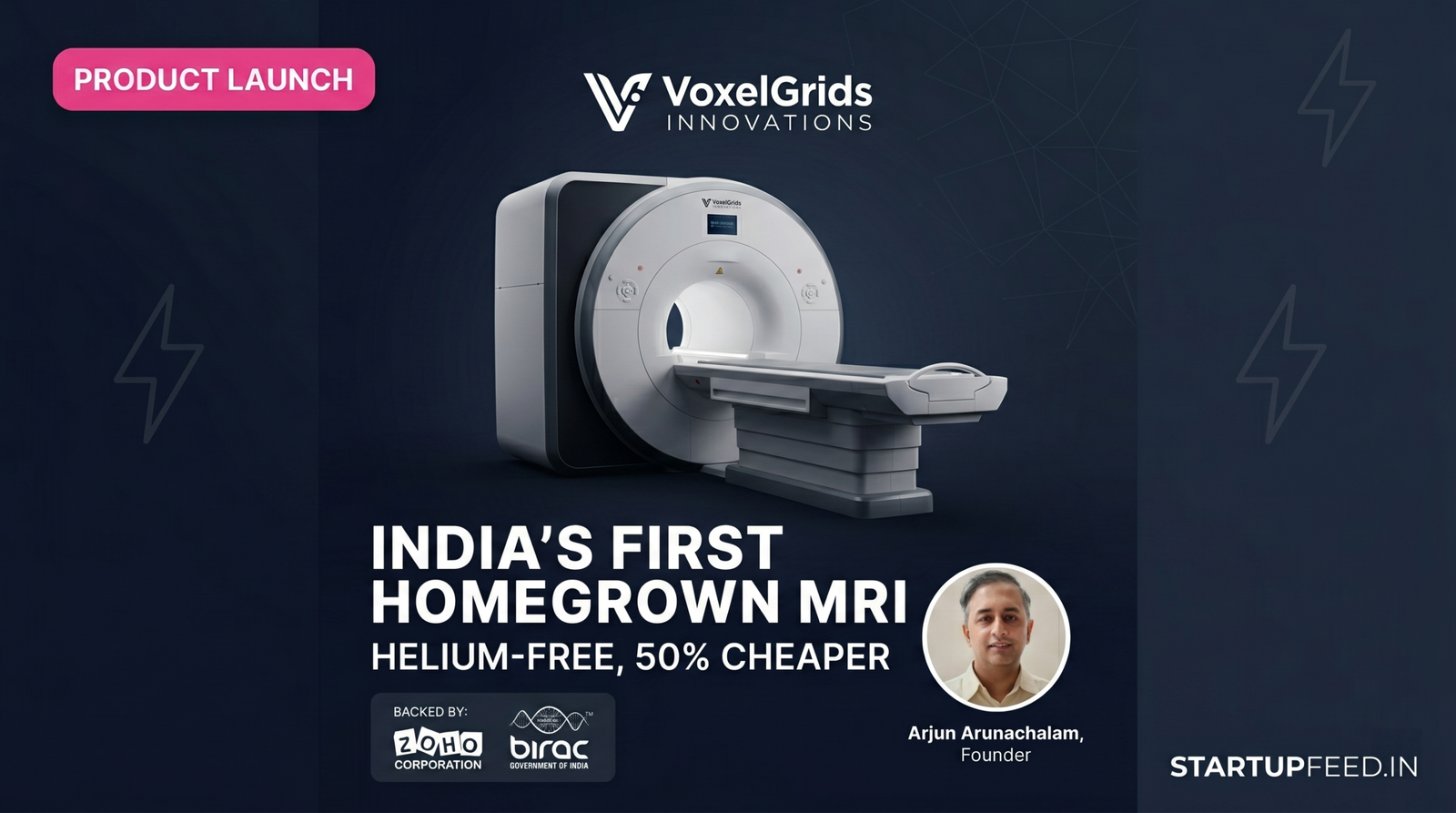
Bengaluru-based deeptech startup VoxelGrids Innovations has unveiled India’s first fully indigenous 1.5 Tesla MRI scanner — a helium-free, domestically engineered system that costs 40-50% less to manufacture and operate than imported alternatives, and weighs just 2.3 tonnes against the 4-6 tonnes of conventional machines.
The scanner was officially unveiled on December 25, 2025, marking the culmination of nearly 12 years of research and development led by founder Arjun Arunachalam — an MRI scientist trained at the University of Wisconsin-Madison and a former researcher at GE Global Research Center in the United States.
The first clinical installation is already live at the Chandrapur Cancer Care Foundation near Nagpur, where the machine is actively used for patient diagnostics — making it the first homegrown 1.5T MRI system in India to move beyond the laboratory and into real-world healthcare delivery.
India currently has approximately 5,000 MRI machines for a population of 140 crore — one of the lowest MRI-to-population ratios in the world. Over 90% of the market is controlled by five multinational manufacturers from the US, China, and Germany, with conventional imported systems priced between Rs 8-15 crore before civil works, shielding, service contracts, and recurring helium refills. VoxelGrids’ machine attacks every single one of those cost barriers simultaneously.


| StartupFeed Insight The big picture: This is not just a product launch — it is India’s first act of sovereign capability in high-end medical imaging. The same way ISRO made satellite launches affordable for the world, VoxelGrids is attempting to make MRI affordable for India. Bull case:
Bear case:
Our prediction: VoxelGrids will secure a government bulk procurement deal (PMJAY/Ayushman Bharat infrastructure scheme) by Q2 FY2027, triggering the scale-up from 25 to 200+ units/year. Exports to Southeast Asia and Africa follow by FY2028. |
What’s New — The Technical Breakthrough
At the core of VoxelGrids’ innovation is a ‘dry magnet’ architecture that uses conduction cooling instead of the liquid helium bath that traditional MRI systems require. This single design decision cascades into a cascade of advantages:
| Feature | VoxelGrids (Indigenous) | Conventional Imported MRI | Advantage |
| Magnet Cooling | Dry / Conduction cooling | Liquid helium bath | No helium dependency |
| Weight | ~2.3 tonnes | 4-6 tonnes | Compact, mobile-ready |
| Manufacturing Cost | ~40-50% lower | Rs 8-15 Cr baseline | Affordable procurement |
| Helium Requirement | Zero | Recurring refills required | No supply chain risk |
| Air-Conditioning | Standard | High-specification required | Lower civil works cost |
| Power Consumption | Lower | Standard high draw | Reduced opex |
| Bore Size | Standard clinical | Standard clinical | No diagnostic compromise |
| Field Strength | 1.5 Tesla | 1.5 Tesla | Same diagnostic quality |
How It Works
Traditional MRI machines create powerful magnetic fields using superconducting coils. To reach superconductivity, these coils must be cooled to near absolute zero (-269°C) — typically achieved by immersing them in a bath of liquid helium. Helium is scarce, expensive, and logistically complex to replenish, especially outside India’s major cities.
VoxelGrids’ proprietary approach uses conduction cooling — a solid-state thermal pathway that achieves the same superconducting temperatures without requiring liquid helium at all. The company has also designed compact, energy-efficient electronics around the magnet, maintaining standard bore size (the tunnel a patient enters) to ensure no compromise on diagnostic capability or patient comfort.
The result is a machine that weighs 2.3 tonnes and can theoretically be installed in a modified truck or container — the foundation of VoxelGrids’ planned mobile MRI units for rural deployment.
The Founder’s Journey


| Arjun Arunachalam, Founder — VoxelGrids Innovations Arunachalam returned to India in 2008 after working at GE Global Research Center in the United States, carrying one mission: build an MRI machine entirely within India. He joined IIT Bombay as faculty to sustain research through lean funding years. A 2013 grant from Spring Singapore enabled the first prototype. Tata Trusts support and FISE incubation formalised the venture in 2016. A 2019 BIRAC grant accelerated indigenous cryogenic technology development. The first prototype was installed at Sathya Sai Institute of Higher Medical Sciences, Bengaluru in 2017-18. Seven years later, the commercial-grade machine stands installed at Chandrapur Cancer Care Foundation — operational, patient-ready, and entirely Indian. |
|
Competitive Feature Comparison
| Feature | VoxelGrids | Siemens MAGNETOM | GE SIGNA | Philips Ingenia |
| Origin | Made in India | Germany | USA | Netherlands |
| Field Strength | 1.5T | 1.5T / 3T | 1.5T / 3T | 1.5T / 3T |
| Helium-Free | Yes | No | No (some models) | No |
| Approx. Price | Rs 4-6 Cr (est.) | Rs 12-18 Cr | Rs 10-16 Cr | Rs 11-17 Cr |
| Weight | ~2.3 tonnes | ~4-6 tonnes | ~4-6 tonnes | ~3-5 tonnes |
| Pay-Per-Use | Yes (planned) | No | No | No |
| Mobile Deployment | Planned | Limited | Limited | Limited |
VoxelGrids competes not on feature richness but on access economics. The machine is not trying to outperform a Siemens 3T in a Mumbai tertiary care hospital — it is targeting the 90% of Indian districts where no MRI machine exists at all.
Who Should Be Watching?
| Stakeholder | Why This Matters |
| District Hospitals & Trust Hospitals | Pay-per-use model removes Rs 10 Cr capex barrier; mobile unit option opens radiology in buildings never designed for MRI |
| Siemens Healthineers & GE Healthcare | VoxelGrids’ cost base fundamentally challenges the Rs 12-18 Cr import price point; expect pricing pressure in Tier 2-3 markets |
| PMJAY / NHA | A Rs 4-6 Cr indigenous scanner compatible with government procurement creates a ready supply chain for the National Health Mission’s diagnostics expansion |
| Medtech Deep-Tech Investors | 12 years of IP is now validated in a clinical setting — Series A is coming and will likely price in export potential |
| State Governments (UP, MP, Bihar) | Mobile containerised units could fulfil diagnostics mandates under state health schemes at a fraction of conventional cost |
India’s MRI Access Crisis — The Context
| Metric | India | USA | Target (NITI Aayog 2030) |
| MRI Machines | ~5,000 | ~36,000 | ~20,000 |
| Per Million Population | ~3.5 | ~108 | ~14 |
| Market Control | 90% imported | Domestic production | Aatmanirbhar target |
| Conventional Machine Cost | Rs 8-15 Cr | $1.5-3 Mn | — |
| Districts with MRI | ~200 of 750 | — | 750 (all districts) |
India’s MRI deficit is not a technology problem — it is a cost and logistics problem. Conventional MRI machines require specialised civil infrastructure, helium supply chains, dedicated high-power electrical feeds, and manufacturer service contracts. VoxelGrids’ design eliminates or simplifies each of these requirements, making the machine viable in settings where conventional imported machines never were.
Funding History & Development Milestones
| Year | Milestone | Funder / Partner |
| 2008 | Arjun Arunachalam returns to India; joins IIT Bombay | — |
| 2013 | First MRI prototype developed | Spring Singapore grant |
| 2016 | VoxelGrids formalised; incubated at FISE | Tata Trusts |
| 2017-18 | First prototype installed at Sathya Sai Institute, Bengaluru | BIRAC / Institutional |
| 2019 | Major grant for indigenous MRI & cryogenic tech | BIRAC (Govt of India) |
| 2023-25 | Series A: $5 Mn raised | Zoho Corporation |
| Dec 25, 2025 | 1.5T scanner unveiled; first clinical install at Chandrapur | — |
| FY2026 (planned) | Commercial launch; 20-25 units/year production | — |
| FY2026-27 (planned) | Mobile containerised MRI units for rural areas | — |
What’s Next
VoxelGrids is preparing for commercial launch by the end of FY2025-26. At current capacity, the Bengaluru facility can produce 20-25 MRI scanners annually — enough to make a proof-of-concept case but far short of the 15,000+ units India needs to meet even the NITI Aayog 2030 target.
The company’s roadmap includes mobile and containerised MRI units that can be deployed in modified vehicles — a direct targeting of India’s 550+ rural districts where patients currently travel 100-200 km for an MRI scan. On business model, the planned pay-per-use pricing — where hospitals pay per scan rather than for the machine — mirrors the OPEX shift that transformed telecom and cloud computing access in India.
Once domestic demand is established, VoxelGrids has indicated export potential to Southeast Asia and Africa — markets with similar MRI access gaps and identical constraints around helium supply, civil infrastructure, and capital expenditure. With Middle East conflicts disrupting global helium supply chains in 2025-26, the strategic timing of a helium-free Indian MRI scanner could not be more precise.
The real test: can Arjun Arunachalam, who spent 12 years building the machine, now build the distribution, regulatory, and institutional partnerships to scale it from 25 units to 2,500?