Quick Take:
- Policy: Career Cards for Children with Special Needs (CWSN) — 150 inclusive cards adapted from the national 500-card framework
- Authority: Department of School Education and Literacy (DoSEL), Ministry of Education
- Affects: India’s approximately 80 lakh school-going children with disabilities, their teachers, and school counsellors
- Launched: March 31, 2026, Kartavya Bhavan-2, New Delhi
- Key Change: First-ever purpose-built career guidance resource for CWSN — now available in Braille format
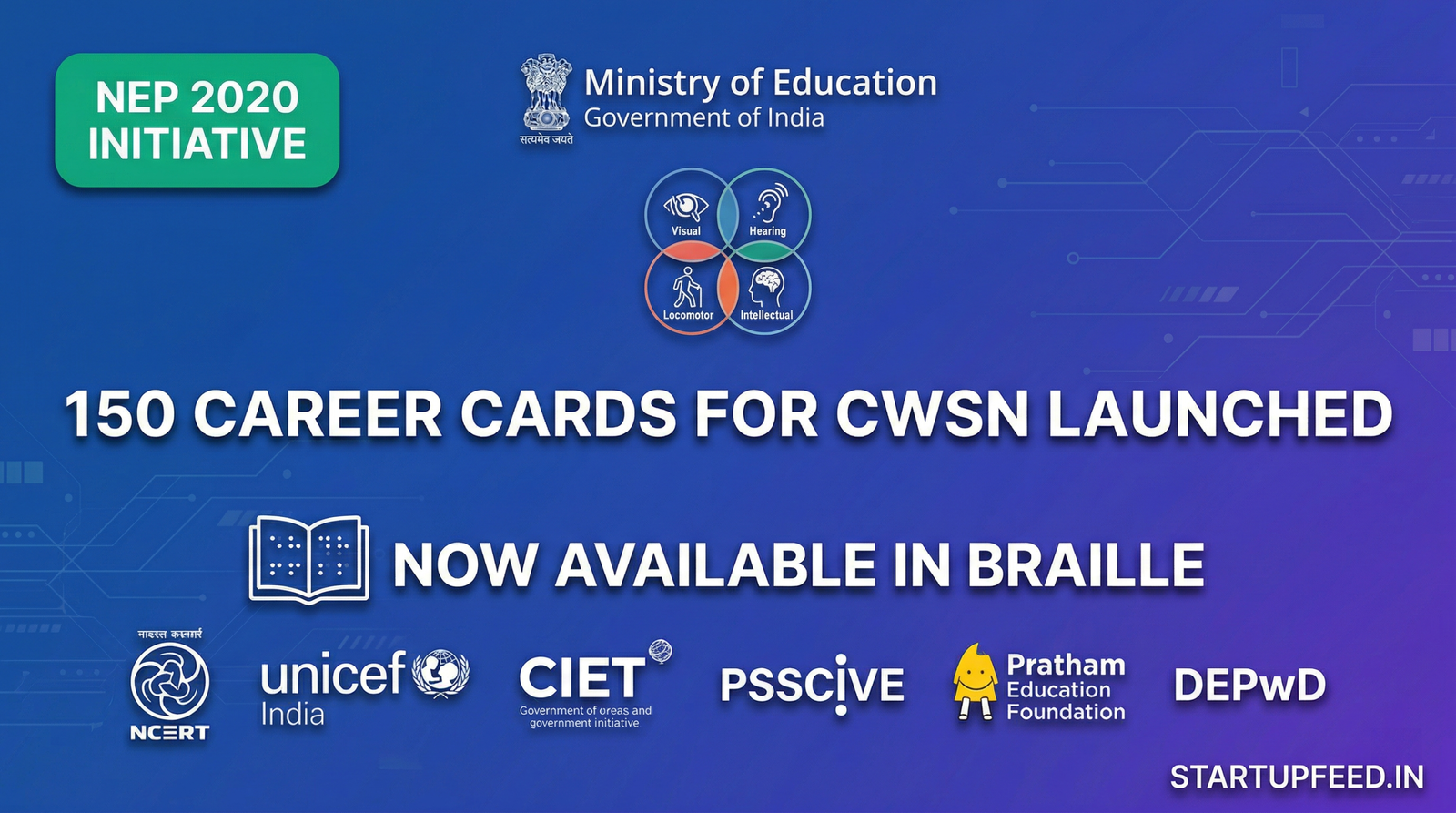
The Department of School Education and Literacy (DoSEL) has launched 150 specially designed Career Cards for Children with Special Needs (CWSN) — adapting India’s existing 500-card national career guidance framework into an inclusive, accessible format that includes Braille, marking the first time a government-backed career guidance resource has been built at scale exclusively for students with disabilities.
The initiative positions India’s school system to deliver on the promise of NEP 2020 and the National Curriculum Framework for School Education (NCF-SE) 2023 — both of which mandate that every learner, including those with special needs, must be enabled to explore diverse educational and vocational pathways. With Viksit Bharat 2047 as the policy backdrop, the message from DoSEL Secretary Shri Sanjay Kumar was direct: no learner gets left behind.
StartupFeed Insight
What this means: India has mainstreamed career guidance for CWSN for the first time at the national level — closing a gap that left 80 lakh specially-abled students without structured career planning tools.
Winners:



- CWSN students across all 36 states and UTs now have structured, accessible career information matched to their interests and abilities
- School counsellors and special educators gain a ready-made toolkit to conduct career guidance sessions without creating materials from scratch
- Visually impaired students specifically gain access to career information in Braille — a format that was entirely absent from the earlier 500-card framework
Losers:
- States that have not yet deployed special educators despite sanctioned posts will find this resource underutilised — the cards need trained hands to deliver them
- Students in rural and tribal schools remain at risk of missing out if distribution does not reach beyond district headquarters
Action required: Schools must integrate these cards into counselling sessions immediately; NCERT will develop a special teacher training module with SCERTs and DIETs — schools should track when that module becomes available for their staff
What’s New
Until July 2024, India had a national Career Guidance Book with 500 Career Cards, developed by NCERT in collaboration with UNICEF India and released at the Akhil Bharatiya Shiksha Samagam. Those cards served general learners — they were not adapted for students with visual, hearing, locomotor, or intellectual disabilities.
The March 31, 2026 launch changes this. Approximately 150 of those 500 cards have been redesigned in an inclusive format for CWSN, and are now additionally available in Braille. Each card tells a student — in a format they can access — about roles and responsibilities in a career, required qualifications, and potential pathways to get there. Teachers and counsellors can use the same cards to structure one-on-one or group guidance sessions.
Key Provisions
| Provision | Earlier Framework | New Development | Impact |
| Career Cards Available | 500 cards (general learners) | +150 cards (CWSN-specific) | Dedicated resource for specially-abled students |
| Accessibility Format | Standard print only | Braille format added | Visually impaired students now included |
| Target Users | All students | Specifically CWSN | Purposeful design for disability-specific needs |
| Development Partners | NCERT, UNICEF India | NCERT, UNICEF, CIET, PSSCIVE, Pratham, DEPwD National Disability Institutes | Broader, more specialised collaboration |
| Teacher Support | Existing counselling tools | New dedicated training module (NCERT + SCERT + DIET) | Structured teacher capacity building |
| NIOS Integration | Standalone | Long-term MoU with CWSN institutions | Formal academic pathway for specially-abled learners |
Who Is Affected
Students: India’s approximately 80 lakh children with disabilities in the school-going age group — across visual, hearing, locomotor, and intellectual disability categories — now have a government-backed career planning tool designed for their specific contexts.
Teachers and Counsellors: The cards function as ready-to-use classroom resources. NCERT will develop a dedicated training module for regular and special teachers in collaboration with State Councils of Educational Research and Training (SCERTs) and District Institutes of Education and Training (DIETs). All government school teachers working with CWSN students should watch for this module.
NIOS-Affiliated Institutions: The National Institute of Open Schooling has signed a long-term MoU with institutions working for CWSN — this creates a formal academic credentialing pathway for specially-abled learners who were previously outside the mainstream certification structure.



Impact Analysis
| Stakeholder | Impact | Why |
| CWSN Students | Positive | First structured career guidance tool built for their needs; Braille format opens access for visually impaired |
| Special Educators | Positive | Ready resource reduces preparation burden; upcoming training module will build delivery capability |
| Regular Teachers | Positive | Targeted training module being developed; currently under-equipped for CWSN career counselling |
| State Govts | Mixed | Cards are available but deployment depends on states filling vacant special educator posts quickly |
| Rural CWSN Students | Cautiously Positive | Initiative is national in scope but last-mile delivery to rural schools remains the execution challenge |
| PSSCIVE | Positive | Specifically mandated to lead inclusive vocational skill development for CWSN under NEP 2020 |
Compliance Checklist for Schools
Action Items:
- Request Career Card sets from District Education Officers — by April 30, 2026
- Identify all enrolled CWSN students and assign a counsellor or special educator as their career guidance contact — immediately
- Enrol relevant teachers in the NCERT training module once released (expected within FY26-27)
- Ensure Braille-format cards reach visually impaired students specifically — coordinate with school resource room or special education teacher
- Document counselling sessions using these cards for state-level reporting under Samagra Shiksha — per MoE guidance
Industry and Expert Reaction
Secretary Shri Sanjay Kumar underlined that while additional special educator posts have been sanctioned, states must urgently accelerate appointments. He called for targeted training of regular teachers alongside the newly planned NCERT module — signalling that the Centre will push states on both fronts.
Joint Secretary Ms. Prachi Pandey noted that today’s launch extends the national guidance framework specifically to CWSN, with approximately 150 cards adapted in an inclusive format to keep inclusion a defining feature of India’s education journey.
Ms. Rukmini Banerjee of Pratham Education Foundation, a key collaborating partner, attended the launch — signalling civil society’s active role in making these resources reach the ground level through Pratham’s network in rural and semi-urban India.
What’s Next
NCERT will develop a specialised teacher training module in collaboration with SCERTs and DIETs — the most critical delivery mechanism that will determine whether these cards remain on a shelf or actually reach CWSN students in classrooms. The module’s timeline has not been publicly specified, but with the March 31 launch done, its development is the active next priority.
PSSCIVE will simultaneously strengthen inclusive vocational skill training, specifically targeting CWSN — aligning with NEP 2020’s mandate that every Class 12 student must possess at least one core vocational skill by 2030.
The NIOS MoU with CWSN institutions creates a formal credentialing structure for specially-abled learners outside mainstream school systems — a complementary pathway that could eventually enroll lakhs of students who are currently out-of-school due to accessibility barriers.
The real test is not the launch. It is whether these 150 cards reach the roughly 80 lakh CWSN students in India’s government schools within the next academic year — or whether they remain a well-designed initiative awaiting last-mile execution.
Liked this story? Follow StartupFeed on Google so our reporting reaches you first.