
Quick Take
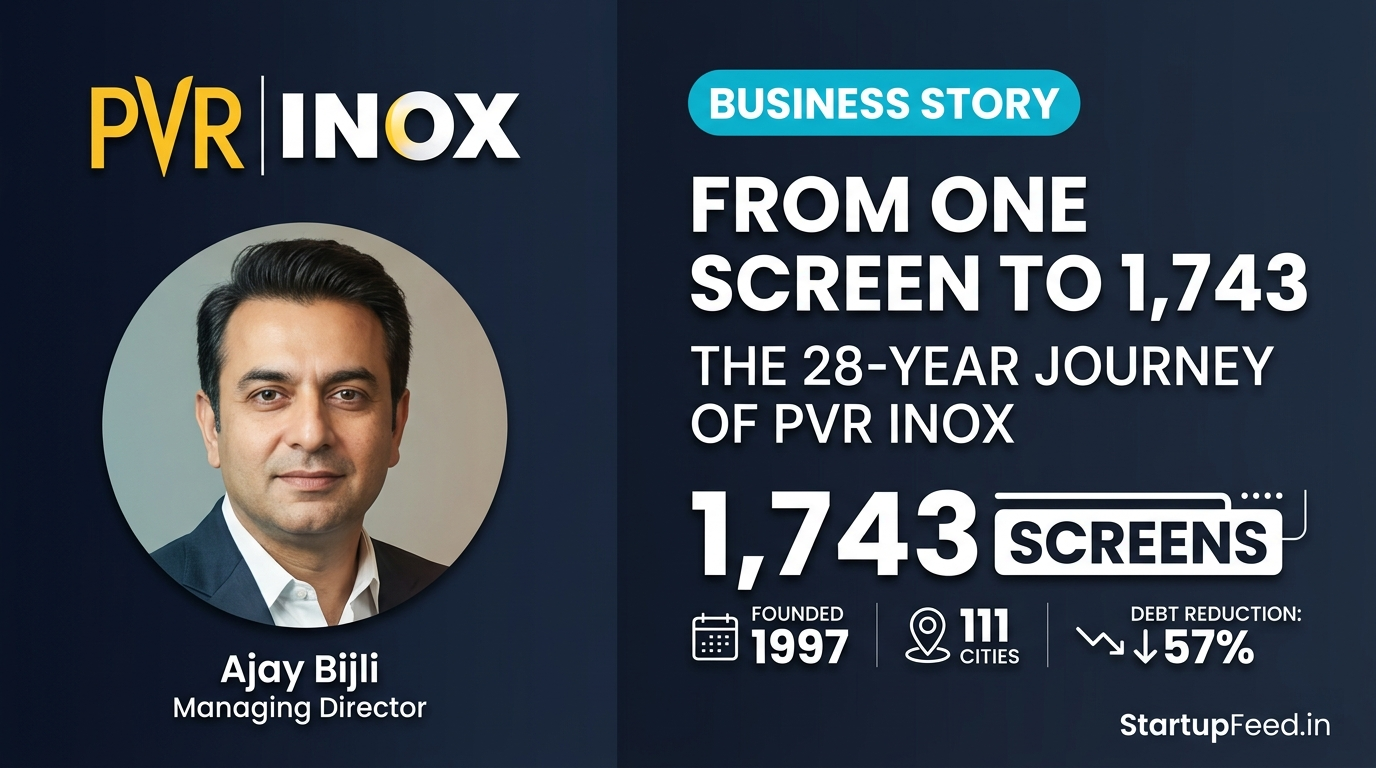
| Founded | 1997 (PVR) · 1999 (INOX) · Merged February 2023 |
| Scale | 1,743 screens · 352 properties · 111 cities · India & Sri Lanka |
| FY25 Revenue | Rs 5,780 Cr (136.9 Mn patrons) |
| The Bet | All-stock merger between India’s #1 and #2 chains — NCLT approved January 2023 |
| Challenge | OTT competition + weak Hindi film slate drove Rs 281 Cr net loss in FY25 |
| What’s Next | Capital-light expansion, 132 screens in pipeline, debt down 57% from merger levels |
The Origin: One Man, One Screen, One Idea
The story of India’s largest cinema chain begins not in a boardroom but in a decaying single-screen theatre in South Delhi’s Vasant Vihar.
Ajay Bijli’s family ran Priya Cinema, which had lost its reputation and couldn’t keep up with competitors because it couldn’t screen popular films. When Bijli took over the running of the hall in 1988, he discovered it was no different from other theatres — one of the causes of its poor ticket sales.
What happened next was a pivot that would change how 1.4 billion Indians watch films. Bijli renovated the theatre with a 5-star hotel ambiance in 1990, then approached Village Roadshow, an Australian company that managed theatres and distributed motion pictures and was reportedly planning to expand into India. Ajay and Village Roadshow’s Asia MD John Crawford founded a joint venture called Priya Village Roadshow with a 60:40 partnership.
The first multiplex, Priya Village Roadshow Anupam 4, opened its doors in Saket, New Delhi, in June 1997 — a landmark event widely recognized as the commencement of India’s multiplex revolution. Four screens. Twenty-four shows a day. Queues stretching outside. The campaign was blunt and effective: “four cinemas under one roof.”
India had never seen anything like it.
StartupFeed Insight
| What the numbers say: PVR didn’t grow by being the best cinema — it grew by being the most aggressive acquirer. Every Rs 100 Cr spent on acquisitions bought years of organic growth that competitors couldn’t replicate fast enough. |
| If you’re a founder: PVR’s story shows that in winner-take-all markets, scale through M&A often beats organic growth — but only if you can service the debt that follows. |
| If you’re an investor: The merged entity’s 57% debt reduction post-2023 is the real signal to watch — it indicates the merger synergies are actually materializing. |
| If you’re an employee: PVR INOX has reduced headcount by 13% over five years to 21,035 — the integration is far from over, and rationalization continues. |
| Our prediction: PVR INOX will turn consistently profitable by FY27, driven by a strong film slate (Pushpa 2 already showed what one blockbuster does to quarterly numbers) and capital-light screen additions that don’t burden the balance sheet. |
Phase 1: Building the Multiplex Habit (1997–2011)
India’s cinema halls in the 1990s were, frankly, grim. Torn seats. Stale samosas. Piracy-ravaged screens showing prints months after release. Ajay Bijli’s bet was that Indian urban consumers would pay a premium for dignity and comfort — and he was right from day one.
PVR rapidly expanded after its inception, establishing India’s largest multiplex and the country’s first Gold Class cinema in 2004. By 2006, PVR was listed on both the NSE and BSE.
Meanwhile, a parallel empire was being built from Mumbai. INOX Leisure was incorporated as a public limited company in November 1999, as part of the INOX Group (Industrial Oxygen) of companies. In 2002, the company commenced operations by opening its first four-screen multiplex at Pune and another four-screen multiplex at Vadodara. In 2004, multiplexes were added in Kolkata, Goa, and Mumbai. In 2006, the company went public.
By the late 2000s, India had two serious multiplex players racing each other to every mall being built in every tier-1 city. The competition was fierce, the economics were improving, and the prize — India’s 1.4 billion filmgoers — was enormous.
Phase 2: The Acquisition Machine (2012–2019)
PVR’s breakaway move came in 2012. The Kanakia Group-owned CineMAX cinema chain was bought for Rs 395 crore, making PVR the largest cinema chain in India. It was the single largest multiplex deal India had seen — and it reset the competitive chessboard overnight.
What followed was a decade of deal-making that no rival could match:


| Acquisition | Year | Price | Strategic Gain |
| CineMAX | 2012 | Rs 395 Cr | #1 position; Mumbai / West India scale |
| DT Cinemas (DLF) | 2016 | Rs 500 Cr | Premium Delhi NCR screens in top malls |
| SPI Cinemas | 2018 | Rs 850 Cr | South India dominance; 76 screens |
| INOX Leisure | 2023 | All-stock | India’s largest, world’s 5th largest chain |
INOX was also busy on its own acquisition track. In 2006, INOX acquired 89 Cinemas in West Bengal and Assam in a share swap deal. INOX later acquired Satyam Cineplexes for Rs 182 crore, giving it ownership of multiplexes in Delhi NCR, Mysuru, and other regions.
PVR also ventured into film production with PVR Pictures in 2007, producing films like Taare Zameen Par — positioning itself as not just an exhibitor but a participant in the full film value chain.
By 2019, PVR crossed 800 screens. The model was working. Then the world shut down.
Phase 3: COVID Breaks the Industry — and Forces the Merger (2020–2023)
India’s exhibitors were hard-hit by the COVID pandemic, with grosses dropping from $1.6 Bn in 2019 to $0.4 Bn in 2020 and $0.5 Bn in 2021. Cinemas sat dark for 18 months. Fixed costs — rent, staff, maintenance — kept running. Both PVR and INOX burned through cash at a pace that made investors deeply uncomfortable.
The crisis clarified something that had been obvious for years but hard to act on: two companies spending on the same cities, same malls, and same infrastructure was irrational. Combined, they could cut costs, negotiate better with landlords, and present a stronger front against the looming OTT threat.
On Sunday, March 27, 2022, the boards of PVR and INOX agreed to terms for an all-stock merger. The merged entity would be the largest exhibition company in India, with a combined 1,546 screens across 341 properties in 109 cities, accounting for 40 percent market share.
On 12 January 2023, the Mumbai bench of the National Company Law Tribunal approved the merger. In February 2023, after the merger was completed, PVR was renamed PVR INOX. The merged entity became the fifth largest listed multiplex chain globally by screen count and the largest in India.
What PVR INOX Looks Like Today
Financial Performance
| Metric | FY24 | FY25 | Change |
| Revenue from Operations | Rs 6,107 Cr | Rs 5,780 Cr | -5.4% |
| Net Profit / (Loss) | Rs 114 Cr profit | Rs 281 Cr loss | Turned negative |
| Patrons | ~151 Mn | 136.9 Mn | -9.3% |
| Average Ticket Price | Rs 258 | Rs 258 | Flat |
| Screens | ~1,740 | 1,743 | Stable |
| Net Debt | Rs 1,294 Cr | Rs 952 Cr | -26% |
The company has reduced its debt to Rs 952 crore in FY25 from Rs 1,294 crore in FY24. PVR INOX also reduced its headcount by 13% over the past five years. These are deliberate moves — the company is engineering itself for leaner, more profitable operations, even if FY25 headline numbers look painful.
The pain in FY25 had a specific cause. The Hindi box office collections saw a substantial drop of 26% in FY25, attributed to fewer film releases and a lack of major star-driven titles. This is the core fragility of the exhibition business: even the largest cinema chain in the country is hostage to the quality of that year’s film slate.
The bright spot? The highest ever F&B spend per head of Rs 148 in Q1 FY26, up 10% year-on-year. Popcorn and nachos are now a genuine profit centre, not an afterthought.
The OTT Threat — and How PVR INOX Is Responding
The most-asked question about any multiplex business in 2026 is simple: why go to a cinema when Netflix, Amazon, and JioCinema deliver blockbusters to your couch within weeks of theatrical release?
PVR INOX’s answer has been to double down on the one thing streaming cannot replicate: the event-cinema experience. The company has been focused on operational efficiencies, including cost rationalization and debt management, while addressing the competitive pressure from OTT platforms through initiatives like ‘cinema lovers day’ and a subscription program.
The technology premium strategy is central to this:
- 2012: PVR Cinemas partnered with IMAX to open its first IMAX theatre in Bengaluru
- 2014: PVR introduced the Superplex format in Noida
- 2016: PVR became the second movie theater chain in India to launch 4DX
- 2022: PVR introduced its immersive theater format called ICE in Delhi NCR
- 2024: Refurbished 86-year-old Eros Cinema, Mumbai — India’s first standalone IMAX with 4K projection
Currently 132 screens have been signed under the capital-light model, expected to open over the next 18-24 months. Rather than owning every property, PVR INOX is franchising — reducing capital risk while continuing to grow screen count.
What’s Next
PVR INOX’s next three years will be defined by two races running simultaneously. The first is financial recovery — proving that the merged entity can generate consistent profit, not just in bumper years driven by a Pushpa 2 or a Jawan, but across the full cycle.
The second race is geographic. South India — historically underpenetrated by multiplexes relative to its population and box office appetite — is the next major frontier. The company has publicly committed to prioritizing this region through FY26 and FY27.
The real question is not whether PVR INOX survives — at its scale, it almost certainly will. The question is whether the cinema experience can remain irreplaceable for the next generation of Indian moviegoers who have never known a world without streaming.
Liked this story? Follow StartupFeed on Google so our reporting reaches you first.