
QUICK TAKE
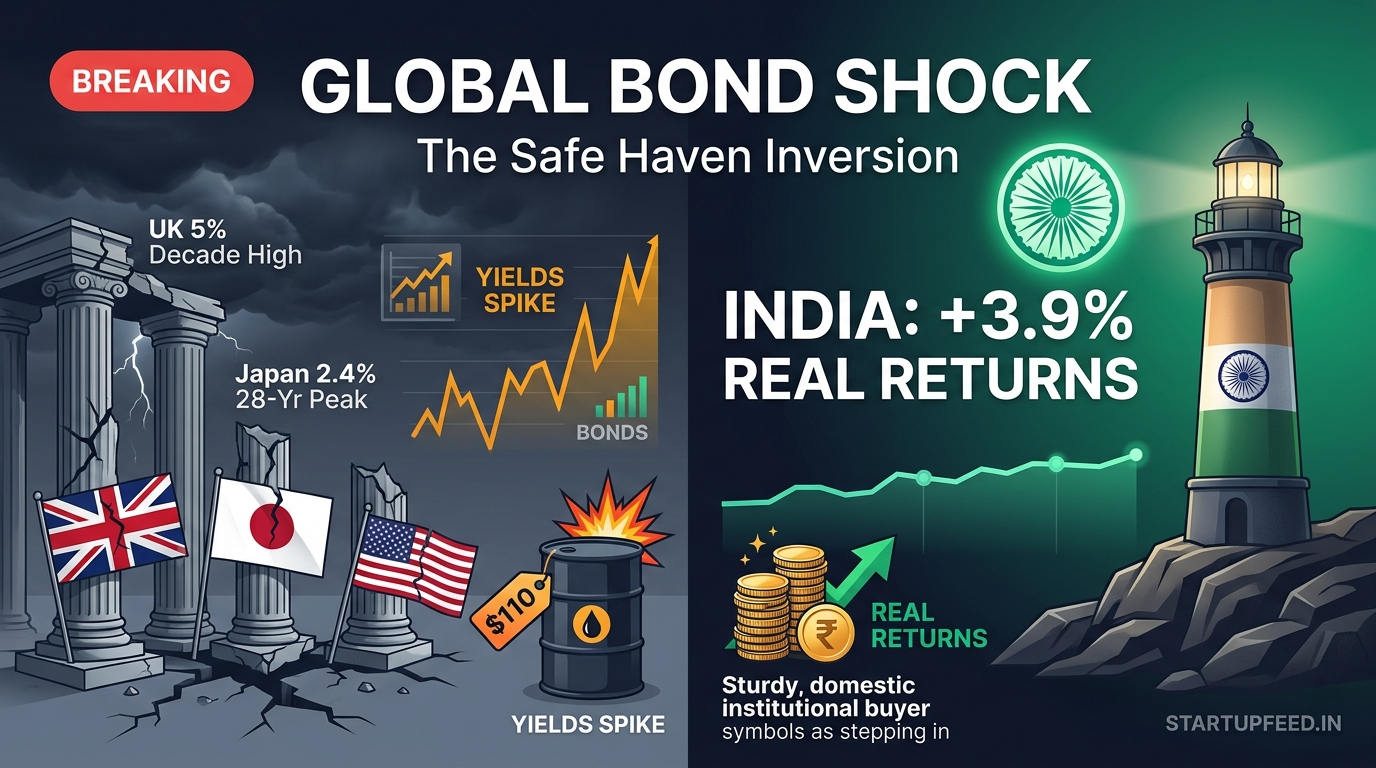
| Global Bond Shock | UK 10Y at 5% (decade-high), Japan 2.4% (28-year peak), US 4.4%. Oil crisis + geopolitical ‘war premium’ triggers panic. |
| India’s Position | 10Y yield at 7.1% (highest since May 2024); under pressure but holding ground vs. developed markets. |
| Why India Resilient | Only 5% foreign ownership (vs 30-50% in DMs); domestic buyers step in during panic; 3.2% inflation (RBI credibility) |
| Real Returns | 7.1% yield – 3.2% inflation = 3.9% real return in INR (vs negative real yields in UK, Japan, parts of Eurozone) |
| The Inversion | For first time ever, EM bonds (India) offering stability + real returns; DM bonds (UK, Japan) facing regime-shift shock |
| What This Means | Indian bonds shift from ‘risky EM’ to ‘best-value real-return asset’ in a fractured global market. Inflows likely if oil stays elevated. |
| Verdict | Hidden safe haven: not safe in traditional sense, but stable in a volatile world. Boring strength beats flashy risk. |
The Global Bond Shock
The fiscal year-end of 2025-26 has unleashed unprecedented volatility across global government bond markets. The UK’s 10-year gilt yield has hit decade-highs near 5.0%, Japan reached 2.40% (a 28-year peak unseen since July 1997), and the US Treasury stands at 4.4%. Yet India’s 10-year G-Sec at 7.1%, though under pressure, has proven remarkably resilient—outperforming developed markets on a relative basis, signaling a historic inversion: emerging market bonds now offer better value than Western ‘safe havens.’
Why This Matters
This positions India as an unexpected beneficiary of a global crisis. The developed world is experiencing psychological shock—yields rising from artificially suppressed levels. India, which never had the luxury of ‘financial repression,’ prices inflation and risk into yields daily. This means Indian bonds offer something Western investors desperately seek: real returns (3.9% real return on IGBs) combined with macro stability (RBI has proven anti-inflation credibility). For global capital, India becomes the ‘best-value real-return asset,’ not because India is low-risk, but because it’s honest-risk. This could trigger significant foreign inflows once the initial panic subsides.
StartupFeed Insight
| What the numbers reveal: | Indian bonds aren’t winning on ‘safety’; they’re winning on ‘honest-pricing + real returns.’ At 7.1%, Indian bonds embed oil-risk, inflation-risk, and fiscal-risk. Western bonds at 4.4%-5% are rising FROM suppressed levels, creating shock. India’s starting point = stability. |
| For global investors: | India’s 5% foreign ownership means minimal FPI panic-selling (unlike UK/Japan with 30-50% FPI). Domestic insurance/pension funds are BUYERS during selloffs. This creates a natural bid that stabilizes yields. Western bonds lack this domestic buffer. |
| For RBI policy: | Oil at $110 pushes inflation toward 4%+, but RBI has inflation-fighting credibility (brought it down from 6.2% to 3.2%). Rate hike expectations are priced in. RBI can pause/pivot without shocking markets. BoE/BoJ face credibility deficits on stagflation. |
| Our prediction: | If oil holds at $100-110 for 6+ months, Indian bond inflows accelerate to $3-5 Bn as global capital rotates to ‘real-return safe havens.’ India’s CAD widening + fiscal pressures → yields stabilize at 6.8-7.2% range. This becomes the new ‘attractive carry trade’ for global funds. |
Global Government Bond Yields: The Shock in Numbers
| Country | 10Y Yield (Now) | Historical Context | Change (Month) | Real Yield Estimate |
| India | 7.1% | Highest since May 2024; mid-range for India | +40 bps | +3.9% (7.1% – 3.2% inflation) |
| UK | ~5.0% | DECADE HIGH (only 3rd time since 2008) | +80 bps | +1.6% (5.0% – 3.4% inflation) |
| Japan | 2.40% | 28-YEAR PEAK (highest since July 1997) | +23 bps | -0.6% (2.4% – 3.0% inflation) |
| USA | 4.4% | Multi-month high; above 4% = recession fears | +50 bps | +0.4% (4.4% – 4.0% estimated inflation) |
| Eurozone | 3.2-3.9% | Spread widening: Germany 2.8% vs France 3.7% | +70 bps | -0.5% to +0.9% |
| KEY INSIGHT | — | India’s 7.1% is LOWEST among major emerging markets; stable within Indian range | Most stable YTD | Best real return in this list |
What’s Driving This Volatility? The Oil-Inflation-Rate Nexus
The Trigger: Iran-Israel geopolitical conflict (ongoing since early 2026) has spiked Brent crude from $75 to $110+/barrel. Attacks on energy infrastructure in the Strait of Hormuz create genuine supply disruption fears. Every $10 rise in oil ≈ 0.2% higher inflation globally.
The Shock: Central banks had assumed oil around $70-80/bbl. At $110, headline inflation could breach 4-5% in developed economies within months. This forces a complete repricing of rate expectations: no more ‘cuts all year’ narratives. Instead: ‘rates stay high longer’ or even ‘hikes possible.’



The Panic: Developed markets experienced a decade of ‘financial repression’—yields held artificially low despite inflation. Investors became complacent. Now, yields rising FROM suppressed levels = shock + losses + portfolio rebalancing panic. A 100 bps yield rise = ~5-7% price drop in long-duration bonds.
India’s Difference: India’s central bank never suppressed rates artificially. 7.1% already reflects oil shocks, inflation risks, and fiscal pressures. No psychological shock = no panic selling. Instead, Indian yields rise 40 bps as a ‘normal adjustment’ within an already-elevated range. Boring, but stable.
Why Indian Bonds Are More Resilient: Four Key Factors
| Factor | India | Developed Markets (UK, US, Japan) |
| Foreign Ownership % | 5% (Mostly domestic institutional buyers) | 30-50% (Vulnerable to panic outflows) |
| Inflation Credibility | HIGH (RBI cut inflation 6.2% → 3.2% in 6 months) | MEDIUM (BoE, BoJ doubted on stagflation response) |
| Oil Shock Surprise Factor | LOW (India always prices in $80-100 oil scenarios) | HIGH (DMs assumed $70; shock = unpredictable) |
| Real Return Attractiveness | 7.1% – 3.2% = 3.9% POSITIVE real return | 4.4%-5% – 3.4-4% = NEAR-ZERO real returns |
What Market Experts Say
Indian government bonds provide stable income and carry. Given still-low foreign ownership and strong domestic demand from insurance and pension funds, Indian bond yields have demonstrated less volatility compared to US yields. The inclusion in JP Morgan EM Bond Index (starting June 2024) has enhanced India’s visibility internationally, but the domestic base remains the real stabilizer.”
— East Spring Investment Management (Global Fixed Income Analysis)
Comparative Bond Market Stress: Who’s Suffering Most?
| Country | Yield Shock | Panic Selling Risk | Recovery Potential |
| UK | 80 bps (month) | HIGHEST | VERY HIGH (FPI vulnerable) | Slow (fiscal pressures persist) |
| Japan | 23 bps (month) | Smallest | HIGH (repatriation risk) | Slow (structural low-growth) |
| USA | 50 bps (month) | Medium | MEDIUM (reserve currency demand) | Medium (Fed credibility intact) |
| India | 40 bps (month) | Within range | LOW (domestic bid strong) | Fast (if oil falls, yields ease quickly) |
| VERDICT | — | India has structural buyers during panic | India bounces back fastest post-oil-shock |
The Safe Haven Inversion: How EM Bonds Became Safer Than DM Bonds
Traditionally, crises drive capital to developed market bonds (USD, GBP, JPY). This crisis is exposing a fundamental flaw: the assumption that ‘developed market bonds = safety.’ But that assumption was built on decades of low inflation + low rates. We’re now in a regime where:
- Japan’s 28-year peak (2.4%) signals the BoJ’s ultra-loose era is over. What was ‘safe’ (ultra-low JGB yields) is no longer safe (regime change)
- UK’s decade-high yields (5%) mean the BoE is abandoning its ‘supportive’ stance. Fiscal pressures + political uncertainty = yields won’t fall anytime soon
- US Treasuries at 4.4% are rising because the Fed may pause cuts (or even hike). The era of ‘Fed puts’ is ending
Meanwhile, India’s 7.1% has always reflected this reality. There was never a ‘free lunch’ in Indian bonds. The yield is high because the risk is real. But the risk is HONEST and PRICED-IN. This honesty is now more valuable than the developed world’s broken ‘safety’ narrative.
Three Scenarios: What Happens to Bond Yields Next?
| Scenario | Oil Price | Indian 10Y Yield | Global Impact |
| SCENARIO A: Peace Deal (Conflict Resolves) | Falls to $80/bbl | Eases to 6.5-6.7% (relief rally) Inflation fears subside, RBI may cut | UK: 4.2% | Japan: 1.8% | US: 3.8% DM bonds outperform EM short-term |
| SCENARIO B: Stalemate (Conflict Prolongs) | Stays at $100-110 | Holds 6.8-7.2% (stable carry trade) Sticky inflation, RBI pauses/hikes | UK: 5%+ | Japan: 2.5%+ | US: 4.5%+ India becomes ‘best real-return bet’ |
| SCENARIO C: Escalation (Major Supply Shock) | Spikes to $130+/bbl | Spikes to 7.5%+ (panic, but stabilizes) Stagflation fears, RBI likely to hike | UK: 5.5%+ | Japan: 3%+ | US: 5%+ Indian inflows accelerate (real-return hunt) |
India’s Bond Market Trajectory: 6-Month & 12-Month Outlook
| Bull Case (Oil $80) | ||
| 6 Months (Oct 2026) | 6.8-7.0% | RBI on hold; Inflation sticky at 4%+ | 6.2-6.5% | RBI cuts 25-50 bps; Inflation moderates |
| 12 Months (Apr 2027) | 6.8-7.1% | New ‘carry trade’ floor; Foreign inflows $2-3 Bn | 6.0-6.3% | Faster normalization; Foreign inflows $1-1.5 Bn |
| Risk to Call | Upside (7.3%+): Fiscal slippage or rating downgrade | Downside (5.8%-): Oil collapse below $70 + significant RBI easing |
India has accumulated over ₹32,200 crore in losses over the past 3 years but maintains inflation credibility and fiscal discipline commitment. The Reserve Bank of India cut the repo rate by 125 basis points in 2025 and has signaled a pause to reevaluate oil-driven inflation dynamics. The government’s fiscal deficit target of 4.4% for FY2025-26 (down from 4.8%) reflects consolidation. Data as of early April 2026.
Liked this story? Follow StartupFeed on Google so our reporting reaches you first.