Quick Take:
|
|
|
|
|
|
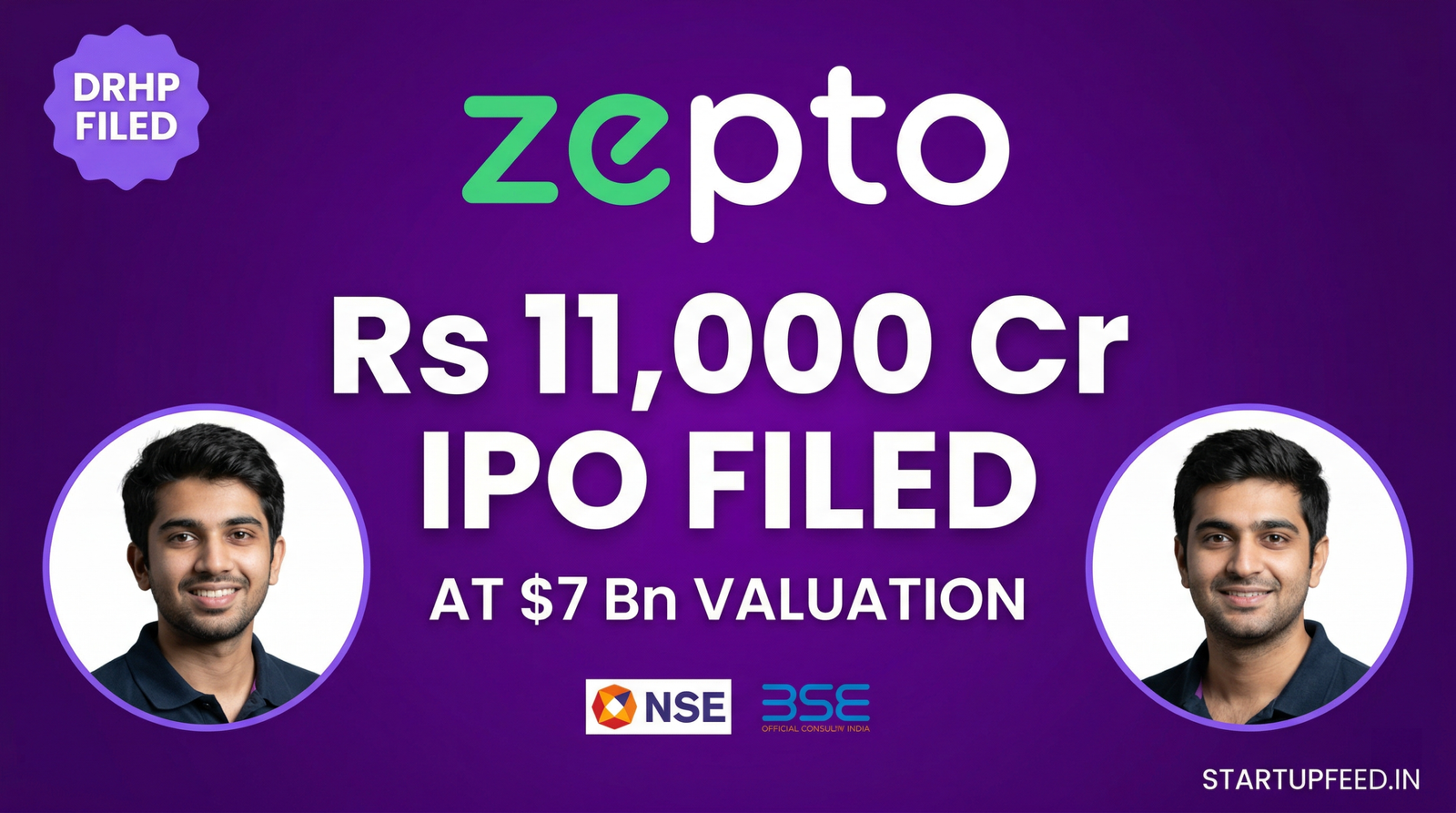
Quick commerce unicorn Zepto has secured SEBI approval for its Rs 11,000 Cr ($1.3 Bn) IPO, clearing the most critical regulatory hurdle on its path to becoming India’s youngest venture capital-backed startup to list on public markets. The Bengaluru-headquartered company, founded in 2021 by Stanford dropouts Aadit Palicha and Kaivalya Vohra, filed its confidential Draft Red Herring Prospectus (DRHP) with SEBI on December 26, 2025, targeting a listing on BSE and NSE between June and September 2026.
SEBI’s nod positions Zepto to tap public markets before rivals drain its war chest — the company held approximately Rs 7,000 Cr in cash as of November 2025, compared to Rs 17,000–18,000 Cr each for listed peers Zomato and Swiggy. With the IPO proceeds, Zepto can narrow this cash gap and fund its 40-to-50-city dark store expansion without relying on further private funding.
STARTUPFEED INSIGHT


| The big picture: Zepto’s SEBI clearance arrives as India’s quick commerce sector races toward a winner-takes-most outcome. A public listing gives Zepto the war chest needed to compete against Blinkit and Swiggy Instamart — both of which already trade on Indian bourses and enjoy access to cheaper capital. |
| Bull case: |
|
|
|
| Bear case: |
|
|
|
| Our take: Zepto’s growth story is compelling, but the widening losses and valuation uncertainty — the company may price 15–20% below its last private round at $5.6–5.95 Bn — mean investors should study the updated DRHP numbers carefully before deciding. This is not a Zomato-style cleared-path-to-profits narrative. |
IPO Structure
| Component | Amount (Rs Cr) | Amount (USD) | % of Total |
|---|---|---|---|
| Fresh Issue | ~Rs 11,000 Cr | ~$1.24 Bn | ~85–90% |
| Offer for Sale (OFS) | Remaining portion | ~$0.06–0.13 Bn | ~10–15% |
| Total IPO Size | Rs ~11,000–11,682 Cr | $1.3 Bn | 100% |
Zepto has opted for the confidential pre-filing route — a path previously taken by Swiggy, Meesho, and Groww — allowing it to incorporate SEBI feedback into a revised DRHP expected by late April 2026 before public disclosure. The updated DRHP is expected to reflect revised financials and potentially a lower IPO valuation of $5.6–5.95 Bn, down 15–20% from the $7 Bn private round valuation, to align with current market multiples.
Who’s Selling?
| Investor | Role | OFS Participation | Note |
|---|---|---|---|
| Aadit Palicha & Kaivalya Vohra | Founders / Co-CEOs | Not selling (as disclosed) | Retaining full stake — confidence signal |
| CalPERS | Lead investor (Oct 2025) | Not selling | Invested $450 Mn in Oct 2025 |
| Nexus Venture Partners | Early backer | Partial OFS expected | Among earliest institutional investors |
| Glade Brook Capital | Series D lead | Partial OFS expected | Early-stage growth investor |
| Y Combinator | Seed backer | Minimal OFS | Original program backer |
The OFS component is relatively small — early investors seeking partial liquidity after holding through multiple private rounds. Founders retaining their stakes is a key positive signal for prospective public market investors.
Valuation Comparison
| Metric | Zepto (IPO) | Zomato / Blinkit | Swiggy / Instamart |
|---|---|---|---|
| Market Cap | $5.6–7 Bn (est.) | ~$28–30 Bn | ~$12–14 Bn |
| Revenue (FY25) | Rs 9,669 Cr | Rs 20,000+ Cr (consol.) | Rs 15,000+ Cr (consol.) |
| P/S Multiple (est.) | 3.5–4.3x | ~8–10x | ~5–6x |
| Profitability | Net loss Rs 3,367 Cr | Adj. EBITDA positive | Still loss-making |
| Quick Commerce Share | ~29–30% | ~44–46% (Blinkit) | ~23–25% (Instamart) |
Zepto’s prospective valuation of $5.6–7 Bn implies a Price-to-Sales multiple of roughly 3.5–4.3x on FY25 revenue — a meaningful discount to Zomato’s consolidated trading multiple, which reflects both its food delivery profitability and quick commerce scale. For Zepto to justify the upper end of its valuation, it will need to demonstrate a credible path to EBITDA breakeven within 12–18 months of listing.
Financial Snapshot (FY23–FY25)
| Metric | FY23 | FY24 | FY25 | Direction |
|---|---|---|---|---|
| Revenue | Rs 2,077 Cr | Rs 4,454 Cr | Rs 9,669 Cr | ↑ +129% YoY |
| Revenue CAGR (2-yr) | — | — | — | +116% CAGR |
| Net Loss | Rs ~1,272 Cr | Rs 1,214 Cr | Rs 3,367 Cr | ↓ Loss widened +177% |
| Loss as % of Revenue | ~61% | ~27% | ~35% | → Volatile |
| Cash & Equivalents | — | — | ~Rs 7,000 Cr | — |
| Daily Orders | — | — | 700,000+ | ↑ |
| Dark Stores | ~70 | 650+ | 900+ | ↑ |
Revenue’s doubling in back-to-back years signals genuine market demand. The FY25 loss widening, though, reflects aggressive dark store rollout costs and delivery subsidies deployed to battle Blinkit. At an estimated monthly burn rate of Rs ~280 Cr, Zepto’s Rs 7,000 Cr cash reserve provides roughly 25 months of runway — sufficient to reach listing and post-IPO operations without emergency fundraising.
Use of IPO Proceeds
| Purpose | Estimated Amount (Rs Cr) | Priority |
|---|---|---|
| Dark store network expansion (40–50 cities) | Rs 3,500–4,500 Cr | Primary |
| Technology infrastructure and AI/ML stack | Rs 1,500–2,000 Cr | High |
| Working capital and operational costs | Rs 2,000–2,500 Cr | High |
| Debt repayment and corporate purposes | Rs 500–1,000 Cr | Secondary |
| OFS (to selling shareholders) | Balance | — |
The emphasis on city expansion over debt repayment signals Zepto is prioritizing market share over near-term profitability — a rational choice given quick commerce’s winner-takes-most dynamics, but one that retail investors must weigh carefully against their risk appetite.
Risk Factors
- Widening losses despite scale: Net loss grew 177% to Rs 3,367 Cr in FY25 even as revenue doubled — profitability timeline remains unclear.
- Cash disadvantage vs. rivals: Zepto holds Rs 7,000 Cr; Zomato and Swiggy each hold Rs 17,000–18,000 Cr — limiting its ability to sustain a prolonged price war.
- CCI antitrust probe: The Competition Commission of India is probing Zepto for predatory pricing and anti-competitive discounting — adverse findings could disrupt operations and sentiment.
- Valuation compression risk: The company may refile DRHP at $5.6–5.95 Bn — 15–20% below its last private round. Investor expectations set at $7 Bn could generate early selling pressure post-listing.
- Regulatory and labour risks: Proposed labour law changes, food safety regulations, and SEBI observations on quick commerce disclosure standards could delay or alter the IPO structure.
Should You Invest? Key Questions
| Question | Assessment |
|---|---|
| Is the valuation justified? | Partially. At $5.6–5.95 Bn, the P/S multiple is more reasonable than the $7 Bn ask. FY25 revenue growth of +129% provides backing, but loss trajectory needs to show reversal in the updated DRHP. |
| Path to profitability? | Store-level breakeven now takes 8 months vs. 23 months previously — a strong operational signal. However, net profitability requires scale and cost discipline across 1,000+ stores. Management targets EBITDA breakeven within 12–15 months. |
| Competitive moat? | Dark store density, 10-minute delivery promise, and ~30% market share are real advantages. Zepto Cafe (targeted Rs 1,000 Cr revenue by end-2026) adds margin-accretive diversification. |
| Growth runway? | Strong. Quick commerce TAM projected at $57 Bn by 2030. Zepto is in only ~35 cities today; 40-to-50-city expansion is the immediate unlock. |
| Insider selling? | Minimal — founders are not selling shares in OFS. Early VCs selling partial stakes is normal and expected. The low OFS proportion is a positive signal. |
IPO Timeline
| Milestone | Date / Timeline |
|---|---|
| DRHP Filed (Confidential) | December 26, 2025 |
| Shareholder Approval (EGM) | December 23, 2025 |
| SEBI Approval Received | April 2026 |
| Revised DRHP Refile (Expected) | Late April 2026 |
| Public DRHP Disclosure | May 2026 (estimated) |
| IPO Open / Close | June 2026 (estimated) |
| BSE / NSE Listing | June – September 2026 (targeted) |
What’s Next
Zepto will refile its updated DRHP by late April 2026, incorporating revised FY25 financials and — critically — any improvement in FY26 quarterly metrics that can demonstrate the loss trajectory is bending downward. The revised valuation target of $5.6–5.95 Bn represents a pragmatic reset; the company would rather price conservatively and see strong subscription than face a poor listing on an aspirational number.
The real test comes at the RHP stage, when the price band is set. Watch for three signals: the FY26 Q1 revenue run-rate (which must show continued 80%+ YoY growth to validate the thesis), CCI probe resolution, and whether Blinkit’s quarterly results show the quick commerce market is growing rather than being redistributed.
Will Zepto become the breakout quick commerce IPO of 2026, or will widening losses dampen appetite? The answer will shape how India’s public markets value the next generation of high-growth, not-yet-profitable consumer tech companies.
Liked this story? Follow StartupFeed on Google so our reporting reaches you first.