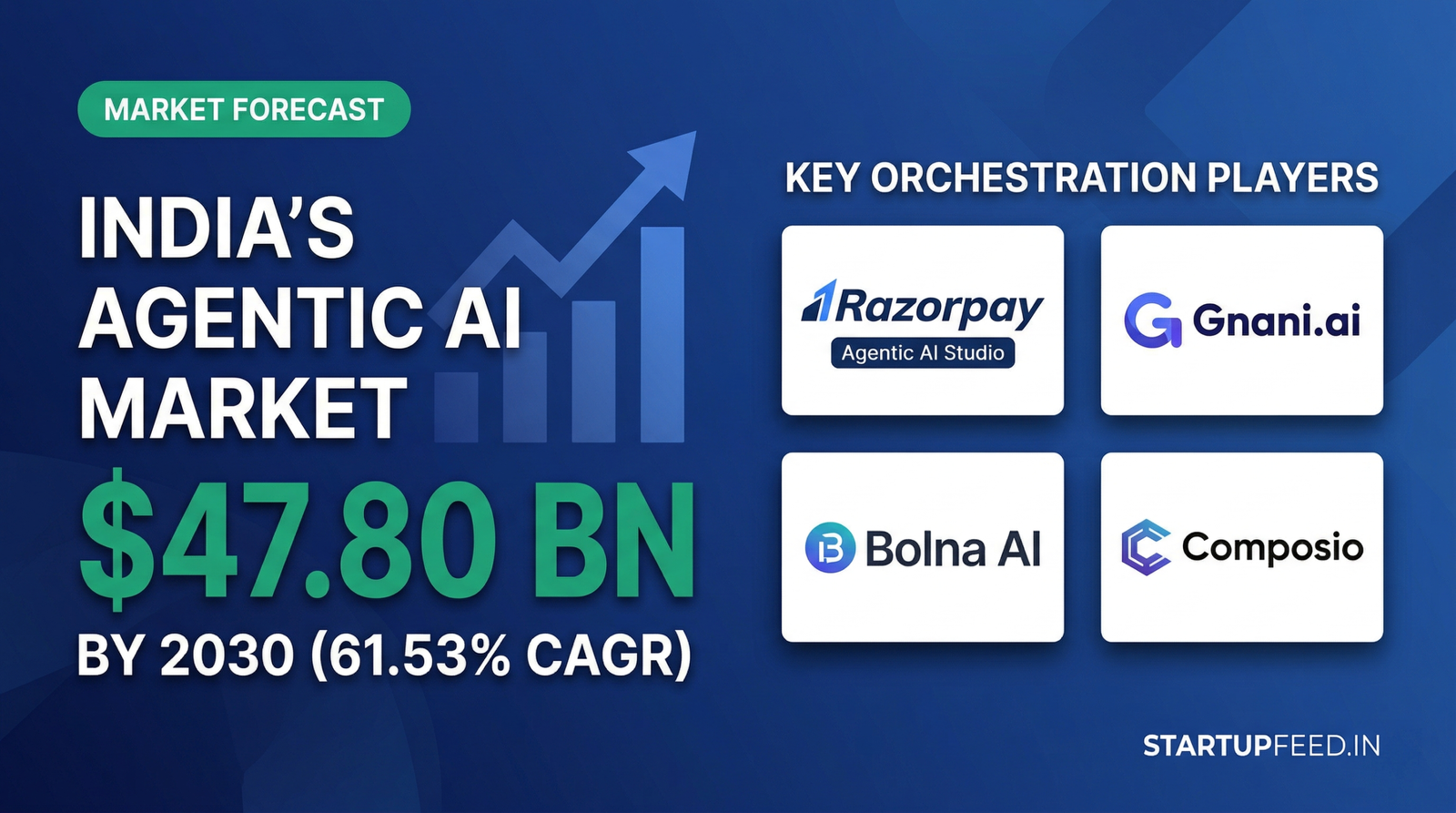
| QUICK TAKE The global agentic AI enterprise platform market is set to surge from $4.35 billion in 2025 to $47.80 billion by 2030 — a CAGR of 61.53%. India’s startups, rather than competing with OpenAI or Google on foundation models, are carving out the orchestration and application layers where long-term enterprise value is increasingly expected to accrue. This is not a compromise strategy. It may be the smartest one in the room. |
The War Nobody Called By Its Real Name
For the past 18 months, every major technology company on the planet has quietly been fighting the same battle. It just took the industry a while to name it properly: the Agentic AI Platform War.
Unlike the foundational model race — where OpenAI, Google DeepMind, Anthropic, and Meta have poured tens of billions of dollars into training ever-larger parameter counts — the platform war is about something more operationally consequential. It is about who controls the layer through which AI agents are created, deployed, orchestrated, and monetised inside enterprises.
The distinction matters enormously. Foundation models answer questions. Agentic AI platforms get things done. They manage multi-step workflows, coordinate swarms of specialised sub-agents, maintain memory across sessions, connect to real enterprise systems like ERP, CRM, and payment infrastructure, and execute decisions without waiting for human instruction at each step. The shift from informational AI to actionable AI is the defining transition of 2026.
And the prize for whoever controls that transition is staggering.
Agentic AI Enterprise Platform Market — Global Size & Forecast


| Year | Market Size (USD) | Key Driver | India Factor |
|---|---|---|---|
| 2024 | ~$1.8 Billion | Copilot integrations, early agent pilots | BFSI & IT sector experimentation |
| 2025 | $4.35 Billion | Enterprise-wide agentic deployments | India AI Mission ($1.2B), 80%+ adoption exploration |
| 2026E | ~$7 Billion | Orchestration platform consolidation | BFSI, telecom, healthtech scaling |
| 2030P | $47.80 Billion | Full enterprise agentic OS dominance | Asia-Pacific fastest-growing region |
Understanding The Stack: Three Layers, Three Battles
To understand why India’s startups are making the choices they are, one must first understand how the agentic AI stack is structured. It is not a monolithic thing. It is a layered architecture, and each layer represents a distinct competitive battleground.
Layer 1: Foundation Models & Frameworks
This is where OpenAI, Anthropic, Google DeepMind, and Meta compete. It is capital-intensive, compute-intensive, and dominated by organisations with access to hundreds of millions — or billions — of dollars in training budgets. OpenAI’s Agents SDK, Google’s Vertex AI Agent Builder, AWS Bedrock Agents, and Microsoft’s Copilot Studio are all battles fought at this layer. Indian startups entering this arena today would be arriving at a gunfight carrying a pen.
Layer 2: Orchestration
This is the control layer. Orchestration platforms manage how multiple agents communicate, share context, hand off tasks, handle failures, and integrate with enterprise data systems. Without orchestration, agentic AI is a collection of disconnected bots. With it, those bots become a coordinated autonomous workforce. This is the layer where, as one investor put it, “the real enterprise value gets locked in.” It is also precisely where the most ambitious Indian startups are building.
Layer 3: Application
At the application layer, agents are deployed for specific industry verticals — debt collection, voice customer service, invoice reconciliation, payment processing, HR workflows. This layer is closest to the revenue and furthest from the model. It is also where Indian startups’ deep understanding of local enterprise needs, vernacular language requirements, and regulatory environments becomes a genuine competitive advantage that Silicon Valley cannot easily replicate.
The Agentic AI Stack: Who Is Fighting Where
| Layer | What It Does | Global Players | Indian Players |
|---|---|---|---|
| Foundation | Base LLMs, training, inference | OpenAI, Anthropic, Google, Meta, AWS | Minimal — Sarvam AI (partial) |
| Orchestration | Multi-agent coordination, memory, workflow management, integrations | LangChain, Microsoft (Copilot Studio), ServiceNow | Razorpay Agent Studio, Gnani.ai Inya, Bolna AI, Composio, UnifyApps |
| Application | Vertical-specific AI agent deployment | Salesforce Agentforce, Oracle, SAP Joule | Fenmo (finance), Prodigal (debt), TCS/Infosys (enterprise) |
India’s Players: Who Is Building What
The Indian agentic AI ecosystem has consolidated around a set of startups whose approaches differ but whose strategic positioning is remarkably consistent: all are building at the orchestration or application layer, using foundational models from global providers as infrastructure rather than competing against them.
Razorpay — The Agentic Payment Platform
In March 2026, Razorpay launched its Agentic AI Studio in partnership with Anthropic’s Claude model. The platform sits squarely at the orchestration and application layers: it uses Claude as the base model but adds Razorpay’s own orchestration logic, payment context, and enterprise integrations on top. Partners including Swiggy, Zomato, PVR Inox, BigBasket, and LinkedIn are in testing, with AI agents capable of placing orders and completing payments without human intervention. The Agent Studio also functions as both a marketplace and a builder platform, enabling businesses to deploy purpose-built agents connected to Shopify, WhatsApp, Tally, QuickBooks, and Slack.

Gnani.ai — The Voice Agent Orchestrator
Bangalore-based Gnani.ai launched Inya, a multi-agent platform that provides enterprises with pre-built voice agent workflows and all necessary configurations for rapid deployment. “In many cases, partners and customers have been able to build and deploy voice AI agents within 30 minutes,” said Ganesh Gopalan, cofounder and CEO. Inya’s orchestration layer specifically manages interactions at scale while minimising latency — a critical requirement for voice AI that foundational model providers do not solve out of the box.
Bolna AI — Multilingual Enterprise Voice Agents
Also Bengaluru-based, Bolna AI operates in the orchestration layer, enabling enterprises to deploy multilingual voice agents across different call scenarios. The multilingual focus is a direct play on India’s linguistic complexity — a structural advantage that global players must work far harder to replicate at the application layer.
Composio — The Integration Infrastructure
Founded by Soham Ganatra and Karan Vaidya, Composio builds the developer-centric integration infrastructure that enables AI agents and large language models to connect with external applications out-of-the-box. Traditional AI agent integrations can take months; Composio’s platform reduces this to days, improving AI agent success rates from 40–50% to over 90%. Clients include Databricks, DataStax, and AI startups like 11x and Arcee.
Large IT — Infosys, TCS, Wipro
India’s technology services giants are not spectators. Infosys, TCS, and Wipro are moving from offering AI-enabled solutions to investing in agentic platforms for supply chain management, autonomous enterprise workflows, and personalised education systems. Their advantage is distribution: direct enterprise relationships with Fortune 500 clients across sectors that smaller startups cannot yet access.
Key Indian Agentic AI Players — Positioning Snapshot
| Company | Layer | Core Offering | Key Partners / Clients | Foundation Model |
|---|---|---|---|---|
| Razorpay | Orchestration + App | Agentic AI Studio — payment-native agent builder | Swiggy, Zomato, PVR Inox, BigBasket | Anthropic Claude |
| Gnani.ai | Orchestration | Inya — no-code voice agent platform | Enterprise CX clients across BFSI, retail | Proprietary + third-party LLMs |
| Bolna AI | Orchestration | Multilingual enterprise voice agents | Enterprise call centres, BFSI | Third-party LLMs |
| Composio | Integration Infra | AI agent — enterprise app connectivity | Databricks, DataStax, 11x, Arcee | Model-agnostic |
| UnifyApps | Orchestration + App | Six-layer agentic platform for CIOs | Enterprise C-suite buyers | Multi-model |
| Fenmo | Application | Autonomous agents for finance workflows | Enterprise CFO offices, ERP-connected firms | Third-party LLMs |
The Big Tech Battlefield: A Framework Arms Race
While Indian startups navigate the orchestration and application layers, the foundational framework battle is being fought between the world’s largest technology companies with a level of competitive intensity that has few historical precedents.
Salesforce launched Agentforce — its flagship agentic AI suite — and has been packaging it as a core component of its enterprise CRM offering. Microsoft has embedded Copilot Studio across Microsoft 365, Teams, Dynamics, and Azure, giving it a distribution advantage that spans hundreds of millions of enterprise users. ServiceNow launched AI Agent Orchestrator and AI Agent Studio, including pre-configured agents across IT, HR, and customer service at no additional cost for Pro Plus and Enterprise customers — a calculated move to raise the baseline and force competitors to match on value. Google’s Vertex AI Agent Builder and AWS Bedrock Agents compete at the infrastructure layer, giving enterprises model flexibility as a differentiator.
Oracle has advanced an “AI included” strategy, embedding intelligence across Fusion Cloud Sales and reinforcing the case that agentic capabilities should be a default, not an add-on. SAP’s Joule platform is making similar moves across ERP workflows, automating previously manual finance, procurement, and HR processes.
The common thread: every major enterprise software platform is racing to become the default orchestration environment for its customer’s AI agents. Whoever wins that position controls the context, the data, the governance, and ultimately the monetisation of enterprise AI at scale.
Global Platform Positioning — Big Tech Agentic AI
| Company | Flagship Agentic Product | Strategic Angle | India Relevance |
|---|---|---|---|
| Microsoft | Copilot Studio + Agent 365 | Native M365 distribution, model flexibility | Major enterprise IT footprint in BFSI, IT |
| Salesforce | Agentforce 360 | CRM-native agents, ISV ecosystem | Large mid-market CRM base in India |
| Vertex AI Agent Builder | Model breadth, Gemini integration | Startup ecosystem via Google Cloud India | |
| AWS | Bedrock Agents | Model-agnostic infra, enterprise trust | Deep enterprise cloud penetration |
| ServiceNow | AI Agent Orchestrator + Studio | ITSM-native, no extra cost strategy | IT services and BPO sector adoption |
| SAP | Joule | ERP workflow automation, finance AI | Large ERP base in Indian manufacturing |
| Anthropic | Claude + MCP Protocol | Foundation model + safety, partner-first GTM | Razorpay, Indian enterprise via API |
The Second-Screen Economy: Agentic AI’s Unexpected Battleground
There is a second front in the agentic AI platform war that receives far less attention than enterprise orchestration but may be equally commercially significant: the second-screen economy.
The second-screen economy refers to the explosion in consumer and prosumer use of AI agents running alongside — or in place of — human-operated digital interfaces. These are AI agents that browse the web, fill forms, make purchases, compare prices, book tickets, and execute tasks on a smartphone or laptop screen while the human user is occupied elsewhere. The agent acts as a persistent, autonomous digital assistant with a full internet session.
Razorpay’s Agentic AI Studio is an early, payment-native expression of this: an AI agent that can open Swiggy, select food, and complete a payment is operating as a second-screen participant in the consumer economy. The implications for advertising, product placement, checkout conversion, loyalty programmes, and search are profound — and largely unresolved.
For Indian startups, the second-screen economy creates opportunity across payments, vernacular commerce, tier-2 and tier-3 market access, and voice-first interfaces where Gnani.ai’s and Bolna AI’s multilingual capabilities become structural advantages. A voice AI agent that can negotiate in Marathi, transact in Hindi, and report in English is not a novelty. It is a market access tool for 800 million users that global players cannot easily serve.
BFSI: India’s Biggest Agentic AI Beneficiary
Across sectors, Banking, Financial Services, and Insurance has emerged as the most advanced adopter of agentic AI in India. The reasons are structural: BFSI handles high-volume, rule-governed workflows — loan servicing, underwriting, collections, fraud detection, KYC verification, reconciliation — that are precisely the kinds of tasks agentic AI is designed to automate.
Shantanu Gangal, cofounder and CEO of Prodigal, which builds AI agents for debt collections, describes the transformation: “What might seem like an agentic AI revolution in the financial services sector, in reality, is a series of specialised agents acting and doing the revolution. We ourselves deploy a swarm of agents: fraud agents, dispute agents, texting agents, web UI agents, and voice agents.”
The multi-agent swarm model is significant. Rather than deploying a single general-purpose AI, leading BFSI adopters are building coordinated systems where each agent is highly specialised and the orchestration layer manages their interactions. This is the architectural pattern that makes orchestration the most valuable layer to own.
Agentic AI Use Cases in Indian BFSI — 2025–26
| Use Case | Agent Type | Impact | Indian Players |
|---|---|---|---|
| Debt Collection | Voice + web UI agent swarm | Reduced collections cost, faster resolution | Prodigal |
| Invoice Reconciliation | Finance process agent | Shrinks closing cycles, reduces manual error | Fenmo |
| Customer Service | Multilingual voice agent | 24×7 resolution, CSAT improvement | Gnani.ai, Bolna AI |
| Payment Automation | Agentic payment executor | Frictionless checkout, order placement | Razorpay Agent Studio |
| Fraud Detection | Specialised fraud agent | Real-time pattern detection | Gnani.ai, enterprise IT players |
| Underwriting & KYC | Document + data agent | Faster onboarding, lower processing cost | TCS, Infosys agentic platforms |
The Consolidation Thesis: Who Wins The Long Game
History offers a useful parallel. The cloud computing market began as a fragmented ecosystem of dozens of infrastructure providers. It consolidated, rapidly and decisively, into three dominant hyperscalers: AWS, Microsoft Azure, and Google Cloud. The mobile app economy began as an open, chaotic developer free-for-all and consolidated around two platform operators: Apple and Google.
The agentic AI platform market is following the same structural trajectory. Today’s landscape of hundreds of frameworks, SDKs, and orchestration tools will consolidate into a handful of dominant platforms over the next three to five years. Control over context, governance, and integration will determine the winners.
For Indian startups, this consolidation thesis creates both urgency and opportunity. The urgency: the window for establishing orchestration-layer positions will close as global platforms extend their reach. The opportunity: Indian startups that achieve deep vertical integration in BFSI, healthcare, and government services before global consolidation are well-positioned for acquisition, partnership, or continued independent operation at scale.
Challenges That Cannot Be Waved Away
The agentic AI opportunity in India is real and large. The challenges are equally real.
- Data security and governance: AI agents that access enterprise ERP, payment, and customer data operate in environments where a single security failure can be catastrophic. Most Indian startups have not yet been stress-tested at enterprise scale on this dimension.
- Reliability at production scale: Early pilots operate at controlled scale. Enterprise-grade agentic systems must handle millions of interactions with near-zero failure rates. Achieving this reliability with third-party foundational models introduces dependency risks.
- Talent scarcity: Building genuinely sophisticated multi-agent orchestration systems requires rare expertise spanning LLM fine-tuning, distributed systems, and domain knowledge. India’s AI talent pool is growing fast but remains thin at the senior level.
- Regulatory uncertainty: Agentic AI that makes autonomous decisions — approving loans, processing payments, flagging fraud — operates in regulatory grey zones that RBI, SEBI, and IRDAI have not yet fully addressed.
- Model dependency risk: Building on Claude, GPT-4, or Gemini as a foundational layer is efficient today. It also means pricing, availability, and capability decisions made by Anthropic, OpenAI, or Google directly affect the operational continuity of Indian startups that depend on their APIs.
| STARTUPFEED INSIGHT The agentic AI platform war is not a threat to Indian startups. It is, counterintuitively, a structural gift. The capital requirements for competing at the foundational model layer are prohibitive for any Indian startup operating today. But the orchestration and application layers — where enterprise workflows are built, where Indian language and regulatory requirements are handled, where payment infrastructure is integrated, and where sector-specific intelligence is encoded — are layers where Indian startups hold genuine structural advantages. The smartest Indian founders in this space are not trying to out-OpenAI OpenAI. They are building the pipes, valves, and meters through which OpenAI’s water flows into Indian enterprises. And in that position, as cloud computing history has demonstrated repeatedly, enormous long-term value is created. The question for 2026 is not whether Indian startups can win the platform war. It is whether they can establish deep enough enterprise relationships before global consolidation closes the window. |
Liked this story? Follow StartupFeed on Google so our reporting reaches you first.