
QUICK TAKE (30-second read)
|
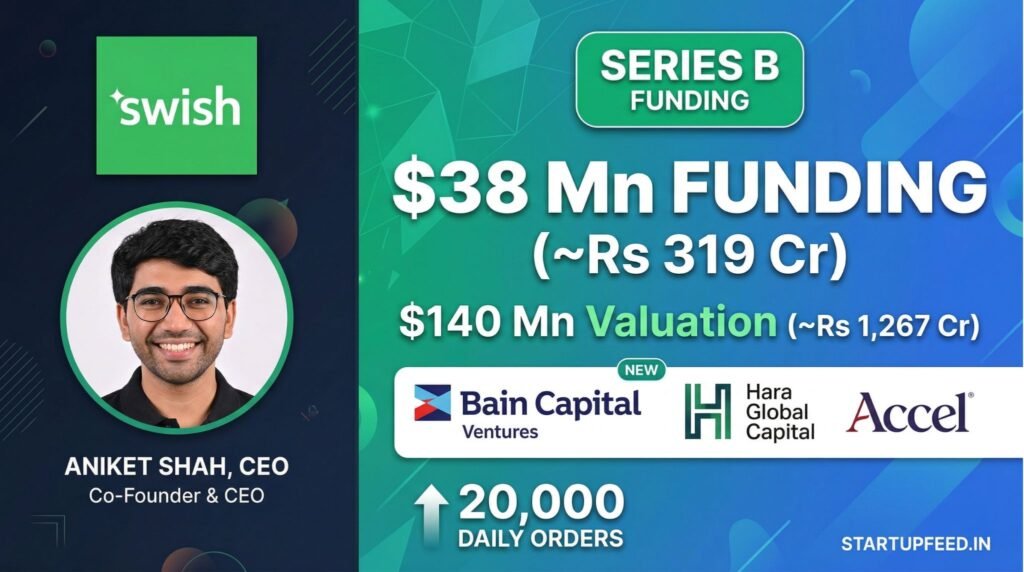
Ten-minute food delivery startup Swish has raised $38 Mn (Rs 319 Cr) in a Series B round co-led by Hara Global Capital and Bain Capital Ventures, with follow-on participation from Accel and venture debt from Alteria Capital and Stride Ventures — valuing the Bengaluru-based company at $140 Mn (Rs 1,267 Cr) post-money, a +133% jump from its $60 Mn Series A valuation set just 12 months ago.
This positions Swish as the sole well-capitalised pure-play in India’s 10-minute food delivery segment, at a moment when every large competitor — Swiggy, Zomato, Zepto, and Ola — has pulled back or shut down their own rapid food delivery experiments. With $54 Mn in total funding now behind it, Swish has the runway to prove that a vertically integrated, hyperlocal model can do what the marketplace giants could not — and multi-city investors are watching closely.
STARTUPFEED INSIGHT
|
Deal Breakdown
The $38 Mn round involves 5 capital providers across equity and venture debt:
| Investor | Amount | Type | Instrument | Status |
| Hara Global Capital | ~$14 Mn (Rs 128 Cr) | VC | Equity | Existing |
| Bain Capital Ventures | ~$10 Mn (Rs 91 Cr) | VC / Growth | Equity | New |
| Accel India | ~$7 Mn (Rs 64 Cr) | VC | Equity | Existing |
| Alteria Capital | Undisclosed | Debt Fund | Venture Debt | New |
| Stride Ventures | Undisclosed | Debt Fund | Venture Debt | New |
| Total | $38 Mn (Rs 319 Cr) | Equity + Debt | Mixed | — |
The inclusion of venture debt from Alteria Capital and Stride Ventures alongside equity is notable — it extends Swish’s runway without additional dilution, a sign that the company is managing cap table discipline even at this early stage.
Valuation Context
| Metric | Seed (Nov 2024) | Series A (Mar 2025) | Series B (Mar 2026) |
| Valuation | ~$10 Mn (Rs 84 Cr)* | $60 Mn (Rs 522 Cr) | $140 Mn (Rs 1,267 Cr) |
| Amount Raised | $2 Mn (Rs 17 Cr) | $14 Mn (Rs 121 Cr) | $38 Mn (Rs 319 Cr) |
| Total Raised (Cumul.) | $2 Mn | $16 Mn | $54 Mn |
| Valuation Growth | — | +500% from Seed | +133% YoY |
* Seed valuation estimated; not publicly disclosed.



Swish’s $140 Mn post-money valuation implies a ~35x multiple on its FY25 revenue of Rs 4 Cr — reflecting pure growth-stage pricing. For context, Blinkit’s Bistro (inside a $7 Bn parent) and Zepto Cafe scale orders at far higher absolute costs. The market is betting Swish’s full-stack density model unlocks better unit economics than asset-light marketplace peers as it scales.
What the Founder Says
“We are very dense, very close to the customer, ensuring that we are almost able to act like a restaurant kitchen, bringing food to your table.”
— Aniket Shah, Co-Founder & CEO, Swish
Shah’s framing — “like a restaurant kitchen” — is deliberate. It positions Swish not as a delivery aggregator but as a vertically integrated food brand. The word choice signals that the pitch to investors is about margin control and quality consistency, not delivery speed alone — the area where Swiggy’s Snacc and Zomato’s Quick failed operationally. What he is not saying is equally telling: no mention of profitability timelines, no mention of commission rates, no marketplace language.
“Customer expectations around delivery times have shifted with the rise of quick commerce. Swish is tackling this challenge with a new approach, rethinking the supply chain to bring the same ultra-fast experience to food delivery.”
— Abhinav Chaturvedi, Partner, Accel India (at Seed round)
Use of Funds
The $38 Mn will be deployed across three primary buckets:
- Geographic expansion: Beyond Bengaluru’s 10 micro-markets into Delhi-NCR and Mumbai — Aniket Shah confirmed both cities are in the pipeline in his TechCrunch interview
- Delight Center infrastructure: Building and equipping more cloud kitchens close to high-density demand clusters, maintaining the sub-1.5 km delivery radius that underpins the 10-minute promise
- Kitchen automation & tech stack: Scaling automated preparation processes that keep food consistent across locations — a core operational differentiator Shah highlighted to TechCrunch
The emphasis on geographic density over immediate profitability signals Swish is in a land-grab phase — replicating the Bengaluru playbook in cities with similarly dense, young, high-frequency ordering populations before larger players can re-enter the 10-minute food segment with fresh capital.
Financial Performance
| Metric | FY25 (Jul 8 – Mar 31, 2025) | Current Run-Rate (Est.) |
| Revenue | Rs 4 Cr | Not disclosed |
| Net Loss | Rs 19 Cr | Widening (expansion phase) |
| Daily Orders | ~5,000 (Nov 2025) | ~20,000 (Mar 2026) |
| Order Growth (4 months) | — | +300% (4x) |
| Avg. Order Value | Rs 200–250 | Rs 200–250 |
| SKUs Offered | ~70 (Aug 2024) | 200+ (Mar 2026) |
| Active Micro-Markets | 3–5 (Bengaluru) | 10 (Bengaluru) |
At ~20,000 daily orders with an AOV of Rs 225 (mid-range), Swish’s annualised GMV run-rate is approximately Rs 164 Cr. Against its FY25 revenue of Rs 4 Cr (partial year), the business has clearly accelerated — but FY26 profitability will depend entirely on Delight Center utilisation rates in new cities, which historically take 6–9 months to stabilise.



Who Should Be Watching?
| Player | 10-Min Food Status | Why Swish’s Round Matters to Them |
| Blinkit (Zomato) | Bistro — active | Swish’s $54 Mn war chest could fund a direct price war in Bengaluru — Bistro’s home turf; Eternal may accelerate Bistro investment in response |
| Swiggy (Snacc) | Shut down (2026) | Swiggy’s exit from 10-min food is Swish’s biggest near-term tailwind — 500K+ former Snacc users with no direct alternative |
| Zepto Café | Scaled back | Closed ~200 of 600 outlets; Zepto pivoting to quick commerce of groceries — Swish fills the white space in food |
| Ola Foods | On hold | Ola’s second exit from food delivery creates further investor validation for Swish’s approach |
| Rebel Foods / Cloud Kitchens | Traditional QSR | If Swish’s Delight Center model scales, it competes directly with standalone cloud kitchen operators for dense urban real estate |
Funding Journey
| Round | Date | Amount | Lead Investor(s) | Valuation |
| Seed | Nov 2024 | $2 Mn (Rs 17 Cr) | Accel, Unacademy’s Gaurav Munjal (angel) | ~$10 Mn* |
| Series A | Mar 2025 | $14 Mn (Rs 121 Cr) | Hara Global Capital + Accel | $60 Mn |
| Series B | Mar 2026 | $38 Mn (Rs 319 Cr) | Hara Global + Bain Capital Ventures | $140 Mn |
| TOTAL | — | $54 Mn (Rs 453 Cr) | — | $140 Mn |
* Seed valuation estimated. Notable angels at Seed include Urban Company founders Abhiraj Bhal and Varun Khaitan, and former Swiggy Instamart head Karthik Gurumurthy.
What’s Next
Swish’s immediate priority is Delhi-NCR, where density economics — young professional clusters in Gurugram, Noida, and South Delhi — mirror Bengaluru’s HSR Layout and Koramangala. A successful launch by Q4 FY27, with 10,000+ daily orders within 90 days, would validate the Bengaluru playbook and set up a Series C at a projected $350–400 Mn valuation.
The larger strategic question is whether Swish can hold its 10-minute delivery promise at city-level scale. In Bengaluru, this works because Delight Centers are within 1–1.5 km of demand clusters. Replicating this in Delhi-NCR — with its fragmented geography and traffic patterns — will stress-test the model in a way that Bengaluru has not. The next 12 months will reveal whether Swish is a Bengaluru phenomenon or a genuinely portable playbook.
One number to watch: if Swish can push average order frequency above 10 orders per user per month — which Shah claims top users are already hitting — the unit economics story becomes compelling enough for a pre-IPO growth round. That would be the signal that India’s 10-minute food delivery market has found its sustainable format.
Liked this story? Follow StartupFeed on Google so our reporting reaches you first.