Quick Take:
|
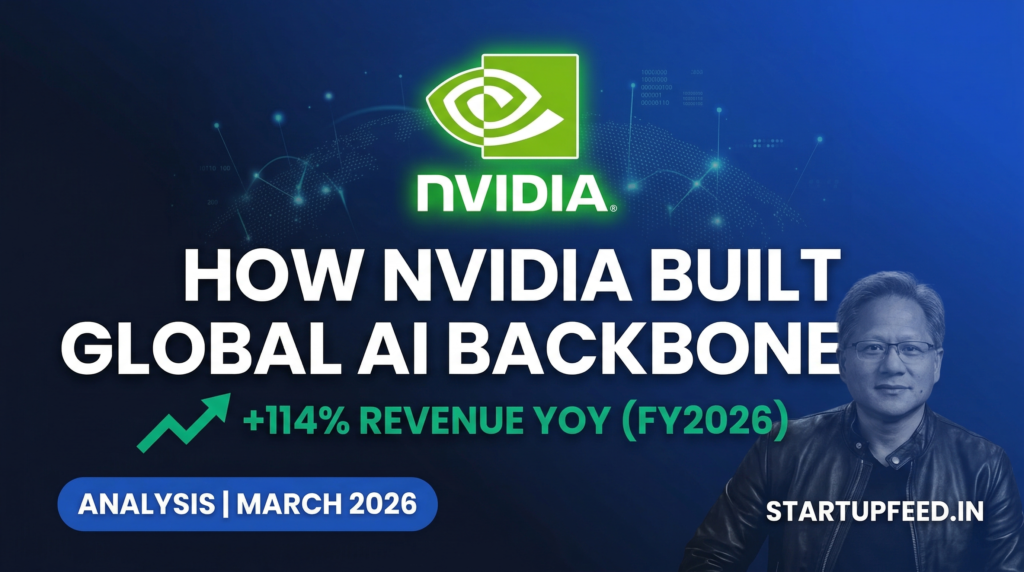
In 1993, three engineers left Sun Microsystems to found a company they believed would build the next generation of 3D graphics chips for videogames. They were right about the graphics chip. They were wrong about the endgame. Thirty-two years later, NVIDIA Corporation is not primarily a gaming company. It is the physical infrastructure of artificial intelligence — the company whose chips train every major language model, run every AI inference at scale, and power the data centres that governments, hyperscalers, and enterprises are building at $300 Bn+ annual investment rates to compete in the AI era. Its FY2026 revenue of $193.7 Bn makes it the fastest-growing large company in the history of semiconductor manufacturing.
This is not a story about lucky timing. It is a story about a 30-year compounding of architectural bets, platform investments, and ecosystem-building that left NVIDIA in the only position that matters when the AI supercycle arrived: irreplaceable. Understanding how NVIDIA got there is the most instructive technology business case study of the 21st century — and the most important context for understanding where India’s own semiconductor and AI infrastructure ambitions must go.
StartupFeed Insight
| The most important lesson from NVIDIA’s story: NVIDIA did not build the backbone of global AI by predicting AI. It built a platform — CUDA — that made GPU computing accessible to anyone who wanted to use it, for any purpose, without knowing that AI training would become that purpose. CUDA launched in 2006. The deep learning revolution began in earnest in 2012. That is a six-year gap between platform launch and the use case that would justify the entire investment. Most companies — and most investors — would have cut the CUDA programme within two years of launch for lack of clear ROI. The NVIDIA lesson for Indian founders and policymakers: platforms built for one purpose always find their killer application in an adjacent one. India’s semiconductor mission, data centre buildout, and AI policy investments will compound in ways that are currently invisible. The investments being made in Dholera’s Tata-PSMC fab, Mumbai’s hyperscale clusters, and IIT Madras’s SHAKTI RISC-V processor are the 2026 equivalent of CUDA in 2006. The return may not be visible for a decade. The compounding will be real. |
The Origin: Three Engineers, a Near-Bankruptcy, and a Bet on Parallelism
NVIDIA was founded on June 5, 1993 by Jensen Huang (then 30, formerly at LSI Logic and AMD), Chris Malachowsky, and Curtis Priem (both from Sun Microsystems). They met at a Denny’s in East San Jose — a detail Huang has repeated in countless speeches because it grounds one of the most extraordinary business trajectories in technology history in something mundane.
The company’s early years were turbulent. Its first product, the NV1 (1995), was designed around a proprietary rendering approach called quadratic surfaces — which turned out to be incompatible with the industry’s emerging DirectX standard. Sega had invested in the NV1 for its Saturn console; the relationship collapsed. NVIDIA was within months of going out of business in 1996 when Huang made a consequential decision: bet the entire company on building a DirectX-compatible chip, the RIVA 128, in less than a year. The chip shipped in 1997 and sold a million units in four months. NVIDIA survived.
The deeper lesson from this near-death experience was not survival — it was the crystallisation of a product philosophy that would define NVIDIA for the next three decades: build the platform that developers and engineers actually want to use, not the platform that makes the most theoretical sense. The NV1 failed because it required developers to learn a new rendering paradigm. The RIVA 128 succeeded because it met developers where they already were.



The Architecture Timeline: From GeForce to Grace Blackwell
| Year | Architecture / Product | Significance |
|---|---|---|
| 1999 | GeForce 256 | Coined the term GPU (Graphics Processing Unit). First chip to handle geometry transformation and lighting in hardware — removing that workload from the CPU. Launched the GPU era |
| 2001 | GeForce3 | First programmable GPU shader architecture. Developers could now write custom programs (shaders) to run on the GPU. First hint that the GPU was a programmable computing platform, not just a fixed-function graphics accelerator |
| 2006 | G80 / CUDA Launch | The watershed moment. CUDA (Compute Unified Device Architecture) allowed any developer to program the GPU for general-purpose computing in C. Not just graphics. Any parallel computation. Scientists, researchers, and engineers began using CUDA to accelerate physics simulations, molecular dynamics, climate modelling. Deep learning researchers would follow |
| 2008 | Tesla Architecture | First NVIDIA architecture designed explicitly for high-performance computing (HPC) and scientific computing, not gaming. First product line aimed at data centres and universities. Named after Nikola Tesla |
| 2012 | Kepler + AlexNet | Geoffrey Hinton’s team (Alex Krizhevsky, Ilya Sutskever) trained AlexNet on two NVIDIA GTX 580 GPUs. Won ImageNet competition by a 10-percentage-point margin. Proved GPU-accelerated deep learning could achieve superhuman image recognition. The modern AI era begins |
| 2014-2016 | Maxwell / Pascal | Rapid generational improvements. Google, Facebook, Baidu, and Microsoft began buying NVIDIA GPUs at scale for deep learning research. NVIDIA’s data centre business begins its ascent |
| 2017 | Volta / V100 | First dedicated Tensor Core architecture — mixed-precision matrix multiplication units optimised for AI workloads. The V100 became the standard training GPU for every major AI lab. NVIDIA explicitly pivots to AI as the primary use case |
| 2020 | Ampere / A100 | 80 Bn transistors. 3rd-generation Tensor Cores. Multi-Instance GPU (MIG) allowing one chip to serve multiple workloads. A100 becomes the gold standard for AI training. Data centre revenue begins exponential climb |
| 2022 | Hopper / H100 | ChatGPT launches November 2022. Every AI lab needs H100s. 80 Bn parameter model training that took weeks on V100s now takes days on H100s. Transformer Engine introduced for LLM workloads. H100 lead times: 6-12 months. NVIDIA revenue supercycle begins |
| 2024 | Ada Lovelace / H200 | H200 adds HBM3e memory (141 GB/s bandwidth), dramatically improving inference performance for large models. RTX 40 series for gaming. 10-for-1 stock split. Market cap crosses $3 Tn |
| 2025 | Blackwell / B200, GB200 | 9th-generation architecture. 2x training performance vs H100. Grace Blackwell (GB200) CPU+GPU system-on-chip. NVLink 72-chip clusters. GB200 = two-thirds of all FY26 data centre revenue. Jensen Huang: ‘Blackwell sales are off the charts’. Nine gigawatts of power on Blackwell now operational globally |
| 2026 (Roadmap) | Vera Rubin | Next-generation platform. Samples being sent to customers. Expected to extend Blackwell’s inference-per-watt leadership. Rubin Ultra to follow. NVIDIA maintains 1-year product cadence |
CUDA: The Real Moat (Not the Chips)
The most important thing NVIDIA built was not a chip. It was a software ecosystem. CUDA, launched in 2006, is a parallel computing platform and programming model that allows developers to use C, C++, and Python to write programs that execute on NVIDIA GPUs. It was, at launch, a risky and expensive bet: NVIDIA was a hardware company deciding to invest massively in developer tooling for a use case — general-purpose computing on GPUs — that did not yet have a clear business application.
The bet paid off in a way that compounded silently for six years before becoming visible. Between 2006 and 2012, thousands of researchers at universities and national laboratories built CUDA-accelerated libraries, frameworks, and models. When deep learning researchers needed to train neural networks at scale in 2012, the entire software toolchain already existed: CUDA, cuDNN (deep neural network library), cuBLAS (linear algebra), and the accumulation of researcher-contributed code. Switching to any other hardware platform would have meant rebuilding that entire toolchain from scratch.
Why CUDA is the real competitive moat, not the GPU hardware:
|
The ChatGPT Supercycle: How One Product Launch Changed NVIDIA’s Revenue Trajectory
November 30, 2022 is the most important date in NVIDIA’s corporate history. On that day, OpenAI launched ChatGPT. Within two months, it had reached 100 million users — the fastest consumer product adoption in history. Within six months, every major technology company, every government, and every large enterprise in the world had a mandatory AI strategy. And every AI strategy required training and running large language models at scale. Which required GPUs. Which, at production quality and in sufficient volumes, meant NVIDIA H100s.
| NVIDIA Fiscal Year | Total Revenue | Data Centre Revenue | Key Driver |
|---|---|---|---|
| FY22 (Jan 2022) | $26.9 Bn | $10.6 Bn | Gaming dominant; DC growing |
| FY23 (Jan 2023) | $26.9 Bn | $15.0 Bn | Gaming slump; DC holding. Pre-ChatGPT |
| FY24 (Jan 2024) | $60.9 Bn | $47.5 Bn | H100 supercycle. ChatGPT + LLM training demand. +124% YoY |
| FY25 (Jan 2025) | $130.5 Bn | $115.2 Bn | H100 + H200 + early Blackwell. +114% YoY. First $100 Bn DC year |
| FY26 (Jan 2026) | $193.7 Bn | $175.3 Bn (est.) | Blackwell ramp. GB200 = 2/3 DC revenue. +68% YoY. 9 GW Blackwell operational |
| FY27 Guidance (Q1) | ~$43 Bn/quarter | Dominant | Vera Rubin roadmap. Enterprise AI wave beginning |
The revenue trajectory above is unprecedented in technology industry history. For context: it took Apple 9 years to go from $10 Bn to $100 Bn in annual revenue. Microsoft took 12 years. NVIDIA went from $27 Bn to $193 Bn in three years. At 75% gross margins, NVIDIA’s profitability profile is also extraordinary for a hardware company — typically hardware manufacturers operate at 30-50% gross margins. The explanation is the software moat: NVIDIA’s pricing power comes from CUDA lock-in, not just chip performance.
The Full Stack: Why NVIDIA Is More Than a Chip Company
The conventional framing of NVIDIA as a ‘chip company’ is incomplete and increasingly misleading. NVIDIA’s competitive position in 2026 rests on a full-stack architecture that spans silicon, systems, networking, software, and cloud services.
| Layer | NVIDIA’s Position |
|---|---|
| Silicon (GPUs) | H100, H200, B200, GB200 (Grace Blackwell) — the flagship AI accelerators. Also A100, A40, L40 for specific workloads. 9 GW of Blackwell power operational globally as of FY26 |
| Systems (DGX/HGX/MGX) | DGX A100, DGX H100, DGX GB200 — integrated AI supercomputer systems. HGX for cloud partners. MGX for modular configurations. Complete hardware solutions, not just chips |
| Networking (Mellanox/InfiniBand) | Acquired Mellanox in 2020 for $6.9 Bn. InfiniBand networking connects thousands of GPUs with microsecond latency for distributed training. NVLink for intra-node GPU interconnects. Spectrum-X Ethernet for AI networking. NVIDIA now owns the pipe between its GPUs |
| Developer Platform (CUDA ecosystem) | CUDA + cuDNN + TensorRT + cuBLAS + NCCL (collective communications). The complete mathematical library stack for AI. Runs on every NVIDIA GPU. 4 Mn+ developers. 20 years of optimisation depth |
| Software Platform (NVIDIA AI Enterprise) | NVIDIA NIM (inference microservices) for standardised AI model deployment. NVIDIA Triton Inference Server. AI Enterprise software suite for enterprise deployment. Moving to recurring software revenue alongside hardware |
| Cloud Services (DGX Cloud) | DGX Cloud on AWS, GCP, Azure, Oracle — NVIDIA-managed GPU clusters in hyperscaler data centres. Gives enterprises GPU access without owning hardware. Direct subscription revenue. Partners: AWS, Google, Microsoft, Oracle, CoreWeave |
| Simulation Platform (Omniverse) | Industrial simulation, digital twins, and robot training environments. Physical AI layer for robotics, autonomous vehicles, and industrial automation. NVIDIA Cosmos for physical AI world model generation |
| Autonomous Vehicles (DRIVE) | NVIDIA DRIVE platform for autonomous vehicle computing. Customers: Mercedes, BYD, XPENG, Li Auto, Zoox. Long-term secular bet on automotive computing |
Sovereign AI: The $30 Bn Business India Must Study
One of the most significant developments in NVIDIA’s FY2026 results was the explicit quantification of a new business category: Sovereign AI. Revenue from the sovereign AI business tripled to over $30 Bn in FY2026, fuelled by national infrastructure projects in Canada, France, the Netherlands, Singapore, the UK, and others. Governments are buying NVIDIA infrastructure to build national AI capabilities — training national language models, building AI-native public services, and ensuring that their countries’ critical AI infrastructure is not dependent on foreign commercial cloud providers.
For India, sovereign AI is both an opportunity and a strategic imperative. India’s AI Mission has already committed Rs 10,000 Cr for AI compute infrastructure, and the government’s stated goal is to ensure that AI models trained on Indian data, in Indian languages, for Indian use cases, run on AI infrastructure within India’s borders. NVIDIA’s partnerships with Reliance Jio (1 GW Jamnagar data centre with NVIDIA chip partnership), AdaniConneX (Google AI campus), and India’s largest manufacturers position NVIDIA directly in the centre of India’s AI infrastructure buildout.
| Country / Region | Sovereign AI Initiative (NVIDIA-involved) |
|---|---|
| USA | Stargate Project ($500 Bn, 10+ year): NVIDIA as key technology partner. OpenAI partnership for 10 GW of NVIDIA systems for next-gen AI infrastructure |
| France | Sovereign AI national infrastructure programme. NVIDIA + French government collab on national LLM |
| Canada, Netherlands, Singapore, UK | National AI compute programmes all feature NVIDIA infrastructure. Combined $30 Bn+ sovereign revenue in FY26 |
| India | Rs 10,000 Cr AI Mission compute allocation | Reliance Jio 1 GW data centre (NVIDIA chips) | AdaniConneX AI campus | NVIDIA-India manufacturing partnerships announced FY26 earnings | ISM-approved projects using NVIDIA A100/H100 for AI inference |
| UAE / Gulf (Pre-Conflict) | Stargate UAE campus in Abu Dhabi planned as largest AI facility outside USA. Trump’s $2 Tn Gulf investment tour included $1.5 Tn+ in AI infrastructure. Status uncertain post Iranian drone strikes on AWS Gulf data centres (March 2026) |
| Japan | NVIDIA + SoftBank partnership for Japan sovereign AI. NTT and Fujitsu building NVIDIA-powered AI supercomputers |
The Jensen Huang Factor: Why the Founder Still Matters at $193 Bn Revenue
Jensen Huang is one of the most studied CEOs in technology history — and deservedly so. His 32-year tenure at NVIDIA (he is the longest-serving CEO of a major tech company) is characterised by a set of strategic decisions that, in retrospect, appear visionary but at the time each looked risky:
Huang’s management philosophy: ‘Speed of execution and clarity of purpose’. Flat organisation with 60 direct reports. No 1:1 meetings; all decisions made in groups. Transparency about failures as learning moments. His signature phrase: ‘Our company is 30 days from going out of business at all times’ — a cultural mechanism to keep urgency alive in a company that is now the 2nd most valuable in the world. |
The Headwinds: What Could Slow NVIDIA Down
NVIDIA’s position appears impregnable in 2026. History suggests that ‘impregnable’ is an invitation for challengers. The following structural risks are real and worth tracking:
| Risk | Detail |
|---|---|
| Custom Silicon from Hyperscalers | Google’s TPU v4/v5, Amazon’s Trainium/Inferentia, Microsoft’s Maia, and Meta’s MTIA are all accelerating. These companies collectively represent 50%+ of NVIDIA’s data centre revenue. If they shift 20% of workloads to custom silicon, NVIDIA loses $25-30 Bn annually |
| AMD’s MI300 / MI350 Push | AMD’s MI300X has achieved real performance parity with H100 for inference workloads. Microsoft Azure, Meta, and Oracle are all deploying AMD chips at scale. CUDA remains the moat, but ROCm compatibility is improving |
| China Export Controls (Revenue Zero) | US export restrictions have effectively reduced NVIDIA’s China revenue to near-zero. China was historically 15-20% of NVIDIA’s data centre revenue. Chinese domestic alternatives (Huawei Ascend 910B, Biren, Moore Threads) are advancing rapidly |
| DeepSeek / Efficiency Models | In early 2025, DeepSeek demonstrated that frontier AI models could be trained at a fraction of the assumed GPU cost. If inference efficiency improves dramatically (more intelligence per GPU), demand growth could slow. NVIDIA’s counter-argument: reasoning models (‘thinking models’) require orders of magnitude more compute per query — adding a new scaling law that keeps demand high |
| Geopolitical Risk (Taiwan Supply) | TSMC manufactures NVIDIA’s chips in Taiwan. The same Taiwan strait risk that threatens cloud data centres in the Gulf threatens NVIDIA’s foundry supply chain. A Taiwan disruption would be as catastrophic for NVIDIA as for the rest of the semiconductor industry |
| Antitrust / Regulatory | EU and US regulators are examining NVIDIA’s bundling of CUDA with hardware (potential anti-competitive tying). The failed $40 Bn Arm acquisition (2022, blocked by regulators) illustrated that NVIDIA’s growth ambitions face regulatory constraints |
| Valuation Expectations | At $3 Tn market cap and 35x forward earnings, NVIDIA is priced for continued hyper-growth. Any quarter where revenue growth decelerates below 40% will trigger significant market revaluation |
The India Dimension: From Consumer of NVIDIA to Partner in the AI Era
India’s relationship with NVIDIA has historically been that of a talent supplier (20% of global semiconductor design talent works at NVIDIA’s India centres or its customers) and a hardware consumer (India’s data centres buy NVIDIA chips). The next decade could reshape that relationship in three ways:
- Sovereign AI Infrastructure
India’s Rs 10,000 Cr AI Mission compute allocation, Reliance’s 1 GW NVIDIA-partnered data centre, and the government’s national AI model initiative (BharatGen, IndiaAI Mission) collectively represent India’s attempt to build sovereign AI compute that is domestically hosted and domestically governed. NVIDIA’s explicit India partnerships — announced at FY26 earnings alongside partnerships with India’s largest manufacturers — signal that India is now a tier-1 market in NVIDIA’s sovereign AI strategy.
- Design Ecosystem Deepening
India already contributes 20% of global semiconductor design talent. ARM opened a 2nm design office in Bengaluru (September 2025). Intel expanded its Bengaluru design centre to 13,000+ engineers. NVIDIA itself has significant chip design operations in India. As India’s DLI (Design Linked Incentive) scheme matures and domestic chip design startups scale, the country’s role shifts from service provider to IP holder — the transition that NVIDIA itself made in its early years when it stopped being a graphics card assembler and became an architecture innovator.
- Manufacturing Independence (The Long Game)
India cannot manufacture NVIDIA-grade chips today. The Tata-PSMC fab in Dholera targets mature nodes (28-110nm) — useful for automotive chips, IoT, and power management, but not the 3nm/4nm nodes that H100 and Blackwell chips use. India’s path to competing with TSMC in advanced node manufacturing is a 15-20 year journey at minimum. But the lesson from NVIDIA’s own history is that the journey starts with infrastructure bets that seem premature. The Dholera fab, the DLI startups, the IIT Madras SHAKTI processor — these are India’s 2026 equivalents of CUDA in 2006.
What’s Next: The Vera Rubin Era and the Physical AI Wave
NVIDIA’s roadmap for FY2027 and beyond rests on two bets that are already in motion:
| Bet 1: Vera Rubin (Next GPU Architecture) Samples already being sent to customers. The Rubin architecture is designed to extend Blackwell’s inference-per-watt leadership. Rubin Ultra follows. NVIDIA’s annual architecture cadence — a GPU generation every year, compared to 2-3 years previously — is itself a competitive weapon. Challengers cannot build the ecosystem of software optimisations that NVIDIA accumulates across a generation in just one year. Bet 2: Physical AI (Robotics, Autonomous Vehicles, Industrial) Jensen Huang’s FY26 earnings quote: ‘Agentic AI and physical AI set the stage for the next wave of AI to revolutionize the largest industries.’ Physical AI — where AI controls physical systems in the real world (robots, autonomous vehicles, industrial automation, defence systems) — requires orders of magnitude more compute than language model inference. Every robot needs a NVIDIA-class processor to perceive its environment in real time and execute decisions. NVIDIA Omniverse + NVIDIA Cosmos (physical AI world model) + NVIDIA DRIVE are the three-layer bet on this wave. If physical AI arrives on a 5-10 year horizon as predicted, NVIDIA’s addressable market expands from data centres to every machine in the world. |
NVIDIA’s story — from three engineers at a Denny’s in East San Jose to the company that literally builds the brain of artificial intelligence — is the defining technology business narrative of our time. It is not a story about prediction or luck. It is a story about platform building, ecosystem cultivation, architectural consistency, and the discipline to invest in the future at the expense of the present. For every startup founder, technology investor, and policymaker in India building the country’s AI future — those four things are the lesson.
Liked this story? Follow StartupFeed on Google so our reporting reaches you first.