Quick Take:
|
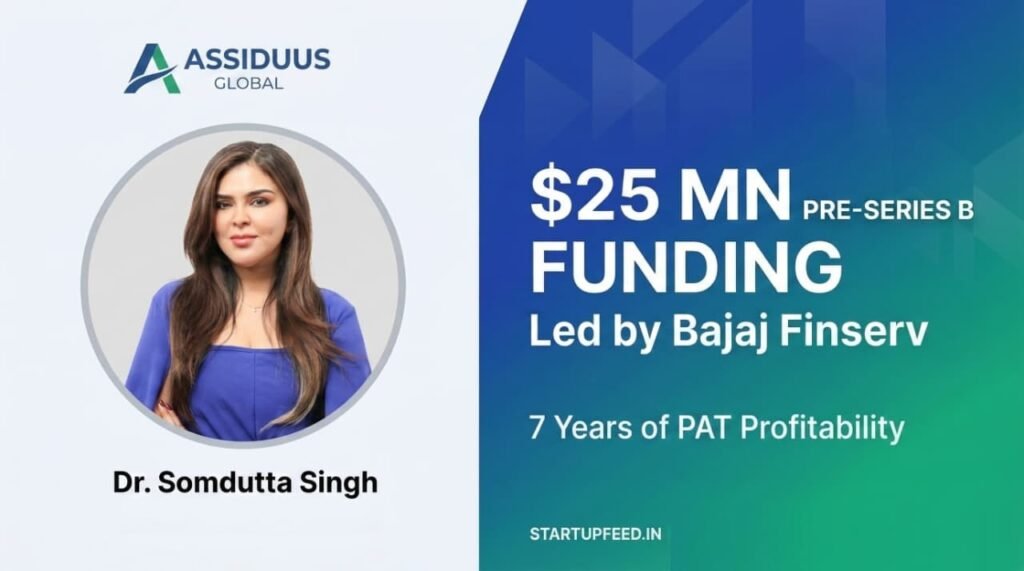
AI-led cross-border ecommerce accelerator Assiduus Global has raised $25 Mn (Rs ~233 Cr) in a pre-Series B round led by Bajaj Finserv, with participation from Uncorrelated Ventures, Aaruha Technology Fund, Vikash Agarwal (Rupa Family Office), and institutional and family-office investors — valuing the company at triple its previous round — as founder Dr Somdutta Singh positions her Bengaluru and Atlanta-headquartered platform as the global operating system for cross-border digital commerce.
The number that stands out is not the $25 Mn — it is the seven consecutive years of PAT profitability. In an Indian startup ecosystem defined by burn-to-grow plays and perpetually loss-making models, Assiduus has compounded growth while staying in the black since 2018. For Bajaj Finserv — a financial services conglomerate with deep interests in ecommerce lending and working-capital financing — a profitable, AI-powered cross-border commerce infrastructure platform is not just a venture investment: it is a strategic distribution asset.
StartupFeed Insight
| What the numbers say: Assiduus’ $25 Mn pre-Series B at 3x its Series A valuation is conservative by the standards of AI platform companies with similar scale metrics — 150+ enterprise brands, 20+ countries, $450 Mn+ GMV. The deliberate valuation discipline signals Singh is not chasing a paper unicorn; she is building a business with clear IPO-readiness metrics. Seven years of PAT profitability is a remarkable credential in an industry where most peers (Thrasio, similar aggregators/accelerators) have cycled through implosions. Assiduus has not. What this means for you:
Our prediction: Assiduus closes a Series B of $50-60 Mn by Q4 FY27, likely led by a strategic investor from the logistics or financial services sector (DHL, Maersk, or a sovereign fund from the GCC given Oman’s strategic hub positioning). Singh files for a US IPO by FY29 — making Assiduus one of the few Indian D2C-adjacent companies to list on NASDAQ in its own right. |
Deal Breakdown
| Parameter | Details |
|---|---|
| Round | Pre-Series B |
| Amount | $25 Mn (Rs ~233 Cr) |
| Lead Investor | Bajaj Finserv (diversified financial services conglomerate, India) |
| Co-Investors | Uncorrelated Ventures, Aaruha Technology Fund, Vikash Agarwal (Rupa Family Office), institutional and family-office investors |
| Valuation | Tripled vs Series A 2022 (exact figure undisclosed) |
| Profitability | PAT positive for 7 consecutive years (2018-2025) |
| Total Raised to Date | ~$41 Mn ($1 Mn seed + $15 Mn Series A + $25 Mn pre-Series B) |
| Previous Investors | Pulsar Capital, 9Unicorns/100Unicorns, Venture Catalysts, StrongHer VC, Rajan Navani (JetLine), Carlos Cashman (Thrasio founder) |
| Use of Funds | AI: predictive demand, pricing intelligence, working-capital optimisation | Expansion: Middle East, Europe, APAC (Oman hub) | Enterprise & sovereign government partnerships |
| Headquarters | Atlanta, USA (with Bengaluru operations) |
The Founder Story: From Rs 2,000 to Global Ecommerce Infrastructure
Dr Somdutta Singh’s story starts at 16, when she left her home in Kolkata with Rs 2,000 in her pocket — after her doctor father, expecting her to follow the family profession, asked her to leave when she chose a different path. She supported herself through management college in Bengaluru by sewing and making chocolates, earning Rs 5,000 a month, while her classmates came from well-off families who unknowingly became her first customers. She topped Bangalore University. Then came Akamai, an MBA from ISB, and a PhD from MIT. Then the corporate world. Then the exits.
| Year | Venture | What Happened |
|---|---|---|
| 2013 | Unspun Group (AdTech) | Founded AI-driven marketing analytics company; built ACT — a proprietary tool crawling, analysing, and recommending marketing channels for startups and SMEs. Acquired within 2 years. Somdutta became a millionaire at 25. |
| 2014-2018 | D2C Brand Portfolio | Built own D2C brands on global marketplaces: Amplicell, Biotevia, Smart Vitamins, The Real Boss Lady Beauty, Irotica. Used marketplace APIs to find high-demand/low-penetration niches. Generated multi-million dollar revenue. Second exit. |
| 2018 | Assiduus Global Inc. | Founded after hitting the wall of cross-border complexity with her own brands. Realised the infrastructure layer for global ecommerce was missing. Built Assiduus to be the solution she wished she had. |
| 2020 | Seed Funding | First institutional capital; validated technology with early brand clients |
| 2022 | Series A ($15 Mn) | Led by Pulsar Capital; participation from Thrasio founder Carlos Cashman; expanded to 12+ marketplaces globally |
| 2024 | South America Expansion | Announced Latin America market entry; GMV crossed $450 Mn+ managed since inception; Inc 5000 Top 600; Deloitte Fast 50 No. 8 |
| 2026 | Pre-Series B ($25 Mn) | Led by Bajaj Finserv; 150+ enterprise brands, 20+ countries, 18+ marketplaces; PAT positive 7 years; valuation 3x Series A |
What Assiduus Actually Does: The Five Barriers It Removes
Assiduus describes itself as a ‘middleware infrastructure platform for global digital commerce’ — but the plainest explanation is this: it is the operating system that lets an Indian brand sell on Amazon Japan, Noon UAE, Walmart US, and eBay Europe simultaneously, without the brand having to understand licensing, warehousing, listing optimisation, or fulfillment in each geography. Every part of that complexity becomes Assiduus’ problem, not the brand’s.
| Barrier Assiduus Removes | How It Solves It | Without Assiduus |
|---|---|---|
| Product Licensing & Import Regulations | Manages compliance, certifications, and regulatory filings in each market; handles customs classification | 6-18 months of regulatory work per market; lawyers, local agents, compliance consultants |
| Demand Forecasting & Inventory Planning | AI-driven predictive demand + data-led inventory models; avoids overstocking or stockouts | Manual guesswork; lost sales from stockouts or cash tied in dead inventory |
| Multi-Platform Integration | Integrates with 18+ global marketplaces (Amazon, Noon, Walmart, eBay, Nykaa, Myntra, quick-commerce platforms) via single API layer | Each marketplace requires separate technical integration and account management |
| Distribution & Fulfillment | End-to-end cross-border logistics; warehousing in key regions; applied robotics + automated fulfillment infrastructure | Separate logistics partners in each country; no visibility; high last-mile failure rates |
| Listing Optimisation & Performance | AI-driven keyword, pricing, ranking intelligence; real-time performance analytics dashboard | Each marketplace optimisation requires dedicated in-market expertise and A/B testing infrastructure |

Client brands include Cipla, Bulletproof, Swiss Image, Strive, Poorna Gummies — spanning pharma, wellness, beauty, and nutrition, all categories where cross-border regulatory complexity is highest and where Assiduus’ compliance infrastructure creates the deepest moat.
Assiduus By the Numbers: 7 Years of Compounding
| Metric | Value / Status |
|---|---|
| Founded | 2018 — Bengaluru, India (also HQ in Atlanta, USA) |
| Founder | Dr Somdutta Singh — MIT PhD, ISB MBA, 2 prior exits |
| Enterprise Brands Served | 150+ (Cipla, Bulletproof, Swiss Image and others) |
| Countries of Operation | 20+ (India, UAE, UK, Denmark, US, Japan, GCC and more) |
| Marketplaces Integrated | 18+ (Amazon, Noon, Walmart, eBay, Nykaa, Myntra, quick-commerce platforms) |
| GMV Managed (Inception to 2024) | $450 Mn+ |
| Profitability | PAT positive for 7 consecutive years (2018-2025) |
| Awards | Inc 5000 Top 600 (2021) | Deloitte Fast 50 #8 (2022) |
| Total Funding Raised | ~$41 Mn across seed, Series A, and pre-Series B |
| Pre-Series B Valuation | 3x Series A valuation (exact figure not disclosed) |
| Strategic Expansion Focus | Oman as MENA hub; South America; Europe; APAC |
| IPO Ambition | US listing (NASDAQ/NYSE) — Singh has publicly stated aspiration to be first woman of Asian descent to lead such an IPO |
Why Bajaj Finserv Led This Round — And What It Signals
Bajaj Finserv is not a typical VC. It is a Rs 1.29 lakh Cr revenue ($15.2 Bn) diversified financial services conglomerate spanning lending, insurance, asset management, and payments. Its bet on Assiduus is strategic, not purely financial. Bajaj Finserv has deep exposure to the SME and MSME lending market in India — and Assiduus’ brands are precisely the kind of Indian SMEs that need working-capital financing to fund their global inventory.
The deal structure also signals Bajaj Finserv’s intent to build embedded financial services within Assiduus’ platform — specifically working-capital optimisation, one of the three stated use-of-funds categories. When Assiduus’ AI predicts that a brand needs 10,000 units of inventory in the UAE for Q4, Bajaj Finserv can provide the purchase-order financing that makes that inventory possible. The investor is not just backing a technology platform — it is accessing a distribution channel into 150+ growing D2C brands’ working capital needs.
What Somdutta Singh Says
Analysis: ‘Compound across cycles, geographies, and generations’ is the most loaded phrase in Singh’s public articulation of the Assiduus thesis. It signals three things: the business model is not tied to a single ecommerce boom-bust cycle; geographic expansion is the primary growth lever; and she is building for decades, not a 5-year VC exit. ‘Infrastructure’ is the key word she uses, not ‘accelerator’ or ‘aggregator’ — the positioning tells you exactly where she sees the valuation ceiling. |
Competitive Landscape: Where Assiduus Fits
| Competitor | Model | Why Assiduus Has an Edge |
|---|---|---|
| Global-e | Ecommerce localisation platform | Global-e focuses on checkout/payments localisation; Assiduus goes deeper into supply chain, fulfillment, and AI-driven performance management |
| Flow Commerce | Cross-border SaaS | Flow targets enterprise DTC; Assiduus has more geographic depth in APAC and MENA where Flow is weaker |
| Thrasio / Aggregators | Brand acquisition | Aggregators buy brands (and have largely imploded); Assiduus is anti-aggregator — it empowers brands without taking equity. Carlos Cashman (Thrasio founder) invested in Assiduus, validating the model divergence |
| Amazon Global Selling | Amazon’s own cross-border tool | Amazon’s program locks brands into a single marketplace; Assiduus works across 18+ marketplaces including competitors to Amazon |
| Unicommerce / Inventory Platforms | India-focused OMS | Inventory/OMS platforms handle domestic logistics; Assiduus handles cross-border regulatory, compliance, and global fulfillment at a layer these platforms cannot reach |
What’s Next
The $25 Mn will be deployed across three parallel tracks. AI deepening — predictive demand (getting inventory to the right market before a stockout), pricing intelligence (real-time dynamic pricing across 18 marketplaces), and working-capital optimisation (the embedded Bajaj Finserv financing hook) — represents Assiduus’ technology moat thickening. Geographic expansion — with Oman positioned as the MENA hub, giving Assiduus a customs-free corridor into the broader GCC — is the revenue diversification play. Enterprise and sovereign partnerships — government-to-government trade facilitation — is the highest-value and most protected revenue category if executed.
The bigger milestone is Singh’s IPO ambition. She has publicly stated her goal to be the first woman of Asian descent to lead a US tech IPO on NASDAQ or NYSE. With seven years of profitability, $41 Mn raised, 150+ enterprise clients, and a Series B likely in FY27, the IPO pathway is not a fantasy — it is a financial model that can be built.
The global ecommerce market is a $6+ Tn opportunity. Cross-border is the fastest-growing segment. India’s ecommerce alone heads to $400 Bn by 2030. The platform that becomes the default middleware for brands navigating this complexity will be worth billions. Assiduus is seven years and $41 Mn into building it — profitably.
Which global marketplace do you think Assiduus will crack next? @StartupFeed_official
Liked this story? Follow StartupFeed on Google so our reporting reaches you first.