
Published: [November 06, 2026]
StartupFeed Quick Take
- TReDS financing rose 36% to Rs 75,788 crore in August and September 2026, from Rs 55,549 crore a year earlier.
- The five platforms financed 3.43 lakh invoices over the two months, against 2.56 lakh last year.
- From June 30, 2026, every operating central public sector firm must settle its MSME invoices on TReDS.
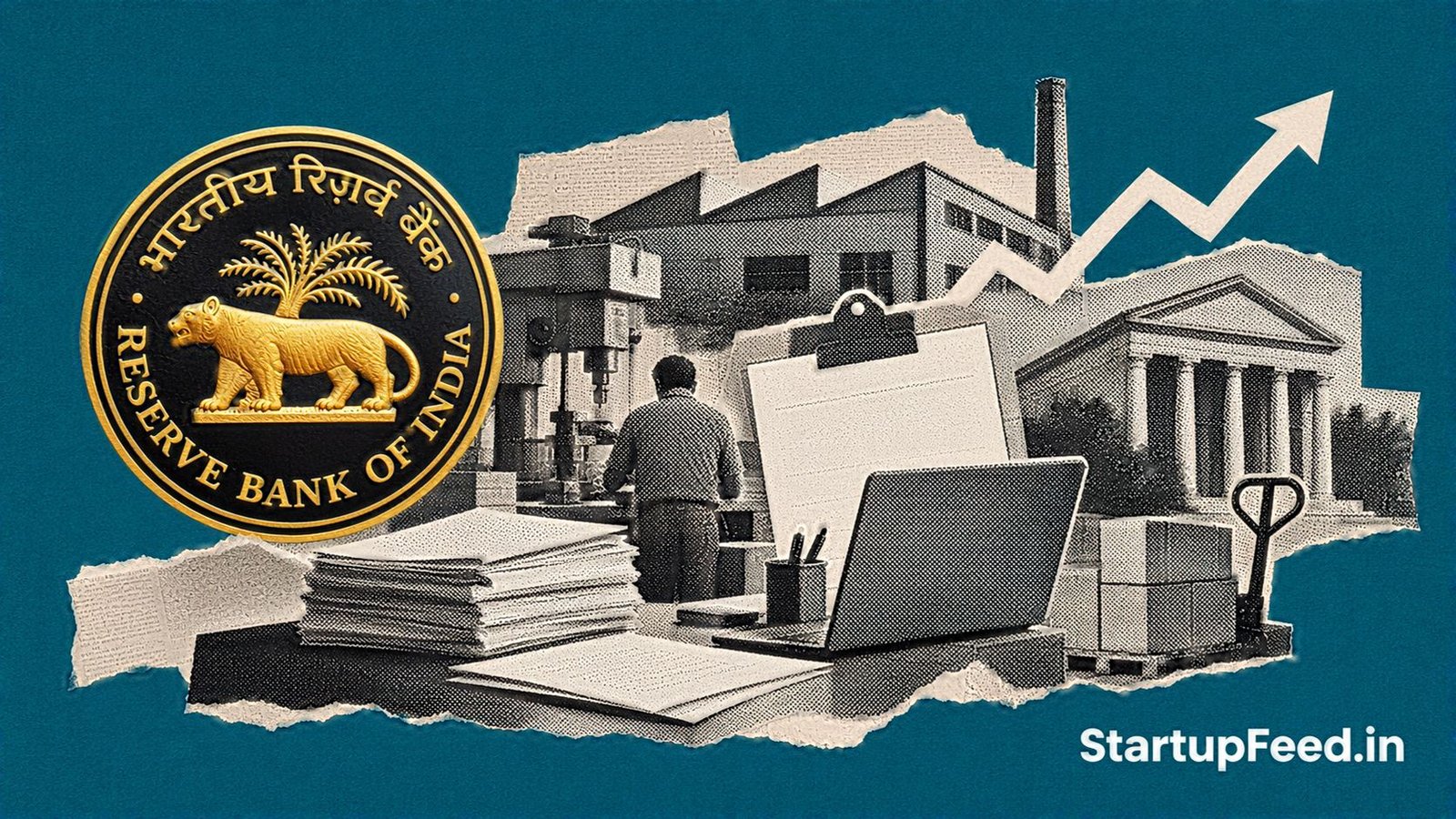
TReDS platforms financed invoices worth Rs 75,788 crore in August and September 2026, up 36% from a year earlier, as MSMEs funded festive stock.
RBI’s entity-wise TReDS data put the same two months of 2025 at Rs 55,549 crore. The gap is Rs 20,239 crore in one year.
September carried the bigger load. The five platforms financed Rs 40,819 crore that month, 16.7% more than August and 34% more than September 2025.
August grew faster against its own 2025 figure, rising 39.4% to Rs 34,969 crore.
Invoice numbers tell a flatter story. The platforms financed 3.43 lakh invoices over the two months, up 34% from 2.56 lakh a year ago.
So the average financed invoice worked out to Rs 22.12 lakh, against Rs 21.72 lakh last year. More invoices moved, not much bigger ones.
The system works like an auction. An MSME uploads an invoice its buyer has accepted, and banks and NBFCs bid to fund it.
The seller is paid before the invoice falls due. The buyer pays the winning bidder on the due date.
Where the TReDS Financing Growth Came From
August and September are stocking months. Factories build inventory for Dussehra and Diwali, and their small suppliers wait 45 to 90 days to be paid.
M1xchange financed over Rs 20,000 crore in the 30 days from the start of Navratri, a third more than the same window in 2025.
Sundeep Mohindru, promoter and director of M1xchange, said his sellers have had good order books for two to three months.

KredX financed Rs 231 crore in September, more than five times its September 2025 figure. Steel, chemicals, farm processing, e-commerce and solar firms led that volume, said founder and chief executive Manish Kumar.
KredX is based in Bengaluru and was started in 2015 by Manish Kumar and Anurag Jain. Its DTX arm was the fifth platform to win an RBI licence.
Kumar sees the platforms turning into something larger.
“TReDS is evolving from just being a discounting platform to a B2B payments platform.”
Manish Kumar, founder and chief executive, KredX. From an interview with The Economic Times, November 6, 2026.
Three Platforms Took 99% of September Volume
M1xchange, RXIL and Invoicemart together financed Rs 40,407 crore of the Rs 40,819 crore in September. That is 99% of the money in a market with five licensed platforms.
The other two are C2treds and KredX’s DTX. Between them they financed Rs 412 crore in September, about 1% of the market.
RXIL has the most MSME sellers signed up, at 1.25 lakh, ahead of M1xchange at 1.15 lakh.
M1xchange has the most corporate buyers, at 15,152, more than the other four put together.
| Platform | Invoices financed | Value financed (Rs Cr) | MSME sellers signed up |
|---|---|---|---|
| M1xchange | 64,482 | 15,511 | 1,15,040 |
| RXIL | 61,889 | 14,006 | 1,24,876 |
| Invoicemart | 49,288 | 10,890 | 72,678 |
| KredX DTX | 929 | 231 | 3,465 |
| C2treds | 1,843 | 181 | 1,534 |
Ticket sizes grew inside the quarter. The average financed invoice was Rs 21.29 lakh in August and Rs 22.88 lakh in September.
Lender counts back up the picture. RXIL had 84 banks and NBFCs on its panel in September, M1xchange 77 and Invoicemart 76.
The June 30 Rule Will Outlast the Festive Season
A festive quarter ends. A rule does not. On June 30, 2026, the MSME ministry ordered every operating central public sector firm to settle MSME invoices on TReDS.
The order also makes each firm disclose those invoices and get a statutory auditor’s certificate at its annual audit. It gives effect to a Union Budget 2026-27 promise.
This is the third widening of the net. In November 2018, companies above Rs 500 crore turnover had to join TReDS. The floor dropped to Rs 250 crore in November 2024.
RBI redrew the rulebook too. Its TReDS Directions of June 23, 2026 let financiers take credit guarantee cover on invoices.
The same rules set a Rs 25 crore net worth floor for platforms, to be met by March 31, 2028.
Financing stays without recourse to the MSME seller. If the buyer defaults, the loss sits with the financier, not the small supplier.
The system is not new, but the volume is. Its guidelines came in December 2014, and the first platform opened in 2017.
Financing across the platforms was Rs 40,000 crore in FY22. In FY26 it reached Rs 3.47 lakh crore, close to nine times as much.
Reach Is Still the Weak Spot
The system reaches under 0.4% of India’s registered small firms. Count every seller account on all five platforms and you get 3.18 lakh, against 8.70 crore firms on the Udyam portal.
The true share is lower still, because one firm can sign up on several platforms.
Buyers are the tighter choke point. The five platforms had 25,704 corporate and public sector buyers signed up at the end of September, up 1,061 in a month.
Sign-ups are moving, though. The platforms added 22,064 MSME seller accounts between the end of August and the end of September 2026.
Not every invoice gets taken. Of 1.90 lakh invoices put up in September, 12,040 worth Rs 2,327 crore found no bid, about 6% of uploads.
Hold this pace for a year and the platforms would finance Rs 4.55 lakh crore, a third more than FY26.
What this means for you: If you supply a central public sector firm, or a company with turnover above Rs 250 crore, your buyer is already required to be on TReDS. Register as a seller on one platform and upload your next accepted invoice, because 94% of September uploads found a bid.
StartupFeed Insight
The festive number will be read as proof that TReDS has arrived. The platform-level data says something narrower. Three platforms hold 99% of the money, and the system still touches under 0.4% of India’s registered small firms. The real test is the June 30 order on public sector buyers. Those buyers pay slowest and carry the best credit, which is the mix financiers want. Watch the RBI release in January 2027 for October to December. If the public sector onboarding is working, that quarter should clear Rs 1.3 lakh crore even without a festive lift.
By Saraswati Chaubey, Writer
Have a tip? Write to us at editorial@startupfeed.in.
Liked this story? Follow StartupFeed on Google so our reporting reaches you first.