
Quick Take
- Drivezy raised about $40 Mn but never closed its $100 Mn Series C in 2019, then liquidated part of its fleet in 2020.
- Zoomcar survived by switching to a peer-to-peer model, yet still lost $14.62 Mn in the year to March 2026 and was delisted from Nasdaq in July 2025.
- Revv raised $38.2 Mn and was bought by CarDekho in December 2023, ending its run as an independent company.
Car rental startups in India did not fail in one clean crash. Most raised money, grew fast, then hit the same wall. The wall was cash. Buying and running a fleet costs more than app rentals bring in.
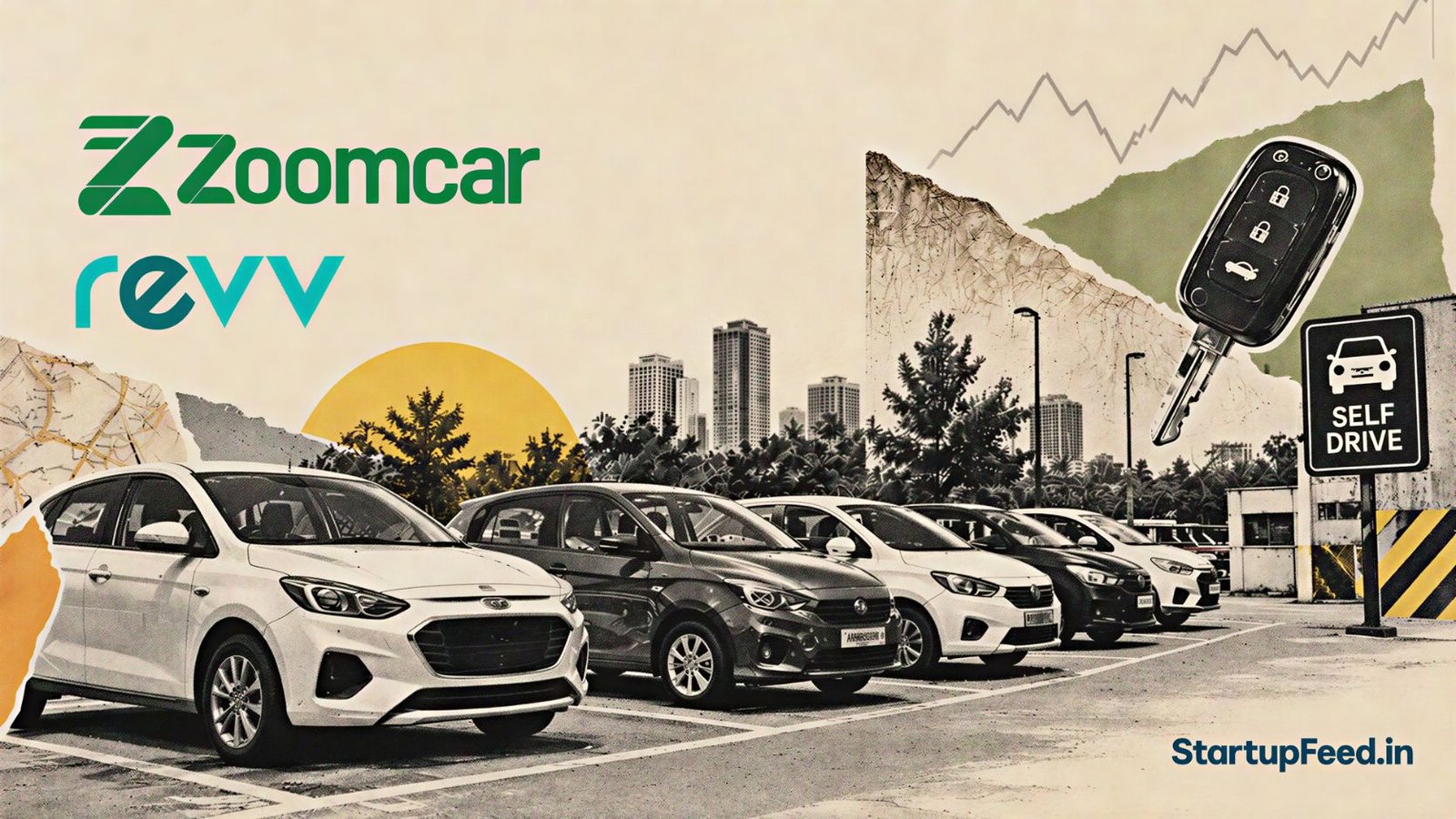
Three names tell the story. Zoomcar, Drivezy and Revv all launched around the same idea. They wanted to end car ownership in India. All three promised cheap self-drive cars booked on a phone. None became a large, profitable, independent business.
This guide explains what broke. It uses company filings, funding data and public results. The pattern matters for any founder building an asset-heavy startup in 2026.
In This Article
What does a car rental startup actually sell?
A self-drive car rental startup rents cars without a driver. You book on an app. You pick up the car, drive it, and return it. You pay by the hour, day, week or month. Zoomcar, Drivezy and Revv all worked this way.
There are two ways to run this business. The first is asset-heavy. The startup buys the cars itself. It pays the loan, the insurance and the repairs. Every idle car still burns money.

The second is asset-light, also called peer-to-peer. Car owners list their own cars on the app. The startup just runs the software and takes a cut. Drivezy took 20% to 25% of each rental this way.
The asset-light model sounds safer. It is not simple, though. In India, few people owned a spare car in 2015. Even fewer would rent it to a stranger. That trust gap slowed every peer-to-peer platform.
So most startups did both. They owned some cars and borrowed others. This mixed model is where the money problems began.
What happened to Drivezy?
Drivezy was founded in Bengaluru in 2015 as JustRide. Five college friends started it: Ashwarya Pratap Singh, Hemant Kumar Sah, Vasant Verma, Amit Sahu and Abhishek Mahajan. The idea came after Singh crashed a new car he barely used but still paid EMIs on.
The startup grew quickly. By 2018 it ran a fleet of about 3,000 cars and 5,000 two-wheelers. It graduated from Y Combinator and Google’s Launchpad accelerator. It raised around $40 Mn in total funding.
Then came the money it could not raise. In March 2019 SoftBank and Amazon were in talks to lead a $100 Mn Series C round, worth about Rs 690 crore. Drivezy could not close it. Investors said the sector had no clear winner yet.
The founders reacted by conserving cash. They gave up their own salaries for a year from March 2018. Drivezy even launched in San Francisco in 2019, the only Indian vehicle-sharing platform to try the United States.
None of it fixed the core problem. When COVID-19 hit in 2020, demand collapsed. Drivezy liquidated part of its fleet that year. Its main corporate entity, Drivezy Automobiles Private Limited, later showed a “strike off” status in company records.
Drivezy also fell into a legal fight with Yamaha, an early backer. Drivezy alleged Yamaha used confidential information to set up a rival business after buyout talks failed. The company that once wanted to end car ownership faded from view.
The order book never ran the business. The debt did.
Why is Zoomcar still losing money?
Zoomcar is the survivor of the group, and its numbers still bleed. Zoomcar was founded in 2013 and is based in Bengaluru. It calls itself India’s largest peer-to-peer car-sharing marketplace.
Zoomcar made one smart move. It stopped owning its fleet and switched to a pure peer-to-peer model, where hosts list their own cars. This cut the cash it burned on vehicles. It did not end the losses.
For the year to March 2026, Zoomcar cut its net loss by 43%. That still left a loss of $14.62 Mn, down from $25.62 Mn a year earlier. Net revenue was almost flat at $9.16 Mn. A shrinking loss is not the same as a profit.
The most recent quarter shows the strain. For the quarter ended June 30, 2026, Zoomcar’s net loss rose 28% year-on-year to $5.37 Mn, from $4.21 Mn. That is the honest headline. The loss grew, it did not shrink.
Some parts did improve in that quarter. Contribution margin rose to 70%, from 49%. Cost of revenue fell 38% to $0.81 Mn. But finance costs climbed to $1.40 Mn and other net expenses rose to $3.1 Mn. Bookings fell 16% to 88,160.
Today Zoomcar advertises a fleet of more than 25,000 cars and over 10 million registered users. Daily rentals start at Rs 499. The scale is real. The profit is not there yet.
The market punished the cash burn. Nasdaq moved to delist Zoomcar after it missed listing standards. Trading was suspended on May 8, 2025, and the delisting became final in 2025. Its shares moved to the over-the-counter market. Zoomcar has leaned on bridge financing and warrant-linked deals to stay alive.
What happened to Revv and Ola Drive?
Revv was the third big name, and it ended by being bought. Revv was founded in 2015 in Gurugram by Karan Jain, Anupam Agarwal and Gaurav Gupta. It pushed car subscriptions hard, letting people use a car for months without a loan or down payment.
Revv raised $38.2 Mn across seven rounds. Its backers included Hyundai Motor Company. It ran subscription services for both Hyundai and Mahindra and reached more than 20 cities.
Consolidation talk swirled for years. In January 2020 Zoomcar was in advanced talks to buy Revv, but the deal stuck on the share-swap ratio. Revv wanted one share for every three. Zoomcar offered one for every 4.25. The talks failed.
SoftBank had earlier pushed Zoomcar to merge with either Drivezy or Revv as a funding condition. Neither merger happened. In the end, Revv was acquired by CarDekho in December 2023. It stopped being an independent company.
Ola tried too, with deep pockets. It launched Ola Drive in 2019 and planned to invest up to $500 Mn, aiming for 20,000 cars. The big-budget self-drive push did not last as a major business. Ola later refocused on ride-hailing and electric vehicles.
The lesson repeats. Even Hyundai’s money and Ola’s scale could not make self-drive rental pay in India.
Why did the self-drive model break in India?
The self-drive rental model broke on economics, not on demand. Indians did want cheap, flexible cars. The problem was the cost of giving it to them. Several forces hit at once.
First, cars are expensive assets that lose value. When a startup owns the fleet, it carries the loans and the depreciation. An accident or theft is a direct loss. Drivezy learned this early when it lost two cars to crashes but kept paying the EMIs.
Second, funding dried up. After the WeWork collapse in 2019, investors turned cold on cash-hungry, asset-heavy startups. Drivezy’s founder said everyone in the sector struggled to raise the next round. No clear winner emerged, so no one wanted to bet big.
Third, insurance and theft ate into margins. Zoomcar’s own filings tie a chunk of its cost of revenue to accidental damage and theft. It had to change insurance cover and add loss-prevention steps to bring these costs down.
Fourth, the peer-to-peer trust gap was real. Owners feared strangers would damage their cars. Renters feared hidden charges. Building that trust took years and heavy support costs.
Fifth, COVID-19 was a body blow. In early 2020, mobility across India froze. Google’s own mobility data showed a 77% drop in trips to public places during the lockdown. Rental demand vanished overnight, right when these startups were low on cash.
The table below sums up how the three main players ended.
| Company | Founded | Total funding | Where it stands now |
|---|---|---|---|
| Zoomcar | 2013 | About $258 Mn | Trading over-the-counter after 2025 Nasdaq delisting; still loss-making |
| Drivezy | 2015 | About $40 Mn | Faded after 2020; main entity struck off |
| Revv | 2015 | $38.2 Mn | Acquired by CarDekho in December 2023 |
What should founders learn from this?
The clearest lesson is about asset weight. If your startup must own expensive things to grow, every unit of growth costs cash. That works only if funding stays cheap and endless. It rarely does.
Zoomcar’s own path shows the fix and its limits. Moving to a peer-to-peer model cut the fleet cost. Contribution margins improved. Yet the company still lost money, because support, insurance and finance costs stayed high.
Timing and cash buffers matter too. Drivezy was one funding round away from survival when the market turned. A single missed round, plus COVID-19, was enough to end it. A deeper cash buffer buys time to fix unit economics.
The table below turns these lessons into checks any founder can run before building an asset-heavy startup.
| Risk from car rental | Question to ask before you build |
|---|---|
| Fleet loans and depreciation | Do I own the costly asset, or does someone else? |
| One missed funding round | Can I survive 18 months with no new money? |
| Insurance and theft losses | Is loss per unit small enough to price in? |
| Trust between strangers | How long and how costly is it to build trust? |
India’s car rental startups were not a bad idea. They were an expensive idea in a market that could not fund the losses long enough. That is the real story, and it is still being written.
About self-drive car rental in India
Self-drive car rental lets a person hire a car without a driver, booked through an app and paid by the hour, day or month. In India the model grew from 2015 through startups like Zoomcar, Drivezy and Revv. Most struggled to turn fleet costs into profit. The sector has since shifted toward peer-to-peer and subscription formats.
Founder checklist before building an asset-heavy startup
- Confirm who owns the costly asset and who carries its loan.
- Model 18 months of survival with zero new funding.
- Price insurance, damage and theft into every unit.
- Plan the time and cost of building user trust.
- Track contribution margin, not just revenue growth.
StartupFeed Insight
Zoomcar’s survival holds the real lesson, not Drivezy’s fall. Zoomcar killed the asset-heavy model, went pure peer-to-peer, and pushed contribution margin to 70% in the June 2026 quarter. It still lost $5.37 Mn that quarter, because finance and support costs stayed high. Asset-light fixes the fleet bill, not the whole business. Watch Zoomcar’s next two quarterly filings closely. If its net loss does not keep shrinking through the year to March 2027, even a fixed model may not be enough, and India’s self-drive rental story may need one more rewrite.
— Avinash Mishra, Business Correspondent
Frequently Asked Questions
Liked this story? Follow StartupFeed on Google so our reporting reaches you first.