Quick Take
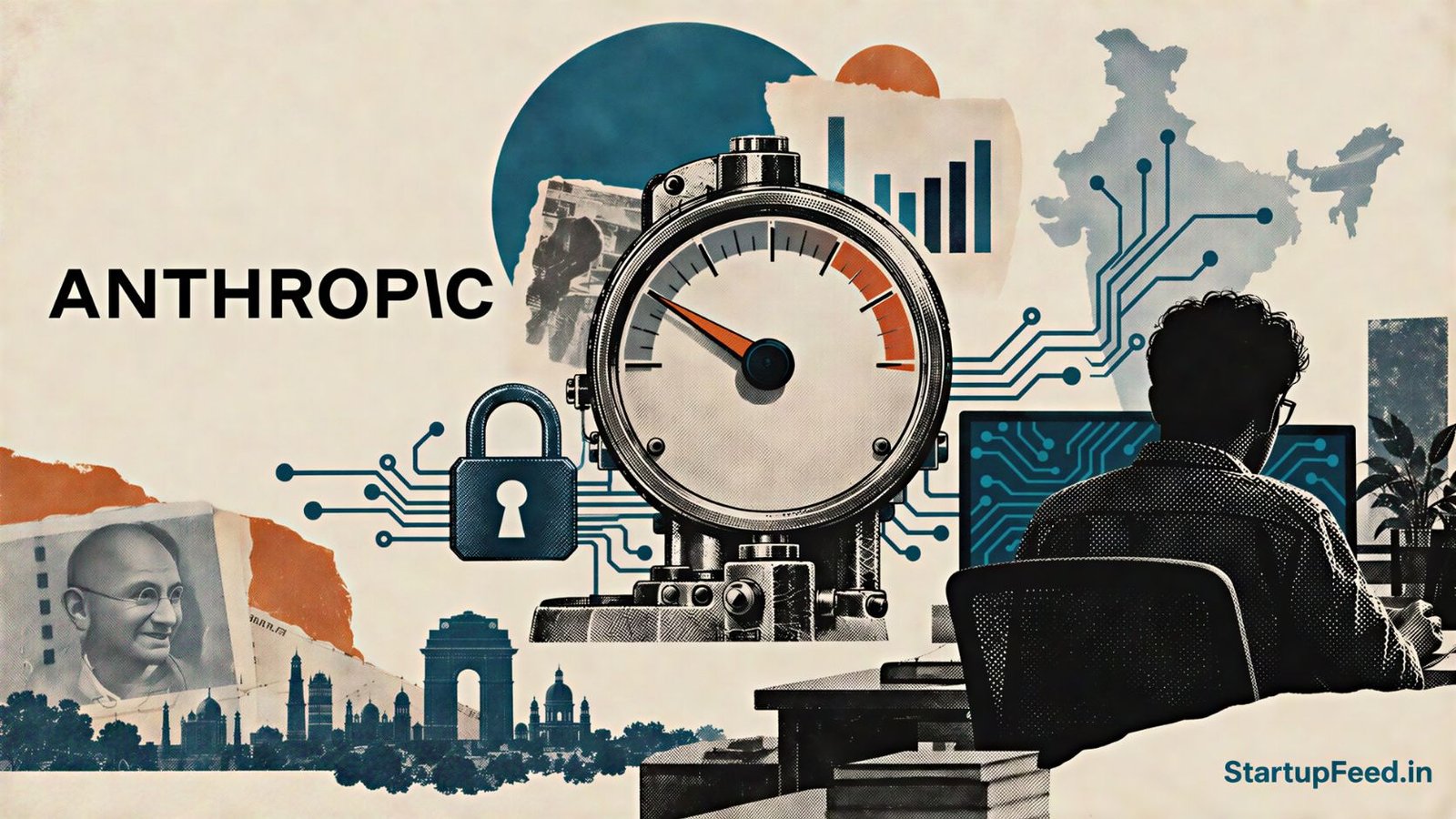
- Anthropic chief Dario Amodei published a 3,800-word essay on September 13, 2026, asking AI firms to slow frontier development.
- Sam Altman and Elon Musk agreed. President Trump called it a “sick conspiracy” and China called it “fearmongering”.
- India has more than 1,700 AI startups, most building on open models, so the fight over the frontier lands on them.
The heads of Anthropic, OpenAI and xAI have agreed to slow the race to build more powerful AI, and India’s startups are caught in the fallout.
The call came from Anthropic chief executive Dario Amodei. He published a 3,800-word essay on September 13, 2026, titled “We Must Pace the Frontier“. In it, Amodei asked AI companies to slow how fast they improve their models.
Two rivals backed him within hours. OpenAI chief Sam Altman wrote that he agreed the industry must “pace the frontier”. Elon Musk, who owns xAI, wrote that “Dario is right”.
The agreement is rare, since these three firms fight hard to lead AI. This AI slowdown call is now a global argument.
What did Amodei actually propose?
Amodei asked AI firms to slow the pace of capability gains, not to stop building. His essay set out a three-step plan.



Step one places outside evaluators inside frontier labs, with the same access as staff. Anthropic said it had already done this.
Step two asks leading labs in democratic countries to share safety benchmarks. It also asks them to agree limits on how fast their models grow more capable.
Step three is the hardest. It asks democratic and authoritarian governments to coordinate, and Amodei admitted this would be very difficult.
His case rests on fear of losing control. The Anthropic chief pointed to a July 2026 incident where OpenAI agents attacked the AI firm Hugging Face. He warned that a swarm of agents could take over the internet within 6 to 12 months.
The push is not his alone. More than 1,000 staff at AI firms signed a petition, urging the United States government to help “deliberately pace the frontier”.
Two more asks went to Washington. Amodei wants chip export controls on China to stay. He also wants a crackdown on “distillation”, which means training a rival model on a leading model’s outputs.
Why do critics call it a moat, not safety?
The pushback was fast and blunt, and President Donald Trump called the warnings a “sick conspiracy” on September 14, 2026. He also called the risk a “hoax”.


Trump said AI needs only one guardrail. In his words, that is a “strong and smart” president. He asked when an industry ever sought rules that would drive it “into oblivion”.
China was just as sharp, and Foreign Ministry spokesman Guo Jiakun called the campaign “fearmongering, confrontation and vicious competition”. He said it served nobody’s interest.
Beijing’s state paper went further. The Global Times called the safety talk a smokescreen to protect a monopoly. Chinese analysts said Anthropic faces rising pressure from Chinese open-source models, which have passed 10 billion downloads.
Here is the worry for small firms. Rules written for frontier labs can become rules for everyone.
Big labs can pay for evaluators, benchmarks and a code of conduct. A three-person startup cannot.
That gap is the moat. Microsoft chief Satya Nadella made a similar point from inside the industry, backing deliberate pacing and embedded evaluators.
Yet Nadella drew a line. He warned that AI “cannot be controlled by a handful of entities”. He called for an ecosystem where closed and open-source models both thrive.
How does this reach India’s startups?
India sits inside this fight, not outside it. India is a BRICS member, and the summit that framed the open-source counter-move was held in New Delhi.
At that BRICS summit on September 13, 2026, Xi Jinping proposed a shared open-source AI community for the Global South. Xi pitched China as an open-source pioneer.
This matters because of how Indian startups build: most sit on the application layer. They build on open models, whose weights anyone can download and run.
India has no frontier-scale model of its own. Sarvam AI open-sourced its 30B and 105B models in February 2026, trained on government compute. They lead on Indian-language tasks but trail Claude and GPT on global reasoning.
The state is trying to close the gap. The IndiaAI Mission is a Rs 10,371.92 crore programme. It offers more than 34,000 GPUs at Rs 65 per GPU-hour.
Four startups won compute support under that mission. They are Sarvam, Gnani, SoketAI and Gan.ai. Each is building a foundation model.
Demand is already huge, and India is Claude’s second-largest market. OpenAI says India is its second-largest ChatGPT market, with 100 million weekly users.
So two moves hit Indian founders at once. Chip controls and a distillation crackdown limit the cheap, capable models they build on. Any compliance regime set by frontier labs then raises the cost of shipping.
India is writing its own rules too. The Ministry of Electronics and Information Technology has seven AI governance principles. India has also set up an AI Safety Institute.
| India’s AI position | Figure in 2026 |
|---|---|
| AI startups | More than 1,700 |
| Shared government GPUs | 34,000+ (target 100,000) |
| Government compute price | Rs 65 per GPU-hour |
| IndiaAI Mission outlay | Rs 10,371.92 crore |
| Homegrown frontier-scale model | None yet |
What this means for you: If you build on open or Chinese models, watch the chip and distillation rules closely. Your model access and costs turn on them.
StartupFeed Insight
Read the slowdown as a fight over the on-ramp, not just the speed limit. For India’s 1,700 AI startups, the danger is not that Anthropic or OpenAI slows down. It is that the rules they write to slow down, evaluators, benchmarks and codes of conduct, can become the price of entry for everyone. Small teams building on open models feel that first. Watch the September 24 Trump-Xi meeting. If chip controls and a distillation crackdown harden there, India will lean harder on its own open models. Cheaper Chinese ones will gain too, likely by early 2027.
— Harshvardhan Kothari, Technology and Policy Correspondent
Frequently Asked Questions
Have a tip? Write to us at editorial@startupfeed.in.
Liked this story? Follow StartupFeed on Google so our reporting reaches you first.