

Quick Take
- FDA granted De Novo authorization to Johnson & Johnson OTTAVA robotic surgical system on July 22, 2026.
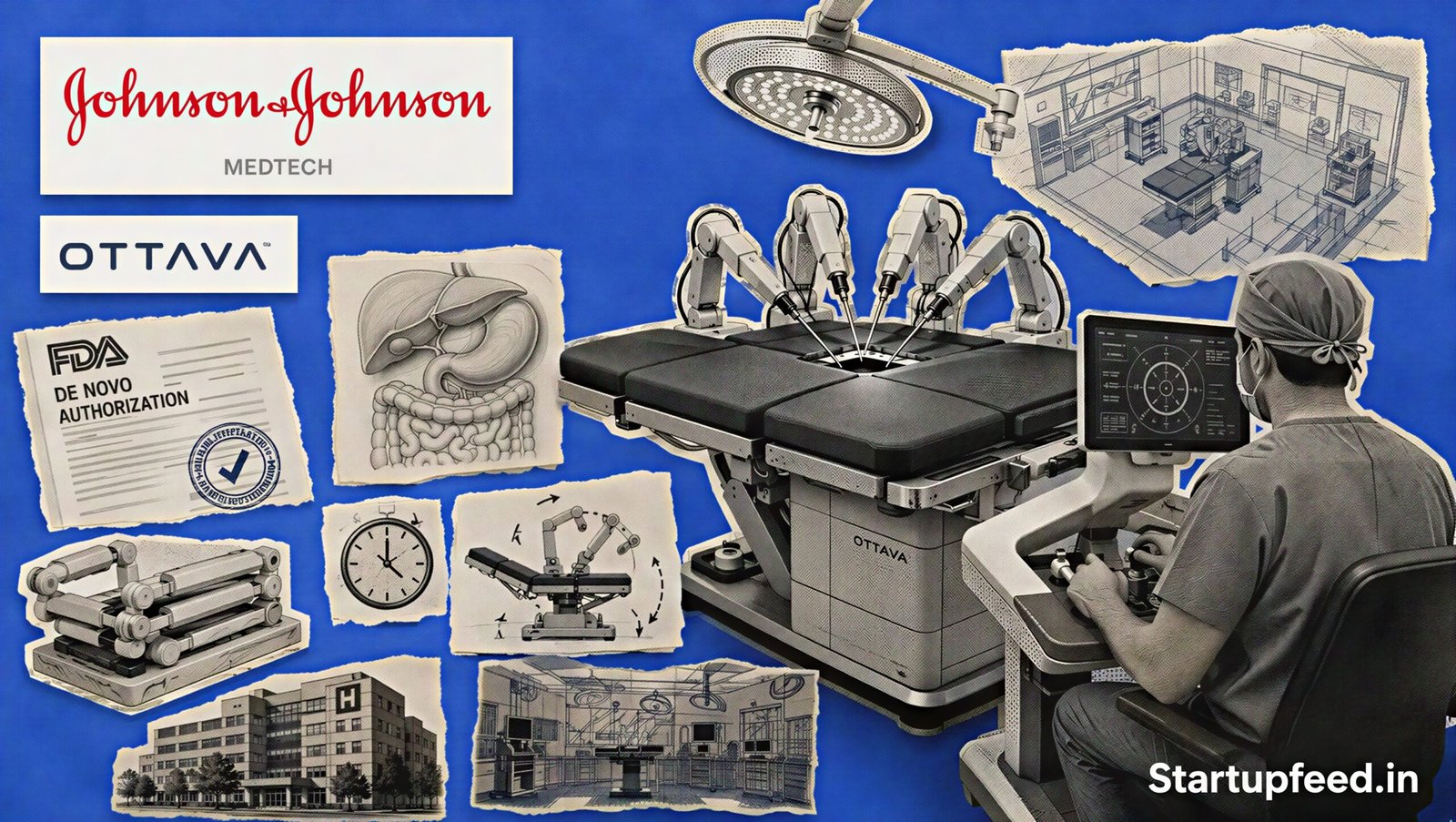
- Arms sit inside the operating table, cutting floor footprint by 30 to 50 percent.
- J&J starts a limited US launch with select hospitals, chasing Intuitive Surgical’s 11,395 installed systems.
In This Article
The J&J robotic surgery business entered the US soft tissue market on July 22, 2026, after the FDA granted De Novo authorization (a pathway for novel low-to-moderate risk devices) to the OTTAVA Robotic Surgical System, Johnson & Johnson announced.
OTTAVA is the world’s first table-integrated soft tissue robotic system, according to the company announcement. The clearance covers upper abdominal general surgery procedures including Roux-en-Y gastric bypass, gastrectomy, cholecystectomy, splenectomy, appendectomy and hiatal hernia repair. Johnson & Johnson will begin a limited commercial launch with select US customers.
StartupFeed Insight
The real story here is not the robot, it is the real estate. Intuitive built a 25-year moat on clinical evidence and surgeon training, and J&J cannot buy that. So it attacked the one thing hospitals complain about most: floor space. A cart-based robot needs a large dedicated OR. OTTAVA folds into the table. That reframes the buying decision from “can we afford a robot” to “can we fit one”, which opens tier-2 hospitals that Intuitive never reached. StartupFeed expects J&J to file for a second indication in inguinal hernia by mid-2027, and expects Indian medtech buyers to watch this footprint math closely. By Soumya Verma.
OTTAVA Authorization: The Key Numbers
De Novo authorization is the FDA pathway used when a device is novel enough that no existing predicate device applies. OTTAVA received this classification because table-integrated soft tissue robotics did not previously exist as a category, per the Johnson & Johnson announcement.
| Metric | Detail | Notes |
|---|---|---|
| Regulatory pathway | FDA De Novo authorization | Creates a new device category |
| Authorization date | July 22, 2026 | Announced from New Brunswick, N.J. |
| Cleared procedures | 10 upper abdominal general surgeries | Includes gastric bypass, gastrectomy, cholecystectomy |
| OR footprint reduction | 30 to 50 percent smaller | Versus boom and cart-mounted systems |
| Robotic arms | Four, integrated into the OR table | Software-coordinated with twin motion |
| Launch scope | Limited US launch, select customers | Additional jurisdictions planned over time |
The footprint claim rests on a J&J evaluation of competing systems available as of September 2025, per the company’s own footnotes. A second US clinical trial in inguinal hernia repair is already underway.
About Johnson & Johnson MedTech
Johnson & Johnson MedTech is the medical device arm of Johnson & Johnson, headquartered in New Brunswick, New Jersey, and founded in 1886. It sells across cardiovascular, orthopaedics, surgery and vision, and its OTTAVA product documentation lists the Apollo console and Polyphonic digital ecosystem. Ethicon, Inc. is a Johnson & Johnson company. Tim Schmid is Worldwide Chairman, MedTech.



Why does the J&J robotic surgery design matter for hospitals?
OTTAVA changes the physical economics of a robotic surgery programme by removing the cart from the operating room floor. Hospitals that could not previously run a robotic programme because of room size now have a viable path, according to the company announcement.
“Surgical robotics will play an increasingly important role in surgical care, but it’s clear that what defined the last 25 years of surgery will not define the next 25,” said Hani Abouhalka, Company Group Chair, Surgery, MedTech, Johnson & Johnson.
The system uses twin motion, which synchronises the table and the arms so surgeons can reposition a patient without repeated intraoperative adjustments. Four software-coordinated arms move into pre-defined poses to cut setup and breakdown time. For a hospital, that translates into more cases per day from the same room, which is the metric that actually pays back a capital purchase.
How does OTTAVA compare with da Vinci and Hugo?
Intuitive Surgical remains the dominant player in soft tissue robotics with 11,395 da Vinci systems installed worldwide, a 12 percent rise year on year, per Intuitive’s latest quarterly disclosure. J&J starts from zero commercial placements.
| System | Company | Position |
|---|---|---|
| da Vinci 5 | Intuitive Surgical | 11,395 systems installed, 431 placements in Q1 2026 |
| Hugo RAS | Medtronic | US urology clearance in 2025, available in 35-plus countries |
| OTTAVA | Johnson & Johnson | De Novo authorization July 2026, limited US launch |
Analysts are cautious. J.P. Morgan analyst Robbie Marcus noted that physician checks still favour Intuitive because of its entrenched hospital workflow integration and academic programmes, per Reuters reporting. What separates OTTAVA is architecture, not price: it is the only cleared multi-port soft tissue system with arms inside the table.
What does this mean for India’s robotic surgery market?
India has become one of the fastest-growing robotic surgery markets outside the US and China, and OR space is a harder constraint here than in Western hospitals. Indian tier-2 and tier-3 hospitals often work with compact theatres that cannot host a full cart-based robotic setup, which is exactly the gap J&J is targeting.
Any Indian entry runs through the Central Drugs Standard Control Organization (CDSCO), India’s device regulator. Since October 2023, every Class C and Class D device sold or imported in India requires a valid CDSCO licence, and a foreign manufacturer must appoint an Authorized Indian Agent. A US De Novo authorization does not automatically transfer, so a separate dossier is needed.
Domestic competition is already entrenched. SS Innovations’ SSi Mantra has roughly 80 systems installed across 75 hospitals, and became the first system in India to win CDSCO approval for telesurgery and teleproctoring. Meril’s MISSO knee robot claims a 66 percent lower investment cost than imported systems. For Indian founders building in surgical robotics, the J&J robotic surgery entry validates the category and raises the engineering bar at the same time.



What’s Next
J&J will focus on early customer success with select US hospitals while pushing into additional indications and regulatory jurisdictions. The ongoing inguinal hernia trial is the next milestone, with analysts expecting a second US regulatory submission in early 2027. An investor conference call is scheduled for August 3, 2026. The open question for Indian buyers: will a smaller footprint beat a 25-year training ecosystem?
Frequently Asked Questions
Have a tip? Write to us at editorial@startupfeed.in.
Liked this story? Follow StartupFeed on Google so our reporting reaches you first.