
Quick Take
- Paninian India unveiled the Yantur 4.5 kN turbofan on July 20, 2026, an India first.
- The engine powers Svayatt L1, a long-range cruise missile built for the MoD Make-I route.
- Paninian is opening a $3 Mn (Rs 29 Cr) round to fund testing and full engine validation.
In This Article
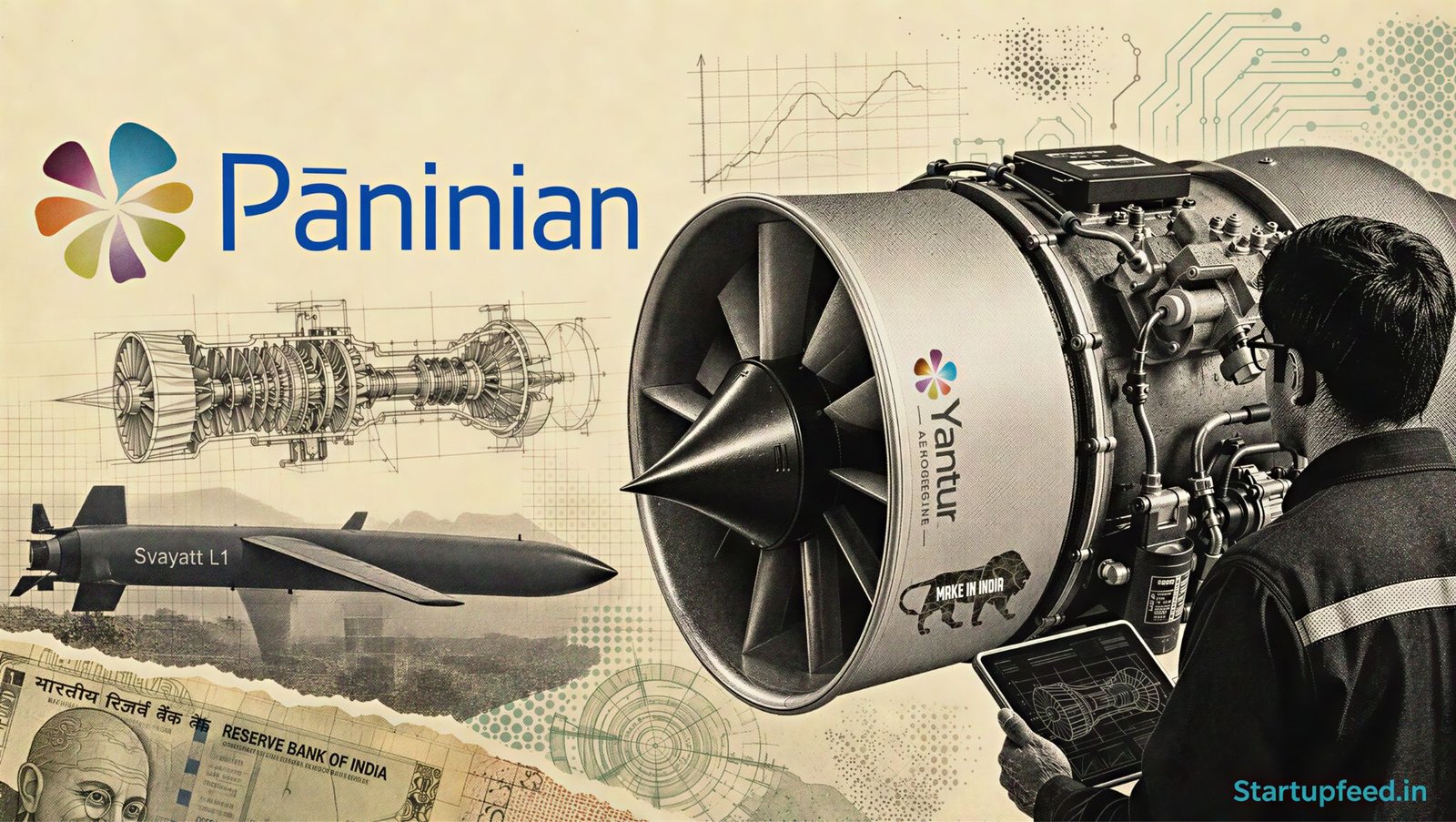
Hyderabad-based deeptech firm Paninian India Private Limited unveiled the Yantur Turbofan Engine programme on July 20, 2026, a 4.5 kN unit the company calls India’s first privately developed turbofan in its class.
The engine will power Svayatt L1, Paninian’s long-range autonomous cruise missile. That platform targets the Ministry of Defence Make-I route for the Long-Range Land Attack Cruise Missile (LRLACM), a category where DRDO first flight-tested a state-built missile in November 2024. Paninian is separately opening a $3 Mn (Rs 29 Cr) round, per the company announcement.
StartupFeed Insight
The number that matters here is not 4.5 kN, it is $3 Mn. Paninian has raised $729K across two rounds since 2018 (Tracxn), so the ask is roughly four times its lifetime funding, for the single most capital-hungry phase of any engine programme: rig testing and certification. Indian defence VCs should watch whether this round closes with strategic or institutional money, because small-engine work needs seven to ten year patience. StartupFeed expects Paninian to announce either a government test-facility tie-up or a first rig-test milestone before March 2027. A missed date on both would signal a funding squeeze. By Avinash.
Yantur Turbofan Engine Programme At A Glance
The Yantur Turbofan Engine is a 4.5 kN thrust-class turbofan designed in India for autonomous strike platforms. Paninian says the programme has cleared conceptual and detailed design and is now moving into subsystem testing, validation and full engine certification, per the company announcement.
| Metric | Detail | Notes |
|---|---|---|
| Engine | Yantur, 4.5 kN thrust class | Company announcement |
| Target platform | Svayatt L1 cruise missile | MoD Make-I, LRLACM class |
| Scale-up path | Same core up to 12.5 kN | For Svayatt CCAV platform |
| Patent claims | 5 across Yantur and Svayatt L1 | Combustor, compressor, digital twin |
| Current stage | Design complete, testing next | Company announcement |
| Funding sought | $3 Mn (Rs 29 Cr) | Round initiated July 20, 2026 |
The scale-up claim is the most commercially interesting line in the announcement. A single core stretching from 4.5 kN to 12.5 kN turns one engine into an engine family, which spreads certification cost across several platforms.
About Paninian
Paninian India Private Limited builds autonomous aerial systems and aero engines for defence use. Registered in Hyderabad in September 2018 (MCA) by Raghu Adla and Sandeep Moturi, it also runs a Bengaluru office. The company sells to armed forces buyers and has raised $729K across two rounds from seven investors (Tracxn). Its work spans propulsion, avionics and digital-twin health monitoring.


What does this mean for India’s propulsion gap?
Small gas turbines are India’s longest-running defence technology gap. State labs have carried this work for four decades, and Paninian’s advisory bench reflects that history.
The programme represents an important step towards establishing sovereign Indian capability in compact turbofan propulsion, engine controls, accessory systems, advanced manufacturing and propulsion-airframe integration. It complements the pioneering efforts of DRDO scientists, whose work has laid a strong foundation for indigenous propulsion development, said Dr G. Gouda, former Group Director (Propulsion), CEMILAC.
Gouda’s four decades of certification work covered the GE404 and GE414 reviews for India’s LCA programme, per the company announcement. His framing matters: he positions Paninian as complementary to DRDO, not competitive with it. That is the realistic commercial posture for a small private firm entering a field where the state is both the regulator and the largest customer.
How will Paninian use the $3 Mn round?
Paninian has earmarked the $3 Mn (Rs 29 Cr) for four specific tasks: engine testing, subsystem qualification, full-engine validation and integration with the Svayatt L1 platform, per the company announcement. Founder Raghu Adla said the firm is seeking support from government, industry and investors together, which suggests a blended structure rather than a straight equity round.
Testing is where small-engine programmes usually stall. Rig time, high-altitude test cells and certification cycles consume cash for years before a single unit ships. The company has raised $729K in total since 2018 (Tracxn), so this round represents a step change in its burn profile.
Who else builds small jet engines in India?
India’s small-engine field is thin, which is exactly why the Yantur Turbofan Engine announcement drew attention. Most credible capability sits inside state labs.
| Player | Type | Focus |
|---|---|---|
| Paninian | Private, seed stage | 4.5 kN turbofan, turbojet, ramjet |
| GTRE (DRDO) | State laboratory | Kaveri family, small turbofans |
| BDL and BEL | Defence PSUs | LRLACM integration and production |
BDL and BEL are the two development-cum-production partners for the state LRLACM programme (PIB, November 2024). Paninian’s difference is structural: it is attempting the propulsion core itself, from a private balance sheet, rather than integrating a supplied engine.
What’s Next
The immediate milestone is subsystem testing, followed by full-engine validation. Watch for a rig-test announcement or a named test-facility partner in the next two to three quarters, since Paninian has said certification is the goal of this phase. The $3 Mn round closing will be the clearest early signal. Will Indian defence funds back a propulsion bet with a decade-long payback?

Frequently Asked Questions
Written by Avinash. Have a tip? Write to us at editorial@startupfeed.in.