Quick Take
- Skyroot Aerospace launched Vikram-1 to orbit on July 18, 2026, from Sriharikota.
- India now hosts over 400 space startups, up from one in 2014.
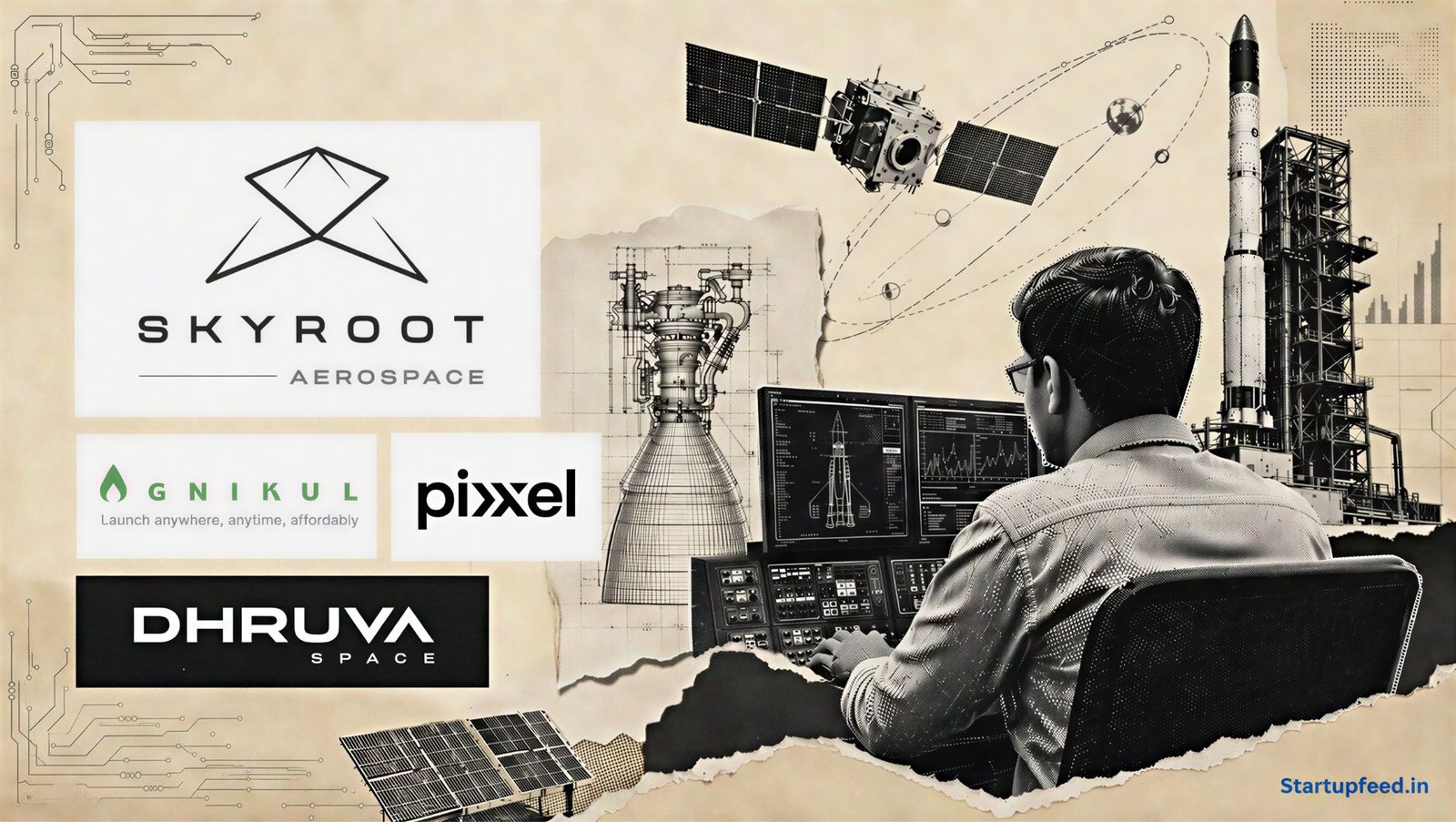
- Agnikul, Pixxel, Dhruva and Digantara line up commercial missions through 2027.
In This Article
India spacetech startups are moving from test flights to paid commercial missions, after Skyroot Aerospace placed Vikram-1 in a 450 km orbit on July 18, 2026, from Sriharikota.
The launch made India the third country with private orbital launch capability, after the United States and China, according to Skyroot’s mission webcast. It has triggered a wave of commercial plans across rocket builders, satellite makers and space-data firms. The government values the sector at about $8.4 Bn (Rs 80,976 Cr) today, per a Press Information Bureau backgrounder on Vikram-1.
StartupFeed Insight
The real signal is not the rocket, it is the order book. IN-SPACe reported that India’s top 10 space startups hold confirmed orders worth $150 Mn (Rs 14,460 Cr), matching the total investment that flowed in during CY 2025. That one-to-one ratio of orders to capital is rare in Indian deep tech, and it means revenue is arriving before the next funding cycle. Satellite operators, defence buyers and geospatial analytics firms should watch pricing closely. StartupFeed expects at least three Indian private orbital launches carrying paying customer payloads by December 2027. By Avinash.
India Spacetech Startups: The Numbers Behind The Push
India’s private space sector has grown from a single startup in 2014 to more than 400 registered companies in 2026, according to the Press Information Bureau. That expansion followed the Indian Space Policy 2023, which opened the full space value chain to private firms.
| Metric | Detail | Notes |
|---|---|---|
| Space startups in India | 400+ (2026) | One in 2014, per PIB |
| Space economy size | $8.4 Bn (Rs 80,976 Cr) | Target: $40-45 Bn by 2030 |
| Investment facilitated | $150 Mn (Rs 14,460 Cr) | CY 2025, via IN-SPACe |
| IN-SPACe authorisations | 133 issued | As of June 2026 |
| IN-SPACe VC fund | Rs 1,000 Cr | Deployed FY 2025-26 to FY 2029-30 |
| Skyroot valuation | $1.1 Bn (Rs 10,604 Cr) | $60 Mn round, May 7, 2026 |
The most telling figure is the order book. IN-SPACe recorded confirmed orders of $150 Mn (Rs 14,460 Cr) across the top 10 startups, the same value as the capital raised in CY 2025.
About Skyroot Aerospace
Skyroot Aerospace builds orbital launch vehicles for small satellite customers. Founded in 2018 by former ISRO engineers Pawan Kumar Chandana and Naga Bharath Daka, the Hyderabad company sells dedicated and rideshare launch slots. Vikram-1 carries up to 350 kg to Low Earth Orbit. It reached a $1.1 Bn (Rs 10,604 Cr) valuation in May 2026, backed by GIC, Sherpalo Ventures and BlackRock.


Why are Indian rocket firms chasing reusability?
Reusability lowers the cost per launch by recovering and reflying expensive hardware instead of discarding it. Chennai-based Agnikul Cosmos has announced Mission 02, an attempt to recover an orbital-class first-stage booster at sea, which would be an Indian first. The mission also aims to keep the Agnibaan upper stage working in orbit after payload release, a design covered by patents in India, the United States and Europe.
One-time-use rockets were originally developed when reaching space was about accomplishing one-off goals, said Srinath Ravichandran, Co-founder and CEO, Agnikul Cosmos.
Former ISRO Chairman S. Somanath joined Agnikul’s board as an observer in July 2026. The economics behind the shift are clear from SpaceX, whose Falcon 9 fleet has completed more than 650 flights on recovered boosters, with individual boosters flying up to 35 times. Skyroot is also planning an upgraded Vikram-1U with strap-on boosters, lifting payload capacity to 550 kg.
Who is building India’s satellite and space-data fleets?
India’s satellite layer is now as commercially active as its launch layer. Bengaluru-based Pixxel operates hyperspectral Earth observation satellites and has said it expects to fly more than 50 satellites over the next year, working towards a 100-satellite network. Hyderabad-based Dhruva Space builds satellite platforms and ground systems, and was selected by IN-SPACe in February 2026 to develop an indigenous small satellite bus.
Digantara tracks objects in orbit for space situational awareness. Bellatrix Aerospace demonstrated an indigenous Green Propulsion System under DRDO’s Technology Development Fund. IN-SPACe has also approved a public-private Earth observation constellation led by Pixxel with Dhruva Space, SatSure Analytics India and Piersight Space, per the IN-SPACe regulatory framework.
How does India compare with global launch rivals?
India competes on cost and turnaround rather than raw scale. The small satellite launch market is led by SpaceX rideshare missions and Rocket Lab’s Electron, while European and Asian governments fund domestic alternatives.
| Vehicle | Operator | LEO Payload |
|---|---|---|
| Vikram-1 | Skyroot Aerospace | 350 kg |
| Vikram-2 | Skyroot Aerospace | 900 kg (in development) |
| Agnibaan | Agnikul Cosmos | Up to 300 kg |
What separates India spacetech startups is manufacturing speed backed by state infrastructure. Skyroot’s Infinity Campus in Hyderabad was built to produce one orbital rocket per month, and private firms get regulated access to ISRO test facilities and the Sriharikota range.
What’s Next
Skyroot has indicated up to two more Vikram-1 test flights before commercial service begins, and Agnikul has yet to confirm a Mission 02 date. Kulasekarapattinam in Tamil Nadu is being developed as a dedicated small-satellite spaceport to ease congestion at Sriharikota. The next real test is whether paying customers book slots at Indian prices. Which Indian launch firm do you think signs the first big international contract?


Frequently Asked Questions
Written by Avinash. Have a tip? Write to us at editorial@startupfeed.in.
Liked this story? Follow StartupFeed on Google so our reporting reaches you first.