
Quick Take
- Zero-ad marketing helped Zoho reach Rs 12,313 Cr revenue ($1.29 Bn) in FY25 without venture capital.
- India’s D2C brands like Wakefit and Mamaearth grew community and content first, then added paid ads later.
- These 7 plays show founders how to cut paid dependence and build owned channels that keep working.
In This Article
Zero-ad marketing is the practice of growing a brand through owned and earned channels, community, content, SEO, and word of mouth, instead of paying for reach on Meta or Google. India’s largest bootstrapped software firm, Zoho, reached Rs 12,313 Cr revenue ($1.29 Bn) in FY25 using this model, according to Zoho’s own reporting.
The idea is not that ads are banned forever. It is that paid ads should not be the foundation. Brands that build an audience first spend less to acquire each customer later. This guide breaks down 7 zero-ad marketing plays used by real Indian companies, with the numbers behind them. All USD figures use the live rate of Rs 95.73 to the dollar on July 30, 2026.
StartupFeed Insight
The real lesson from Zoho is not “never advertise”. It is sequencing. Zoho put 60% of revenue into research and product, which made the product itself the marketing. That order (product, then community, then paid) is what lowers customer acquisition cost. Watch India’s D2C sector closely here: with ad costs rising around 30% year-on-year in crowded categories, we expect more 2026 and 2027 funding decks to show organic and SEO channels as a majority of new customer traffic, not a side note. Founders who build owned channels now will out-survive those renting attention. By Harshvardhan Jain.
What is zero-ad marketing?
Zero-ad marketing means acquiring customers without paid advertising as the main engine. Growth comes from owned channels (your blog, email list, app, and community) and earned channels (word of mouth, press, and creator content you did not pay for). The goal is a customer base that does not vanish the moment you pause a campaign.
This matters because paid-only growth is a treadmill. Ad costs in competitive Indian categories have risen roughly 30% year-on-year, and when spending stops, traffic stops. Zero-ad marketing builds assets that keep compounding after the work is done, which is why bootstrapped founders lean on it hardest.
The 7 zero-ad marketing plays
Zero-ad marketing works through specific, repeatable moves, not vague “be authentic” advice. Each play below has been used by a named Indian company at real scale. Use them in order, since each one feeds the next.

1. Make the product itself the marketing
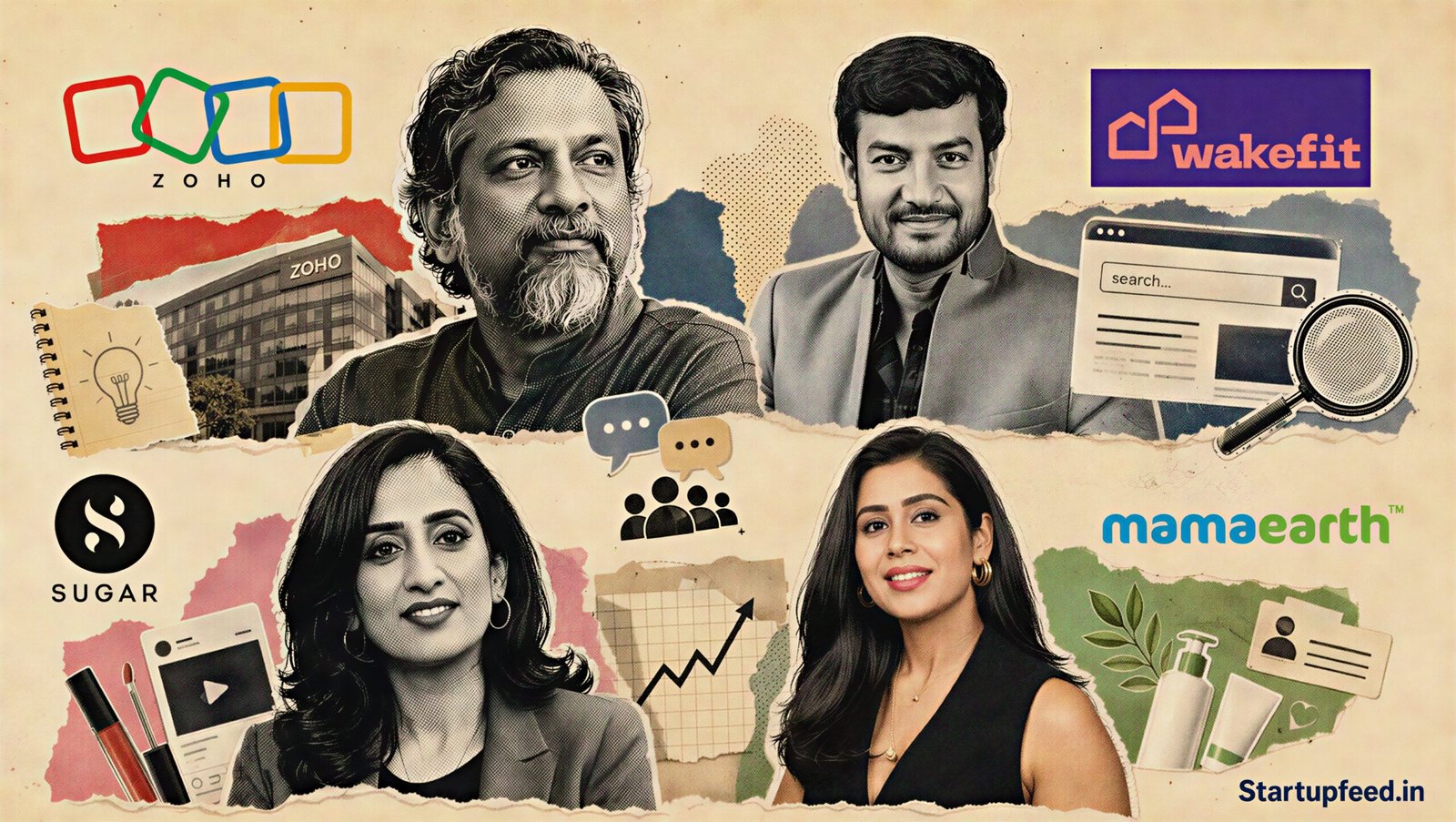
Zoho Corporation, founded by Sridhar Vembu in 1996, reinvests about 60% of revenue into research and development rather than mass advertising, according to Zoho and Forbes reporting. That product depth acquires customers organically through free tiers and word of mouth. The result: Rs 12,313 Cr revenue with Rs 3,191 Cr profit in FY25, serving 100 million users across 150 countries, all without raising venture capital. When the product solves the problem better, the referral does the selling.
2. Build a community before you build a campaign
boAt grew its “boAtheads” following by turning buyers into fans who posted unboxing videos and reviews on their own. Mamaearth, now a public company, first grew through mom communities on Facebook and WhatsApp, where parents shared honest reviews. Both built a trusting audience before scaling paid spend. Community gives you free word of mouth and free product feedback at the same time.
3. Publish content that answers real questions
Wakefit, the Bengaluru sleep-solutions brand founded in 2016 by Ankit Garg and Chaitanya Ramalingegowda, runs blogs, YouTube content, and community events to build trust over time. Content marketing pulls in organic traffic that costs nothing per click, unlike a paid banner. Wakefit crossed Rs 1,017 Cr revenue in FY24 with a 24% year-on-year rise, per the company. Useful content becomes a salesperson that works while you sleep.
4. Win category search with SEO
Brands that rank for buyer searches like “best vitamin C serum” or “ergonomic office chair” cut their paid dependence over time. Indian shoppers, the maturing “Jio Generation”, now research before buying and look for outside proof in search results. Regional-language search in Hindi, Tamil, and Telugu is growing fast, and D2C brands that build regional content face far less competition for top terms.
5. Seed products to creators without paying for posts
Product seeding means sending your product to relevant creators with no paid requirement. Sugar Cosmetics, built by Vineeta Singh and Kaushik Mukherjee, grew an Instagram-led following through micro and mid-tier beauty creators who tested products and made tutorials for free. Around 43% of Indian shoppers are influenced by creator content. Seeding turns a good product into authentic, organic reach.
6. Turn every order into a shareable moment
Handwritten notes, a strong unboxing, and a story with each product push customers to post on their own. This is how brands earn user-generated content instead of buying it. The plainer version of the rule: deliver an experience worth talking about, and customers become your distribution.
7. Use free tiers and trials to remove risk
Zoho‘s freemium model and Wakefit’s 100-day free mattress trial both lowered the buyer’s risk to almost zero. A no-risk first step converts interest into a paying customer without a single ad impression. Once the product proves itself at home or at work, the upgrade and the referral follow naturally.


Zero-ad marketing scoreboard: the numbers
Zero-ad marketing is best judged by revenue built on organic foundations, not by ad budgets alone. The table below shows verified figures for the companies referenced above, drawn from company reporting and filings.
| Company | Latest Revenue | Organic Foundation | Notes |
|---|---|---|---|
| Zoho | Rs 12,313 Cr (FY25) | Product-led, freemium, no VC | Rs 3,191 Cr profit; 100 Mn users |
| Wakefit | Rs 1,017 Cr (FY24) | Content, community, trials | +24% YoY; Rs 65 Cr EBITDA |
| Sugar Cosmetics | D2C beauty leader | Creator-led, product seeding | Instagram-first early growth |
| Mamaearth | Listed FMCG brand | Mom communities, reviews | Community before paid scale |
The standout fact: Zoho reached over Rs 12,000 Cr in revenue while pouring the majority of its money into product, not promotion. That single choice reshaped its entire cost structure.
About this guide
This StartupFeed.in guide is written for Indian D2C and startup founders who want to lower paid-ad dependence. It uses only verified, publicly reported figures from company announcements and filings. It is a strategy explainer, not a report on a single funding event, and every example names a real Indian company and its founders so the plays can be traced and copied.
Does zero-ad marketing actually work?
Zero-ad marketing works best as a foundation, with paid ads added later, not as a lifelong ban on advertising. The honest picture matters here. Zoho is the strongest true case: it built a billion-dollar business with almost no traditional mass advertising, though its MCA filings do show some promotional spend, Rs 1,354 Cr in FY23.
“Zoho’s ability to grow revenue organically without external funding is a testament to the strength of our product offerings and customer loyalty,” said Sridhar Vembu, CEO, Zoho.
The D2C brands are different. Wakefit and Mamaearth grew community and content first, but both later spent on ads and signed celebrity ambassadors. Wakefit’s ad spend was Rs 77.36 Cr in FY24, per RoC filings. So the realistic playbook is: build owned channels early, and paid ads become cheaper support, not the whole engine.
How top brands compare on the organic-first path
Zero-ad marketing looks different in software than in consumer goods, so comparing paths is more useful than comparing budgets. The three below show the same principle applied in three sectors.
| Brand | Main Organic Lever | Paid Ads Later? |
|---|---|---|
| Zoho (SaaS) | Product depth, freemium | Minimal, product-led throughout |
| Wakefit (Sleep) | Content and free trials | Yes, ambassadors added later |
| Sugar (Beauty) | Creator seeding | Yes, scaled with paid over time |
What separates the durable brands is the order of operations: they earned an audience before they rented one, which is exactly what a bootstrapped founder can copy on a small budget.
What’s Next
The clearest 2026 signal to watch is customer acquisition cost. As paid reach gets pricier, expect more Indian D2C founders to report SEO and community as their top traffic sources within the next 12 to 18 months. The brands that start building owned channels this quarter will hold the advantage. Which zero-ad marketing play will you test first in your own funnel?
Frequently Asked Questions
Have a tip? Write to us at editorial@startupfeed.in.