

Published: [October 23, 2026]
StartupFeed Quick Take
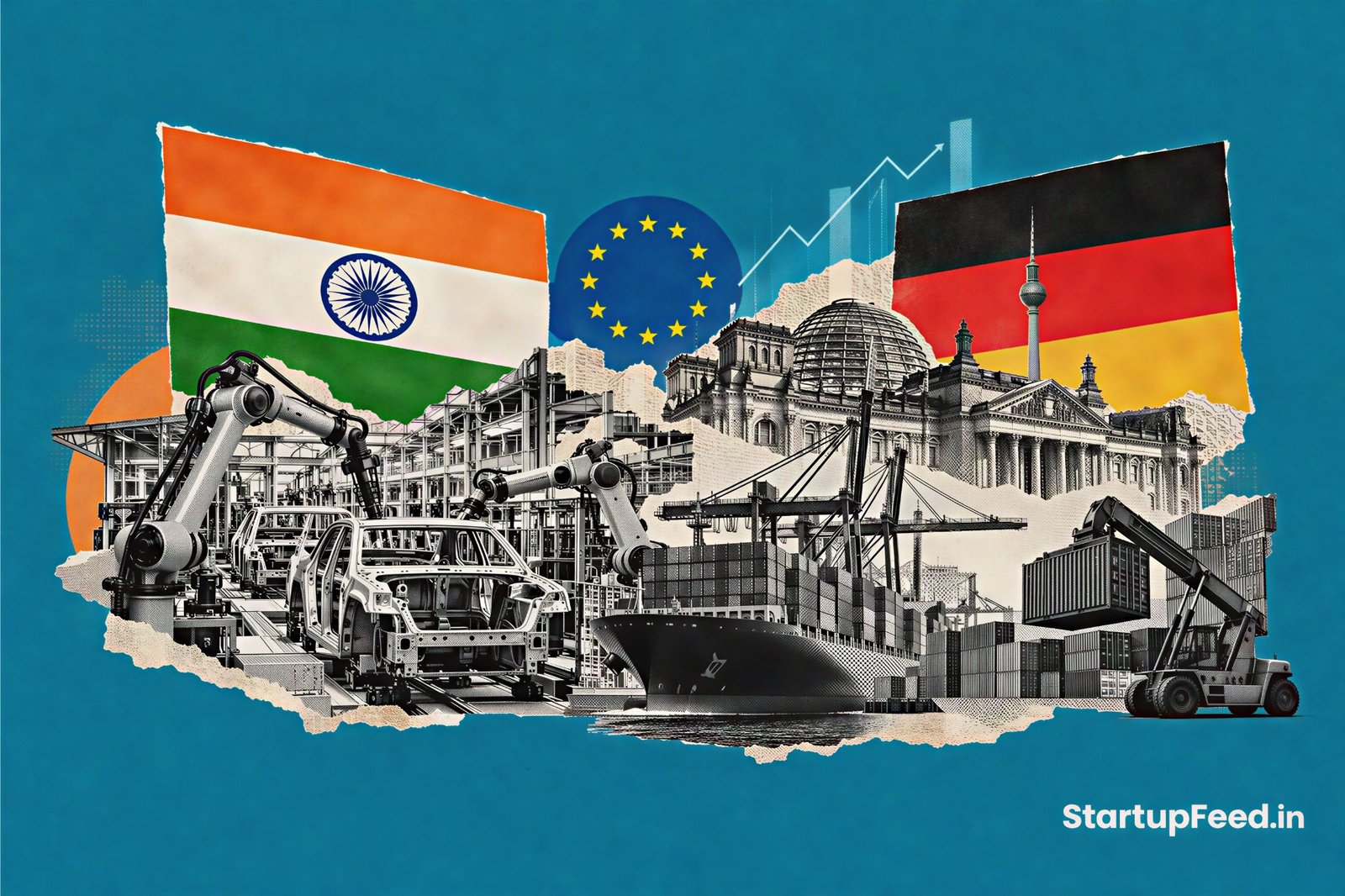
- India and Germany traded goods worth about €31.5 billion in 2025. The new target is €310 billion.
- The India EU FTA was closed on January 27, 2026. Signing is expected before December, with entry into force 4 to 5 months later.
- The European Commission puts duty savings for European exporters at €4 billion a year, with 90% of tariff lines cut or removed.
Commerce minister Piyush Goyal asked Indian and German businesses in Berlin on October 22 to plan for a tenfold rise in trade, to €310 billion.
The two countries traded goods worth about €31.5 billion in 2025. The target is almost ten times that. Katherina Reiche, Germany’s federal minister for economic affairs and energy, said the present level sits below what both economies can do.
No deadline came with the number. The roadmap was left to companies on both sides. A commerce ministry statement of October 21 said the minister travelled with about 100 Indian businesses and startups.
Goyal put the job on industry in one line.



“That’s for the businesses to decide.”
Piyush Goyal, Union minister of commerce and industry, Government of India. From his remarks at the business roundtable in Berlin, October 22, 2026.
Why Goyal Named 310 Billion Euros
India and Germany mark 75 years of diplomatic ties in 2026. Goyal described German precision engineering, training and quality as a fit for India’s infrastructure, digital systems and young workforce.
In Berlin, companies were asked to find customers, investors and partners now, rather than wait for the deal to start.
The Berlin leg ran from October 22 to October 24. The Netherlands follows, from October 24 to October 27. The Indian delegation visits the Port of Rotterdam on October 25.
The India Centre of the German Council on Foreign Relations opened in Berlin on October 22, with Goyal and Reiche present. The centre is meant to carry Indian positions into German policy debate.
Reiche and Goyal met the same day. Their talks covered trade, investment, technology, green energy and training.
One-to-one meetings with German chief executives were listed in the ministry statement. Schaeffler, Mercedes-Benz, Infineon, RENK, ENERTRAG and Herrenknecht were among the companies named.
What the India EU FTA Changes for Indian Exporters
India and the European Union closed the agreement on January 27, 2026. Talks had started in 2007, stopped in 2013 and restarted in 2022.


The last 13 months did the real work, Goyal said.
The European Commission’s agreement page sets out the gains in its own terms. European exporters save about €4 billion a year in duties. Tariffs fall or go to zero on 90% of lines.
The rise in EU goods and services exports to India is put at €58 billion. About 6,000 European companies already run operations in India. Trade between the two sides is above €180 billion a year.
Some doors stay shut. The European Union keeps its present tariffs on beef, sugar, rice, chicken meat, milk powders, honey, bananas, soft wheat, garlic and ethanol.
No matching Indian figure has been published. StartupFeed could not find an official estimate of what Indian exporters will save. That gap matters when you price a 2027 contract.
The Maths Behind a Tenfold Jump
No year came with the €310 billion target, so the pace is open. StartupFeed worked out the growth needed from the 2025 base of €31.5 billion.
Each row below assumes the same growth every year. No single year does the heavy lifting.
| Target met by | Years from 2026 | Growth needed each year |
|---|---|---|
| 2031 | 5 | 58.0% |
| 2036 | 10 | 25.7% |
| 2041 | 15 | 16.5% |
At 58% a year the target arrives in 2031. At 16.5% a year it arrives in 2041. The Berlin remarks picked neither.
The 2025 base is about €31.5 billion. The gap to €310 billion is about €278 billion. Change the base and every row moves.
For scale, €310 billion is larger than the €180 billion the European Union and India trade in goods and services today.
Four Steps Before the Deal Is Live
The agreement is closed, not in force. Signature proposals went from the Commission to the Council of the EU in September 2026.
Four steps follow before Indian goods can move at the new rates.
- The Council of the EU adopts the decision
- The European Union and India sign the agreement
- The European Parliament gives its consent
- The Council takes the decision to conclude the deal
India must also ratify the agreement. Only after that does it enter into force. Signing is expected before the end of 2026, Goyal said, with 4 to 5 months after that.
Two further talks are still open. The European Union and India are negotiating separate agreements on geographical indications and on investment protection.
What this means for you: If you export engineering goods, textiles, auto parts or software services to Germany, your pricing changes once the deal is live. Check your EU customs paperwork and rules of origin now, because the first cuts may land by mid-2027.
StartupFeed Insight
The €310 billion figure is a slogan until someone puts a year on it. Trade would have to grow 25.7% a year for ten years to reach it. The useful part of Goyal’s Berlin trip is the clock, not the target. Signing in December 2026, plus the four to five months described, puts entry into force around April or May 2027. Indian exporters have until then to fix rules-of-origin paperwork and EU customs filings. Watch the Council of the EU in November and December 2026. That decision, not the roundtable, sets the real date.
By Saraswati Chaubey, Writer
Have a tip? Write to us at editorial@startupfeed.in.
Liked this story? Follow StartupFeed on Google so our reporting reaches you first.