Quick Take
- Indian factory workers wear head cameras, capturing egocentric data that teaches robots human hand movements.
- Workers earn about Rs 400 daily, while packaged data sells abroad at $15-50 per hour.
- Rates fell 30% in six months, and consent gaps under DPDP Act now worry legal experts.
In This Article
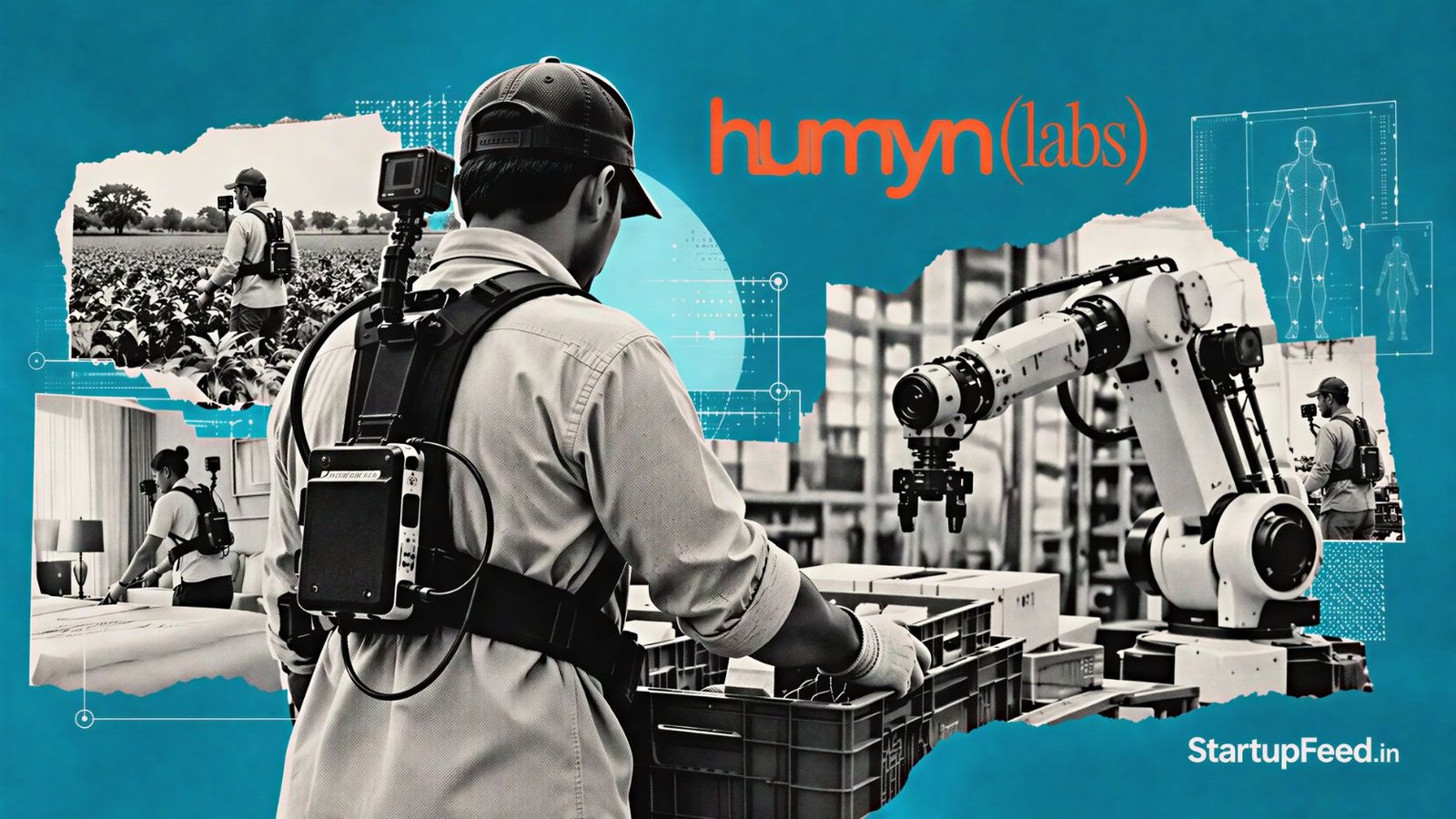
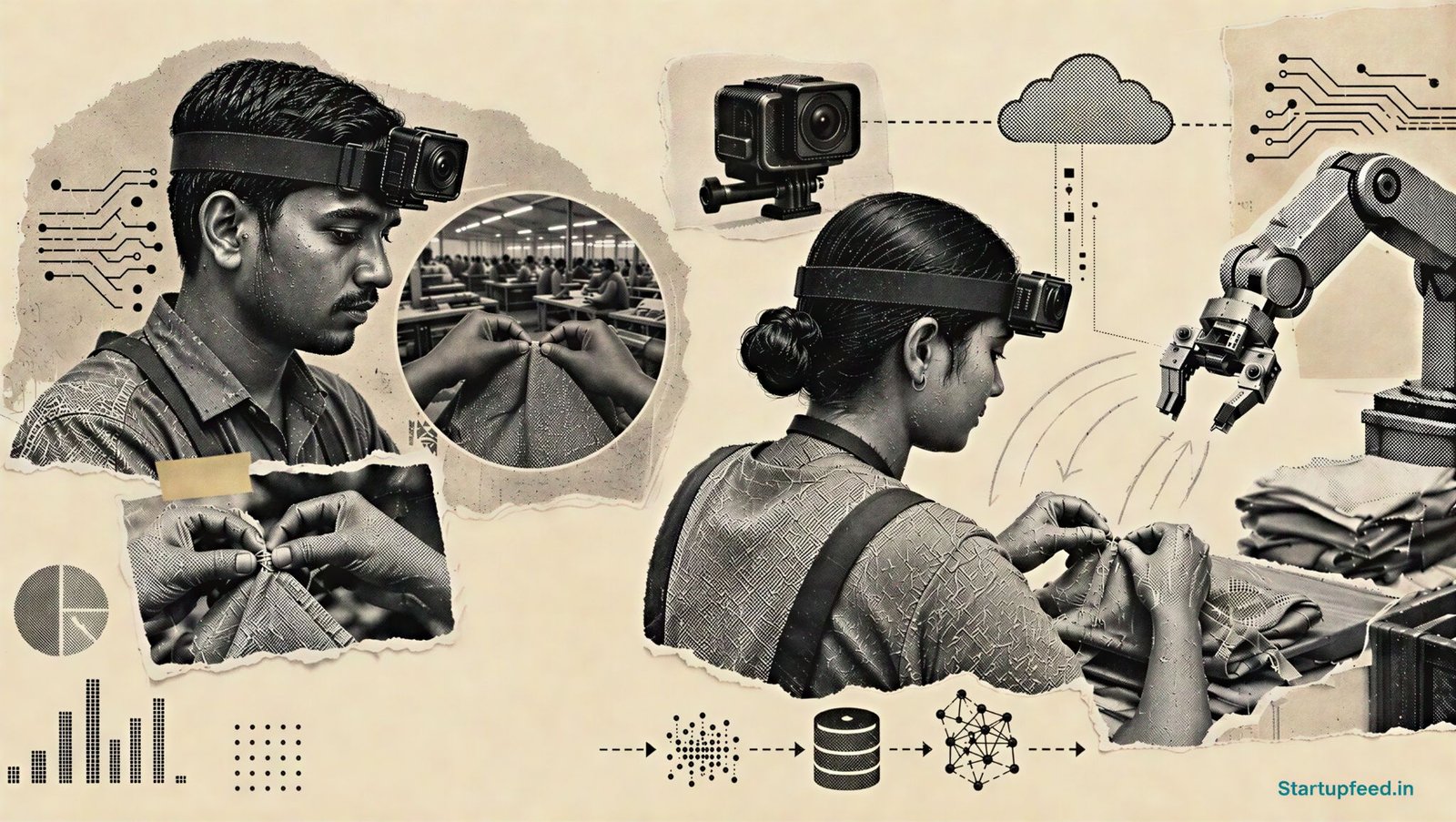
Egocentric data collected from Indian blue-collar workers now trains robots built in the United States. Workers wear small head cameras that record every wrist angle, grip and correction as they sew or pack.
The footage travels by cloud to robotics labs abroad, where it teaches machines to move like people. A viral April 2026 clip of camera-wearing textile workers in Delhi NCR exposed this quiet trade. The headgear was traced to Egolab.AI, a first-person data startup founded by two teenagers.
StartupFeed Insight
The real signal here is not the technology but the margin split. A worker earns Rs 400 for a shift of footage that resells at up to $50 (Rs 4,730) per hour abroad, so almost all the value sits overseas. This mirrors the 1990s transcription wave, where India supplied labour and others kept the intellectual property. Investors and policymakers should watch closely, because StartupFeed expects synthetic data and maturing foundation models to shrink demand for human-captured footage sharply by late 2027. Pipelines without their own models will likely fade first. By Avinash.
Egocentric Data Pipeline: The Numbers
Egocentric data is first-person footage from body-worn cameras that captures exactly what a robot’s camera will later need to see. The table below maps how money and volume move through the Indian pipeline, according to figures reported by the companies involved.
| Metric | Detail | Notes |
|---|---|---|
| Worker pay | About Rs 400 per day | Paid to a garment worker for wearing a camera during a shift |
| Payment to factory | Rs 450-500 per hour | Per RoBoEra founder Thaslim Pattan |
| Raw data price | $1-10 per hour (Rs 95-946) | Priced by task complexity, per Human Archive |
| Packaged data resale | $15-50 per hour (Rs 1,419-4,730) | Sold to global robotics labs once annotated |
| Daily capture (one player) | Up to 1,000 hours of 4K footage | Awign, using its 1.5 Mn gig workers |
| Rate change | -30% (January to June 2026) | Falling as more suppliers enter, per an industry executive |
The most striking gap is at the two ends. A worker’s daily earning is a fraction of what a single hour of finished data fetches abroad, and even that resale price is now sliding.
About Egolab.AI
Egolab.AI is an Indian first-person point-of-view data aggregator that collects egocentric video from factory workers using lightweight head cameras. It was founded in January 2026 by Raghav Samani, 19, and Varun Pareek, 18, and packages footage for global firms building robots and computer-vision systems. Company documents name buyers among leading US robotics makers. Egolab was later acquired by Build AI, a Delaware-registered firm, with its India arm based in Bengaluru.

Why does egocentric data matter for robots?
Egocentric data matters because robots lack the vast pre-training corpus that language models enjoyed. Large language models (LLMs, AI systems trained on huge text sets) learned from the open internet, then got fine-tuned for tasks. Robots had no equal.
“A robotic arm can be post-trained for a specific task using simulation or teleoperation, but that breaks the moment the environment changes,” said Rushil Agarwal, COO of Human Archive.
First-person human footage is the closest fix. It needs no special hardware, maps naturally to a robot’s viewpoint, and costs far less than teleoperation, where a human physically puppeteers a machine through a task. That mix is why so much money now flows to India for egocentric data.
Where does consent get messy?
Consent turns murky the moment a camera captures people who never agreed to be filmed. India’s Digital Personal Data Protection Act (DPDP Act 2023) lets employers process worker data for employment purposes without explicit consent. Legal experts argue that benchmarking one worker’s productivity against colleagues in other factories stretches that exemption too far.
The bigger gap sits outside the factory. When a domestic worker wears a camera inside a home, a child, guest or customer can enter the frame unaware.
“When you go to a mall or any public place, you will always see a notice that you are under surveillance. If that is not there, then there might be an issue with regards to a third person,” said Harshit Sharma, an advocate at the Delhi High Court.
Under current law, who else lands in the training data has no clean answer.
Is this egocentric data boom scalable?
The egocentric data business looks fragile as a long-term bet, despite booming demand today. Indian players mostly collect, annotate and ship footage, while the models, robots and intellectual property sit with overseas buyers. It reads more like a high-volume services contract with thin margins than a technology moat.
Two risks stand out. Data collection rates already fell 30% between January and June 2026 as suppliers multiplied, an industry executive said. Synthetic data is also improving fast, so demand for human-captured footage may shrink as physical AI models mature.


Most businesses in this space may be flourishing now but are not scalable ventures, said Ashish Taneja of GrowX Ventures, which tracks physical AI.
What sets a durable player apart, per Taneja, is treating data as an input to build its own models, not a product sold once. Research on learning robot skills from first-person human video, such as the EgoVLA vision-language-action study, shows why this footage is prized. For context on the labour side, the buyer of gig platform Awign detailed its India bet in an official Mynavi announcement.
What’s Next
The next test arrives as foundation models for physical AI mature over the next 12 to 18 months. If synthetic footage closes the quality gap, demand for human-captured egocentric data could fall well before 2028. Indian startups that build proprietary models may survive, while pure collectors risk the fate of 1990s transcription firms. Will any Indian player move up the value chain in time, or stay the world’s cheapest data hand?
Frequently Asked Questions
Last updated: July 1, 2026 at 18:30 IST
Written by Avinash. Published: July 1, 2026. Updated: July 1, 2026. Have a tip? Write to us at editorial@startupfeed.in.
Liked this story? Follow StartupFeed on Google so our reporting reaches you first.