Quick Take
- The Supreme Court released draft AI rules on June 3, 2026, governing AI use across Indian courts.
- AI can assist research and drafting, but cannot decide cases, pass sentences, or set bail.
- Public comments are open until June 20, 2026, before the framework is finalised nationwide.
In This Article
The Supreme Court AI Rules, released as a draft on June 3, 2026, allow Indian courts to use AI only as an assistive tool and bar it from deciding cases, passing sentences, or determining bail.
Prepared by the Supreme Court‘s AI Committee, the draft is titled “Regulations for Use of Artificial Intelligence (AI) in Courts, 2026”. It applies to the Supreme Court, High Courts, subordinate courts, tribunals, and statutory commissions across India. The Court has invited comments from judges, lawyers, technologists, and the public until June 20, 2026, before the framework is finalised. You can read the official draft on the Supreme Court of India website.
StartupFeed Insight
The real signal here is restraint, not speed. By banning AI from bail, sentencing, and recidivism scoring while permitting research and drafting, the Court has split the legal-tech market in two: efficiency tools get a green light, decision tools get a hard wall. Legal-tech founders building court products should watch the proposed Apex Body closely, because a central approval gate decides who sells into courts. StartupFeed expects the first certified court AI tools to focus narrowly on translation, transcription, and summarisation by early 2027. The disclosure mandate for AI-assisted filings will reshape how every litigation firm in India works. By StartupFeed Desk.
What the Supreme Court AI Rules Cover
The Supreme Court AI Rules set out where AI is allowed, where it is banned, and who stays accountable. The draft is built on a principle the Court calls “human primacy”. Every AI system must stay strictly subservient to human judgment.
| Metric | Detail | Notes |
|---|---|---|
| Draft Title | Regulations for Use of AI in Courts, 2026 | Per Supreme Court notice |
| Released On | June 3, 2026 | By the apex court |
| Prepared By | Supreme Court AI Committee | Chaired by Justice P.S. Narasimha |
| Scope | SC, High Courts, tribunals, commissions | Nationwide application |
| Comments Close | June 20, 2026 | Email to AI Committee |
| Core Principle | Human primacy | AI stays assistive only |
The most interesting line is the scope. These rules do not stop at the Supreme Court. They reach every High Court, tribunal, and adjudicatory commission in the country, lawbeat reported.
About the Supreme Court AI Committee
The Supreme Court AI Committee is the apex court body that drafted these rules after consultations and deliberations. It is chaired by Supreme Court Justice P.S. Narasimha. The committee studied a year of AI problems in courts, including fake AI-generated case citations, before proposing the framework. The draft also proposes a permanent Apex Body at the Supreme Court to approve AI tools, set standards, and publish annual governance reports.



What do these rules mean for lawyers?
For practising lawyers, the Supreme Court AI Rules introduce a mandatory disclosure duty. Lawyers and parties must tell the court whenever AI has helped prepare or submit documents, pleadings, or evidence. Courts can ask which AI tool was used and what checks were done before filing.
“Every AI System shall function solely in an assistive capacity and shall not supplant or compromise the independent exercise of judicial authority by a duly appointed judicial officer,” the draft states, according to the draft regulations.
The draft is firm on responsibility. A lawyer cannot blame AI for a wrong or misleading submission. Legal experts have welcomed the move as a balanced way to protect due process while still allowing useful tools.
Where is AI banned in courts?
The Supreme Court AI Rules draw clear red lines on where AI cannot go. Regulation 20 of the draft lists prohibited uses, the SCC Online report noted. AI cannot decide judicial outcomes, pass sentences, or perform any adjudicatory function.
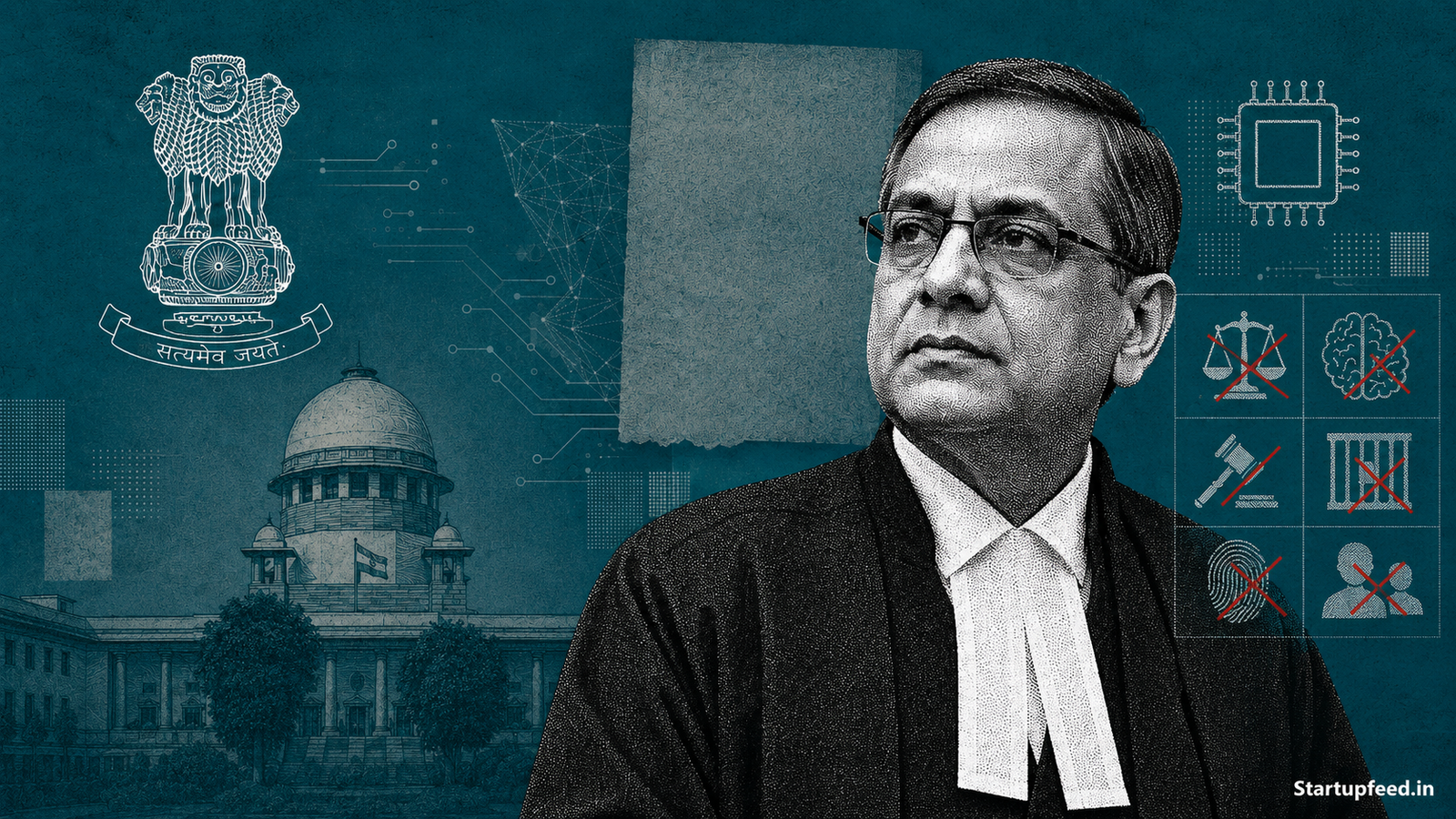
AI is also barred from sensitive risk tasks. It cannot determine bail eligibility, predict recidivism (the likelihood of re-offending), assess flight risk, or evaluate the credibility of parties or witnesses. The Court wants to avoid the “black-box” problem, where outcomes come from opaque algorithms instead of human reasoning. What AI can do is support work like legal research, citation checks, drafting help, summarisation, translation, transcription, and case management.
How does India compare globally?
India’s draft is among the most detailed AI court frameworks proposed worldwide. Its absolute ban on risk scoring and algorithmic adjudication sets it apart from more permissive systems, indialaw noted. Some foreign courts, in places like China, have tested AI-led decision-making in petty and small-value matters.
| Approach | AI in Decisions | Stance |
|---|---|---|
| India (draft) | Banned | Strict human primacy |
| Permissive systems | Tested in minor cases | Efficiency-led |
What makes India’s draft different is its rights-based design. It treats the judicial function itself as something that cannot be handed to a machine.
What’s Next
The next milestone is the comment deadline of June 20, 2026. After that, the AI Committee will study the feedback and finalise the rules. The proposed Apex Body would then begin approving which AI tools courts can use, likely shaping a new certification market. Will a central approval gate speed up safe AI adoption, or slow courts down with red tape?



Frequently Asked Questions
Last updated: June 8, 2026 at 19:30 IST
Written by Suraj Prajapati. Published: June 8, 2026. Updated: June 8, 2026. Have a tip? Write to us at editorial@startupfeed.in.
Liked this story? Follow StartupFeed on Google so our reporting reaches you first.