Quick Take
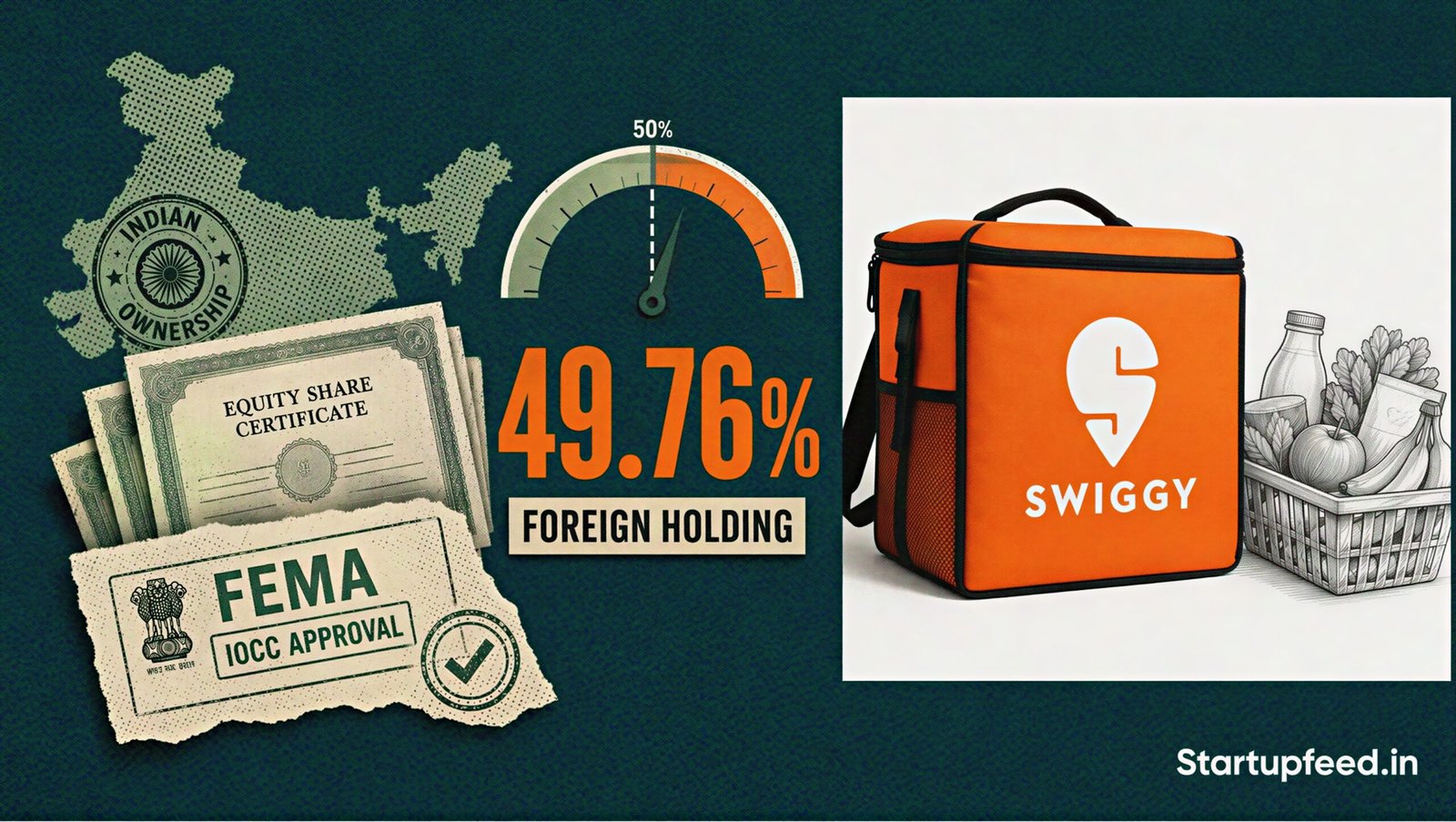
- Swiggy became majority Indian owned as foreign holding fell to 49.76% on July 6, 2026.
- The shift crosses the 50% ownership line that FEMA sets for IOCC eligibility in India.
- IOCC status could ease FDI limits on Instamart inventory, aiding margins over the next year.
In This Article
Swiggy became majority Indian owned after its foreign shareholding fell to 49.76% of paid-up equity as of July 6, 2026, the company disclosed in a stock exchange filing. Resident Indian investors now hold more than half the food delivery and quick commerce firm.
The crossover matters because it clears the ownership half of the test for Indian Owned and Controlled Company (IOCC) status under FEMA (Foreign Exchange Management Act) rules. Swiggy told the market the change does not affect its control, share capital, or day-to-day operations. It marks a quiet turn after a governance vote stumbled in May 2026, as reported in Swiggy’s BSE corporate filings.
StartupFeed Insight
Crossing 50% resident holding is the easy half of the IOCC test, but not the finish line. FEMA also demands domestic control of the board, and that is exactly what Swiggy’s shareholders blocked in May by handing the special resolution only 72.36% support against the 75% needed. Watch the next AGM cycle closely: founders, Prosus, and SoftBank must still agree on a board framework that regulators accept. StartupFeed expects Swiggy to file a fresh governance resolution before March 2027, because the Instamart margin prize is too large to leave on the table. The ownership number is done. The control fight is next. By Soumya Verma.
What does majority Indian owned mean for Swiggy?
Majority Indian owned means resident Indian citizens and Indian-controlled entities now beneficially hold more than 50% of Swiggy’s equity. As of July 6, 2026, foreign investors held 49.76% of paid-up equity, down from a level near 60% around its 2024 listing, according to Swiggy’s exchange disclosure. That single percentage point below half is the trigger for the ownership half of the IOCC framework.
The transition happened through gradual share flows, not a single deal. Domestic mutual funds, insurers, and retail investors lifted their combined stake after Swiggy’s initial public offering and later share sales. For a firm with no identifiable promoter group, this drift toward domestic hands carries real regulatory weight for the fintech and commerce businesses it runs.
Swiggy Shareholding Shift: Key Numbers
The shareholding shift moved Swiggy across the FEMA ownership threshold for the first time as a listed company. The table below sets out the core facts of the disclosure and the wider context.
| Metric | Detail | Notes |
|---|---|---|
| Foreign holding | 49.76% of paid-up equity | As disclosed on July 6, 2026 |
| Resident holding | Above 50% | Crosses FEMA IOCC ownership line |
| Impact on control | None stated | No change to share capital or operations |
| Key foreign backers | Prosus, SoftBank | Among largest non-resident shareholders |
| Prior vote | 72.36% in favour | Short of 75% needed, May 21, 2026 |
| Listing | BSE: 544285, NSE: SWIGGY | Listed November 2024 |
The most striking figure is how narrow the crossing is. At 49.76%, foreign holding sits just 0.24 percentage points below the line, so ordinary trading could nudge the ratio either way in future quarters.
About Swiggy
Swiggy is a Bengaluru food delivery and quick commerce company founded in 2013 by Sriharsha Majety, Nandan Reddy, and Phani Kishan Addepalli. It runs restaurant delivery, the Instamart grocery service, and Dineout, and reported Q4 FY26 operating revenue of Rs 6,383 Cr, up 44.7% year on year. Prosus and SoftBank rank among its largest backers.
Why does IOCC status matter for Instamart?
IOCC status matters most for Instamart because India’s FDI rules restrict foreign-controlled marketplaces from owning inventory or influencing pricing. A firm classified as an IOCC is treated as domestic, which unlocks inventory-led models that lift quick commerce margins. Swiggy has said the classification supports greater operational flexibility, though ownership alone will not grant it.
“The transition toward becoming an Indian Owned and Controlled Company remains an enduring priority for the company,” a Swiggy spokesperson said after the May vote.
Control, not just ownership, is the sticking point. Under DPIIT’s policy, control covers the right to appoint most directors or steer major decisions. Swiggy still needs a board framework that keeps that control in Indian hands, and its May resolution to amend its Articles of Association fell short. The full disclosure sits on Swiggy’s corporate page.
How do rivals compare on Indian ownership?
Rivals reached domestic ownership earlier, giving Swiggy a template to follow. Eternal, the parent of Zomato and Blinkit, capped foreign ownership at 49.5% in April 2025, which let it record full sales value rather than only commissions. One97 Communications, which runs Paytm, turned majority Indian owned when domestic investors reached 50.3% by end-March 2026.
| Company | Domestic ownership move | Timing |
|---|---|---|
| Swiggy | Foreign holding fell to 49.76% | July 2026 |
| Eternal (Zomato) | Foreign ownership capped at 49.5% | April 2025 |
| One97 (Paytm) | Domestic stake reached 50.3% | March 2026 |
What sets Swiggy apart is that it reached the ownership line while its board control question stays open, unlike peers that paired both steps.
What’s Next
The next milestone is a fresh governance resolution that satisfies FEMA control tests, likely within the coming year. Swiggy must win over 75% of shareholders, including Prosus and SoftBank, on a board nomination framework. Full IOCC recognition also needs regulatory sign-off. Will Swiggy convert its ownership crossover into the Instamart flexibility it has chased for months?
Have a tip? Write to us at editorial@startupfeed.in.
Frequently Asked Questions
Liked this story? Follow StartupFeed on Google so our reporting reaches you first.