
Quick Take
- Delhi High Court asks the Centre to justify the Telegram Ban tied to the NEET re-exam.
- MeitY restricted access until June 22 under Section 69A, hitting over 150 million Indian users.
- No interim relief granted; the matter will be heard again on June 18 at 2:30 PM IST.
In This Article
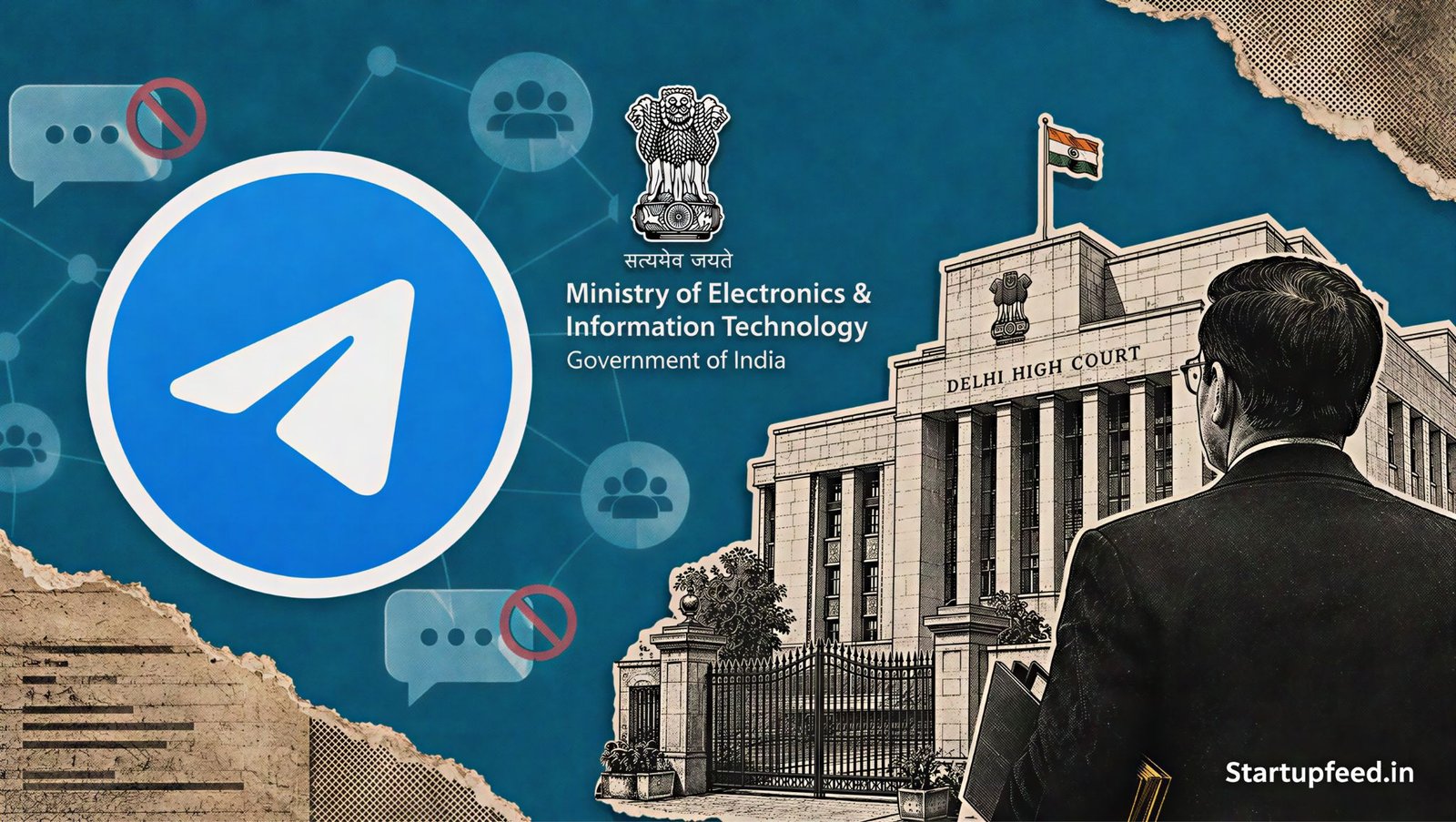
The Telegram Ban faced its first courtroom test on June 17, 2026, when the Delhi High Court asked the Centre to present proof that justifies blocking the messaging platform in India.
A vacation bench of Justice Tejas Karia issued notice to the government and refused immediate interim relief to Telegram. The Ministry of Electronics and Information Technology (MeitY) had restricted access until June 22 under Section 69A of the Information Technology Act, 2000, citing paper-leak risks ahead of the NEET-UG 2026 re-examination on June 21 (LiveLaw).
StartupFeed Insight
The real test here is proportionality, not paper leaks. The court asked the Centre point-blank if blocking a 150-million-user platform was a measured response, and the government asked for a day to gather material. That sequencing matters. When a regulator restricts first and assembles proof second, the Section 69A process itself comes under scrutiny. Every platform operating in India, from WhatsApp to Signal, should watch this closely. StartupFeed predicts the June 18 hearing will turn on whether MeitY skipped the Rule 8 hearing requirement, and that procedural gap, not the leak claim, could decide the Telegram Ban outcome. By StartupFeed Desk.
The Blocking Order: Key Facts
The Telegram Ban is a temporary Section 69A direction restricting the app in India until June 22, 2026, plus a separate order to disable message editing until June 30. MeitY issued both directions on recommendations from the National Testing Agency (NTA) and the Department of Higher Education.
| Metric | Detail | Notes |
|---|---|---|
| Legal Provision | Section 69A, IT Act 2000 | Blocking of information, per Centre (LiveLaw) |
| Access Restriction | Until June 22, 2026 | Covers June 21 re-exam (NTA) |
| Edit-Feature Block | Until June 30, 2026 | Curbs backdated leak proof (NTA) |
| Users Affected | Over 150 million | India user base, per Telegram counsel |
| Links Taken Down | Over 900 | NEET-related, per Telegram plea |
| Next Hearing | June 18, 2:30 PM IST | Centre to file reply (LiveLaw) |
The most striking number is 900: Telegram says it removed over 900 unlawful NEET links using artificial intelligence and machine learning tools before the order landed.
About Telegram
Telegram is a cloud-based messaging app founded in 2013 by brothers Pavel and Nikolai Durov, now headquartered in Dubai. It operates Telegram FZ LLC, the entity that filed the Delhi High Court plea. The platform runs on a freemium model with channels, large groups, and bots. It counts over 150 million users in India and roughly 1 billion monthly active users globally, per company statements.


What does the ban mean for users?
For users, the Telegram Ban means lakhs of students, educators, and ordinary subscribers lost access to study groups and communities mid-week. Telegram argued the order is “grossly disproportionate” and violates Article 14 of the Constitution by singling it out while similar platforms operate freely.
The action punishes 150M+ ordinary Telegram users in India, not the insiders who leaked the exam materials, Pavel Durov, CEO, said in an X post.
Durov added that the leaks simply moved to other apps after the block. The company also told the court it was denied a hearing under Rule 8 of the 2009 Blocking Rules, despite weeks of active cooperation with authorised agencies.
Why Did the Centre Order the Telegram Ban?
The Centre blocked Telegram because the NTA flagged organised cheating rackets using the platform to defraud NEET candidates. Solicitor General Tushar Mehta told the court the platform was “repeatedly called” to fix its system but failed, and the action was a last resort after coordinated takedowns fell short.
One channel starts, it is prohibited, and then another is started. And with a QR code, you can make a payment. This is continuous, Tushar Mehta, Solicitor General, submitted before the court.
The NTA named channels like “PAPER LEAKED NEET” and “Re-NEET 2026” that allegedly demanded thousands to several lakhs of rupees from families. The agency said both directions were taken in the interest of public order.
Jio and the BGP hijacking claim
Reliance Jio denied any role in any Border Gateway Protocol (BGP) route misconfiguration linked to the Telegram Ban. The clarification followed allegations on social media that the operator sabotaged access for people outside India using BGP hijacking, after Durov shared a snapshot mentioning “Reliance Communications”.
| Entity | Position |
|---|---|
| Reliance Jio (AS55836) | Denies involvement; cites global routing standards |
| Reliance Communications (AS18101) | A separate entity; named in Durov’s snapshot |
Experts noted ambiguity in the Durov post on X, where it stayed unclear if he meant Jio or Reliance Communications. Jio’s distinct ASN and ownership separate it from the entity Durov flagged.
What’s Next
The Delhi High Court will hear the Telegram Ban case again on June 18, 2026, at 2:30 PM IST, after the Centre files its reply with supporting material. The June 21 NEET-UG re-examination falls within the block window, so the court’s view on interim relief carries real weight for both students and the platform. Will the proportionality test reshape how India uses Section 69A?

Frequently Asked Questions
Last updated: June 18, 2026 at 10:30 IST
Written by Avinash. Published: June 18, 2026. Updated: June 18, 2026. Have a tip? Write to us at editorial@startupfeed.in.
Liked this story? Follow StartupFeed on Google so our reporting reaches you first.