
Last updated: October 7, 2026
StartupFeed Quick Take
- Blinkit market share of the top three players’ orders reached 46.6% in FY26, from 44.4% in FY25
- Zepto passed Swiggy Instamart on orders, 640.2 million against 412.2 million, or 32.5% against 20.9%
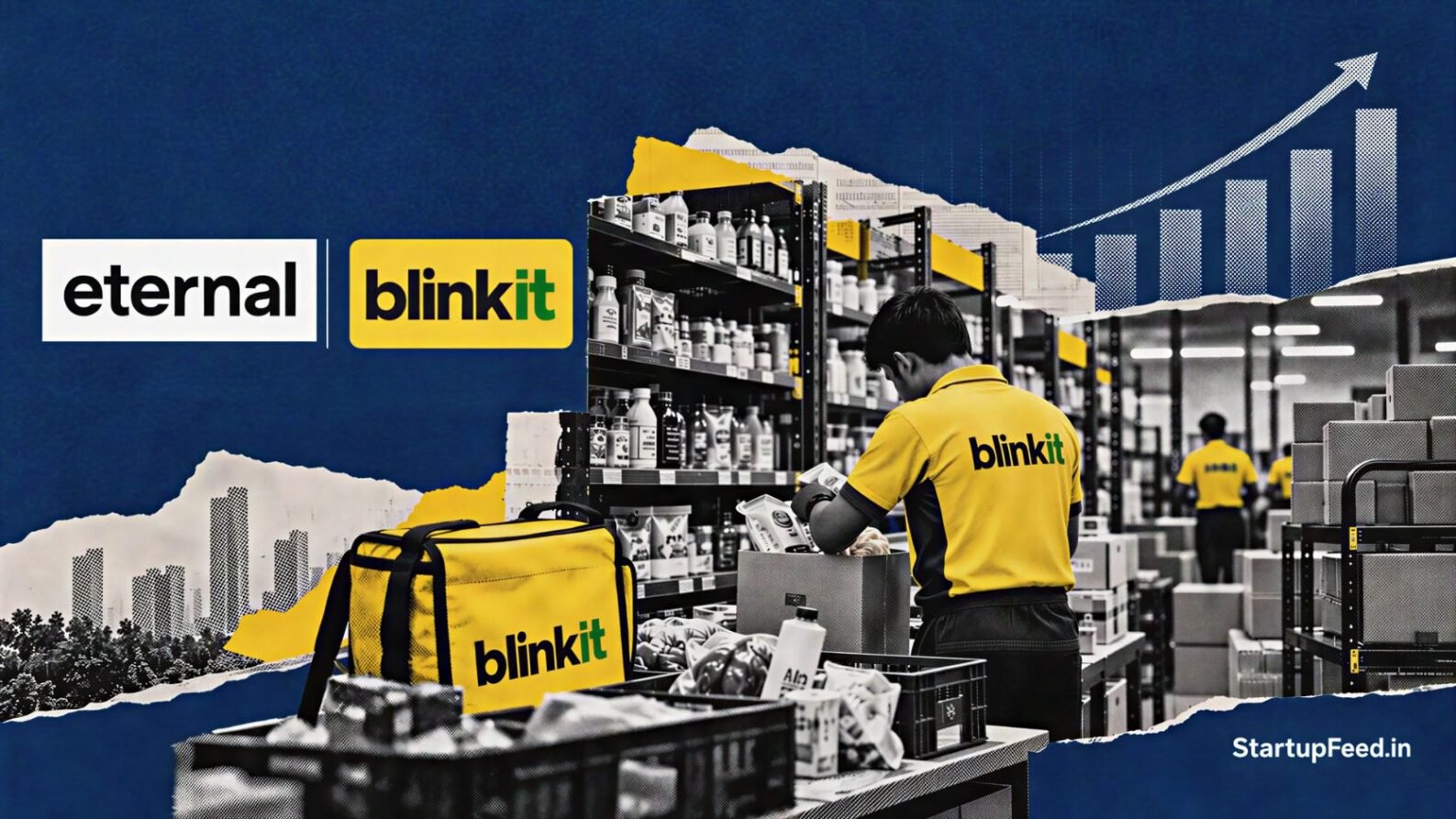
- Blinkit ended March 2026 with 2,243 dark stores, against 1,143 for Swiggy Instamart and 1,139 for Zepto
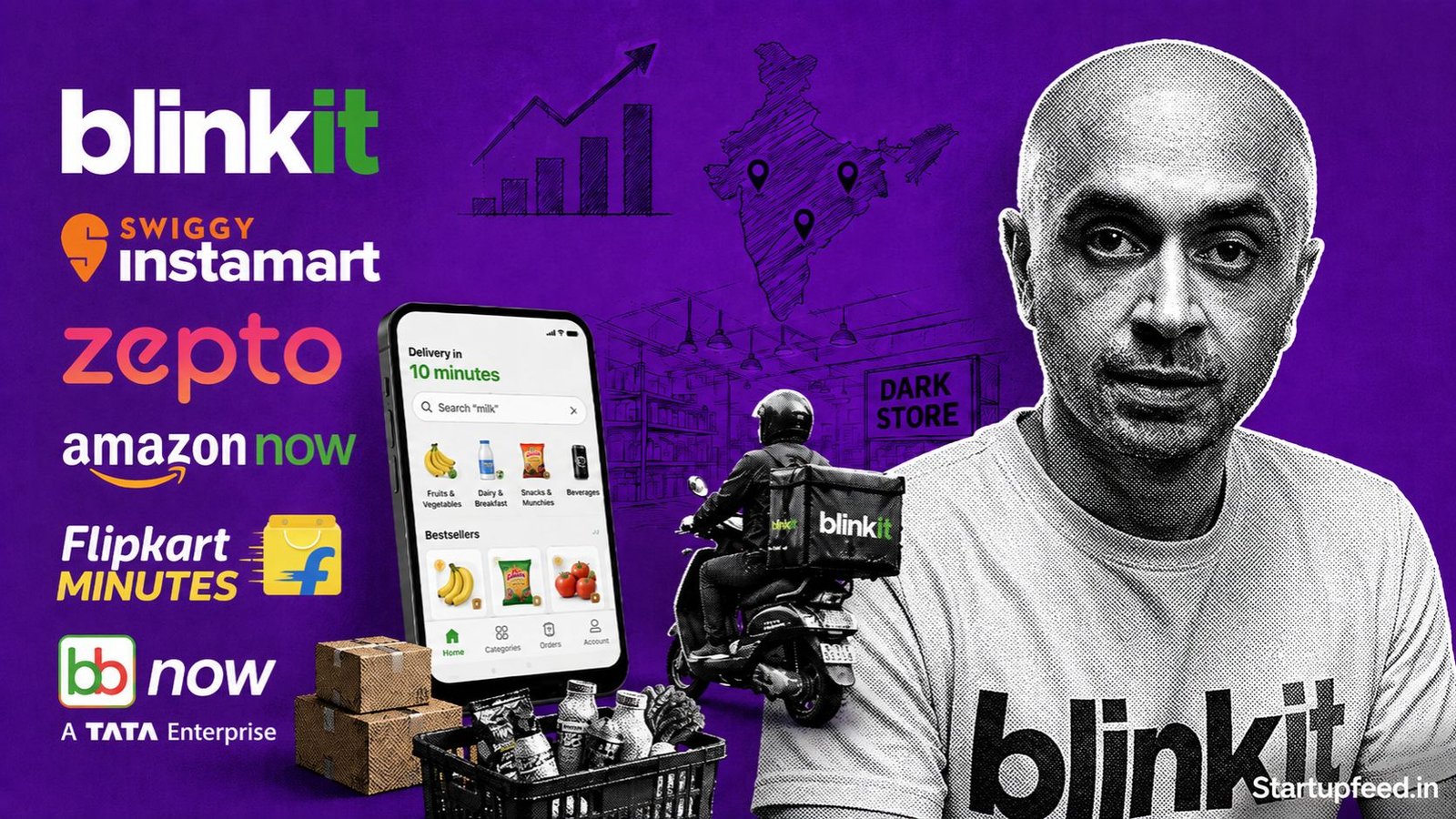
Quick commerce is grocery and daily goods delivered in ten to twenty minutes from a small neighbourhood warehouse called a dark store.
In This Article
Blinkit Market Share in India 2026
Blinkit ran 916.6 million orders in FY26. Zepto ran 640.2 million and Swiggy Instamart ran 412.2 million.
Zepto’s updated IPO filing of June 8, 2026 is the source for all three counts. It is the first document to measure the three on one definition, in one place.
That filing reverses the order of the chasing pack. Zepto now holds 32.5% of the three players’ orders. Swiggy Instamart holds 20.9%.
Swiggy Instamart has fallen in each of the last two years. Its share was 34.3% in FY24 and 24.5% in FY25.
Blinkit has led all three years. Its share moved from 39.7% in FY24 to 44.4% in FY25 and 46.6% in FY26.
These are shares of three companies, not of the whole market. Amazon Now, Flipkart Minutes and BB Now sit outside the count, so every figure here is lower once they are added.
StartupFeed worked out the Blinkit and Zepto percentages from the order counts in the filing.
| Player | FY26 orders (Mn) | Share of the three | Dark stores, March 2026 | Cities |
|---|---|---|---|---|
| Blinkit | 916.6 | 46.6% | 2,243 | Not disclosed |
| Zepto | 640.2 | 32.5% | 1,139 | 66 |
| Swiggy Instamart | 412.2 | 20.9% | 1,143 | 129 |
Dark Stores: Who Built and Who Stood Still
Dark stores are the unit of this fight. Each store sets the delivery radius, the daily order ceiling and the burn rate.
Blinkit ended March 2026 with 2,243 dark stores. Swiggy Instamart had 1,143. Zepto had 1,139.
The year’s building explains the gap. Blinkit added 942 stores in FY26, against 122 for Swiggy Instamart and 110 for Zepto.
Zepto grew orders 88% on a store count that barely moved. Each Zepto store therefore carries far more orders a day than a Blinkit store.
That is efficient, and it is also a ceiling. Zepto cannot hold that growth rate without building again, and building needs money it has not yet raised.
Swiggy Instamart served 129 cities at the end of FY26 and Zepto served 66. Eternal does not publish a city count for Blinkit, so that cell is blank rather than guessed.
The newest counts are higher again. Blinkit reached 2,443 stores by June 2026, and Swiggy Instamart reached 1,171 stores across 131 cities.
What the FY26 Money Numbers Show
Revenue does not compare across these three. Blinkit booked Rs 37,779 Cr for FY26 because it now sells much of its stock itself, after leaving a pure marketplace model in June 2025.
Zepto booked Rs 22,624 Cr on its own basis. Swiggy Instamart’s segment revenue was Rs 3,859 Cr, which sits closer to a commission figure than a sales figure.
Order value compares better. For the March 2026 quarter, Blinkit’s net order value was Rs 14,386 Cr, against Rs 8,134 Cr for Zepto and Rs 5,675 Cr for Swiggy Instamart.
Profit is where the three separate completely. Blinkit’s adjusted EBITDA loss for FY26 was Rs 277 Cr. Swiggy Instamart lost Rs 3,511 Cr and Zepto lost Rs 5,042 Cr.
Set those losses against orders and the distance is stark. Blinkit lost about Rs 3 an order. Zepto lost about Rs 79 and Swiggy Instamart about Rs 85.
Blinkit has since crossed into profit on this measure. Its adjusted EBITDA was Rs 37 Cr in the March quarter and Rs 102 Cr in the June quarter, or 0.6% of net order value.
Swiggy Instamart reached contribution break-even in May 2026 and cut its quarterly adjusted EBITDA loss to Rs 778 Cr. Sriharsha Majety, who runs Swiggy, described the next phase this way:
“our differentiated assortment strategy will be the engine for our next phase of growth”
Sriharsha Majety, managing director and group chief executive, Swiggy. From Swiggy’s Q1 FY27 shareholder letter, July 30, 2026.
| Player | FY26 revenue (Rs Cr) | FY26 adjusted EBITDA (Rs Cr) | Loss per order (Rs) | Q4 FY26 net order value (Rs Cr) |
|---|---|---|---|---|
| Blinkit | 37,779 | -277 | 3 | 14,386 |
| Zepto | 22,624 | -5,042 | 79 | 8,134 |
| Swiggy Instamart | 3,859 | -3,511 | 85 | 5,675 |
Zepto’s own accounts go deeper into the red. Its net loss for FY26 was Rs 5,905 Cr, against Rs 4,700 Cr the year before.
What does the Amazon and Flipkart entry mean?
Two deep-pocketed rivals change this fight through capital depth, customer overlap and range beyond grocery.
Amazon India committed Rs 2,800 Cr to Amazon Now in 2026. Flipkart’s Singapore entity put Rs 3,248 Cr into its marketplace arm to fund the Minutes push.
Neither files quick commerce numbers the way Eternal and Swiggy do, so their scale rests on estimates. The figures below carry that health warning.
| Challenger | Estimated share | Estimated dark stores | Position as at mid-2026 |
|---|---|---|---|
| BB Now (BigBasket) | 5-7% | About 700 | Tata sourcing and bulk grocery |
| Flipkart Minutes | 3-4% | 800 to 1,000 | Adding about 100 stores a month |
| Amazon Now | 3-5% | 500 plus | Prime loyalty and wider catalogue |
Bernstein counts more than 6,000 dark stores across India and valued the sector near $11.5 Bn (Rs 95,500 Cr) at the end of 2025.
The squeeze lands hardest on Zepto. It is the only one of the six without a parent balance sheet behind it.
How do the six players compare on strategy?
Each player is fighting a different war.
Blinkit chases a higher basket and wider range, and funds store building from Eternal’s balance sheet. Its margin guidance for mature markets is 5% to 6% of net order value.
Zepto runs the lowest basket value of the three and wins on order count instead. That works until it has to build stores again.
Swiggy Instamart leans on cross-sell from the food app and on a differentiated range rather than price. Its share of orders is falling even as its order count rises.
BB Now leans on Tata supply chain and bulk grocery. Flipkart Minutes is the only major non-grocery play, pushing phones and electronics through dark stores. Amazon Now bets on Prime loyalty.
The differentiator is no longer ten minutes. It is cost per order at scale.
About India’s Quick Commerce Market
India’s quick commerce sector delivers groceries and daily goods in ten to twenty minutes from dark stores placed inside residential areas. Bernstein valued it near $11.5 Bn (Rs 95,500 Cr) at the end of 2025. Six players now matter: Blinkit, Zepto, Swiggy Instamart, BB Now, Flipkart Minutes and Amazon Now. Blinkit, owned by Eternal, leads on orders, stores and profit.
What to watch over the next two quarters:
- Whether Zepto restarts store building before it refiles for its IPO
- Whether Swiggy Instamart’s order share falls below 20%
- Whether Blinkit holds its adjusted EBITDA margin above 0.5% of net order value
- Whether Amazon Now or Flipkart Minutes crosses 1,200 dark stores
- Whether any player publishes a city count on a common definition
StartupFeed Insight
The number that matters in FY26 is not Blinkit’s lead. It is Zepto’s store count. Zepto added 110 dark stores all year and still grew orders 88%, so it is sweating its assets harder than anyone in the sector. That helps the IPO story and hurts the loss line. Rs 5,042 Cr of adjusted EBITDA loss across 640.2 million orders works out at Rs 79 an order, against Rs 3 an order at Blinkit. Efficiency per store cannot fix a gap that wide. StartupFeed expects Zepto to cross 1,400 dark stores before it refiles, by May 2027.
By Dr. Mayank Raj, Contributing Editor
Frequently Asked Questions
Have a tip? Write to us at editorial@startupfeed.in.
Disclaimer: This article is for information only and is not investment advice. StartupFeed and its authors are not SEBI-registered investment advisors. Please speak to a SEBI-registered advisor before investing.
Liked this story? Follow StartupFeed on Google so our reporting reaches you first.