QUICK TAKE
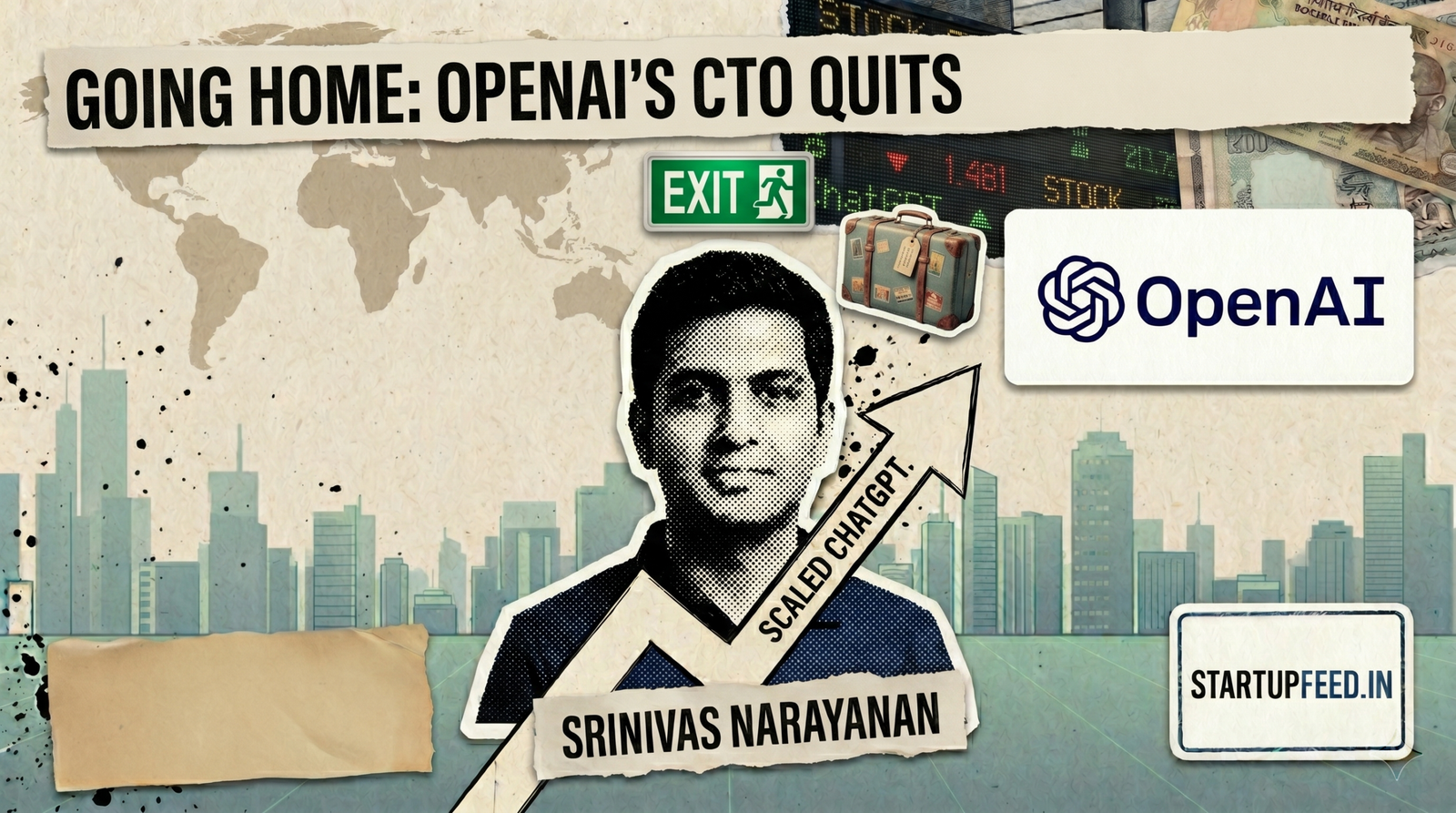
- Who: Srinivas Narayanan — IIT Madras ’95, ex-Meta VP, CTO of B2B Applications at OpenAI since September 2025
- When: Announced April 17, 2026; leaving end of week of April 17
- What He Built: Scaled Applied Engineering team from 40 people → shipped ChatGPT + Developer API to hundreds of millions
- Why Leaving: Family — returning to India to spend time with ageing parents; next role under consideration
- Wider Context: Triple same-day exit: Kevin Weil (OpenAI for Science) + Bill Peebles (Sora) also departed April 17
- OpenAI State: $25 Bn annualised revenue, $14 Bn projected 2026 losses, 900 Mn+ weekly ChatGPT users, $852 Bn valuation
Srinivas Narayanan, the Indian-origin engineering leader who helped transform OpenAI from a research organisation into the company behind the world’s most widely used AI products, announced his departure on April 17, 2026. The IIT Madras and University of Wisconsin-Madison alumnus, who joined OpenAI as VP of Engineering in April 2023 and was elevated to CTO of B2B Applications in September 2025, wrote on X that after “three incredible years that felt more like ten,” he was stepping back — with plans to return to India and spend time with his ageing parents before deciding on his next move.
Narayanan’s exit is not happening in isolation. Two other senior OpenAI executives — Kevin Weil, who led the company’s OpenAI for Science initiative, and Bill Peebles, who built Sora from scratch — announced their departures on the same day. The triple exit follows weeks after CPO Fidji Simo took medical leave, and months into a pattern that has now seen 9 of OpenAI’s 11 original co-founders leave the company — leaving only Sam Altman and Greg Brockman remaining.
StartupFeed Insight
What the numbers say: Narayanan joined when the Applied Engineering team was 40 people on a single floor. By the time he left, that team had shipped ChatGPT to 900 million weekly users and an API that powers thousands of enterprise products globally. His exit represents a phase shift — the ‘zero-to-one’ builder leaving as OpenAI pivots to ‘one-to-scale’ execution under enterprise revenue pressure.
What this means for you:
- If you’re an Indian founder or technologist: Narayanan’s career arc — IIT Madras → IBM → Meta VP → OpenAI CTO — is the clearest recent proof that Indian-origin technologists are not just joining the global AI race, they are setting its pace. His return to India, even temporarily, may also signal the pull of a maturing Indian AI ecosystem that is beginning to offer opportunities worth coming home for.
- If you’re an enterprise buyer of OpenAI products: The departure of the CTO who built and led the B2B applications engineering team creates short-term uncertainty. OpenAI has not announced a successor. Expect 3–6 months of leadership transition risk in the enterprise product roadmap — worth factoring into multi-year AI infrastructure contracts.
- If you’re a talent professional or competing AI lab: OpenAI’s leadership churn is creating one of the richest talent pools in AI history. Narayanan, Weil, and Peebles are world-class operators with deep AI-at-scale experience. The labs (Anthropic, Google DeepMind, Meta Superintelligence) and well-funded AI startups will be in serious competition for this cohort.
Our prediction: Srinivas Narayanan will return to an operating role within 12 months — likely in India or as a bridge between Silicon Valley and India. The Indian AI ecosystem (iSPIRT, DPIIT’s AI mission, emerging foundation model startups) is at an inflection point that precisely matches his background: applied AI infrastructure, B2B products, and large-scale engineering leadership. A Narayanan-backed or Narayanan-led Indian AI venture, or an advisory/operating role at a major Indian tech conglomerate, is the most probable next chapter.
Profile — Srinivas Narayanan
| Aspect | Details |
| Full Name | Srinivas Narayanan |
| Title at OpenAI | CTO, B2B Applications (from Sep 2025); VP Engineering (Apr 2023 – Sep 2025) |
| Departure Date | End of week of April 17, 2026 (announced April 17, 2026) |
| Education | B.Tech, Computer Science — IIT Madras (1991–1995); M.S., Computer Science — Univ. of Wisconsin-Madison (1995–1996) |
| Previous Roles | VP Engineering, Meta (Facebook) — 10+ years; CTO & Co-founder, Viralizr (2007); Director of Technology, Tavant Technologies; Software Engineer, IBM Almaden Research Center (from 1997) |
| Key Products Built | ChatGPT, OpenAI Developer API, enterprise-grade OpenAI products; scaled Applied Engineering team from 40 to hundreds |
| Years of Experience | ~29 years in technology leadership (1997–2026) |
| What’s Next | Returning to India to spend time with ageing parents; next role under consideration |
Narayanan’s career follows a distinctly product-engineering path — not the pure research trajectory of an Ilya Sutskever or a Geoffrey Hinton. From IBM’s research labs to a decade at Meta building Facebook’s photo systems and AI recommendation engines to co-founding a social startup in between, his defining skill is the same one OpenAI needed most in 2023: turning research models into reliable, scalable products used by millions. He was, in the truest sense of the phrase, the engine behind ChatGPT’s product velocity.
Career Timeline — From IBM to IIT to OpenAI
| Period | Role | Organisation | Key Achievement |
| 1997–2007 | Software Engineer → Director | IBM Almaden Research Center; Tavant Technologies | Built early AI/software foundations |
| 2007–2008 | CTO & Co-Founder | Viralizr | Built social collaboration consumer products |
| 2008–2023 | VP Engineering | Meta (Facebook) | Led Facebook Photos, language/vision/recommendation AI systems |
| Apr 2023 | VP of Engineering | OpenAI | Joined to scale Applied Engineering; shipped ChatGPT + API |
| Sep 2025 | CTO, B2B Applications | OpenAI | Led enterprise AI products for global business clients |
| Apr 2026 | Exit | OpenAI → India (family time) | Next role TBD |
“The last three years have been an incredible journey that felt more like ten. Leading the B2B engineering team has been an enormous privilege. With the recent/upcoming product launches, this felt like the right time to step back.”
— Srinivas Narayanan, farewell post shared with team, April 17, 2026
The phrase ‘recent/upcoming product launches’ is deliberate. Narayanan is leaving at a moment he characterises as a completion — not a crisis. He helped ship ChatGPT, scaled the API, built the enterprise engineering foundation, and was elevated to CTO in September 2025. The implication: the first phase of his mandate is done, and he is choosing not to stay for the next chapter. That is a fundamentally different signal than the exits of researchers like Sutskever or safety voices like Miles Brundage.
The Triple Exit — What April 17 Really Means for OpenAI
| Executive | Role at OpenAI | Project Shut Down | Destination |
| Srinivas Narayanan | CTO, B2B Applications | B2B team restructuring | India (family); next role TBD |
| Kevin Weil | VP, OpenAI for Science (ex-CPO) | OpenAI for Science — disbanded | Announced same day; destination TBD |
| Bill Peebles | Lead, Sora AI Video | Sora app shut down (Apr 26, 2026) | Announced same day; destination TBD |
| Fidji Simo | Chief Product & Business Officer | Medical leave (weeks prior) | Medical leave; not departed |
The simultaneity of three senior exits on April 17 is not coincidental. Each of the departing executives was leading a product that OpenAI is either shutting down or radically restructuring. Sora’s web and app versions were discontinued; the API shutdown is scheduled for April 26. OpenAI for Science — Weil’s initiative — has been absorbed into other research groups. The B2B applications team Narayanan led is being restructured as OpenAI narrows its enterprise focus to ChatGPT and the API ecosystem.
Sora alone reportedly cost $1 million per day in compute costs. OpenAI is projecting $14 Bn in losses on $25 Bn in revenue in 2026. The strategic directive is clear: cut projects that don’t contribute directly to enterprise revenue, and redirect resources toward products that can generate the $200 Bn in revenue the company needs by 2030 to justify its $852 Bn valuation. The executives tied to the discontinued initiatives exited with their projects.
The Bigger Picture — OpenAI’s Leadership Exodus (2024–2026)
| Name | Former Role | Year Exited | Where They Went |
| Ilya Sutskever | Co-Founder & Chief Scientist | 2024 | Safe Superintelligence (SSI) — founded |
| Mira Murati | Chief Technology Officer | 2024 | Own venture (AI startup) |
| John Schulman | Co-Founder, Safety Researcher | 2024 | Anthropic |
| Bob McGrew | Chief Research Officer | 2024 | Break; supporting new research lead |
| Barret Zoph | VP of Research | 2024 | Not publicly disclosed |
| Shengjia Zhao | ChatGPT / GPT-4 key architect | 2025 | Meta Superintelligence Labs — Chief Scientist |
| Joanne Jang | GPT-4 / DALL·E builder | 2026 | TBD |
| Kevin Weil | CPO → VP OpenAI for Science | Apr 2026 | TBD |
| Bill Peebles | Sora AI Video Lead | Apr 2026 | TBD |
| Srinivas Narayanan | CTO B2B Applications | Apr 2026 | India → next role TBD |
Nine of eleven original co-founders have now left. The departure of the research and product originators — Sutskever, Murati, Schulman, McGrew — and the subsequent exit of applied engineering leaders like Narayanan represents a complete generational change at the organisation. OpenAI has hired replacements: Denise Dresser (ex-Slack CEO) as Chief Revenue Officer, and new research leads. But the DNA of the company that built ChatGPT is dispersing — to Anthropic, Meta Superintelligence Labs, Safe Superintelligence, and now to family.
Leadership changes are a natural part of companies, especially companies that grow so quickly and are so demanding.”
— Sam Altman, OpenAI CEO,
OpenAI’s Financial Position — The Stakes Behind the Exits
| Metric | Value | Context |
| Monthly Revenue | ~$2 Bn/month | Annualised run rate: $25 Bn+ |
| Projected Net Loss (2026) | $14 Bn | On $25 Bn revenue — deeply loss-making |
| Last Valuation | $852 Bn (Apr 2026 round) | $122 Bn funding round closed April 2026 |
| ChatGPT Weekly Active Users | 900 Mn+ | Enterprise = 40%+ of total revenue |
| Cumulative Spend to 2029 | $115 Bn estimated | Cash-flow positive target: 2029 |
| Revenue Target by 2030 | $200 Bn | Requires enterprise adoption to accelerate |
The financial context matters. OpenAI is simultaneously one of the fastest-growing revenue businesses in history and one of the most expensive. At $14 Bn in projected losses against $25 Bn in revenue, the company is spending roughly 56 cents of every dollar it earns. The target path to profitability — $200 Bn revenue by 2030, cash-flow positive by 2029 — requires enterprise AI adoption to accelerate faster than compute costs. That is the mandate that now falls to whoever succeeds Narayanan in the B2B CTO role.
What’s Next — 3 Questions That Matter
- Who replaces Narayanan? OpenAI has not announced a successor. The B2B CTO role is critical to the company’s enterprise growth thesis — the segment that already generates 40%+ of revenue and is on track to match consumer revenue by end-2026. A prolonged vacancy would be a meaningful risk signal.
- What does Narayanan do in India? His return to India is framed as family-first — but an operator of his calibre, at the peak of the AI investment cycle in India, will attract significant attention from Indian conglomerates, AI startups, and international funds looking to build Indian AI capability. Watch for any advisory announcements within 6–12 months.
- Does OpenAI’s leadership churn affect enterprise trust? CIOs and CTOs buying OpenAI enterprise products want continuity. Back-to-back C-suite exits — CPO on medical leave, B2B CTO departed, science VP gone, Sora lead gone — raise legitimate questions about the stability of the enterprise product roadmap. This is the question OpenAI’s new CRO Denise Dresser must answer immediately.
Srinivas Narayanan’s exit is more personal than political, more completion than conflict. He built something historic at OpenAI — a team that scaled from 40 people to the engineers behind the world’s most-used AI product. The fact that he is choosing family in India over a continued CTO role at a company valued at $852 Bn says something about both his priorities and the pace of what he has just lived through. For India’s tech community, it is a moment of quiet pride — and perhaps a signal about where the next chapter of his story will be written.
What do you think Srinivas Narayanan should do next? Share your view at @StartupFeed_official
Liked this story? Follow StartupFeed on Google so our reporting reaches you first.