Quick Take:
|
Dalal Street emerged as a founder’s paradise in 2025 — 18 Indian startups listed on Indian exchanges, collectively raising a record Rs 41,248 Cr from public markets. The surge was driven by macroeconomic tailwinds, robust GDP growth projections, and SEBI’s own reforms: simplified DRHP filings, flexible ESOP rules, and an expanded retail investor base that crossed 20 Cr demat accounts.
In 2026, the pipeline is even more ambitious — but the context has changed. Five new-age tech companies listed in Q1 2026, and most debuted flat or below issue price. Amagi, a SaaS major that turned profitable in H1 FY26, was oversubscribed 30.2x — and still listed at a 12.2% discount to issue price. The public market’s message is clear: profitability is necessary but no longer sufficient. Valuation must also be reasonable.
| StartupFeed Insight The 2026 IPO market is a market in two speeds:
What this means for founders: If you are planning to list in 2026 or 2027, the single most important preparation is demonstrating operating cash flow discipline — not PAT (which can be managed with deferred tax gains), but genuine operational cash generation. Amagi’s lackluster debut despite profitability suggests the market is even discounting accounting profitability in favour of structural cash flow reliability. Build that first. Our prediction: Zepto and OYO will be the bellwether listings of 2026. If Zepto — which narrowed losses but still posted Rs 3,367 Cr net loss on Rs 11,109 Cr revenue in FY25 — gets a strong listing, the market is willing to fund growth-stage companies with clear paths to profitability. If it lists flat or below, the recalibration extends another year and even profitable startups face valuation pressure. |
The Numbers — India’s 2026 IPO Market at a Glance
| Metric | 2025 (Record Year) | 2026 (Pipeline/Projection) |
| Startup IPO listings | 18 mainboard listings | 5 in Q1 2026; 48+ total expected over 12-18 months |
| Capital raised by startups | Rs 41,248 Cr (record) | Rs 47,000–50,000 Cr from unicorns alone; Rs 2.5–2.65 lakh crore total across all categories |
| DRHPs filed with SEBI (startups) | Strong pipeline | 23 startup DRHPs filed; 23+ finalising |
| Total IPO filings (all categories, March alone) | 22 filings | 38 filings in March 2026 alone — highest in 3 years |
| SEBI-approved IPOs awaiting launch | — | 124 companies have SEBI approval, awaiting timing |
| Average listing performance | Generally strong | Mixed — several flat or below issue price |
| Retail investor demat accounts | ~18 Cr | 20 Cr+ (crossed milestone) |
| Investor priority | Growth narrative + future potential | Strong fundamentals + profitability + low cash burn (48% of investors) |
The Big 5 Unicorn IPOs — What They Could Raise and Where They Stand
| Company | Sector | Estimated IPO Size | Last Known Valuation | Status / Notes |
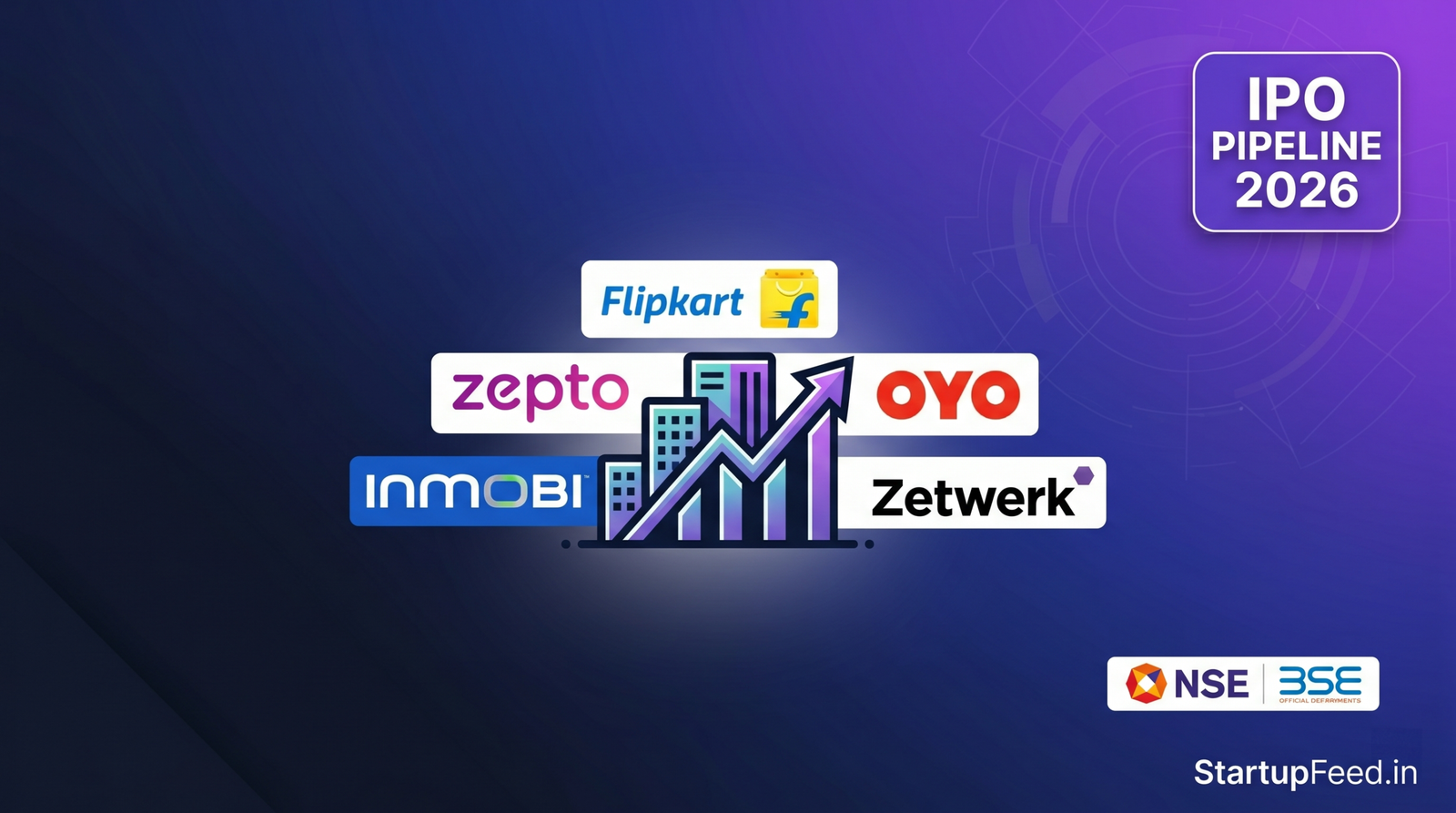
| Flipkart | E-commerce | Rs 25,000–30,000 Cr ($3–4 Bn) | $60–70 Bn | NCLT approval for domicile shift Singapore→India secured; SEBI DRHP pending; FY26 prep ongoing |
| Zepto | Quick Commerce | Rs 8,000–10,000 Cr | $7 Bn (post-$450 Mn CalPERS round, Oct 2025) | Confidential DRHP filed; potential listing July–September 2026; FY25: revenue Rs 11,109 Cr; loss Rs 3,367 Cr |
| OYO (PRISM) | Hospitality | Rs 6,650 Cr | $7–8 Bn | Confidential DRHP filed; third IPO attempt; FY25: net profit Rs 623 Cr (+172% YoY); revenue Rs 6,463 Cr (+20%) |
| InMobi | AdTech / AI | Rs 4,000–5,000 Cr (est.) | $1 Bn+ (unicorn) | IPO plans firming; bankers being finalised |
| Zetwerk | B2B Manufacturing | Rs 4,000–5,000 Cr (est.) | ~$5 Bn | Six bankers appointed (Kotak, JM Financial, Avendus, HSBC, Morgan Stanley, Goldman Sachs); originally targeted 2027, now back to 2026 |
More Key Startups in the 2026 IPO Pipeline
| Company | Sector | IPO Details | Financial Snapshot | Status |
| PhonePe | Fintech / UPI | Rs 15,000+ Cr (est.) | India’s UPI leader (~50% of UPI transactions); revenue scaling strongly | SEBI approved; domicile returned to India from US; bankers finalised; IPO expected 2026 |
| Fractal Analytics | AI / Enterprise SaaS | Rs 5,000+ Cr (est.) | SaaS unicorn; AI-powered analytics; turning profitable | SEBI approval received — one of first AI-centric companies to list in India |
| boAt (Imagine Marketing) | Consumer Electronics | Rs 1,500 Cr (Rs 500 Cr fresh + Rs 1,000 Cr OFS) | Wearables/audio leader; second IPO attempt | Updated DRHP filed; audit observations flagged by SEBI; founders Aman Gupta and Sameer Mehta OFS participants |
| Amagi | SaaS / Media | Rs 1,000+ Cr (approx.) | Net profit Rs 6.5 Cr (H1 FY26); first profitable period | LISTED — Q1 2026; oversubscribed 30.2x; listed 12.2% below issue price at Rs 317 vs Rs 361 issue price |
| Aye Finance | NBFC | Rs 1,010 Cr (Rs 710 Cr fresh + Rs 300 Cr OFS) | Net profit declined 40% YoY to Rs 64.6 Cr (H1 FY26); revenue Rs 843.5 Cr | LISTED — Q1 2026; flat debut at issue price Rs 129; undersubscribed at 97% |
| Travelstack | Travel SaaS | Rs 250 Cr fresh + OFS of 2.69 Cr shares | Net profit Rs 32.2 Cr (H1 FY26, includes deferred tax); operating revenue Rs 400.4 Cr | SEBI approved March 2026; IPO imminent |
| Infra.Market | B2B Construction | Rs 5,000–8,000 Cr (est.) | B2B materials unicorn; strong revenue trajectory | IPO plans in advanced stages; bankers being finalised |
| Razorpay | Fintech / Payments | Potential listing | Payments infrastructure leader; domicile shift underway | Under preparation; 2026 listing possible but not confirmed |
Q1 2026 Listings — The Mixed Performance Reality
Five new-age tech companies debuted on Indian exchanges in January–March 2026. Their performance reveals the market’s current calibration:
| Company | Issue Price | Listing Price | Listing Performance | Key Signal |
| Amagi | Rs 361 | Rs 317 (BSE) | −12.2% below issue price | 30.2x oversubscription failed to translate into listing gains — valuation still mattered even for a profitable SaaS company |
| Aye Finance | Rs 129 | Rs 129 (BSE/NSE) | Flat — at issue price | 97% undersubscription; declining net profit flagged; market demanding growth + profitability, not just either |
The pattern emerging from Q1 2026 listings: The market is no longer rewarding companies simply for filing — or even for narrow profitability. The demand is for quality of earnings — predictable, recurring revenue; operational cash generation; demonstrated ability to sustain growth without capital infusion. Companies meeting this bar will get good listings. Companies that do not will face flat or negative debuts regardless of oversubscription levels.
The 2025 Base — What India’s Record Year Looked Like
2025’s record performance was built on three structural enablers:
- SEBI reforms: Simplified DRHP filings reduced bureaucratic friction; more flexible ESOP rules allowed founders to retain meaningful ownership through IPOs — addressing a historic concern that listing diluted founder control disproportionately
- Macroeconomic tailwinds: Robust GDP growth projections (7%+ for India) revived institutional and retail investor confidence; India’s ‘Goldilocks’ macro narrative attracted both domestic and foreign portfolio investors into the primary market
- Retail investor surge: Demat accounts crossing 20 Cr represents an unprecedented retail investor base. For IPOs, this means deep subscription pools and retail enthusiasm that supports strong listing premiums for quality companies
- OFS providing liquidity: The Offer for Sale component of public issues gave early-stage investors (VCs, PEs) a clear, structured exit pathway — removing the overhang of investor pressure for secondary sales and making the IPO pipeline more attractive for all parties
The Investor Mindset Shift — 2021 vs 2026
| Dimension | 2021 IPO Market | 2026 IPO Market |
| Primary investor signal | Future growth potential; TAM story; burn rate considered acceptable | Demonstrated unit economics; operating cash generation; path to profitability visible in current numbers |
| Revenue metrics | Top-line growth (GMV, revenue) dominant | Revenue quality (gross margin, contribution margin, repeat customer revenue) |
| Profitability expectation | Optional; growth startups valued on revenue multiple | Preferred; market heavily discounts companies with widening losses |
| Valuation tolerance | High — comparable to global SaaS multiples | Compressed — closer to Indian market comparable + risk premium |
| Cash burn | Acceptable if growth is strong | Actively penalised in pricing; companies with high burn face valuation haircuts |
| Governance | Improving but flexible | Strict; any SEBI observation (as in boAt’s case) creates negative investor sentiment |
| What drives listing premium | Subscription oversubscription, brand recognition | Quality of earnings, cash flow reliability, management credibility |
“IPO-bound startups in 2026 will be increasingly defined by their ability to demonstrate predictable cash flows, sustainable unit economics, and operational discipline rather than headline growth alone. Public market investors will place greater emphasis on governance, capital efficiency and long-term value creation.” — Rehan Yar Khan, Managing Partner, Orios Venture Partners
What Makes an IPO Work in 2026 — The Checklist
Based on Q1 2026 listing patterns and investor surveys, these are the factors that will determine which 2026 startups get strong listing premiums:
- Operating cash flow positive (not just accounting profit): Deferred tax gains and one-time items can produce PAT profits that mask underlying cash burn. Amagi’s listing discount despite PAT profitability suggests the market is looking through accounting profits to operational cash generation
- Revenue quality above revenue volume: ARR (Annual Recurring Revenue), net revenue retention above 100%, and contribution margin percentages matter more than GMV or total transaction value
- Coherent unit economics at current scale: Payback periods below 18 months, LTV:CAC above 3:1, and clearly declining CAC as brand scales — these metrics, presented credibly in the DRHP, drive institutional investor confidence
- Governance clean-up: boAt’s SEBI audit observations (discrepancies in lender submissions, compliance gaps) created negative sentiment. DRHP filings that reveal historical governance issues will face valuation penalties in 2026
- Valuation modesty: The 2026 market will not accept 2021 valuations for pre-profitability companies. Companies that file DRHPs at realistic, market-clearing valuations — rather than the last private round valuation — will get better reception. Companies that try to preserve the last private round headline valuation will face grey market and listing pressure
The Broader Pipeline — March 2026 Surge
March 2026 saw 38 companies file IPO papers with SEBI — significantly higher than 22 in March 2025 and 16 in March 2024. Of those 38, nine chose the confidential filing route (an increasingly common choice for companies in competitive sectors that want to control the information flow ahead of formal IPO announcement).
The full market pipeline (all categories, not just startups):
- 64 companies currently awaiting SEBI clearance (DRHP filed, approval pending)
- 124 companies already have SEBI approval but have not yet launched their IPOs — waiting for market timing
- 190+ companies total with SEBI approvals or draft filings across all categories
- Rs 1.25 lakh crore in IPOs have received regulatory clearance and are waiting for the right market window
- Rs 2.5–2.65 lakh crore in total targeted fundraising across the full 2026 pipeline
Which of the 2026 startup IPOs are you most excited about — and which do you think will face valuation pressure at listing? Tell us on X @StartupFeed_news


Liked this story? Follow StartupFeed on Google so our reporting reaches you first.