
Quick Take :
|
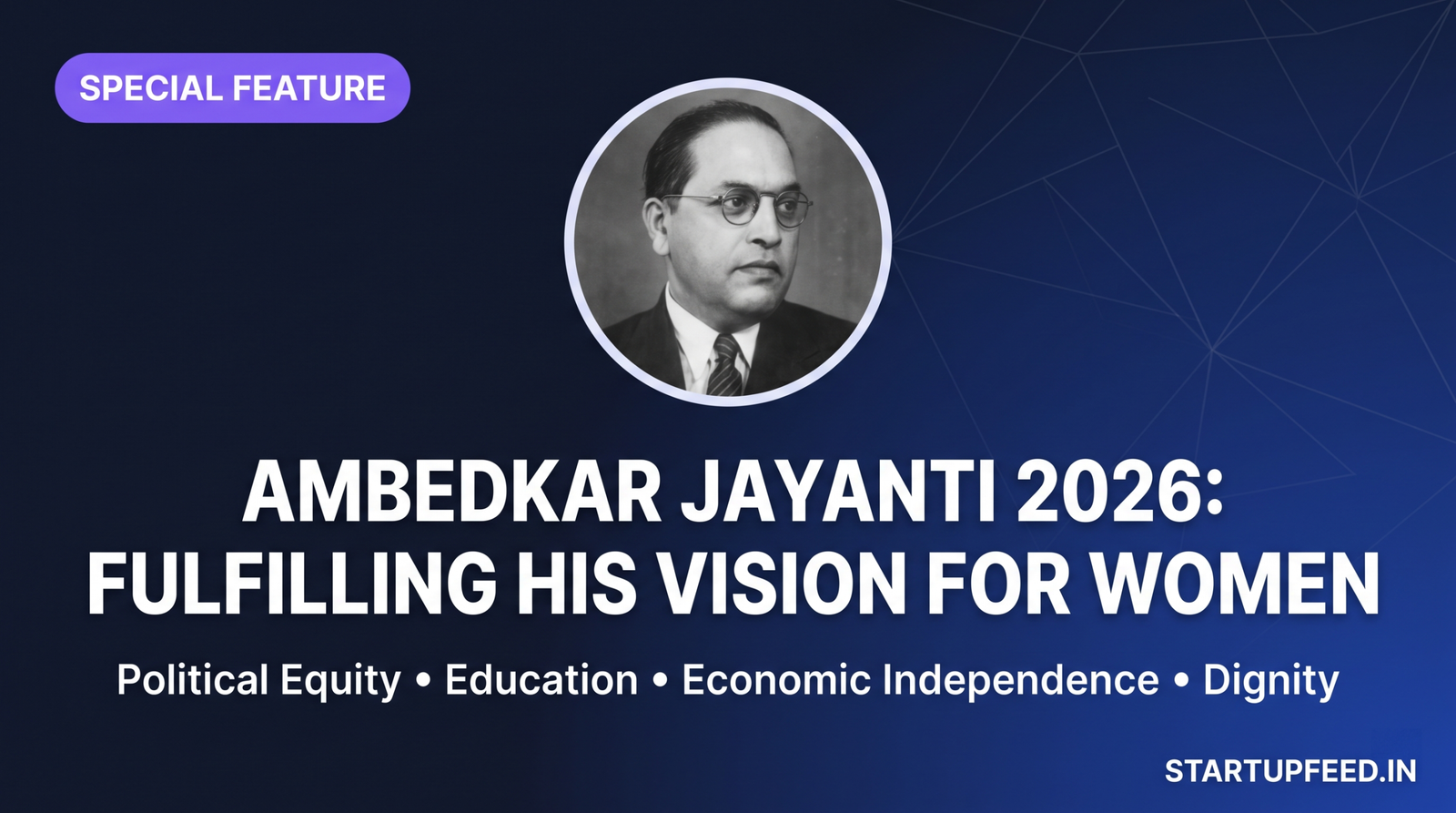
Dr. B.R. Ambedkar did not merely write the Constitution — he engineered legal personhood for Indian women at a time when the law offered them none. On his 135th birth anniversary, the metrics of governance reveal how far those ideals have traveled from parchment to practice, and how much road remains.
The distance between Ambedkar’s vision and today’s ground reality is not measured in speeches — it is measured in Jan Dhan accounts, toilet coverage, girls’ enrollment rates, and seats held in Parliament. Each number tells a story of structural change, imperfect but directional.
| StartupFeed Insight What the numbers say: Women’s economic participation has moved from policy intent to measured outcome — Jan Dhan accounts and Mudra loans show systemic financial inclusion, not symbolic gestures. What this means for you:
Our prediction: By 2028, women-led businesses supported through government schemes will account for 20%+ of India’s MSE credit disbursement — creating a structural investment opportunity that few are tracking today. |
Political Equality: The Unfinished Constitutional Mandate
Ambedkar’s draft Constitution guaranteed equal political rights — a radical act in 1949. He pushed for proportional representation, understanding that legal equality without political power was incomplete.
| Indicator | Status (2026) | Ambedkar’s Intent |
| Women in Lok Sabha | 15.2% (83 of 543) | Equal representation |
| Nari Shakti Vandan Act | 33% reservation passed, 2023 | Structural political equity |
| Women Chief Ministers | 3 of 28 states (2026) | Equal governance access |
| Panchayat Reservation | 50% in 20+ states | Grassroots political power |
The Nari Shakti Vandan Act of 2023 — reserving 33% of Parliamentary and State Assembly seats for women — is the most direct translation of Ambedkar’s demand for structural representation into law. Implementation is pending delimitation, but the legislative intent now matches the constitutional promise.
Education as Empowerment: Beti Padhao in Numbers
Ambedkar’s own life was a testament to education as liberation. He spent his life arguing that knowledge was the only tool that could break the double bind of gender and caste. Modern policy frameworks have operationalized this conviction.


| Scheme | Scale | Outcome |
| Beti Bachao Beti Padhao | 1.18 Cr girls covered | Sex ratio at birth improved: 918 to 934 |
| Sukanya Samriddhi Yojana | 3.5 Cr+ accounts | Rs 1.19 lakh Cr corpus (FY25) |
| Kasturba Gandhi Balika Vidyalaya | 6,600+ schools | SC/ST/OBC girls in residential schools |
| Girls’ Gross Enrollment Ratio (Higher Ed) | 28.5% (2023-24) | Historic high; surpassed boys in 2018 |
Girls’ Gross Enrollment Ratio in higher education surpassed that of boys in 2018 — a data point that would have moved Ambedkar, who was denied access to quality education before fighting his way to Columbia and the LSE. The challenge now is retention and quality, not just enrollment.
Economic Independence: From Scheme to Scale
Ambedkar argued that economic dependence was the structural root of women’s subordination. Financial inclusion, in his framework, was not a welfare measure — it was a justice measure. The data from the last decade reflects this philosophy at scale.
| Programme | Women Beneficiaries | Financial Impact |
| PM Jan Dhan Yojana | 29.56 Cr women (55.6%) | Rs 1.28 lakh Cr in deposits |
| PM Mudra Yojana | 68% loans to women | Rs 30,000+ Cr disbursed (FY25) |
| Self Help Groups (DAY-NRLM) | 1.03 Cr SHGs formed | 10.3 Cr rural women mobilised |
| Stand Up India | 80%+ beneficiaries women | Rs 40,700+ Cr sanctioned to date |
The 10.3 crore women mobilized through Self Help Groups represent the largest organized economic collective in Indian history. Ambedkar’s demand for economic independence was structural — he wanted systems that removed gatekeepers. SHGs and Jan Dhan, at their best, do exactly that.
Safe and Equal Workplaces: Rights That Are Written and Enforced
Ambedkar’s labour policy work — as Labour Member of the Viceroy’s Executive Council from 1942 to 1946 — established the legal scaffolding for worker rights. He championed maternity benefits and equal wages decades before they were codified.
| Legal Safeguard | Current Status |
| Maternity Benefit Act (amended 2017) | 26 weeks paid leave — among highest globally; covers 10 lakh formal sector women |
| POSH Act (2013, strengthened) | Mandatory Internal Complaints Committee; 500+ companies penalised in 5 years |
| Equal Remuneration Act | Integrated into Labour Codes 2020; equal pay mandate retained |
| Mines Act — women underground | Mines allowed women underground for first time; 2019 amendment |
| Factories Act amendment | Women permitted night shifts with consent and safety mandates |
The 2019 decision permitting women to work underground in mines directly reversed a 70-year exclusion that Ambedkar would have found paradoxical — a protection that was functionally a prohibition. The shift signals that workplace safety policy is moving from paternalism toward choice.
Dignity in Everyday Life: The Infrastructure of Equality
Ambedkar’s vision of dignity was not abstract. It was about the daily experience of a woman’s body in public space — whether she could travel safely, relieve herself with privacy, cook without inhaling smoke, and live without the risk of violence. Governance metrics in these dimensions are perhaps the most honest test of his legacy.
| Intervention | Scale | Impact |
| PM Ujjwala Yojana (LPG) | 10.33 Cr connections | Replaced biomass cooking for 10 Cr rural women |
| Swachh Bharat — Toilets | 11.7 Cr toilets built | Open defecation-free: 6 lakh+ villages |
| PM Awas Yojana — women title | 3.2 Cr homes to women | Property ownership — structural wealth creation |
| Beti Bachao — sex ratio | Sex ratio at birth: 934 (2023) | Up from 918 in 2014-15 |
| Nirbhaya Fund | Rs 6,200+ Cr deployed | Safe city, forensic labs, crisis centres |
House ownership registered in women’s names under PM Awas Yojana — 3.2 crore homes — may be the single most durable wealth-building intervention for women in independent India’s history. Ambedkar, who fought for property rights for women in the Hindu Code Bill, would have recognised the significance.

What’s Next: The Unfinished Agenda
Ambedkar was unsparing in identifying the gap between constitutional promise and lived experience. By that standard, the scorecard today is a work in progress.
Women’s labor force participation in India remains at 37% — among the lowest for large economies. The Nari Shakti Vandan Act awaits delimitation before it reshapes Parliament. Gender pay gaps persist in the formal sector. And violence against women remains the most stubborn indicator of social inequality.
Ambedkar did not measure progress by intent. He measured it by outcome. The outcomes of the last decade mark a directional shift — not arrival. The question his birth anniversary poses is not what has been done, but what remains structurally undone and by when it will be corrected.
Liked this story? Follow StartupFeed on Google so our reporting reaches you first.