QUICK TAKE :
|
|
|
|
|
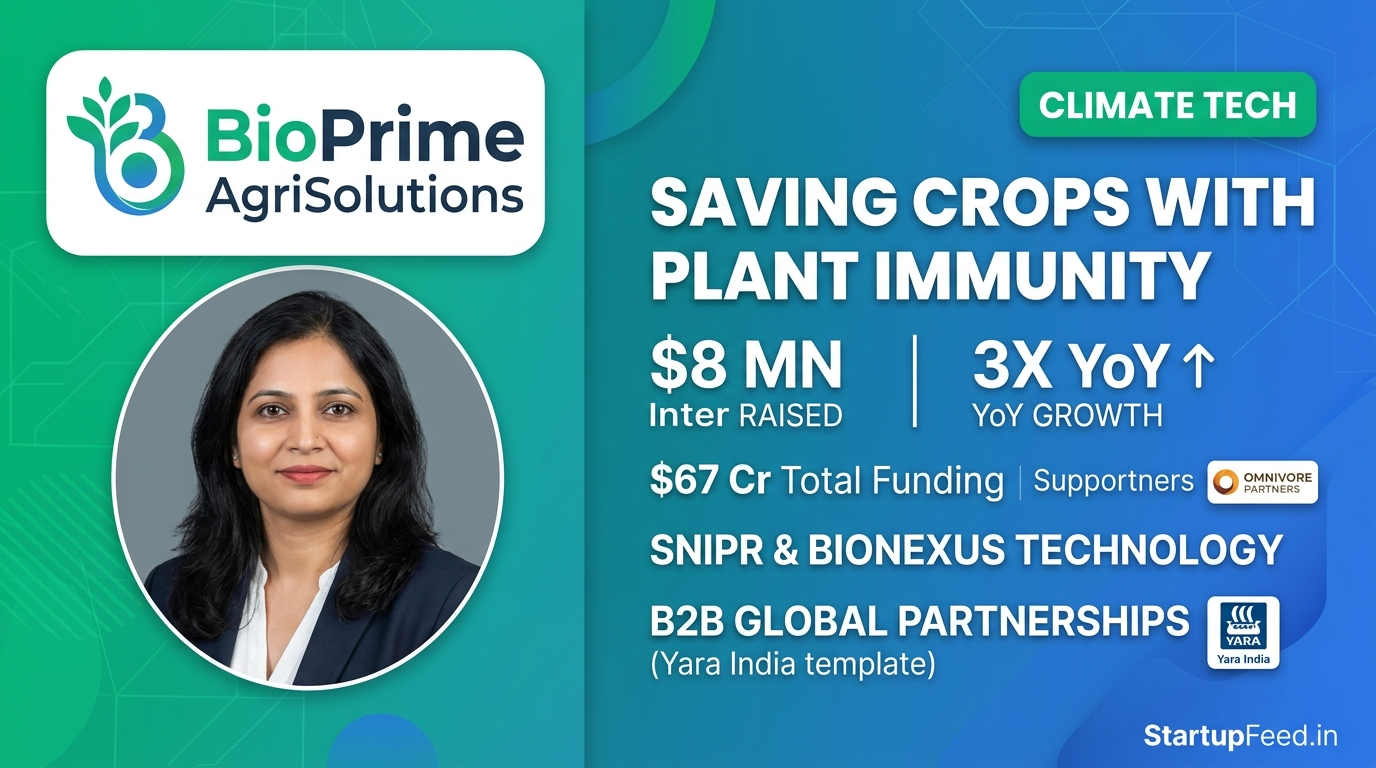
India’s farms have always battled nature, but the adversary has changed. Erratic monsoons, prolonged heatwaves, and unseasonal cold spells are no longer exceptions — they are the new norm. Pune-based BioPrime AgriSolutions has built a patented biological technology platform that lets crops defend themselves, using the same mechanisms plants evolved over millions of years before synthetic chemicals arrived.
The startup’s approach — priming crops with plant-derived biomolecules and beneficial microbes before stress hits — could rewrite how India and the world manage crop losses due to climate volatility. With $8 Mn raised, 3x year-on-year growth, and a B2B distribution playbook through large agri-input companies, BioPrime is no longer just a research outfit. It is a scaling commercial business targeting global markets.
STARTUPFEED INSIGHT
| What the numbers say: 3x YoY revenue growth with losses barely increasing is the clearest signal of operating leverage in a deeptech startup — BioPrime is past the ‘expensive science project’ stage and entering commercial scaling mode. |
| What this means for you: |
|
|
|
| Our prediction: BioPrime will secure a partnership or licensing deal with a global agrochem major — BASF, Corteva, or Syngenta — by FY28. India’s government push for natural farming (PM Pranam scheme, natural farming mission) will provide regulatory tailwind that accelerates their domestic commercial expansion by 2x in 18 months. |
Company Snapshot
| Attribute | Details |
|---|---|
| Full Legal Name | BioPrime Agrisolutions Pvt. Ltd. |
| Founded | 2016 |
| Headquarters | Pune, Maharashtra, India |
| Founders | Renuka Diwan (CEO), Amit Shinde, Shekhar Bhosle — all research scientists |
| Sector | Agritech / Agri-Biologicals / Climate Tech / Deeptech |
| Business Model | B2B — supply biologicals to large agri-input companies; licensing tech platform |
| Core Technology | SNIPR (biomolecules) + BioNexus (microbes) — two patented platforms |
| Products | Biostimulants, biofertilisers, biocontrols, bio-insecticides, bio-fungicides |
| Total Funding | ~$8 Mn (Rs ~67 Cr) across 8 rounds |
| Valuation | Rs 135 Cr (~$16 Mn) as per Tracxn (latest) |
| Revenue Growth | 3x YoY (most recent disclosed period) |
| Profitability Target | Next financial year (per CEO statement) |
| Key Partnerships | Yara India (Chiron product co-launch, May 2024) |
| Regulatory Approvals | Indian Govt approval for commercial microbe strains (Feb 2024) |
| Recognition | BIRAC BIG grant; AIM/ANIC 1.0 grantee; Top Sustainable Startup (CXO Today 2024) |
The Problem BioPrime Is Solving
India loses an estimated 15–25% of total crop production annually to abiotic stresses — heat, drought, waterlogging, salinity. Chemical solutions provide short-term relief but degrade soil health over time, increasing long-term vulnerability. Biological solutions existed before BioPrime, but most were slow-acting, inconsistently effective, or not designed for the specific stress patterns Indian crops face.

The deeper problem is timing. Farmers typically respond to stress after it appears — but by then, cellular damage has already occurred. BioPrime’s core insight is that crops can be pre-activated, primed to respond faster and more effectively when stress arrives, rather than being treated after the damage is done.
The SNIPR Platform: Priming Crops Before the Storm Hits
| SNIPR Attribute | Details |
|---|---|
| Full Name | Smart Nanomolecules Induced Physiological Response |
| Mechanism | Activates plant innate immunity using secondary metabolites naturally found in plants |
| What Secondary Metabolites? | Alkaloids, terpenes, amines, glucosinolates, quinones, phenolics, peptides |
| How It Works | Biomolecules prime the crop in advance — activating defense pathways before stress hits |
| Result | Crops survive temperature spikes, drought, waterlogging with lower yield loss |
| Key Advantage | Immediate, targeted action — works within hours of application |
| Chemical Profile | 100% biological, residue-free, non-toxic to soil and downstream ecology |
| Patent Status | Patented (India); international patent applications filed |
The SNIPR approach draws from innate immunity — the same principle by which a plant that has survived a drought once becomes better at surviving the next one. BioPrime has industrialised this mechanism into reproducible, scalable formulations that can be applied at scale across diverse crop types and geographies.
The BioNexus Platform: Restoring What Chemistry Has Destroyed
| BioNexus Attribute | Details |
|---|---|
| Full Name | Plant Trait Modifying Microorganisms platform |
| Core Library | 17,000+ plant-associated microbes collected across India |
| Geographic Coverage | Western Ghats, Himalayas, Northeast — India’s most biodiverse agroclimatic zones |
| Mechanism | Reintroduces beneficial microbes that decades of chemical farming have eliminated |
| Benefits | Better nutrient absorption, pest/disease resistance, improved soil structure |
| Timeline of Action | Long-term — soil restoration over growing seasons |
| Key Analogy | Gut microbiome for crops — restoring microbial balance that determines plant fitness |
| Outcome | Reduced dependence on synthetic fertilisers; 30–50% reduction in chemical input need (claimed) |
The gut microbiome analogy Diwan uses is not just marketing. It reflects genuine science: just as disruption of human gut flora causes metabolic dysfunction, destruction of plant-root microbiomes through synthetic inputs creates crops that become structurally dependent on chemical fertilisers to function. BioNexus aims to break that dependency cycle, not by eliminating inputs, but by restoring the biological baseline that makes crops naturally resilient.
SNIPR + BioNexus: Immediate Protection + Long-Term Restoration
| Dimension | SNIPR (Biomolecules) | BioNexus (Microbes) |
|---|---|---|
| Primary Action | Immediate crop protection from weather stress | Long-term soil and plant microbiome restoration |
| Timeline | Hours to days after application | Growing season to multi-season benefit |
| Mechanism | Activates plant innate immunity | Restores beneficial microbial ecosystems |
| Input Equivalent Displaced | Reduces chemical crop protection inputs | Reduces synthetic fertiliser dependency |
| End Benefit | Lower yield loss during climate stress events | Higher soil health, lower long-term input cost |
| Combined Effect | Immediate resilience + sustained health improvement |
Together, the two platforms address the two biggest pain points of Indian agriculture simultaneously — the urgent (this season’s crop loss) and the structural (this decade’s soil degradation). No other Indian agri-biologicals startup currently fields both a fast-action biomolecule platform and a large-scale microbe discovery library under one roof.
The Business Model: Why B2B Is the Right Play
BioPrime does not sell directly to farmers. Instead, it operates B2B — supplying formulations and licensing technology to established agri-input companies that already have last-mile distribution networks, farmer trust, and regulatory approvals in place. This is not a concession; it is a structural advantage.
| B2B Channel | What BioPrime Provides | What Partner Provides |
|---|---|---|
| Large agri-input companies (e.g. Yara India) | Formulations, technology IP, efficacy data, registration support | Distribution network, brand, farmer relationships, commercial scale |
| Agrochem multinationals (target) | SNIPR / BioNexus technology licensing | Global distribution, regulatory infrastructure across 50+ markets |
| Direct institutional (government schemes) | Bulk supply of bio-inputs for government natural farming programs | Procurement volume, policy alignment |
The Yara India partnership — which produced the co-branded Chiron product in May 2024 — is the template. Yara brings global credibility and a 175-country distribution footprint; BioPrime brings the science. The arrangement lets BioPrime achieve global presence without needing to build country-by-country regulatory and distribution infrastructure independently.

What the CEO Says
“We grew three-fold year-on-year, and our losses from the previous year barely increased. We are now looking to become profitable next year, with a strong focus on international expansion.”
— Renuka Diwan, CEO, BioPrime AgriSolutions
The quote encodes the key financial signal: revenue is growing 3x but losses are not growing proportionally. That is the definition of positive operating leverage — the business model is working, costs are not scaling 1:1 with revenue. A startup on this curve typically crosses profitability within 1–2 revenue-doubling cycles.
“BioPrime works to transform the way we grow crops making food more nutritious, and residue-free while restoring soil health using cutting-edge technologies and approaches, always keeping sustainability at our core. At Bioprime we are focusing on discovering fundamental aspects of plant communication, developing novel biologicals based on trait-modifying microbes and physiology-modulating molecules.”
— Renuka Diwan, CEO, BioPrime AgriSolutions
Funding History
| Round | Date | Amount | Lead Investor(s) | Use of Funds |
|---|---|---|---|---|
| Seed | 2017 | Undisclosed | Venture Center / BIRAC | Early R&D, platform development |
| BIRAC BIG Grant | 2018–19 | Govt grant | BIRAC, DBT, Govt of India | SNIPR platform research & IP |
| Pre-Series A | Oct 2022 | Rs 9 Cr (~$1.1 Mn) | Inflexor Ventures (lead), Omnivore | SNIPR registrations, IP portfolio, production scale |
| Series A | Oct 2025 | $1.24 Mn | Capitar Ventures | Market expansion, biologicals registrations |
| Total (disclosed) | 2017–2025 | ~$8–9.33 Mn | Multiple investors | Cumulative across all rounds |
BioPrime’s funding profile is deliberately capital-efficient for a deeptech agri-biologicals company. Eight rounds over 8 years at $8 Mn total means the team has funded meaningful IP creation, regulatory approvals, and commercial traction without diluting excessively — a deliberate founders’ choice to retain strategic control while proving the model.
Key Investors
| Investor | Type | Investment Thesis Fit |
|---|---|---|
| Omnivore Partners | Agri-focused VC (India) | Agriculture, food systems, rural tech — BioPrime is core to the thesis |
| Inflexor Ventures | Deep tech VC (India) | Backs pure-science Indian companies with IP-led models |
| BIRAC / DBT | Govt of India biotech fund | Supports early biotech innovations with national agricultural impact |
| Capitar Ventures | VC (latest round) | Series A lead — growth stage agricultural biotech focus |
| Venture Center | Incubator/seed | CSIR-NCL-affiliated incubator in Pune — first institutional backer |
Competitive Landscape
| Company | What They Do | Differentiation vs BioPrime |
|---|---|---|
| Invati Crucials | Biological crop protection, seed treatments | No patented biomolecule platform; narrower product line |
| Nano-Yield | Nano-nutrient agri-biologicals | Nano-nutrient delivery focus; lacks microbe library depth |
| Nanoventions | Nanotech agricultural inputs | Technology platform, not a dual biomolecule+microbe play |
| Global: Indigo Agriculture (US) | Microbial seed treatments | Microbe-only platform; no SNIPR-equivalent biomolecule tech |
| Global: Pivot Bio (US) | Nitrogen-fixing microbes | Nitrogen focus only; does not address abiotic climate stress |
BioPrime’s combination of SNIPR and BioNexus into a single platform — addressing both immediate climate stress and long-term soil health — is not replicated by any funded Indian competitor. Globally, the closest analogues operate in narrow verticals. The integrated platform is BioPrime’s core defensible moat.
Market Opportunity
| Market | Size / Projection | BioPrime’s Entry Point |
|---|---|---|
| India Agri-Biologicals Market | Rs 3,500 Cr (FY25); growing 12–15% CAGR | B2B supply to established players with distribution |
| Global Biopesticides Market | $7.6 Bn (2025); projected $14 Bn by 2030 | Licensing SNIPR to multinational agrochem companies |
| Global Biostimulants Market | $3.5 Bn (2025); fastest-growing agri input category | BioNexus + SNIPR combination product range |
| India Natural Farming Mission | Govt targeting 1 Cr farmers by 2025-26 | Government procurement and scheme-backed distribution |
Global Expansion: The Yara India Blueprint
The Yara India partnership for the Chiron product — announced May 2024 — is not just a commercial win. It is proof that BioPrime’s B2B licensing playbook works with a company that operates in 175 countries. Yara is the world’s largest mineral fertiliser producer and a significant biopesticide investor. For BioPrime, the Yara relationship provides a template for replication with other global agrochem majors across geographies where SNIPR registration is obtained.
The company’s govt-approved commercial microbe strains (Feb 2024) further strengthen its global expansion readiness — regulatory approvals in India are often a prerequisite for applications in regulatory frameworks in Southeast Asia, the Middle East, and parts of Africa, where Indian approvals carry recognition weight.
What’s Next for BioPrime
- Profitability: CEO Renuka Diwan has publicly targeted profitability in the next financial year — a meaningful milestone for a deeptech startup with 8 years and 8 funding rounds behind it.
- SNIPR registrations in new geographies: Regulatory approvals for biologicals are the longest-lead-time item in global expansion — BioPrime is already in process for multiple international markets.
- IP portfolio expansion: Additional patents based on the 17,000-microbe BioNexus library are expected — this library is a strategic moat that compounds with each new filing.
- New global partnerships: Following the Yara India model, BioPrime is positioning for additional multinational agri-input company partnerships across Asia, Africa, and Latin America.
Our view: BioPrime is the quietly building story in Indian agritech — no flashy consumer app, no GMO controversy, no dependence on government subsidy cycles. Just a science-first team with patented technology, a capital-efficient model, and a global distribution partnership already operational. If it achieves profitability next year, the fundraising narrative transforms entirely — from ‘promising deeptech’ to ‘profitable IP company seeking global scale capital.’
Liked this story? Follow StartupFeed on Google so our reporting reaches you first.