
Published: October 15, 2026
StartupFeed Quick Take
- India will get its first dedicated national data centre policy, covering a sector the government sees as a $200 Bn opportunity.
- Minister Jitin Prasada gave no scope or start date. The power ministry expects AI data centres to need 26.3 GW of extra power by 2031-32.
- The policy will sit over projects already under way: Google’s 1 GW Visakhapatnam hub, TCS’s 1 GW Hyderabad campus, and Amazon’s 422 MW Thane plan, which locals are protesting.
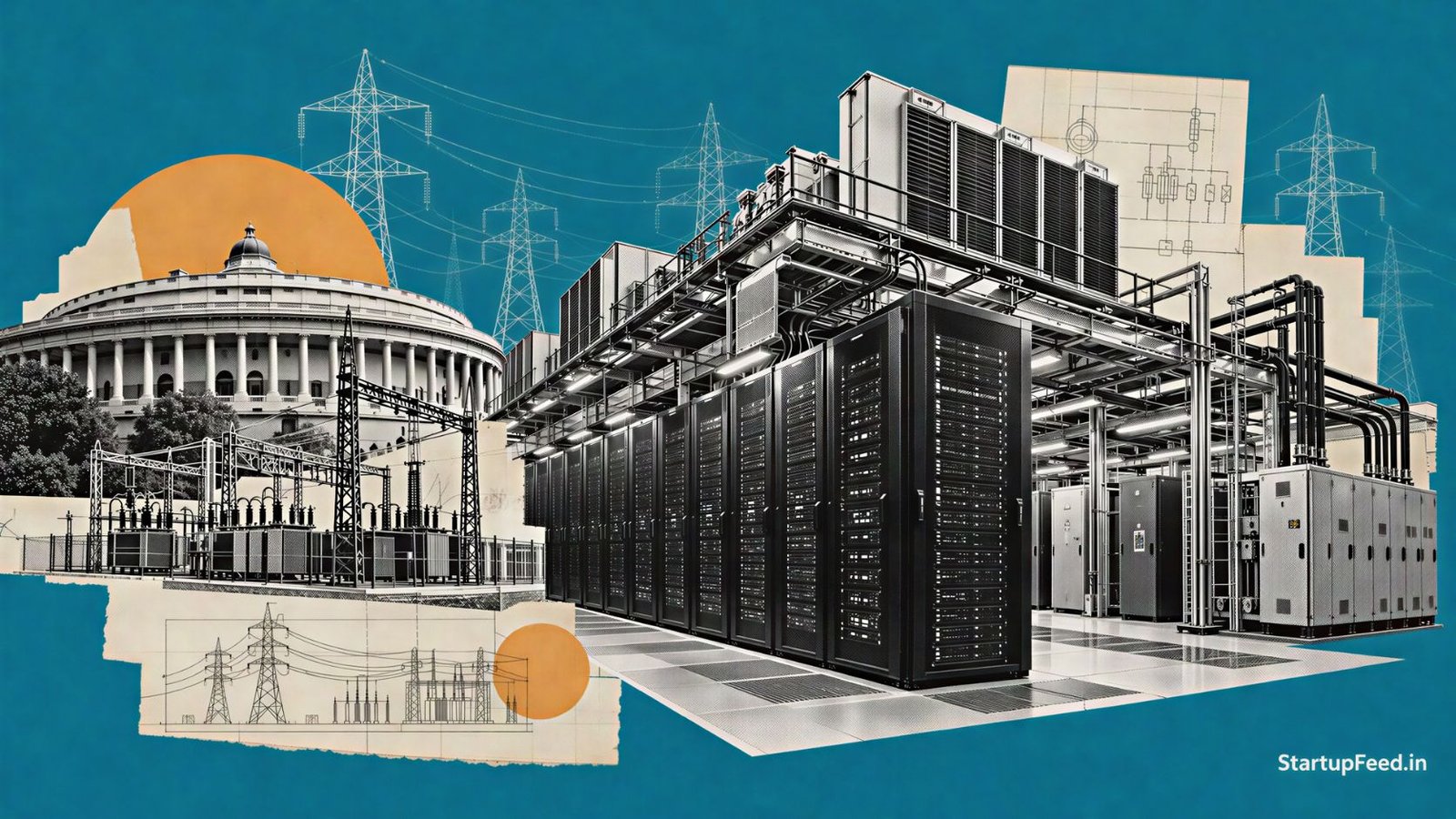
India will frame a national data centre policy to stop the sector’s power use from lifting home power bills, minister Jitin Prasada said in New Delhi.
Prasada spoke on October 14 at a Central Electricity Authority conclave on making the power sector AI-ready. He gave no detail on what the policy would cover or when it would arrive. The government sees data centres as a $200 Bn opportunity.
Their power use is climbing fast. The power ministry has told Parliament that AI data centres could need 26.3 GW of extra power by 2031-32, nearly double its estimate from March. That is a heavy new load for a grid that still leans on coal.
Why India wants a data centre policy now
India wants a data centre policy because the sector’s power and water use is starting to clash with consumers’ needs. Prasada said data centres in some countries pull power away from households, who then pay more. He wants to avoid that at home.


The worry is already on the ground. In Thane, near Mumbai, residents are protesting a proposed Amazon data centre that would draw about 422 megawatts. Their complaints cover power and water demand, diesel-generator noise and tree felling.
Google has met the same pushback in Visakhapatnam, over land, water and energy. Supply is the other half of the problem. Prasada warned that green power is not growing fast enough for what AI will need.
Water is a worry too. Many of India’s data-centre hubs, from Mumbai to Hyderabad, already run short in summer. Last month Prasada pointed to closed-loop systems that recycle cooling water as one answer.
At the conclave, the minister put it plainly:
“We are rolling out a policy for data centres because we think India is a very fertile ground for hyperscaler data centres.”
Jitin Prasada, minister of state for electronics and IT. From his remarks at the Central Electricity Authority conclave, New Delhi, October 14, 2026.
What the policy could change
Right now India has no single rulebook for data centres. The sector runs on general environmental and building rules, plus a patchwork of state deals. Several states offer long tax breaks and cheap power to win projects.
A national policy would set common standards over the top. One idea under discussion is to place new data centres away from crowded cities, near clean energy, to ease grid strain. The goal is to match where the power sits with where the demand lands.
The money is already in place. In this year’s Budget, the government offered a tax holiday until 2047 for foreign firms that serve global cloud customers from Indian data centres. National rules would add power, water and siting on top.

The projects the policy will have to govern
Over three decades, India built about 2.2 GW of data-centre capacity. This year alone, firms have announced several times that. The policy will land on a market it has never had to manage before.
Four projects alone show the new scale, and the power they will pull from the grid. Two are gigawatt-scale campuses; the other two range from 240 to 422 megawatts.
| Project | Location | Power capacity | Status |
|---|---|---|---|
| Google AI hub (with AdaniConneX, Airtel) | Visakhapatnam, Andhra Pradesh | Up to 1 GW | Building since April 2026; $15 Bn over 2026-30 |
| TCS HyperVault | Hyderabad, Telangana | Up to 1 GW | Announced September 2026; up to Rs 70,000 Cr |
| Amazon | Thane, near Mumbai | 422 MW | Proposed; residents protesting |
| CoreWeave (with AdaniConneX) | Navi Mumbai | 240 MW (can double to 480) | First phase from mid-2028 |
The list keeps growing. Microsoft has committed $3 Bn to expand its cloud and AI work in India. HCLTech has tied up with Sarvam AI for a $1.5 Bn data centre in Odisha.
OpenAI and Meta are expanding here too. By one estimate from S&P Global, the sector’s power use could rise about fivefold by 2030, from 13 terawatt-hours in 2024 to 57. That would make India the second-biggest data-centre power user in the Asia-Pacific region.
The policy has to keep pace with all of it.
What this means for you: If you run an AI, cloud or data-heavy startup, your compute costs and site approvals will soon hinge on one national rulebook, not state-by-state deals. Watch the policy’s power-sourcing and siting rules before you sign a long data-centre lease or pick a city for one.
StartupFeed Insight
This policy’s real fight will not be about welcoming data centres. The country has all but won that race, with gigawatt-scale campuses rising in Andhra Pradesh and Telangana and big leases around Mumbai. That fight will be over who pays for the power: the hyperscaler, the state, or the household. States have bid against each other with cheap tariffs and long tax breaks, and a national policy may quietly cap that race. Expect the first draft to favour sites away from big cities and firm clean-power supply. If it lands before the February 2027 Budget, read the power-tariff clauses first.
By Avinash Mishra, Business Correspondent
Have a tip? Write to us at editorial@startupfeed.in.
Liked this story? Follow StartupFeed on Google so our reporting reaches you first.