Published: October 13, 2026
StartupFeed Quick Take
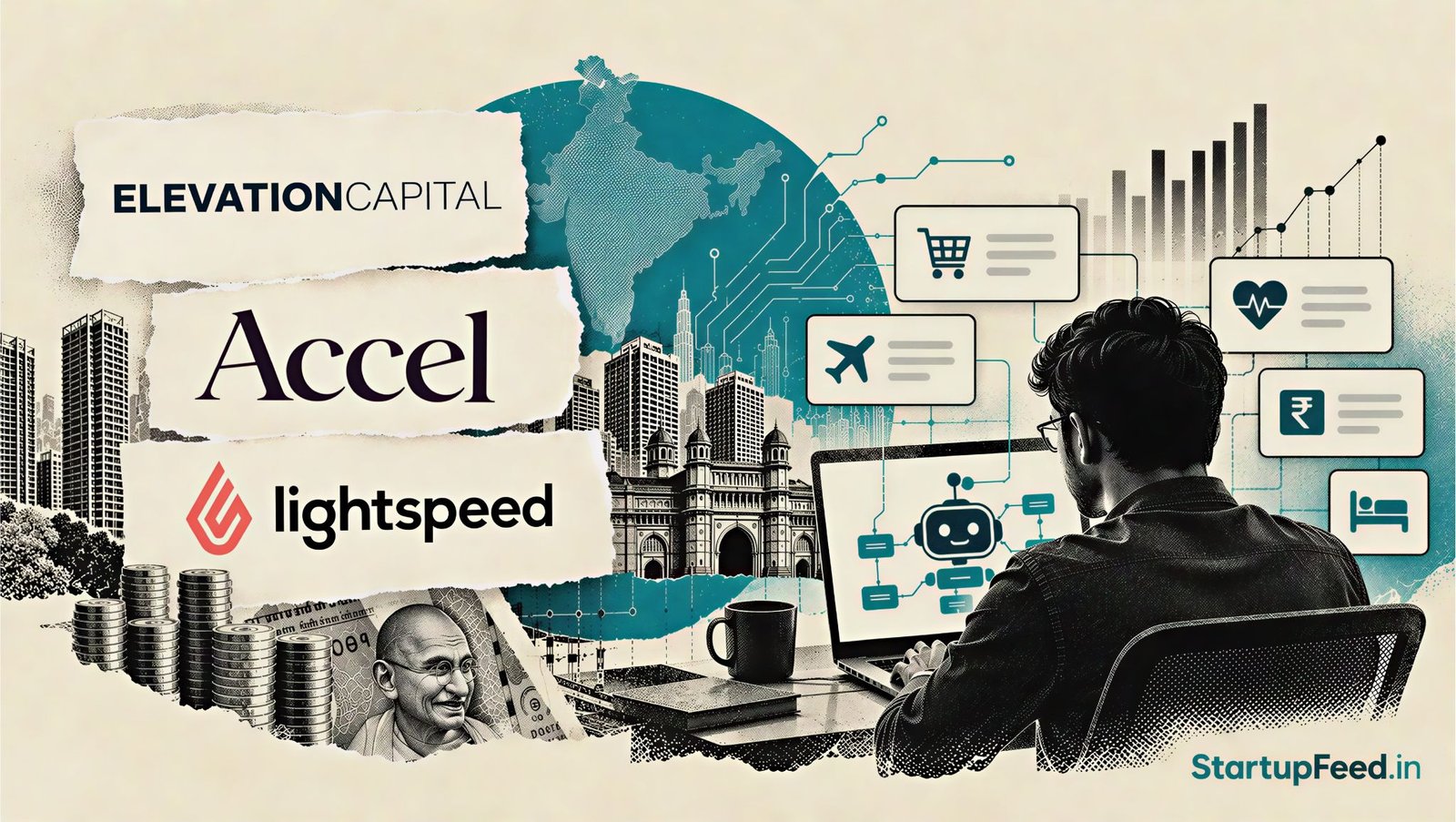
- Three Indian VCs, Elevation, Accel and Lightspeed, have raised about $1.3 Bn in new early-stage funds in 2026, much of it aimed at AI.
- Elevation closed a $500 Mn fund in July. Accel closed a $550 Mn India fund in August. Lightspeed is raising a $250 Mn India fund built only for AI.
- The three funds plan to keep deploying through 2027, with early bets like Oolka ($14 Mn) and Dextr AI ($6.7 Mn).
Three of India’s largest early-stage funds have raised about $1.3 Bn in 2026 to back startups building AI agents for consumers.
The shift is sharp, not loose. Two of those Indian VCs are actually raising less than before.
Elevation’s new fund is $500 Mn, down from the $670 Mn it raised in 2022. Lightspeed is targeting $250 Mn, half the size of its last India fund.
The money is chasing a real jump. Inc42 data shows Indian AI startups raised $676 Mn in the first half of 2026. That is more than four times the $162 Mn from a year earlier.
Three new funds, all tilted toward AI
Elevation Capital closed its ninth fund, Fund IX, at $500 Mn in July 2026. The firm said it is backing seed and Series A founders who build products on top of AI models, not the models themselves.
Accel closed a $550 Mn India fund in August, its eighth for the region. The firm still holds more than half of its earlier $650 Mn India fund. It plans to start deploying the new money in 2027.
Lightspeed is raising a $250 Mn India fund that invests only in early-stage AI. The firm has committed about 80% of it already. For the first time, Lightspeed has lined up its India fund with its global cycle.
Add the three together and you get about $1.3 Bn in fresh early-stage capital, aimed at Indian founders building with AI. A fourth investor, Peak XV, is working the same seam through its Surge programme.
Peak XV framed the trend plainly when it unveiled its latest Surge cohort in September.
“AI is a major enabler, but increasingly it is becoming the architecture of the product rather than the product itself.”
Rajan Anandan, Managing Director, Peak XV and Surge. From the firm’s Surge 12 announcement, September 2026.
What a consumer AI agent actually does
An AI agent is software that acts for you. You state what you want. The agent then searches, compares, books and pays, often without you opening an app.
For a decade, consumer apps competed for your attention. They fought over feeds, banners and the home screen.


The bet now is different. Investors think the next wave of value will sit with software that acts on your intent, not your scrolling.
SuperLiving shows the shape. The Bengaluru startup runs a round-the-clock AI companion for health and wellness, built for users in smaller Indian cities. Lightspeed led its $7 Mn round in June 2026.
The pattern repeats across sectors. Some agents manage your money. Others run a hotel’s front desk or coach your spoken English.
Where Indian VCs are writing cheques
The clearest signal is the deal flow. Each of the four funds has already backed a consumer AI agent this year. The table below maps one round to each.
Oolka is the most funded of the group. The credit startup has crossed 6 million users and $2.5 Mn in yearly recurring revenue. Accel led its $14 Mn round in April 2026.
| Startup | What its AI agent does | Round | Lead investor |
|---|---|---|---|
| Oolka | Manages credit and personal finance | $14 Mn Series A, April 2026 | Accel |
| SuperLiving | Health and wellness companion | $7 Mn Series A, June 2026 | Lightspeed |
| Dextr AI | Runs hotel and hospitality operations | $6.7 Mn seed, September 2026 | Elevation |
| Ditto | AI matchmaker inside iMessage | $9.2 Mn seed, 2026 | Peak XV (Surge) |
The cheques are small by global standards. Oolka’s $14 Mn is the largest here, and most rounds sit between $6 Mn and $9 Mn. For seed and Series A in India, that is normal.
The catch: startups don’t own the smart layer
There is a weak spot in this bet. Most Indian agent startups do not own the parts that matter most. They rent the AI models from firms like OpenAI and Google, and they reach users through platforms like WhatsApp.
So the intelligence and the distribution both sit with someone else. If a model maker or a platform builds the same feature, the startup can be squeezed. That is the risk investors are paying to get ahead of.
Even so, some have scale. Elevation also backs SpeakX, an AI English-speaking tutor that says it has crossed 10 million users.
India may still offer a real edge. Much of the country’s supply has no software interface, and vendors deal in regional languages. An agent that can call a local shop and book in Hindi or Kannada reaches commerce that global models miss.
What this means for you: If you are a founder building a consumer app at the application layer, three of India’s largest early-stage funds are now actively writing AI cheques. Pitch the agent, the data and the real-world task you own, not another feed, because Elevation, Accel and Lightspeed plan to deploy through 2027.
StartupFeed Insight
Read the fund sizes, not just the headlines. Two of these three funds are smaller than their last ones, so this is a sharper bet, not a bigger one. The investors are buying focus. The real moat for an Indian agent startup is not the chatbot. It is the messy local supply that has no software link, and speaks in regional languages. Whoever wires that up owns the layer. My call: by the end of 2027, the first breakout agent from this group will come from fintech or hospitality. Those are the places where returns are easy to measure, not a general assistant.
By Saraswati Chaubey, Writer
Have a tip? Write to us at editorial@startupfeed.in.
Liked this story? Follow StartupFeed on Google so our reporting reaches you first.