
Quick Take
- Microsoft opened its fourth India cloud region, India South Central, in Hyderabad.
- It is backed by a $20.5 Bn India investment, split across two commitments.
- Early users include Meesho, PhysicsWallah, HDFC Bank, Adani Group and Bajaj Finserv.
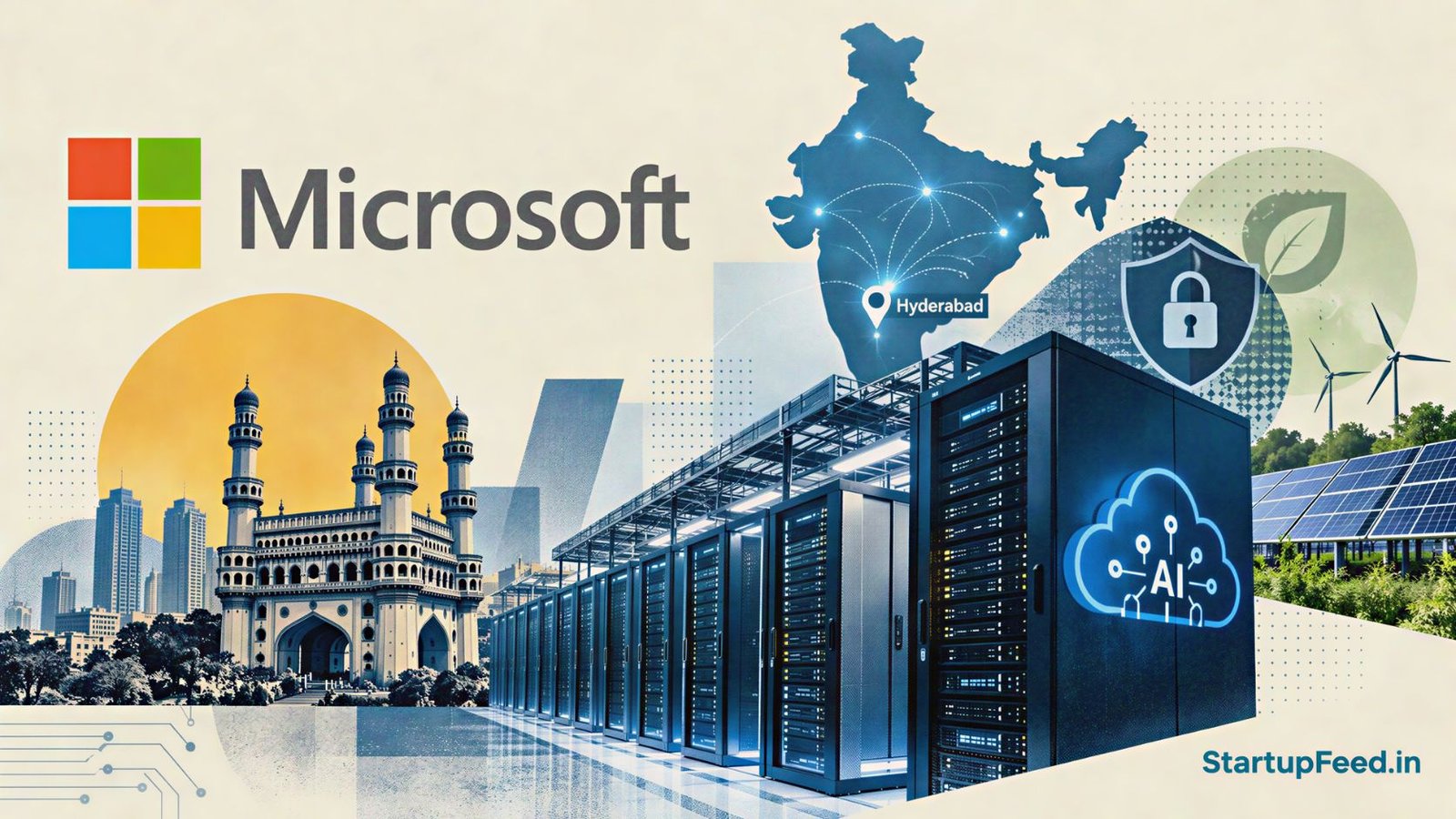
Microsoft has opened its fourth India cloud region in Hyderabad, giving startups and banks a new home for AI workloads inside the country. The region is called India South Central.
It became generally available on August 6, 2026. Microsoft formally launched it on Monday at its AI Infrastructure Summit in New Delhi.
The region joins three older ones: Central India in Pune, South India in Chennai, and West India in Mumbai. Hyderabad is now the company’s largest cloud hub in India.
The launch is the first delivery against Microsoft’s $17.5 Bn India commitment, announced in December 2025. That sits inside a wider $20.5 Bn pledge for the country’s cloud and AI build-out.
What did Microsoft launch in Hyderabad?
Microsoft launched a full cloud region with three availability zones in Hyderabad, Telangana. Each zone has its own power, cooling and networking. That design lets a bank fail over to another zone if one goes down.

The region is built for AI from day one. It uses air-cooled chillers that need effectively zero water for cooling. It is backed by more than 1,000 MW of renewable energy contracts.
“India heard our commitment,” said Puneet Chandok, President of Microsoft India and South Asia. “Today, India can see it, built, live and running.”
The region will also support Microsoft Foundry and more AI services as capacity grows. Microsoft says all its India regions are now AI-enabled.
Who is already using the region?
Named early customers include Adani Group, HDFC Bank, Bajaj Finserv and PB Pay. Startups on the list include Meesho, PhysicsWallah, Kore.ai and Fractal. Air India and Apollo Hospitals have signed up too.
HDFC Bank is using Hyderabad as a disaster recovery site for its Pune workloads. Atish Bhanushali, Senior Vice President II and Head of Cloud Infra at HDFC Bank, called the launch a milestone in the bank’s Azure journey.
The region ships with sovereign public and private cloud options. It is aligned with MeitY guidelines, RBI rules and CERT-In norms. That helps firms meet India’s Digital Personal Data Protection framework.
How much data centre capacity does India have?
India has about 2 GW of data centre capacity today. Chandok expects that to reach 12 GW to 14 GW by 2035. The gap is the whole point of the investment.

The country makes a lot of data but stores little of it at home. That mismatch is what Microsoft is betting on.
| Measure | Where India stands |
|---|---|
| Share of world’s data generated | About 20% |
| Share of global data centre capacity | About 3% |
| Data centre capacity now | About 2 GW |
| Projected capacity by 2035 | 12 GW to 14 GW |
“Between these two numbers sits the largest opportunity of the decade for India,” Chandok said. The first number is the 20% of data. The second is the 3% of capacity.
What does Microsoft plan next?
Microsoft will expand its existing regions in Chennai, Hyderabad and Pune. It also plans to skill 20 million Indians in AI by 2030, including two million teachers.
Shri Jitin Prasada, Minister of State for Commerce and Industry, and Electronics and Information Technology, backed the move. He said the region strengthens the digital base India needs for its AI-first goal.
Chandok compared the build-out to India’s Green Revolution. In his words, AI models are the new seed and compute is the irrigation. The demand is here. The supply is being built.
What this means for you: Indian founders now get an AI-ready, data-resident cloud region in Hyderabad, which makes DPDP compliance and low-latency AI easier to run at home.
StartupFeed Insight
The headline number is $20.5 Bn, but the number founders should watch is the jump from 2 GW to 14 GW. That is a seven-fold rise in home capacity by 2035, and it decides whether Indian AI startups train models here or keep renting capacity abroad. The customer list is the real tell. Meesho, PhysicsWallah, Kore.ai and Fractal are not enterprise giants, they are scaled startups picking a sovereign region for compliance and latency. Expect more Indian AI firms to move core workloads onshore through 2027 as DPDP enforcement tightens and data residency stops being optional.
— Avinash Mishra, Business Correspondent
Frequently Asked Questions
Liked this story? Follow StartupFeed on Google so our reporting reaches you first.