Quick Take
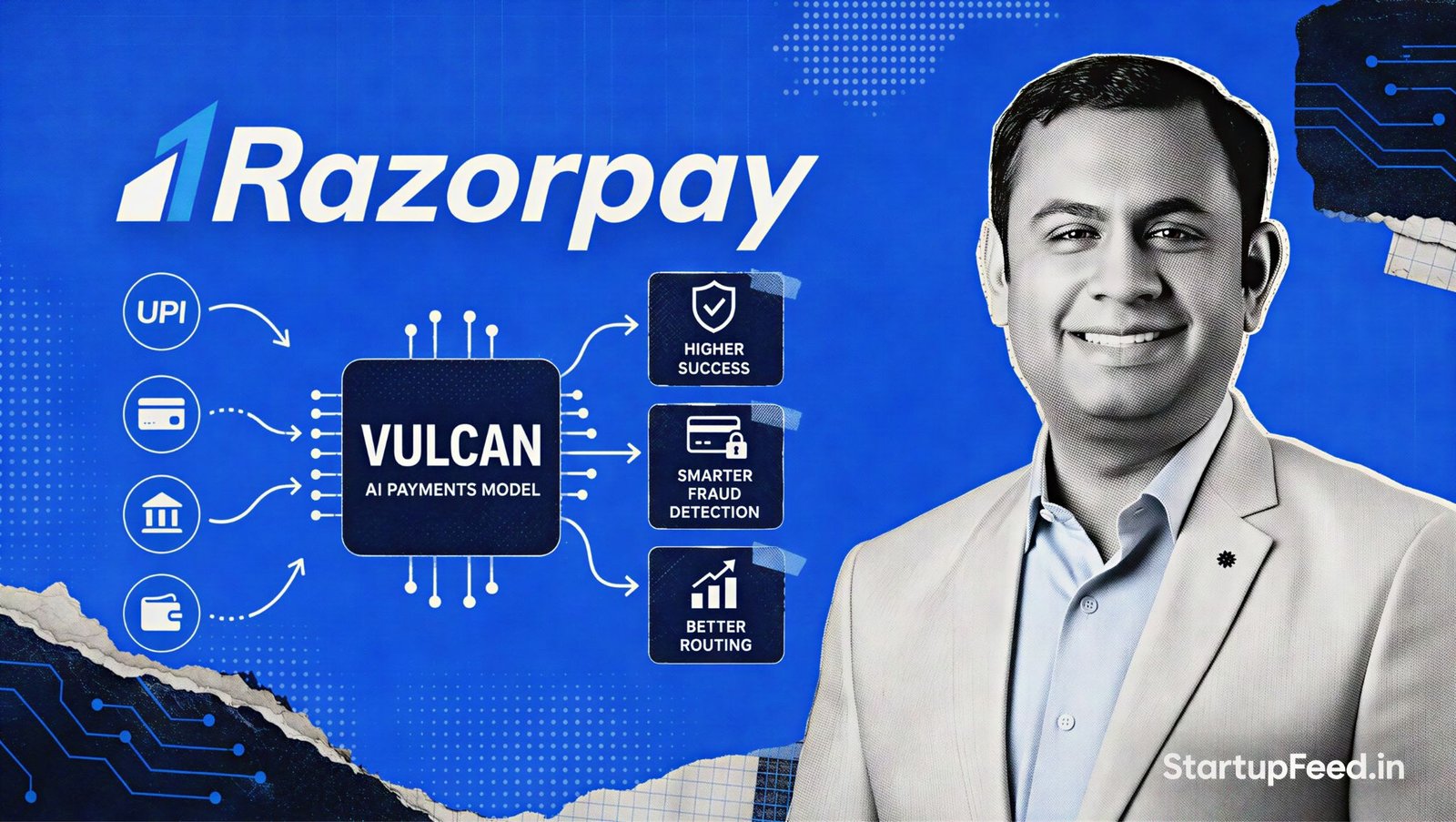
- Razorpay launched Vulcan, an AI payments model trained on 4 billion payments and about 3 trillion data points.
- The model lifts payment success rates by up to 10% and flags 8 times more international card fraud.
- Razorpay is not charging merchants for Vulcan, and its confidential IPO papers are already filed.
Razorpay has launched an AI payments model called Vulcan, built with technology from Nvidia and Amazon Web Services. The company announced it on Tuesday, August 18, 2026.
Razorpay calls Vulcan India’s first transformer-based AI foundation model built only for payments. It is designed to cut payment failures, catch fraud and fix checkout friction.
The model is trained on about 4 billion payments and roughly 3 trillion data points, according to the company. It reads around 3,000 signals for every single transaction.
That scale is the point. A normal fraud model checks one signal at a time. Vulcan reads the whole journey of a payment at once.
What is Razorpay Vulcan?
Razorpay Vulcan is a proprietary AI foundation model for payments. Razorpay owns both its design and its training data.



Razorpay frames Vulcan as a system that learns how money moves, not as a chatbot. It is not a large language model that reads text.
Instead, Vulcan learns from the payments network and improves with every transaction it processes. It replaces many small machine-learning models with one shared intelligence layer.
The name follows Razorpay’s recent AI push. At its FTX 2026 event, the company showed Agent Studio, an AI platform built on Anthropic’s Claude. Vulcan sits deeper in the stack, inside the payment itself.
Razorpay processes more than $180 billion in annualised payments. Its network runs across UPI, cards, net banking, wallets and cash on delivery, through hundreds of banks and gateways.
How does Vulcan improve payments and fraud detection?
Vulcan improves payments by picking the best route for a transaction before it is even attempted. It also scores fraud and risk in real time.
Razorpay has deployed early parts of the model on live transactions. The company reports clear early results from that rollout.
Payment success rates rose by up to 10%. The model detected and prevented 8 times more international card fraud than before.

It also caught 5 times more fraudulent or disputed transactions. It did this without raising the number of alerts, so genuine buyers face less friction.
On checkout, 40% more shoppers now see their preferred UPI app first. Razorpay says that helps complete an extra 1 to 2 lakh purchases every month.
Blinkit, the quick-commerce firm, is among the early platforms using the system. It has reported better transaction completion.
| Metric | Result with Vulcan |
|---|---|
| Payment success rate | Up to 10% higher |
| International card fraud caught | 8x more |
| Fraudulent or disputed transactions flagged | 5x more |
| Shoppers seeing preferred UPI app | 40% more |
| Extra purchases completed monthly | 1 to 2 lakh |
Why did Razorpay build Vulcan now?
Razorpay built Vulcan after studying where payments break. The internal study covered 1.5 million shoppers and more than 51,000 businesses.
It found that payment friction hit buyers in both big cities and smaller towns. Failed payments push some Indians back toward cash.
Razorpay Chief Executive and Co-founder Harshil Mathur said the aim was to make digital payments more dependable. He pointed to consumers still deciding whether to trust digital payments over cash.
Razorpay was founded in 2014 by Harshil Mathur and Shashank Kumar. It has raised over $740 million from backers including Y Combinator, Tiger Global and Peak XV Partners.
The technology partners bring the compute. Pahal Patangia, who leads global payments business development at Nvidia, said India’s digital economy is a chance to make payments more intelligent and secure.
The AWS side runs on Amazon SageMaker. Kiran Jagannath, Head of FSI and Conglomerates at AWS India and South Asia, said the model consolidates billions of transaction insights into one learning layer.
What does Vulcan mean for Razorpay’s IPO?
Vulcan lands as Razorpay prepares to go public. The company filed confidential draft IPO papers in June 2026.
Its public offer is expected to be about $600 million to $700 million. That could value Razorpay at $5 billion to $6 billion.
The figure sits below its last private valuation of $7.5 billion, set in December 2021. Razorpay reported revenue of Rs 3,783 crore in FY25.
For now, Razorpay is not charging merchants to use Vulcan. The company is treating it as a way to grow payment volume and keep merchants on its platform.
That choice matters in a crowded market. Razorpay competes with PhonePe, Paytm, Cashfree and global players like Stripe.
Razorpay says Vulcan will later power decisions across authentication, routing, fraud and lending. The model is built to grow as India’s digital commerce grows.
StartupFeed Insight
The number that should catch an operator’s eye is not the fraud multiple. It is the zero. Razorpay is giving Vulcan away, and a free infrastructure layer is a competitive weapon aimed straight at PhonePe and Cashfree. Success rate is where payment firms win or lose enterprise merchants, and a 10% lift is enough to move a large account. The IPO timing is not a coincidence either. A model owning its own data and architecture is an asset story investors can price, unlike a reseller of someone else’s AI. Expect at least one rival to announce a comparable payments model before Razorpay lists, likely within two quarters.
— Harshvardhan Kothari, Technology and Policy Correspondent
What this means for you: If you run checkout on Razorpay, ask your account team when Vulcan routing switches on for you, because a 10% success lift is real revenue.
Frequently Asked Questions
Have a tip? Write to us at editorial@startupfeed.in.
Liked this story? Follow StartupFeed on Google so our reporting reaches you first.