
Quick Take
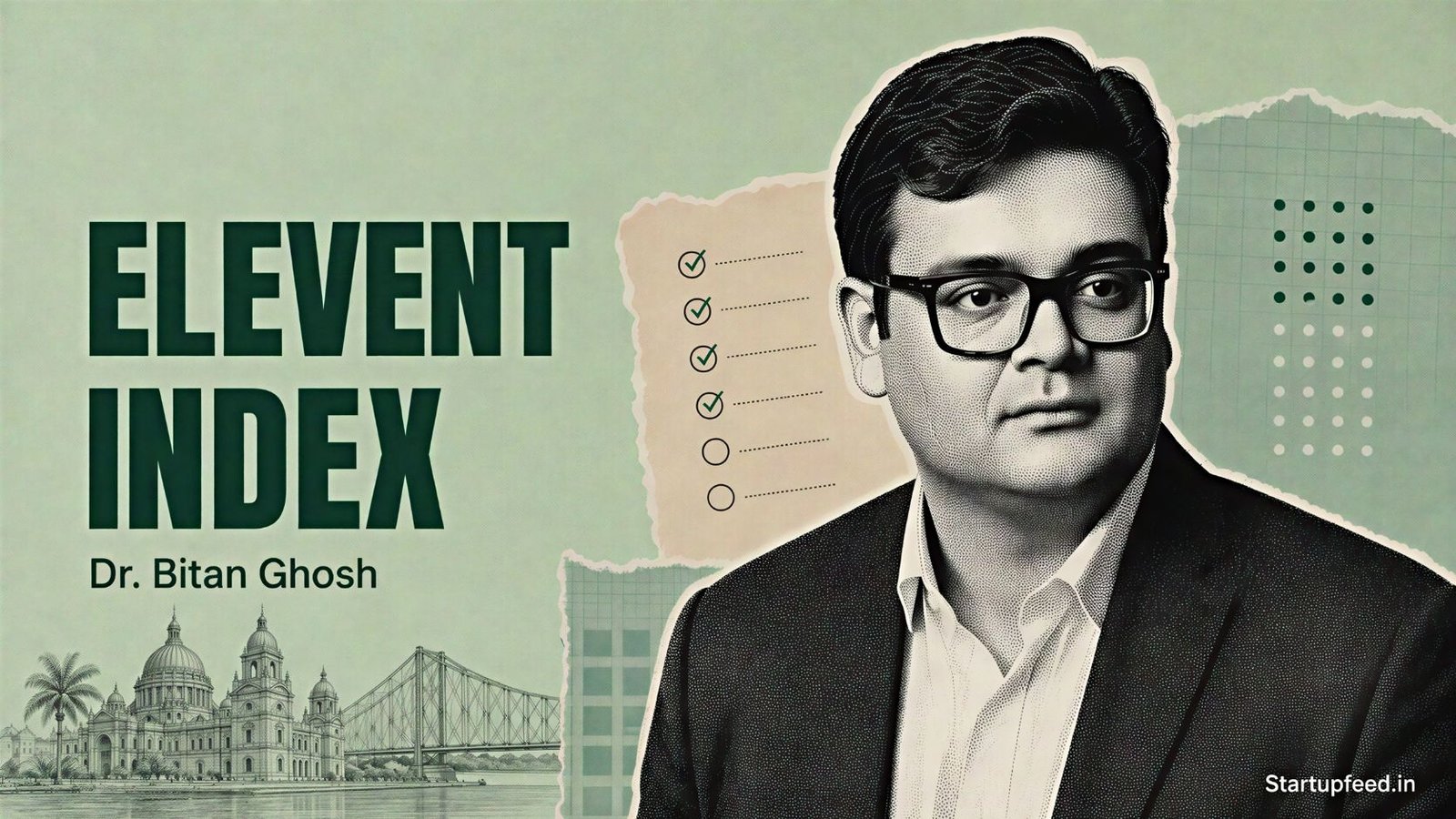
- Dr. Bitan Ghosh is a Kolkata based entrepreneur and researcher who built the Elevent Index scoring methodology and framework
- For years his sharp deal-scoring method lived only in his head, unwritten and unshared.
- Now the Elevent Index scores startups on sixteen points and hands founders a clear fix-list.
In This Article
Dr. Bitan Ghosh sat in a meeting room in New Delhi, walking the investment committee through a startup deal. He laid out eleven angles he used to judge a company, angles he had scored in his head for years. Then a senior partner, a man with over twenty years in the business, stopped him. If Dr. Ghosh checked every deal this carefully, why had no one ever seen it written in a memo? He had no good answer that day. That quiet gap, between sharp judgment and written proof, is where the Elevent Index began.
Dr. Bitan Ghosh is a Kolkata-based entrepreneur, researcher, and business strategist with more than twelve years around startups and the people who fund them. The Elevent Index is his framework for judging whether a young company is truly worth backing. It scores two separate things: how good the business is, and how ready it is to raise money. The goal is human. It gives founders an honest answer instead of a vague no, and offers India a fairer, shared way to fund ideas. He told the full story himself in a personal note on his own website and his upcoming book on the Elevent Index framework.
StartupFeed Insight
The real lesson of the Elevent Index reaches past one man in Kolkata. It is about honesty in the place where money meets ideas. For too long, a startup’s fate has turned on who read the pitch, not on clear thinking anyone can check. Ghosh is trying to fix that with a written, shared test. Founders in smaller Indian cities, angel investors, and government grant teams should watch this space, and StartupFeed will keep tracking it. As more first-time founders chase capital through 2027 and beyond, tools that reward reasoning over polish will only grow in value. By StartupFeed Desk.
The problem that Dr. Bitan Ghosh saw
Startup funding runs on judgment, and judgment can be messy. Ask five investors what makes a startup fundable, and you may get five different answers. One trusts the founder. One trusts the market size. One wants to see the numbers first. So two investors can look at the very same company and reach opposite calls. Neither is exactly wrong. There has just never been one shared test underneath.
This gap has a human cost, and Ghosh saw it up close. One founder, deep in a hard fundraise, told him the worst part of a no was not the no itself. It was never learning what, exactly, had killed the deal. Another founder said he would rather hear a hard truth about a real weakness than a polite line about bad timing. These founders did not want comfort. They wanted an honest answer they could act on. That wish sits at the heart of his framework.
About Dr. Bitan Ghosh
Dr. Bitan Ghosh is an entrepreneur, independent researcher, and business strategist based in Kolkata, India. He created the Elevent Index, a framework that scores startups on both business quality and funding readiness, built on sixteen checkpoints. His training spans a BTech in Civil Engineering, an MBA in International Business and Finance, and a Doctoral degree in Business Administration, focused on Finance. That mix of engineering structure and financial thinking shapes how he reads a young company. He shares his work on LinkedIn.



| Milestone | Detail | Year |
|---|---|---|
| Roots | Kolkata, India; entrepreneur, researcher, and strategist | Present |
| Training | BTech (Civil Engineering), MBA (International Business and Finance), Doctorate (Finance) | Earlier |
| The private habit | Scored deals on eleven private angles, only in his head | For years |
| The turning point | A senior partner asked why it was never in a memo | 2021 |
| The build | Eleven angles grew to sixteen; three scores (IQS, FRS, CRS) | 2025 |
| Public today | Framework shared openly at eleventindex.com | 2026 |
The most striking part is the number itself: what started as eleven private checkpoints in one person’s head is now a sixteen-point test built for anyone to use.
What Almost Stopped Dr. Bitan Ghosh?
The hardest part of the journey was not money. It was being honest with himself. In that meeting, Ghosh saw an uncomfortable truth. His careful method had never really left his head. He used it a little differently each time, shaped by the deal, the day, and how convincing the founder sounded. After years of trusting his own judgment, that was hard to admit.
Then a second problem crept in. Some startups he scored highly, companies he would have called strong, still could not raise a round. Not once or twice. Often enough that he could not blame bad luck. Something was missing, and naming it took him a long time. He kept trying to squeeze it into his old eleven checks, and it would not fit.
He described the whole road as turning “an instinct into something I could finally defend on paper,” in a personal essay on his website.
How Did Dr. Bitan Ghosh Turn It Around?
Ghosh’s key insight was to split one question into two. How good is the business? And how ready is it to raise money? Most checks blend these together. He pulled them apart.
Then he did something rare. He went back to founders and asked if more rigor would feel like fairness or just another hurdle. He heard relief, nearly every time.
His first eleven checks measured business quality, and each one is examined through ten smaller sub-checks. Then he found five more things that decide if a company is ready to raise: clean financial records, sound legal papers, a real fundraising plan, clear investor updates, and a founder ready for hard questions. Eleven grew to sixteen.
By 2026, this became the Elevent Index, built on three scores: the Investment Quality Score (how good the business is), the Funding Readiness Score (how ready it is to raise), and the combined Capital Readiness Score, which gives business quality more weight. The name holds the promise. “Elevent” joins those eleven original checks with the word relevant. Ghosh built it, in his words, “to actually matter in the room when a real decision was being made.” The full framework now sits openly on the Elevent Index website.



Who does the Elevent Index Framework Benefit?
The Elevent Index is built to help far more than big venture funds. Its first gift is to founders. Instead of a flat no, it points to the exact weak spots, weak governance, thin paperwork, or a shaky fundraising plan, and turns each one into a fix, in order. Fundraising becomes a checklist a founder can work through, not a talent they either have or lack.
It reaches wider too. Angel investors and family offices, who rarely have big research teams, get a clear way to judge deals. Banks and lenders get a view of a company’s risk beyond its balance sheet. Accelerators can show their startups are truly improving. Government teams handing out grants to hundreds of applicants get one fair way to compare them all.
There is a quiet national note here as well. This framework did not come from Bengaluru, Mumbai, or Delhi. It came from Kolkata, making it’s mark in the startup ecosystem. As more first-time founders rise from India’s smaller cities, a shared, honest test could help them get judged on real thinking, not on who happened to read their pitch.
The Lesson and What’s Next
Here is a lesson anyone can use. When the same problem keeps repeating and will not fit your old boxes, give it its own room instead of forcing it in. That is exactly what Ghosh did: he stopped treating fundraising readiness as a side note and built five checks around it. The takeaway for founders is sharp: a good business and a fundable business are two different jobs. Clean your records and your story before you need to. Whether the Elevent Index becomes the shared language it hopes to be is still an open question, and the next few years will tell. Which job are you ignoring right now?
Frequently Asked Questions
Have a tip? Write to us at editorial@startupfeed.in.
Liked this story? Follow StartupFeed on Google so our reporting reaches you first.