Quick Take
- Over 20 startup funding programs India wide are accepting applications through July and August 2026.
- Cheque sizes run from Rs 7 Lakh grants to Rs 10 Cr defence contracts.
- Delhi added Rs 400 Cr on July 16, 2026, expanding the campus incubation pipeline.
In This Article
More than 20 startup funding programs India founders can access are open for applications across July and August 2026, spanning central grants, state policies, and equity-free accelerators. The SIDBI Seed Fund at a-IDEA closes on July 31, 2026.
The cheque sizes vary sharply. BIRAC offers Rs 50 Lakh as pure grant-in-aid. iDEX writes up to Rs 10 Cr under its PRIME track. Delhi approved a Rs 400 Cr policy on July 16, 2026, according to the state cabinet announcement. Founders now face a selection problem, not a scarcity problem.
StartupFeed Insight
The real signal here is not the number of schemes, it is the quiet repricing of prototype capital. DST doubled NIDHI PRAYAS support from Rs 10 Lakh to Rs 20 Lakh, and added a Rs 40 Lakh deep-tech tier, because hardware costs in robotics, space, and medical devices outgrew the old ceiling. Hardware founders should read that as permission to build bigger prototypes. StartupFeed expects at least three more states to copy Delhi’s campus incubation model before March 2027, since student-led ventures produce cheap, measurable job numbers that governments can report. Apply to grants first, accelerators second. By Soumya Verma.
Startup Funding Programs India: The 2026 Money Map
The active startup funding programs India offers in 2026 fall into four buckets: central government grants, defence challenges, state policies, and corporate accelerators. Each bucket carries different dilution terms and different timelines. The table below sets out the largest verified programs currently open or running on rolling calls.
| Program | Support | Notes |
|---|---|---|
| SIDBI Seed Fund at a-IDEA | Up to Rs 1 Cr equity | Agritech focus, deadline July 31, 2026 |
| BIRAC BIG | Up to Rs 50 Lakh grant | Biotech, 18 months, calls on Jan 1 and Jul 1 |
| iDEX SPARK | Up to Rs 1.5 Cr | Defence, equity-free, PRIME track up to Rs 10 Cr |
| NIDHI PRAYAS 2.0 | Rs 20 Lakh to Rs 40 Lakh | DST prototype grant, physical products only |
| ASIIM (VCF-SC) | Up to Rs 30 Lakh equity | SC and Divyang founders, via DST-backed TBIs |
| MeitY TIDE 2.0 | Rs 4 Lakh to Rs 7 Lakh | ICT startups, 51 partner incubators |
The most interesting number in that table is the iDEX ceiling. The Department of Defence Production confirms that SPARK grants reach Rs 1.5 Cr, while iDEX PRIME cases go to Rs 10 Cr. That is venture-scale money without a term sheet.
About These Programs
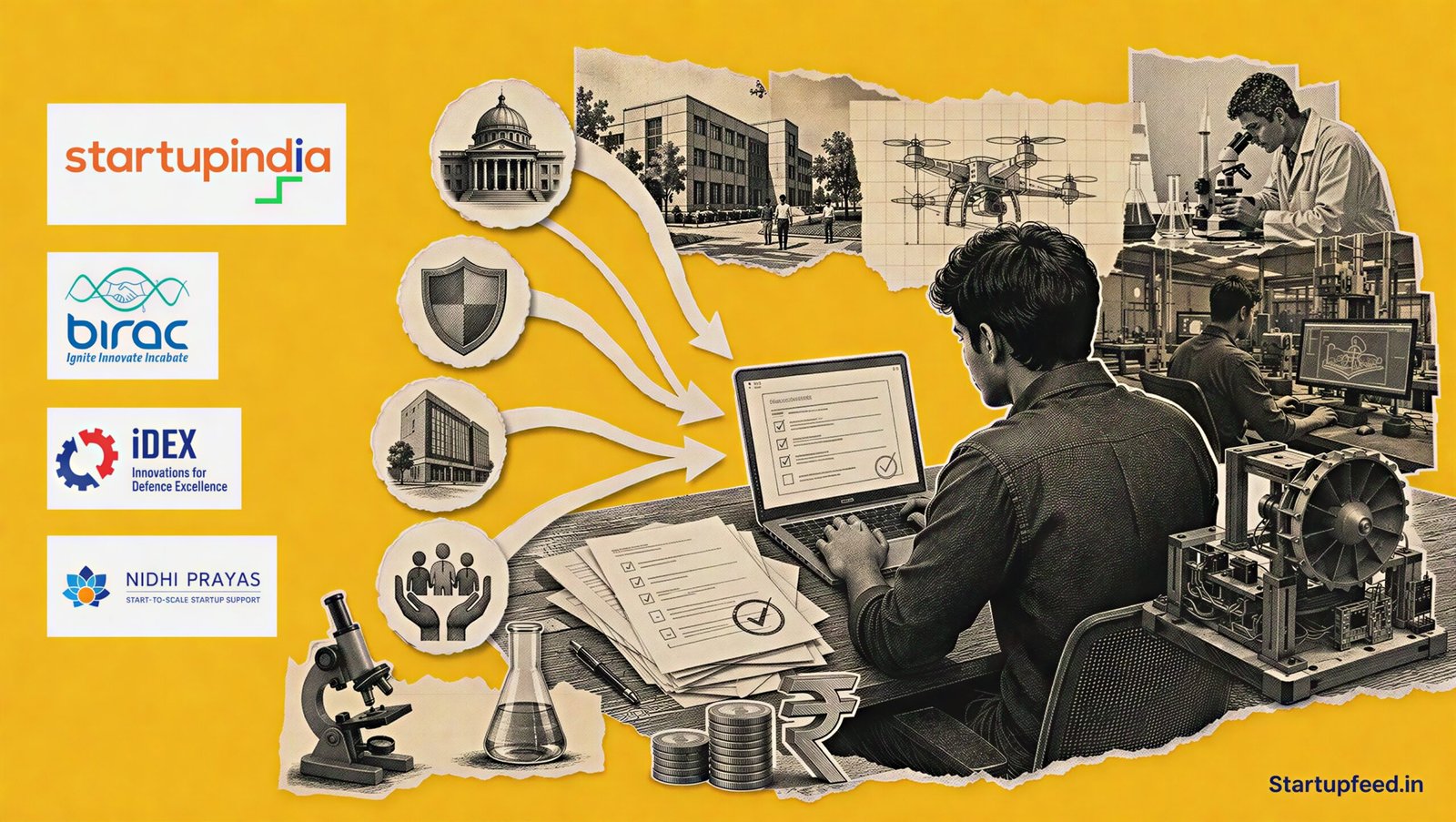
These schemes are run by central ministries, state governments, and private accelerators. BIRAC sits under the Department of Biotechnology and was set up in 2012. DST runs NIDHI PRAYAS through PRAYAS Centres, managed by a project unit at SINE, IIT Bombay. iDEX operates under the Ministry of Defence through the Defence Innovation Organisation. Together they have deployed several thousand crore across Indian startups.


Which programs should you apply to first?
Grant programs should come before accelerators for most early-stage teams, because grants are non-dilutive and accelerators are not. BIRAC’s Biotechnology Ignition Grant gives Rs 50 Lakh as grant-in-aid over 18 months, with no equity taken. The startup funding programs India runs at the grant layer are the cheapest capital a founder will ever raise.
India’s startup ecosystem is moving into a new frontier of agentic workflows and physical AI systems engineered to solve high-stakes, real-world challenges, said Preeti Lobana, Vice President and Country Manager, Google India.
Google selected 20 startups from roughly 2,500 applications for its 2026 India cohort, a 0.8% acceptance rate, according to the company’s announcement. That is harder than most seed funds. Founders should treat accelerator applications as a distribution play, not a funding play, since the Google for Startups Accelerator India program is equity-free and gives no cheque.
How do state schemes compare on cheque size?
State schemes generally write smaller cheques than central programs, but they clear faster and carry lighter compliance. Delhi’s new policy is the outlier on total corpus.
| Scheme | Corpus or Cheque | Target |
|---|---|---|
| Delhi Start-up and Incubation Policy | Over Rs 400 Cr, five years | 11 state universities, colleges, ITIs |
| NIDHI PRAYAS 2.0 (central) | Rs 20 Lakh per innovator | Physical product prototypes |
| ASIIM (central) | Rs 30 Lakh over three years | SC and Divyang founders |
Delhi’s policy was cleared by the state cabinet on July 16, 2026, allocating over Rs 400 Cr across five years. Institutions receive one-time capital plus annual operating support, and attached startups get milestone-linked assistance. What separates Delhi from earlier state efforts is the campus-first design: the money follows institutions, not individual founders.
What’s Next
The next hard deadline is July 31, 2026, for the SIDBI Seed Fund at a-IDEA. BIRAC’s next BIG call opened on July 1, 2026, and typically stays open around 45 days, which puts mid-August as the practical cut-off. DST’s NIDHI PRAYAS portal lists PRAYAS Centres accepting rolling innovator applications. Which of these schemes fits your current stage best?
Frequently Asked Questions
Have a tip? Write to us at editorial@startupfeed.in.
Liked this story? Follow StartupFeed on Google so our reporting reaches you first.