Quick Take
- PM Modi phoned Skyroot founders Pawan Chandana and Bharath Daka on July 18, 2026.
- Vikram-1 reached a 453-km orbit on its maiden flight, exceeding stated mission objectives.
- India becomes the third country with private orbital launch capability, after the US and China.
In This Article
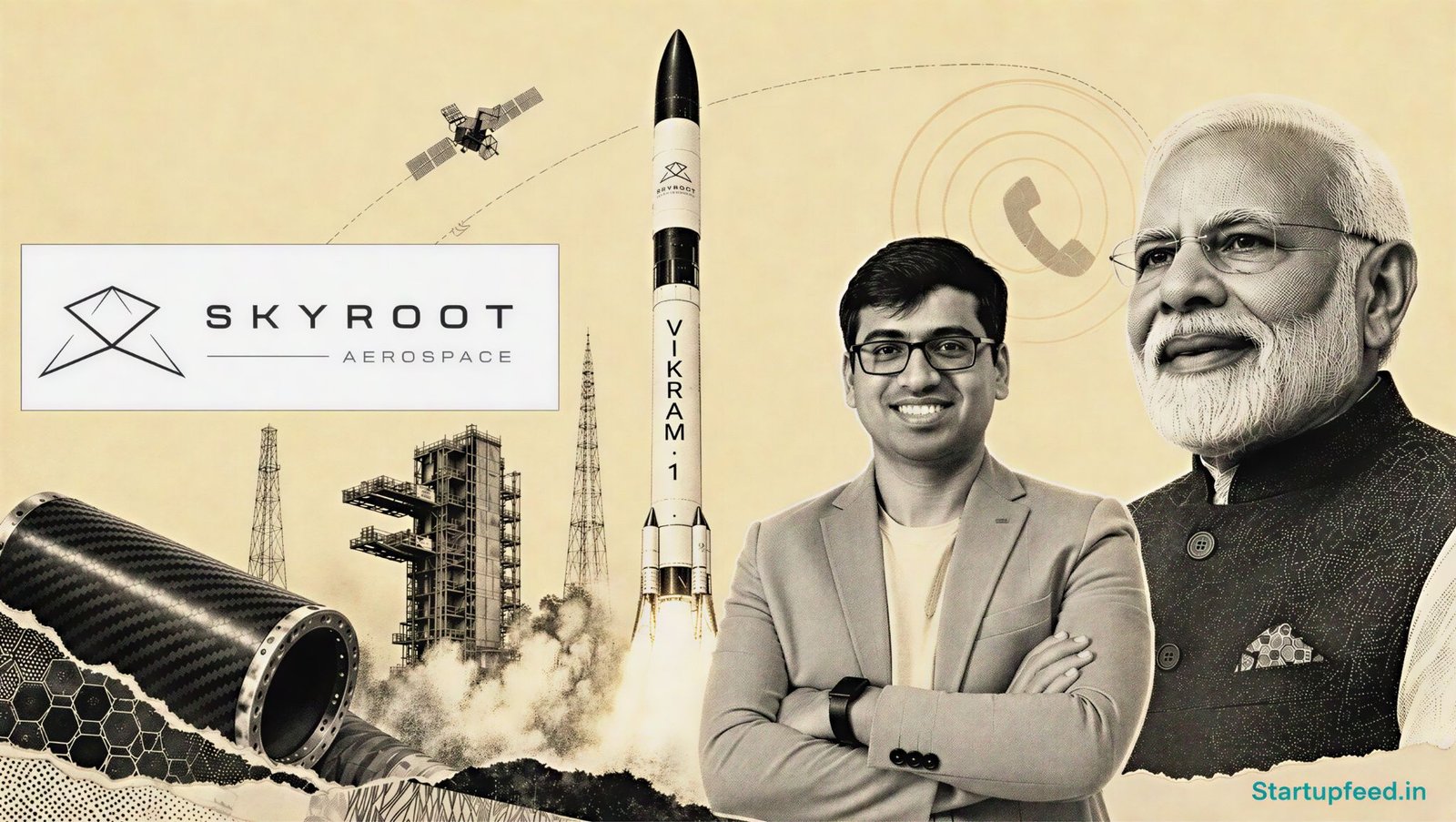
The PM Modi call to Skyroot founders on July 18, 2026 followed Vikram-1 becoming the first Indian private rocket to reach orbit, at 453 km altitude.
Prime Minister Narendra Modi phoned co-founders Pawan Kumar Chandana and Naga Bharath Daka minutes after Mission Aagaman lifted off at 11:30 AM from the First Launch Pad at Satish Dhawan Space Centre, Sriharikota. The Prime Minister had publicly backed the mission hours earlier, calling it a new frontier for India’s space journey.
StartupFeed Insight
The number that should interest founders is not 453 km, it is 28. That is the average age of the team that built this rocket, according to CEO Pawan Chandana. India’s launch cost advantage was always assumed to come from cheap labour, but Skyroot’s real edge is a young engineering base that treats carbon-composite manufacturing as a software problem. Investors tracking deeptech should watch the follow-on effect: expect at least three Indian launch or satellite startups to close rounds above $50 Mn (Rs 483 Cr) before March 2027, priced off this single flight. StartupFeed will track each one. By Avinash.
Mission Aagaman: The Numbers
Mission Aagaman was the maiden test flight of Vikram-1, a four-stage small-satellite launch vehicle built by Skyroot Aerospace. The rocket cleared its objectives roughly 17 minutes after liftoff, IN-SPACe (Indian National Space Promotion and Authorisation Centre) confirmed.
| Metric | Detail | Notes |
|---|---|---|
| Mission name | Aagaman (Test Flight-1) | Aagaman translates as arrival |
| Orbit achieved | 453 km, Low Earth Orbit | Stated objective was only to clear the tower, IN-SPACe |
| Launch site and date | Sriharikota, July 18, 2026 | First Launch Pad, SDSC-SHAR, 11:30 AM IST |
| Vehicle configuration | Four stages, all-carbon-composite | Payload capacity around 350 kg to LEO, company data |
| Company valuation | $1.1 Bn (Rs 10,615 Cr) | Series C, May 7, 2026, Tracxn |
| Total funding raised | About $160 Mn (Rs 1,544 Cr) | Across nine rounds since 2018, company disclosure |
The most striking detail sits in the objective column. IN-SPACe Chairman Pawan K Goenka said the formal mission goal was simply to clear the tower, so a 453-km orbital insertion on a first attempt sits far above the bar the regulator had set.
About Skyroot Aerospace
Skyroot Aerospace builds orbital launch vehicles for small satellite deployment. Founded in 2018 in Hyderabad by former ISRO scientists Pawan Kumar Chandana and Naga Bharath Daka, the company sells launch capacity to satellite operators. Its Infinity Campus spans about 200,000 square feet and can build one orbital rocket a month. Backers include GIC, Temasek, Sherpalo Ventures and BlackRock.

Why does the PM Modi call to Skyroot matter?
The PM Modi call to Skyroot converted a company milestone into a national policy signal within minutes of the launch. Modi told the founders they had planted a new tree in space while strengthening a root on the ground to inspire the next generation, and invited the team for a meeting.
This is the first time that a private company in India has built the rocket, brought the launch pad, and taken off, Pawan Kumar Chandana, Co-founder and CEO, Skyroot Aerospace.
ISRO Chairman V Narayanan credited the 2020 space reforms, noting India had one space startup when private participation opened and now counts more than 400. Goenka described the day as an India moment rather than a SpaceX moment. That framing matters for procurement, because it positions private launch as domestic infrastructure rather than an imported model.
How does Skyroot compare with global rivals?
Skyroot now competes directly in the small-satellite launch segment, where supply remains tighter than demand. Chandana has said the market is deeply constrained on the supply side, which is the gap Skyroot is pricing against.
| Company | Orbital status | Payload to LEO |
|---|---|---|
| Skyroot (India) | Orbital, first success July 2026 | About 350 kg |
| Agnikul Cosmos (India) | Sub-orbital demonstration completed | Around 100 kg, planned |
| Rocket Lab (US) | Orbital since 2018 | About 300 kg on Electron |
Skyroot’s differentiator is vertical control: the company designed the vehicle, built the carbon-composite structures in-house and set up its own launch infrastructure at Sriharikota.
What’s Next
Skyroot has said the next step is commercial flights on Vikram-1, with heavier Vikram-II and Vikram-III vehicles under development for larger payloads and multiple orbital insertions. The Infinity Campus build rate of one rocket a month gives the company a path to a repeat launch within the next two quarters. The commercial question is pricing, not physics. Will Indian launch costs reset the global smallsat market?
Frequently Asked Questions
Have a tip? Write to us at editorial@startupfeed.in.

Liked this story? Follow StartupFeed on Google so our reporting reaches you first.