


Quick Take
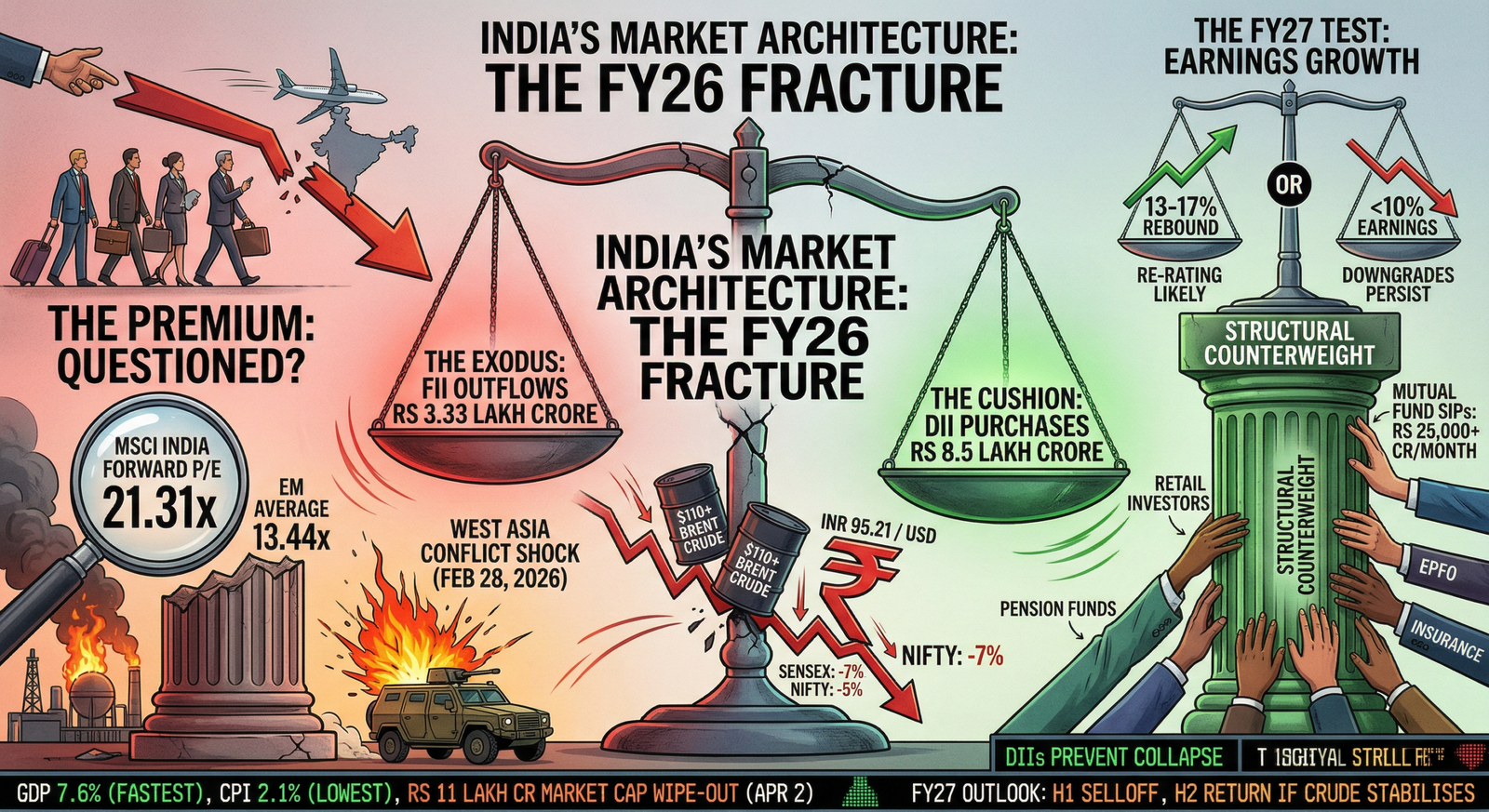
- The Exodus: Rs 3.33 lakh crore — FII equity outflows in FY26, the largest annual exit on record (NSDL data)
- The Cushion: Rs 8.5 lakh crore — DII purchases in FY26, the structural counterbalance that prevented a collapse
- The Premium: MSCI India forward P/E at 21.31x vs MSCI EM average of 13.44x — a 59% premium that foreign investors are questioning
- The Shock: Brent crude crossed $110/barrel post West Asia conflict (Feb 28, 2026); rupee hit Rs 95.21 — steepest fall since FY2012
- The Test: FY27 earnings growth consensus: 13-17% — the number that will determine everything
- What’s Next: FII selling likely to persist in H1 FY27; structural return possible in H2 if crude stabilises and earnings deliver
For twelve months, foreign investors quietly but systematically repriced their view of India. In FY26, foreign institutional investors (FIIs) sold a record Rs 3.33 lakh crore of Indian equities — not because India’s growth story broke, but because the premium India commanded over its emerging market peers stopped being justifiable against a backdrop of high crude prices, a weakening rupee, and global risk-off sentiment triggered by a fresh conflict in West Asia.
The question entering FY27 is not whether India’s long-term structural story remains intact — it does. The question is narrower and more urgent: can India’s corporate earnings and macroeconomic stability in FY27 deliver numbers that justify a 59% valuation premium over the EM average? The answer will determine whether foreign capital returns, and when.
Part I — What Actually Happened in FY26
The Two Halves of a Fractured Year
FY26 was not a single story — it was a tale of two distinct phases, divided sharply by what happened on February 28, 2026.


The first half of FY26 was broadly constructive. GDP grew 7.6% — the fastest pace in recent years. Inflation remained below the RBI’s 4% target for most of the year. GST collections crossed record levels. The Sensex scaled a life high of 86,159 on December 1, and the Nifty hit 26,373 in early January 2026. Domestic flows were relentless, earnings were steady, and India received credit rating upgrades from global agencies.
Then on February 28, 2026, US and Israeli forces struck Iran. Brent crude crossed $110 per barrel within days. The rupee — already under pressure from FPI outflows and a widening trade deficit — fell to Rs 93.94 on March 23, breached Rs 95 intraday, and recorded the steepest full-year depreciation since FY2012’s 12.4% fall. FIIs were net sellers every single trading session in March 2026. The RBI paused its rate-cutting cycle and spent an estimated $55 billion defending the currency.
The Scorecard
| Metric | FY26 Outcome | Context |
| GDP Growth | 7.6% | Fastest pace in recent years; strong structural base |
| CPI Inflation (average) | 2.1% | Lowest in series history; below RBI’s 4% target for most of FY26 |
| Sensex FY26 Return | -7% (5,467 pts) | Ended at 71,948 from Dec high of 86,159 |
| Nifty 50 FY26 Return | -5% (1,187 pts) | Ended at 22,331 from Jan high of 26,373 |
| FII Net Equity Outflows | Rs 3.33 lakh crore | Largest annual FII exit on record (NSDL) |
| DII Net Equity Purchases | Rs 8.5 lakh crore | Record DII buying — structural counterweight to FII selling |
| INR vs USD (FY26) | -11% depreciation | Rupee hit Rs 95.21 — steepest fall since FY2012 |
| Brent Crude (Mar 2026) | $110-115/barrel | Surged 50%+ in March 2026 alone on West Asia conflict |
| Forex Reserves | $682 billion | Comfortable at 11 months of import cover; down from ~$700 Bn |
| MSCI India Forward P/E | ~21.31x (Feb 2026) | vs MSCI EM average of 13.44x — a 59% premium |
| India vs EM Peer Returns | Only EM to decline | Taiwan +59%, South Korea +113% in same period |
Part II — The Valuation Premium: Justified or Stretched?
What Foreign Investors Are Actually Saying
The selloff was not irrational. Foreign investors exited for three clearly articulated reasons, as documented by analysts at Samvitti Capital: India’s persistently high valuations relative to EM peers; the weakening rupee eroding dollar-denominated returns; and a global capital rotation toward markets offering better risk-adjusted entry points, particularly in the context of US tech and AI-driven equities.
At the peak before the correction, MSCI India traded at a forward P/E of approximately 21.31x — a 59% premium to the MSCI EM Index’s forward multiple of 13.44x. Even after the FY26 correction, the premium persists. Goldman Sachs lowered its rating on India to ‘marketweight’ (from ‘overweight’) and cut its Nifty 50 target by nearly 14% to 25,300, warning of further earnings downgrades.
The Sensex’s trailing P/E fell to approximately 20x by end-FY26 — down from a 5-year average of 24x. India’s market capitalisation-to-GDP ratio dropped to 109% from a peak of 152% in September 2024. These corrections make the entry point better — but they do not eliminate the premium.

The Case For the Premium
| Argument | Supporting Data |
| Earnings superiority | India’s 5-year EPS CAGR of 16.2% is the highest among all EMs; most peers below 8% |
| GDP growth leadership | 7.6% FY26 GDP growth; 6.5-7.2% projected for FY27 — among the fastest globally |
| Domestic liquidity depth | Rs 8.5 lakh crore DII inflows in FY26; SIP monthly flows structurally above Rs 25,000 Cr |
| Fiscal discipline | Government maintained 4.3% fiscal deficit while executing 11-22% capex growth |
| Policy continuity | GST 2.0, income tax restructuring, trade agreements with EU and interim US deal |
| Corporate governance | Credit rating upgrades; improved tax compliance; strengthened balance sheets |
The Case Against the Premium
| Risk Factor | Quantified Impact |
| Crude oil dependency | 88% import dependence; every $10/barrel rise adds ~60 bps to CPI inflation and ~50-70 bps GDP drag |
| Rupee vulnerability | Rs 95+ vs USD; 11% full-year depreciation erodes USD returns for foreign investors |
| FY27 inflation forecast | 4.6-5.2% CPI (RBI projection); peak Q3 FY27 — limits rate cut headroom |
| CAD widening | Projected to widen from 1% GDP (FY26) to 1.7-2.5% GDP (FY27) on oil import bill |
| FY26 earnings disappointment | Nifty EPS growth just 3.8% in FY26 — well below the 12-15% projected at start of year |
| EM competition | Brazil, South Korea offer lower valuations; EM rotation risk in a global risk-on environment |
| Geopolitical sensitivity | April 2, 2026 alone saw ~Rs 11 lakh crore market cap wiped out on war fears |
Part III — The DII Revolution: India’s New Market Architecture
The single most important structural development of FY26 was not the FII selloff — it was what happened underneath it. Domestic institutional investors purchased approximately Rs 8.5 lakh crore of Indian equities across FY26, creating what analysts describe as a structural bid beneath the market that FII selling could pressure but not overwhelm.
Mutual fund SIP monthly flows have institutionalised retail participation. Insurance companies, pension funds (EPFO, NPS), and provident funds now deploy capital with structural consistency that insulates markets from the episodic volatility of foreign flows. This is a qualitative shift — India’s equity market is no longer a market where FIIs alone set the price.
| DII Segment | FY26 Contribution | Forward Outlook |
| Mutual Funds (SIPs) | ~Rs 25,000+ Cr/month inflow | SIP book growing; monthly SIP amounts structurally above Rs 25,000 Cr |
| Insurance Companies | Consistent long-term deployment | IRDA’s equity allocation reforms increasing equity exposure |
| EPFO / Pension Funds | Steady incremental deployment | Corpus growing; equity allocation percentage gradually rising |
| Total DII FY26 Purchase | ~Rs 8.5 lakh crore | Analysts estimate DII inflows could exceed $100 Bn (Rs 8.4 lakh crore) in FY27 |
| Mutual Funds Cash Reserve | ~5.9% cash currently | Deployable liquidity estimated ~$6 Bn — ready to absorb volatility |
The DII counterbalance is not infinite — extreme FII selling can still overwhelm it. But the structural support has materially raised the floor. India’s market can absorb foreign selling at levels that would have caused collapses in previous cycles.
Part IV — The FY27 Equation: Five Variables That Will Decide Everything
- Earnings Delivery — The Non-Negotiable
FY26 delivered just 3.8% Nifty EPS growth — a fraction of the 12-15% that was projected at the start of the year. The consensus for FY27 is a sharp rebound: 13-17% earnings growth, with some brokerages projecting 17-19% over the FY26-FY28 period.
The sectors expected to lead: Banking and financials (16-17% earnings growth projected FY27-28), automobiles, capital goods, and power. The sectors most at risk: Aviation, paints, chemicals, and any industry with heavy imported raw material dependence — all vulnerable to the oil price shock.
PL Capital’s base case values Nifty at 18.3x December 2027 earnings, arriving at a 12-month Nifty target of 27,958. Their bull case extends to 30,497 if earnings surprises sustain and multiples expand to 20x. Their bear case — if earnings downgrades persist — caps Nifty near 26,486.
| Scenario | FY27 EPS Growth | Nifty Target (PL Capital) | FII Return Probability |
| Bull Case | 17-19% | 30,497 | High — valuation re-rating likely |
| Base Case | 13-15% | 27,958 | Moderate — selective sector flows |
| Bear Case | <10% (crude/war pressure) | 26,486 | Low — selling likely continues |
- Crude Oil — The Uncontrollable Variable
India imports approximately 88% of its crude requirements. Brent above $100/barrel is not a headwind — it is a structural tax on every Indian business and consumer. The arithmetic is unambiguous: every $10/barrel rise adds approximately 60 basis points to retail inflation and shaves 50-70 basis points from GDP growth.
With Brent at $110-115 in March 2026 and no clear resolution in sight for the West Asia conflict, the RBI’s FY27 CPI projection of 4.6% (peaking at 5.2% in Q3 FY27) looks optimistic to some analysts. Moody’s projects FY27 inflation at 4.8%, compared to FY26’s 2.4%. This environment leaves little room for rate cuts and compresses both consumer spending and corporate margins.
- The Rupee — The Foreign Investor’s P&L Multiplier
A foreign investor who bought Indian equities when the rupee was at Rs 84 and sold when it was at Rs 95 lost approximately 12% on the currency alone — even if the underlying stock appreciated. This is why FII selling accelerates when the rupee weakens: every day of depreciation makes the exit more rational.
The RBI holds $682 billion in forex reserves — 11 months of import cover. But the intervention spending was substantial: an estimated $55 billion in FY26 alone. The rupee’s trajectory in H1 FY27 is the single most important variable for foreign flow reversal. Barclays analysts note that the rupee remains particularly vulnerable to an oil supply shock.
- Geopolitical Resolution — The Binary Risk
Dr. V K Vijayakumar, Chief Investment Strategist at Geojit Investments, summarised the changed macro landscape starkly: the ‘Goldilocks’ scenario India enjoyed before the West Asia conflict — high GDP growth, low inflation, moderate fiscal and current account deficits, and expectations of higher earnings growth in FY27 — has almost disappeared.
If the West Asia conflict de-escalates and crude falls back below $85-90/barrel, the entire FY27 macro equation improves dramatically. Inflation moderates. The rupee stabilises. The RBI can resume rate cuts. Corporate margins expand. And the earnings upgrade cycle begins. This is the binary that markets are pricing.
- Trade Agreements — The Underappreciated Tailwind
India concluded a trade agreement with the European Union and reached an interim arrangement with the United States in FY26. Tariff reductions for textiles, gems and jewellery, auto components, and engineering goods reduce export uncertainty and improve earnings visibility for these sectors.
Analysts at PL Capital believe this provides a quiet but meaningful earnings tailwind for FY27 in labour-intensive manufacturing sectors — which happen to be among the most underweighted by foreign investors. A stronger export performance could partially offset the crude oil headwind on India’s current account.
StartupFeed Insight — What The Smart Money Is Actually Doing
- The data point that matters: The key number: India’s 5-year EPS CAGR of 16.2% is the highest in EM — but FY26’s 3.8% EPS growth showed that this track record is not guaranteed. FY27 must deliver to restore confidence.
- Why DIIs change the game: DII inflows could exceed $100 billion in FY27 (Samvitti Capital estimate). This structurally prevents a repeat of earlier FII-driven crashes — but it also means the market requires stronger fundamental justification to move up, because momentum buying from retail is less available.
- What the analysts are doing: HDFC Securities (upgrading Swiggy to BUY at Rs 460 target) and similar bottom-up calls show that domestic analysts are finding value — but in specific names, not the index broadly. FY27 is a stock-picker’s year.
- Our prediction: Foreign capital will return — but selectively. The sectors foreign investors were buying before exiting — IT, FMCG, power — are exactly where Fireside-style conviction capital has been building. H2 FY27 is when the return is most likely, contingent on crude stabilisation.
Part V — Sector Positioning for FY27
| Sector | FY27 Earnings Outlook | FII Positioning | StartupFeed View |
| Banking & Financials | 16-17% earnings growth (BFSI) | Underweight vs history | High conviction — PSU banks at 8-9x vs historical 11-12x; value exists |
| Capital Goods / Defence | Above-average growth | Neutral | Government capex tailwind; capex cycle revival story intact |
| Automobiles | Strong — GST cuts driving demand | Moderate | EV transition + GST benefit + festive demand = multi-year runway |
| IT / Technology | Modest — 13% PE expensive | Overweight historically | Global slowdown risk; rupee depreciation helps margins but demand uncertain |
| Consumer Discretionary | 58.1x PE — demanding | Mixed | GST 2.0 and income tax relief boost near-term; execution risk high |
| Energy / Oil & Gas | Beneficiary of crude spike | Underweight | Domestic refiners benefit; upstream exploration plays attracting attention |
| Real Estate | Down 23.6% in FY26 | Underweight | Early-stage incremental buying noted from domestic institutions |
| Chemicals / Aviation | Vulnerable to crude costs | Neutral to underweight | Avoid until crude stabilises below $90 |
Part VI — The Four Things to Watch in FY27
- Q1 FY27 Earnings Season (July-August 2026): This is the first real data point on whether the FY27 earnings recovery is real. If Q1 delivers 12%+ earnings growth, expect a meaningful reversal in FII sentiment. If it disappoints — as Q1 FY26 did — the selling pressure will intensify.
- Brent Crude Trajectory: Every week that crude stays above $100 is a week that Indian macro deteriorates. The RBI’s rate policy, rupee stability, DII sustainability, and FII return probability are all downstream of this number.
- Rupee Stabilisation: A sustained move back toward Rs 86-88 would be the clearest signal that FII flows are reversing. Watch the RBI’s intervention posture and the pace of forex reserve depletion.
- US-India Trade Deal Finalisation: An interim arrangement exists, but a comprehensive deal would be a structural positive for manufacturing exports and would materially reduce geopolitical risk discount in Indian valuations.
The Bottom Line
India’s market is not losing relevance. The DII revolution, the structural earnings superiority, the GDP growth leadership, and the policy continuity that characterised FY26’s first half are not illusions. They are real.
What FY26 demonstrated is that India’s premium — real and historically justified — has a price. When global shocks push crude above $100, the rupee toward Rs 95, and FII returns deeply negative in dollar terms, that premium gets repriced. Not permanently. Not catastrophically. But significantly.
FY27 is the year India must re-earn its valuation. The earnings cycle, not sentiment or liquidity, will drive the next leg of re-rating. If corporate India delivers 13-17% EPS growth in FY27, foreign capital will return — quietly at first, then with conviction. If it disappoints again, the premium compression will continue.
The structural bull case for India remains intact. The tactical reality for the next two quarters does not allow complacency.
Liked this story? Follow StartupFeed on Google so our reporting reaches you first.