
Quick Take
- Starbucks is building in-house AI software to replace Microsoft inventory and IBM maintenance tools, Bloomberg reported.
- The coffee chain spends about $400 Mn (Rs 3,820 Cr) a year on software, per its CTO.
- Some tools could launch by the end of 2027, part of a $2 Bn (Rs 19,100 Cr) cost-cut plan.
In This Article
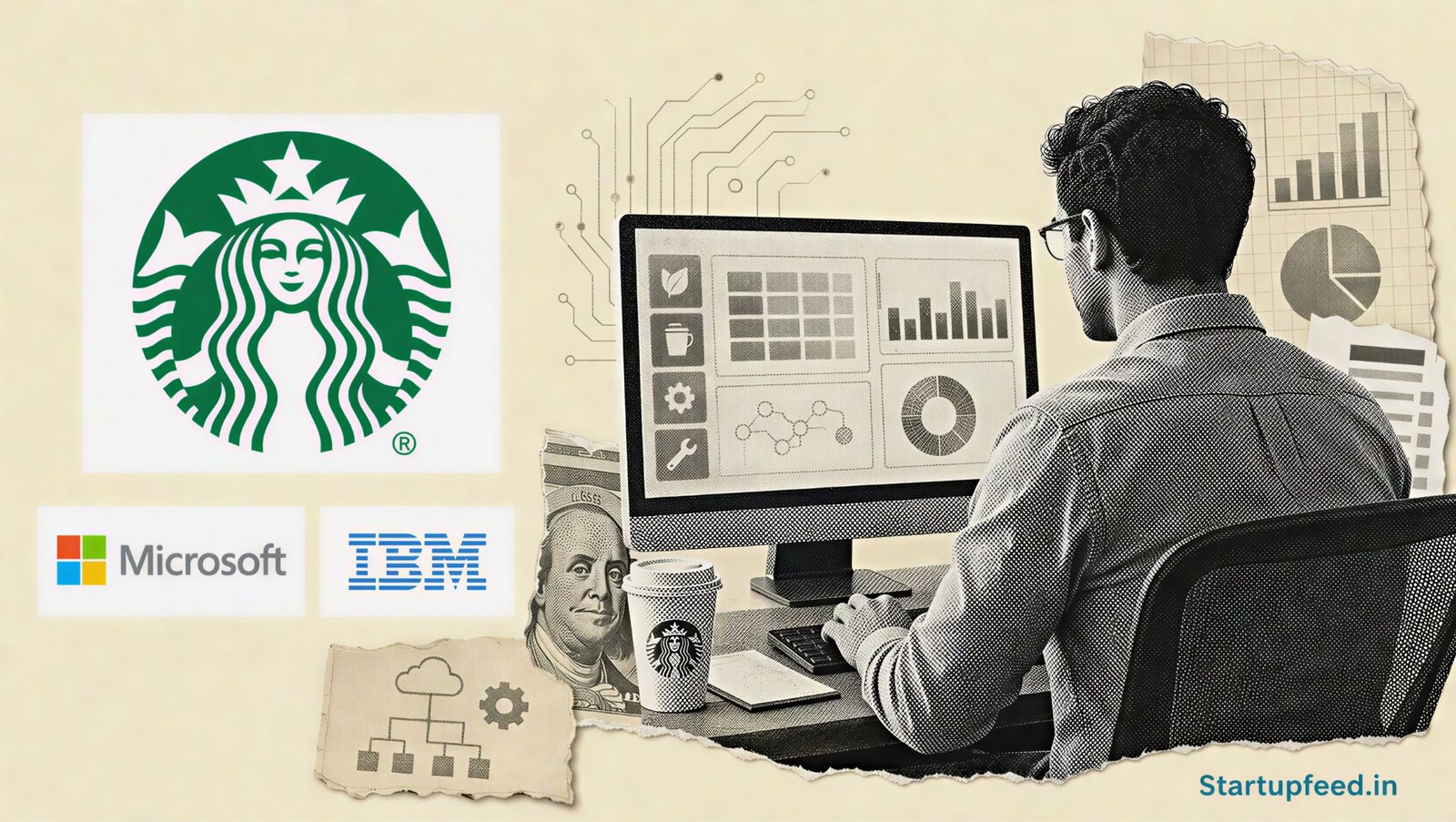
Starbucks AI software is being built in-house to replace some applications the coffee chain now buys from Microsoft and IBM, according to an internal presentation reviewed by Bloomberg News on July 9, 2026. The company is creating alternatives to a Microsoft inventory system and an IBM maintenance tool.
Some of the internally built software could roll out by the end of 2027, pending test results. The push forms part of a wider plan to cut $2 Bn (Rs 19,100 Cr) in costs. Starbucks spends roughly $400 Mn (Rs 3,820 Cr) a year on software, Chief Technology Officer Anand Varadarajan told staff earlier this year, and sees clear room to trim that bill.
StartupFeed Insight
The real signal here is not the $400 Mn (Rs 3,820 Cr) bill, it is who is now writing the code. AI-assisted coding built the platform meant to replace the IBM tool, which means a coffee chain, not a software firm, shipped enterprise software. Indian SaaS founders and enterprise sales heads should watch this closely, because the same logic can hollow out mid-tier licence revenue fast. Expect at least three large Indian enterprises to announce similar build-versus-buy AI reviews before the end of the March 2027 quarter, and expect vendor renewal cycles to get harder from here. StartupFeed.in will track how this reshapes the SaaS sector. By Avinash.
Starbucks AI Software: The Key Numbers
Starbucks AI software is aimed squarely at cutting third-party licence spend across its technology stack. The table below sets out the core figures from the Bloomberg report and the CTO’s internal remarks.
| Metric | Detail | Notes |
|---|---|---|
| Annual software spend | About $400 Mn (Rs 3,820 Cr) | Stated by CTO Anand Varadarajan |
| Tools being replaced | Microsoft inventory, IBM maintenance | Per internal presentation |
| Expected rollout | By end of 2027 | Pending testing |
| Wider cost-cut target | $2 Bn (Rs 19,100 Cr) | Part of turnaround effort |
| Tech budget cut this year | About $30 Mn (Rs 287 Cr) | Fiscal year ending late September |
| Source | Bloomberg News | Reported July 9, 2026 |
The most striking detail is the method: AI-assisted coding played a central role in building the platform meant to replace the IBM tool. Starbucks is also factoring AI usage into tech-worker bonuses.
About Starbucks
Starbucks Corporation, founded in 1971 and headquartered in Seattle, is the world’s largest coffeehouse chain, run under Chief Executive Officer Brian Niccol. It operates a mix of company-owned and licensed stores across more than 80 markets. The firm sells coffee, food, and beverages, and is midway through a broad turnaround focused on store performance and cost discipline.

Why is Starbucks building its own AI tools?
Starbucks is building its own tools to lower long-term licence costs and tailor software to its exact needs. AI now makes in-house builds cheaper and faster than before, changing the old build-versus-buy math. Varadarajan framed the goal plainly in an internal forum.
There’s clear opportunities to reduce the spend in software, Varadarajan said, according to a recording reviewed by Bloomberg News.
The company is reviewing every contract and service tied to technology. It has also spent years building a point-of-sale system to replace Oracle Simphony, per Bloomberg. In the long run, though, building can raise a firm’s own maintenance and labour costs, a trade-off Starbucks now has to manage.
What does this mean for Microsoft and IBM?
For Microsoft and IBM, the move signals a risk that large customers may start building what they once licensed. Both stocks fell on July 9, 2026 after the Bloomberg report, with Microsoft down about 1.5% and IBM sinking around 4% in early trading. The scale of the reaction shows how sensitive software valuations have become to this theme.
| Vendor | Tool at risk | Reported move on July 9 |
|---|---|---|
| Microsoft | Inventory tracking system | Shares down about 1.5% |
| IBM | Maintenance management tool | Shares down about 4% |
| Oracle | Simphony point-of-sale | Long-running replacement effort |
What sets Starbucks apart is that its own workers, using AI, are now the competition its vendors face.
How big is the enterprise AI shift?
The enterprise AI shift is broad, as more firms use generative AI to build custom software instead of buying it. Software makers now face competition from upstarts and even from their own customers. The same week, OpenAI released ChatGPT Work, a GPT-5.6 agent that can build documents, spreadsheets, presentations, and web apps from connected files, per OpenAI’s official announcement. Tools like that lower the cost of building in-house software further, adding pressure on traditional licence models. You can read the wider trend context in Bloomberg’s original report.
What’s Next
Watch for the first Starbucks-built tools to enter live testing before the end of 2027, and for its enterprise tech budget to drop by roughly $30 Mn (Rs 287 Cr) in the fiscal year ending late September 2026. If the IBM replacement performs well, more vendor swaps could follow. Will other large retailers copy the Starbucks AI software playbook next?
Frequently Asked Questions
Have a tip? Write to us at editorial@startupfeed.in.

Liked this story? Follow StartupFeed on Google so our reporting reaches you first.