
Quick Take
- India’s Padma Shri Founders trail began in 1989 with Kiran Mazumdar-Shaw of Biocon, decades before the unicorn era.
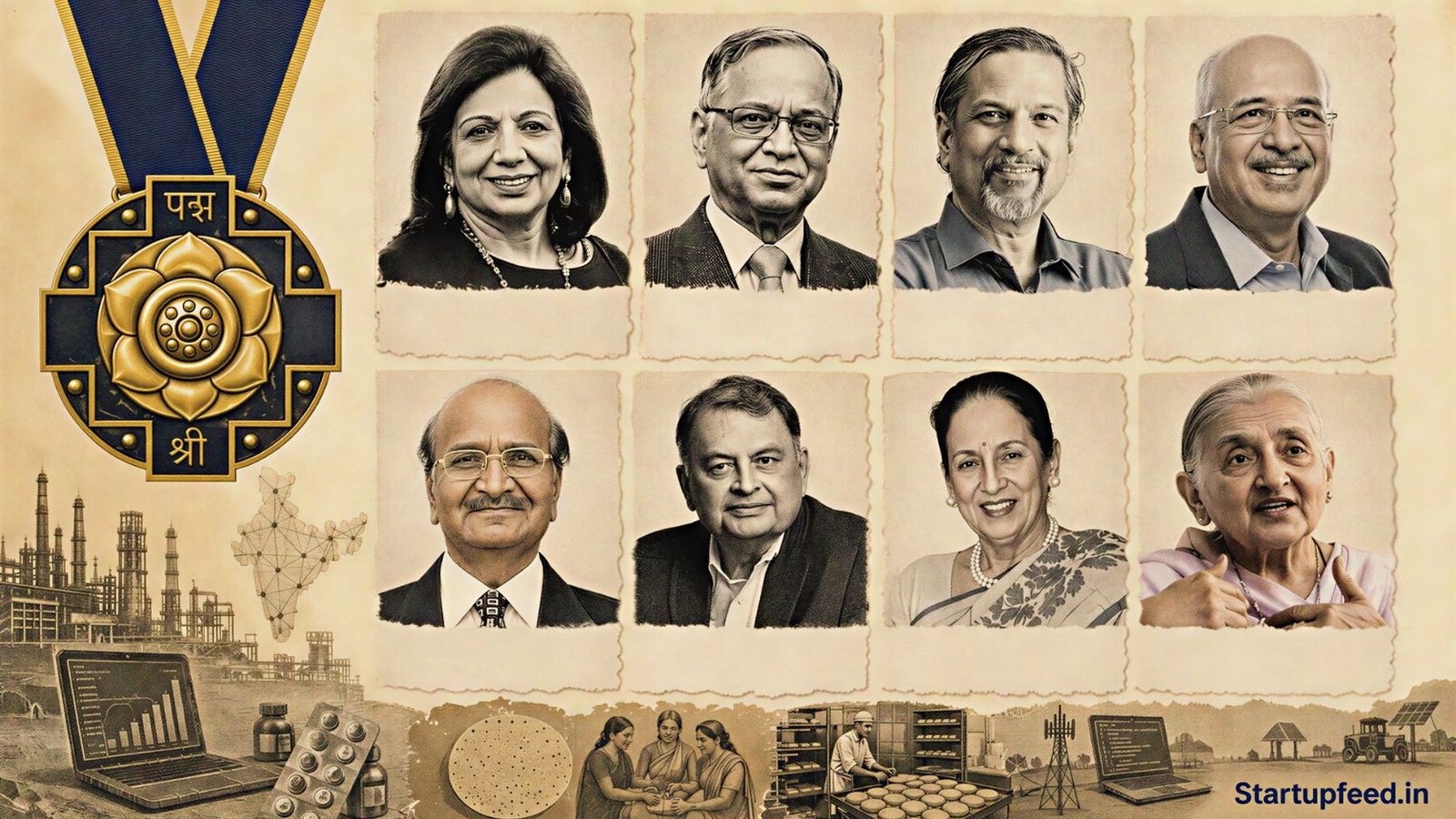
- Honourees span biotech, IT, FMCG, pharma, SaaS and cooperatives: Murthy, Patel, Popat, Shanghvi, Srivastava, Vembu, Bector.
- Pattern signals what comes next: institution building, rural jobs, women-led cooperatives, deeptech depth over valuation speed.
In This Article
India’s Padma Shri Founders story did not begin with the unicorn boom. It began on a January morning in 1989, when President R. Venkataraman pinned the medal on a 35-year-old biotech entrepreneur named Kiran Mazumdar-Shaw.
That moment matters because it set a quiet template. The Padma Shri is not a startup award. It is India’s fourth-highest civilian honour, given for distinguished service. When founders make this list, the state is recognising something deeper than fundraising: category creation, jobs, supply chains, trust, and access. This list of Padma Shri Founders spans four decades and tells the real story of Indian entrepreneurship.
StartupFeed Insight
The Padma Shri founder list is a quiet index of what India actually values in entrepreneurship: durability, not velocity. Notice the gap. From Kiran Mazumdar-Shaw in 1989 to Narayana Murthy in 2000, the state waited 11 years to honour another business builder. From 2010 onward, the cadence quickened. StartupFeed’s read: by 2030, expect the first AI and deeptech founder, and at least one climate or rural manufacturing founder, to enter this list. Institution depth, not valuation speed, will decide who gets the call. By Dr. Mayank Raj.
Who are the Padma Shri Founders of Indian business?
The Padma Shri Founders in trade and industry form a compact group, each tied to a specific category they helped create. Eight names anchor the modern story.
| Founder | Company | Padma Shri Year | Category Built |
|---|---|---|---|
| Kiran Mazumdar-Shaw | Biocon | 1989 | Industrial biotech, biosimilars |
| N. R. Narayana Murthy | Infosys | 2000 | IT services, global delivery model |
| Karsanbhai Patel | Nirma | 2010 | Mass-market detergents, cement |
| Dilip Shanghvi | Sun Pharmaceutical | 2016 | Specialty and generic pharma |
| Saurabh Srivastava | IAN, NASSCOM (co-founder) | 2016 | Angel investing, IT industry building |
| Jaswantiben Popat | Shri Mahila Griha Udyog Lijjat Papad | 2021 | Women’s worker cooperative |
| Rajni Bector | Mrs. Bectors Food Specialities, Cremica | 2021 | Bakery, biscuits, QSR supply chain |
| Sridhar Vembu | Zoho Corporation | 2021 | Bootstrapped global SaaS, rural tech |
The most striking pattern is the gap. After Kiran Mazumdar-Shaw in 1989, the next founder honoured in trade and industry was N. R. Narayana Murthy in 2000 (Infosys management profile). The state took a full decade before recognising another business builder.
About the Padma Shri Award
The Padma Shri is India’s fourth-highest civilian honour, instituted in 1954 by the Government of India. It is given for distinguished service in fields ranging from art and science to trade and industry. The award is announced on Republic Day eve and presented by the President of India at the Rashtrapati Bhavan investiture ceremony. Recipients are recommended by the Padma Awards Committee, constituted annually by the Prime Minister.



Why does the Padma Shri pattern matter beyond unicorns?
The Padma Shri Founders list rewards a specific kind of work: building institutions, not just companies. Each of the eight founders moved from business success to a broader national contribution. Kiran Mazumdar-Shaw started Biocon in a Bengaluru garage in 1978 with Rs 10,000 seed capital. She built India’s first listed biotech company and pioneered affordable biosimilars (Biocon leadership profile).
“On the Padma Shri award, it is a huge honor and I feel humbled. I dedicate this to our employees, my extended family, for keeping the faith,” said Sridhar Vembu after receiving the honour in 2021.
Vembu’s case is instructive. Zoho is bootstrapped, headquartered in Chennai, and the founder runs the company from Mathalamparai village in Tenkasi district, Tamil Nadu. The state honoured him for taking software jobs to rural India, not for hitting a valuation milestone. Jaswantiben Popat’s recognition followed similar logic. She co-founded Lijjat Papad in 1959 in Mumbai with a Rs 80 loan and seven other women. The cooperative now employs nearly 45,000 women.
How do Padma Shri Founders compare with the unicorn generation?
India had 118 unicorns as of January 2026, according to widely cited industry trackers. Yet very few unicorn founders have received the Padma Shri. The reason sits in the eligibility logic. The honour weighs institution building, jobs created, categories opened, and trust earned over many years. A USD 1 Bn (Rs 8,300 Cr) valuation does not automatically translate to that.
Compare the cohorts on three dimensions. First, on durability: Lijjat Papad has run as a cooperative for 67 years; Biocon has compounded for 48 years. Second, on jobs: Lijjat employs around 45,000 women, Nirma group revenues crossed Rs 23,000 Cr at peak, and Zoho serves over 100 million users with employees largely outside metro hubs. Third, on category creation: each Padma Shri founder opened a market segment that did not exist before they arrived. What makes this group different is patience: most of these founders waited 25 to 40 years for the honour.
What’s Next
The next decade will test which Indian founders cross the threshold from business success to national contribution. Watch three signals: AI and deeptech founders who turn into institution builders, climate and manufacturing entrepreneurs who create jobs outside metro hubs, and women-led or cooperative businesses that earn the recognition they deserve. Will Indian entrepreneurship be remembered for valuation speed or institution depth?
Frequently Asked Questions
Last updated: June 24, 2026 at 14:30 IST
Written by Dr. Mayank Raj. Published: June 24, 2026. Updated: June 24, 2026. Have a tip? Write to us at editorial@startupfeed.in.

Liked this story? Follow StartupFeed on Google so our reporting reaches you first.