
Quick Take
- Zara India revenue falls 1.2% to Rs 2,749 Cr in FY26, its weakest result since pandemic year FY21.
- Net profit at the Inditex-Trent joint venture dropped 32% to Rs 204 Cr in the same year.
- Trent’s own Zudio chain grew 18.2% in revenue, adding indirect pressure on Zara’s performance.
In This Article
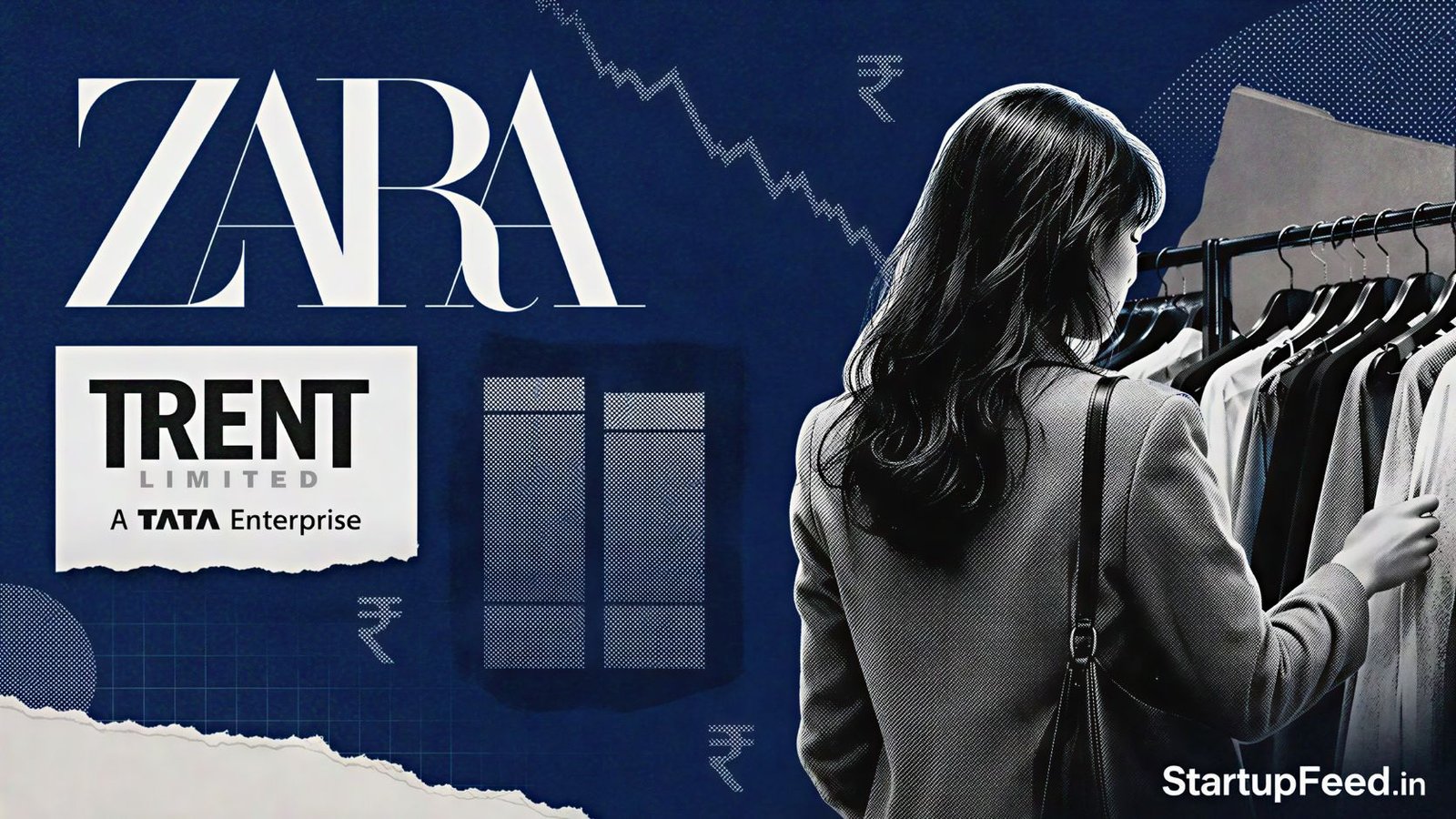
Zara India revenue falls 1.2% to Rs 2,749 Cr ($327 Mn) in FY26, the weakest result for the brand’s India joint venture since pandemic-affected FY21, per Trent Ltd’s FY26 annual report filed on May 30, 2026.
The figures come from Inditex Trent Retail India Pvt Ltd (ITRIPL), the joint venture (JV, a business co-owned by two companies) between Spain’s Inditex group and Tata Group’s Trent Ltd. ITRIPL operates 22 Zara stores across 13 Indian cities. Net profit dropped to Rs 204 Cr ($24 Mn) in FY26, down 31.9% from Rs 299 Cr in FY25. Revenue growth in FY25 was already near-zero at 0.5%, so two consecutive weak years confirm a structural slowdown, not a one-off dip.
StartupFeed Insight
The Zara India revenue falls confirm a pattern brand strategists have quietly flagged for two years. Premium international fashion is losing the price-sensitivity battle in India’s tier-1 malls. Zudio, the value chain from Zara’s own JV partner Trent, powered an 18.2% jump in Trent’s consolidated revenue while Zara slid. Trent also reduced its equity stake in ITRIPL to 20% during FY26, tendering 94,900 shares in a buyback. That move signals Trent increasingly treats the JV as a passive financial holding, not a growth vehicle. Investors and brand strategists tracking India’s consumer sector should watch whether Inditex launches a strategic overhaul of its India presence, including possible store format changes or a wider city footprint, before FY28. By StartupFeed Desk.
How Did Zara India Revenue Perform in FY26?
Zara India revenue falls in FY26 mark the first actual contraction since pandemic year FY21. From Rs 1,815 Cr in FY22, the brand grew +41% in FY23 to Rs 2,562 Cr. Growth then cooled sharply to +8% in FY24 (Rs 2,768 Cr) and near-flat +0.5% in FY25 (Rs 2,782 Cr). FY26’s Rs 2,749 Cr is the lowest revenue the brand has reported since before the post-pandemic recovery period.
The profit decline is steeper than the revenue figure alone suggests. Total income, which includes non-operating items beyond store sales, dropped 2.5% to Rs 2,767 Cr from Rs 2,839 Cr in FY25. PAT (Profit After Tax, net earnings after all deductions) fell 31.9%, from Rs 299 Cr to Rs 204 Cr. Higher fixed costs on a flat-to-declining revenue base compressed margins well beyond the top-line dip.
A structural ownership change accompanied the earnings slide. Trent reduced its ITRIPL equity stake to 20% in FY26, tendering 94,900 shares in a buyback. It had already reduced from 49% to 34.94% in FY25. Trent’s annual report confirms ITRIPL is treated as a financial investment, not a strategic retail asset.

FY26 Numbers at a Glance
| Metric | FY26 | FY25 | Change |
|---|---|---|---|
| ITRIPL Revenue from Operations | Rs 2,749 Cr | Rs 2,782 Cr | -1.17% |
| ITRIPL Total Income | Rs 2,767 Cr | Rs 2,839 Cr | -2.53% |
| ITRIPL Net Profit (PAT) | Rs 204 Cr | Rs 299 Cr | -31.9% |
| Trent Consolidated Revenue | Rs 19,701 Cr | ~Rs 16,667 Cr | +18.2% |
| Trent EBIT | Rs 2,341 Cr | N/A | N/A |
| Massimo Dutti India Revenue | Rs 128 Cr | Rs 100 Cr | +28% |
| Zara India Store Network | 22 stores, 13 cities | 22 stores, 13 cities | No change |
EBIT (Earnings Before Interest and Taxes, a profitability measure that strips out financing costs) of Rs 2,341 Cr at the Trent level shows the parent company is healthy. The contrast with ITRIPL’s 31.9% profit drop is stark.
About Inditex Trent Retail India
Inditex Trent Retail India Pvt Ltd (ITRIPL) is a joint venture established around 2010 between Spain’s Inditex group and Tata Group’s retail arm Trent Ltd. It operates 22 Zara stores across 13 Indian cities and is headquartered in Gurugram, Haryana. Trent now holds a 20% equity stake following two successive buyback rounds. ITRIPL sources all merchandise exclusively from the Inditex group, which also owns Massimo Dutti, Pull and Bear, and Bershka globally.
Where Zara India Revenue Falls Short in FY26
The Zara India revenue falls reflect structural pressure from three directions. First, Trent’s own Zudio chain offers trend-driven clothing mostly under Rs 999 and now spans more than 1,000 outlets across India. Indirectly, Zara’s most capable volume competitor is the very parent company that co-owns Zara’s India JV.
Second, digital-first Indian brands have grown fast on platforms like Myntra and AJIO. Labels such as Snitch and Rare Rabbit target fashion-conscious shoppers at prices well below Zara’s Rs 2,000-plus range. A Rs 3,000 Zara top competes on the same smartphone screen as a Rs 799 alternative from a homegrown brand.
Third, global rivals H&M and UNIQLO maintain active India presences. H&M entered India in 2015 and now operates more than 50 stores across major cities, with entry-level pricing that undercuts Zara considerably.
Trent’s annual report makes the strategic framing explicit: ITRIPL and the Massimo Dutti JV “should be viewed primarily as financial investments rather than strategic retail assets.” This reduces the probability of a Trent-backed Zara expansion push in the near term.
“I have long believed that Trent is not intended to be defined by a single brand, but rather by a portfolio of brands. In a diverse and evolving market like India as well as globally, it is unlikely that any one brand can capture a dominant share of the lifestyle space.”
Noel Tata, Chairman, Trent Ltd, from Trent’s FY26 Annual Report.



How Does Zara India Compare to Rivals?
Zara India occupies a distinct premium tier. Its 22-store count keeps the brand exclusive but limits its ability to respond to mass-market pressure. Rivals cover more of the market on both store count and price range.
| Brand | India Stores | Price Range (Approx) | Owner |
|---|---|---|---|
| Zara India | 22 (13 cities) | Rs 2,000-10,000 | Inditex-Trent JV (80:20) |
| H&M India | 50+ | Rs 500-5,000 | H&M Group (Sweden) |
| UNIQLO India | 10+ | Rs 1,000-8,000 | Fast Retailing (Japan) |
| Zudio (Trent) | 1,000+ | Rs 199-999 | Trent Ltd (Tata Group) |
Zara’s premium positioning and 22-store ceiling make a large-scale, low-price response structurally difficult without a fundamental shift in how Inditex approaches its India JV.
What’s Next
One outlier in the Inditex India portfolio stands out: Massimo Dutti India posted 28% revenue growth to Rs 128 Cr in FY26. Its ultra-premium positioning appears to hold better than Zara’s mid-premium tier in India’s current consumer climate. Trent continues investing heavily in Zudio, which now has 1,286 outlets including six in the UAE. The key question is whether Inditex will respond to the Zara India revenue falls with a store-count push, a new pricing strategy, or a quiet structural review of the JV. Trent’s FY27 annual report will be the clearest signal.
Also Read
- D2C and E-Commerce Startup Coverage on StartupFeed
- Latest Startup Funding and Investment Deals in India
- For Founders: Guides to India’s Startup and Business Ecosystem
Frequently Asked Questions
How much did Zara India revenue fall in FY26?
Zara India revenue falls 1.2% to Rs 2,749 Cr in FY26, down from Rs 2,782 Cr in FY25, per Trent Ltd’s annual report. Net profit dropped 31.9% to Rs 204 Cr from Rs 299 Cr. This marks the brand’s weakest India performance since pandemic year FY21, when it posted a net loss of Rs 41 Cr.
What is Inditex Trent Retail India (ITRIPL)?
Inditex Trent Retail India Pvt Ltd (ITRIPL) is the joint venture between Spain’s Inditex group and Tata Group’s Trent Ltd that operates all 22 Zara stores in India. Trent holds a 20% equity stake after two successive buyback rounds. ITRIPL sources all merchandise exclusively from Inditex and is headquartered in Gurugram, Haryana.
Why is Zara India profit dropping so sharply?
Zara India’s profit drop reflects rising competition from value chains like Zudio, fast-growing digital-first Indian brands, and global rivals H&M and UNIQLO. The Zara India revenue falls also narrow the revenue base. Fixed costs across 22 stores then compress margins sharply, explaining the 32% profit decline even on a relatively small revenue decrease.
Disclaimer: This article is for informational purposes only and does not constitute investment advice. StartupFeed and its authors are not SEBI (Securities and Exchange Board of India) registered investment advisors. The analysis above is based on publicly available information and should not be the sole basis for any investment decision. Please consult a SEBI-registered financial advisor before making investment decisions.
Have a tip? Write to us at editorial@startupfeed.in.
Liked this story? Follow StartupFeed on Google so our reporting reaches you first.