
Quick Take
- The Union Cabinet, chaired by PM Narendra Modi, approved two new semiconductor manufacturing projects on May 5, 2026 — Crystal Matrix Limited’s GaN compound semiconductor fab and ATMP facility in Dholera, and Suchi Semicon Private Limited’s OSAT facility in Surat — with a combined investment of ₹3,936 crore.
- These are the final two approvals under ISM 1.0, taking the total sanctioned project count to 12 and cumulative planned investments to approximately ₹1.64 lakh crore. Both units will be located in Gujarat and are expected to create 2,230 skilled jobs.
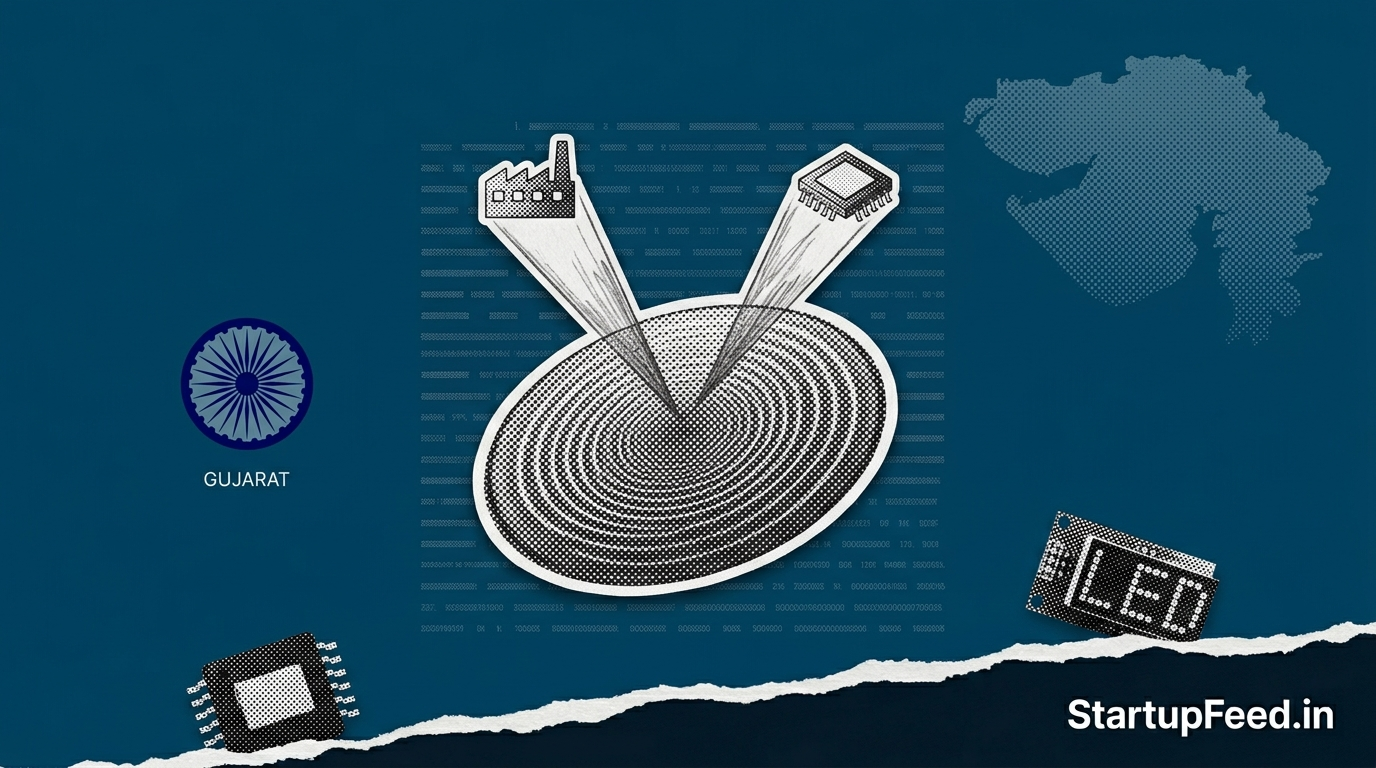
- Crystal Matrix’s facility will be India’s first commercial Mini/Micro-LED display manufacturing unit based on GaN technology. Suchi Semicon’s OSAT will have a planned capacity of over 1,033 million chips per year targeting automotive, industrial automation, and consumer electronics.
The Union Cabinet’s approval of India Semiconductor Mission projects for Crystal Matrix and Suchi Semicon on May 5, 2026 closes ISM 1.0’s project approval window — completing the full pipeline of twelve semiconductor manufacturing projects that the government will support under the original scheme framework. The two Gujarat-based facilities represent ₹3,936 crore in combined investment and 2,230 expected skilled jobs, but their strategic significance exceeds their capital footprint: Crystal Matrix’s GaN compound semiconductor fab will be India’s first commercial Mini/Micro-LED display manufacturing facility, and Suchi Semicon’s OSAT at Surat adds over one billion chips per year of discrete semiconductor packaging capacity in a segment — power electronics and automotive — that India currently imports almost entirely.
The approvals were announced by Information and Broadcasting Minister Ashwini Vaishnaw alongside a broader Cabinet session that also cleared an ₹18,100 crore Emergency Credit Line Guarantee Scheme (ECLGS) for MSMEs and airlines affected by the West Asia conflict — providing context for the government’s parallel attention to both strategic deep-tech investment and near-term economic resilience.
StartupFeed Insight
The Crystal Matrix approval is the most strategically underappreciated semiconductor decision India has made in 2026. The mainstream semiconductor policy narrative focuses almost exclusively on logic chip fabs — Tata-PSMC’s fab in Dholera, with TSMC’s N28 process node, gets the headlines. But compound semiconductors based on Gallium Nitride are the enabling technology for the next generation of display devices (Mini and Micro-LED), power electronics (EV chargers, industrial power supplies), and radio frequency components (5G base stations, satellite communications).
The global GaN semiconductor market is projected to reach $7 billion by 2030 at a 27% CAGR — and India currently has zero domestic production capacity in this segment. Crystal Matrix’s 6-inch GaN epitaxy wafer capability and 72,000 sqm annual display panel capacity is India’s entry point into a market that will be defined by whoever builds process expertise now, not by whoever arrives with capital later.
For Indian founders building in EV, industrial automation, XR devices, or display technology: Crystal Matrix’s approval means that within 2–3 years, India will have a domestic GaN foundry offering epitaxy services on 6-inch wafers. That is the upstream component that every downstream application in these categories currently imports. The startup that builds products on top of domestic GaN supply — without import dependency and with the cost arbitrage of domestic sourcing — will have a structural manufacturing advantage that competitors in China and South Korea cannot easily replicate in the Indian market. Watch Crystal Matrix. — StartupFeed Desk
What Are Crystal Matrix and Suchi Semicon Building Under the India Semiconductor Mission?
| Parameter | Crystal Matrix Limited (CML) | Suchi Semicon Private Limited (SSPL) |
|---|---|---|
| Facility type | Compound semiconductor fab + ATMP (Assembly, Testing, Marking and Packaging) | OSAT (Outsourced Semiconductor Assembly and Test) |
| Location | Dholera, Gujarat | Surat, Gujarat |
| Technology | Gallium Nitride (GaN) — compound semiconductor; Mini and Micro-LED display modules; GaN foundry services including epitaxy on 6-inch wafers | Discrete semiconductors — lead frame and wirebond packaging; power electronics and analog ICs |
| India-first claim | India’s first commercial Mini/Micro-LED display manufacturing facility based on GaN technology | Adds to Gujarat’s growing OSAT cluster (following Kaynes Semicon in Sanand) |
| Annual production capacity | 72,000 sq. metres of Mini/Micro-LED display panels; 24,000 sets of RGB GaN epitaxy wafers | Over 1,033.2 million chips per year |
| Target applications | Large displays (TVs, signage); medium displays (tablets, smartphones, in-car); micro-displays (XR glasses, smartwatches) | Power electronics, analog ICs, industrial systems; end markets: automotive, industrial automation, consumer electronics (ACs, TVs, mobiles, laptops, EV battery management) |
| Project cost | Approx. ₹3,068 crore (derived: ₹3,936 Cr total minus ₹868 Cr Suchi Semicon) | ₹868 crore |
| Direct employment | Not separately disclosed (combined 2,230 skilled jobs for both units) | 630 direct jobs confirmed |
About the India Semiconductor Mission (ISM)
The India Semiconductor Mission was launched in December 2021 under the ₹76,000 crore Production Linked Incentive framework for semiconductors. The scheme provides up to 50% of project cost as central government support for semiconductor fabrication units, compound semiconductor fabs, ATMP and OSAT facilities, and Design Linked Incentives (DLI) for chip design companies.
With the May 5, 2026 Cabinet approval of Crystal Matrix and Suchi Semicon, ISM 1.0 has now completed its project approval pipeline — 12 projects sanctioned with cumulative planned investments of approximately ₹1.64 lakh crore. Ten of the twelve previously approved projects are in various stages of execution, with some already achieving commercial shipments and others nearing operational status. ISM 2.0, announced earlier in 2026 under the Union Budget 2026-27 with ₹40,000 crore allocated for the Electronics Component Manufacturing Scheme, pivots the government’s support framework from assembly-led incentives toward IP-centric, fabless models and compound semiconductors — a direction that Crystal Matrix’s GaN fab directly exemplifies.
The government has also extended design infrastructure support to 315 academic institutions and 104 startups under the DLI scheme.



What Is GaN Semiconductor Technology and Why Does Crystal Matrix’s Fab Matter?
Gallium Nitride (GaN) is a compound semiconductor — a material made from two or more elements — as distinct from silicon, which is a single-element semiconductor. GaN has three properties that make it superior to silicon for specific high-performance applications: it can operate at higher voltages and temperatures, it switches electricity far faster (enabling high-efficiency power electronics), and it emits light far more efficiently (enabling the next generation of display technology in Mini and Micro-LED devices).
Crystal Matrix’s facility will serve two distinct markets simultaneously. On the display side, its 72,000 sqm annual Mini/Micro-LED panel capacity targets the global display market’s highest-growth segment: Mini-LED backlights for TVs and monitors (where Samsung and LG currently dominate), and Micro-LED panels for the emerging XR device market where Apple, Meta, and Samsung are all racing to produce display components at scale. On the foundry side, its GaN epitaxy capability on 6-inch wafers gives Indian power electronics and RF component manufacturers their first domestic source of GaN substrate — the critical input that currently must be imported entirely from international suppliers.
What Is Suchi Semicon and Why Does Its Cabinet Approval Matter?
Suchi Semicon Private Limited is a Surat-based semiconductor company founded by Ashok Mehta — a visionary entrepreneur from Surat with over 25 years of experience in import-export across 30+ countries who founded Suchi Industries in 2004 and subsequently pivoted into semiconductor assembly and test as India’s ISM policy framework created the enabling environment for domestic OSAT investment. The Cabinet approval formalises ISM support for what the company had already been building independently: Suchi Semicon started production of semiconductors and had begun operating an initial OSAT facility in Surat before ISM approval arrived — an unusually capital-forward posture for an Indian semiconductor startup.
The ISM-sanctioned facility will expand Suchi Semicon’s capacity to over 1,033 million chips per year — targeting discrete semiconductors for power electronics (voltage regulators, diodes, transistors), analog ICs, and industrial systems. Its primary end markets — automotive electronics, industrial automation, and consumer electronics — are exactly the segments where India’s rapid growth in EV adoption, factory automation, and consumer electronics manufacturing creates the highest near-term domestic demand for locally assembled chips.
Where Does ISM 1.0 Stand — and What Is ISM 2.0?
| ISM Milestone | Status (May 5, 2026) |
|---|---|
| Total projects approved (ISM 1.0) | 12 (Crystal Matrix and Suchi Semicon are the 11th and 12th — final two approvals) |
| Cumulative planned investment | ~₹1.64 lakh crore across all 12 projects |
| Projects in execution | 10 previously approved projects in various stages of construction and commissioning |
| Commercial shipments | Some previously approved projects already shipping; Micron (Sanand ATMP) and Kaynes Semicon (Sanand OSAT) operational |
| Flagship project (Tata-PSMC Fab) | Dholera SEZ notified April 9, 2026; India’s first logic chip fab; TSMC N28 process node; largest single semiconductor project |
| Design support | 315 academic institutions and 104 startups supported under Design Linked Incentives (DLI) |
| ISM 2.0 outlay | ₹40,000 crore under Electronics Component Manufacturing Scheme (Union Budget 2026-27); IP-centric, fabless-focused pivot |
| India semiconductor market size | ~$62 Bn in 2026; projected to grow to $155 Bn by 2031 (Inc42 report) |
| Import dependency | India currently imports over 90% of semiconductor inputs; R&D spend at ~0.6% of GDP |
The structural challenge that the ISM’s 12-project pipeline has not yet resolved is upstream: India currently relies on imports for over 90% of semiconductor inputs — including chemicals, gases, equipment, and substrate materials. Building downstream assembly and test capacity (ATMP, OSAT) is the correct first step, but India cannot claim semiconductor sovereignty until it has domestic supply chains for the materials and equipment that feed those facilities. ISM 2.0’s pivot toward IP-centric and fabless models — combined with the India Semiconductor Mission 2.0’s ₹40,000 crore Electronics Component Manufacturing Scheme — signals that the government understands this constraint and is beginning to address it at the materials and design layer, not just the assembly layer.
What’s Next
Four milestones to track in the next 18 months. First, ground-breaking announcements for Crystal Matrix’s Dholera facility — the physical commencement of construction will set the timeline for when India’s first GaN commercial fab reaches production readiness.
Second, Suchi Semicon’s capacity ramp to 1,033 million chips per year — the company was already operational before ISM approval, so the question is how quickly ISM incentive funding accelerates its expansion.

Third, the Tata-PSMC logic chip fab’s construction progress in Dholera — the SEZ notification in April 2026 was a regulatory milestone; actual construction commencement will be the commercial milestone.
Fourth, the first ISM 2.0 project approvals — these will reveal whether the government’s IP-centric pivot translates into support for genuinely deep-technology projects in compound semiconductors, SiC, and fabless chip design, or defaults again to assembly-and-test economics. India’s semiconductor ambition is now 12 projects and ₹1.64 lakh crore deep. The next chapter is whether ISM 2.0 builds the domestic IP layer that makes the assembly investments self-sustaining.
Frequently Asked Questions
What did the Union Cabinet approve for the India Semiconductor Mission on May 5, 2026?
The Union Cabinet approved two new semiconductor manufacturing projects under the India Semiconductor Mission on May 5, 2026.
The first is an integrated compound semiconductor fabrication and ATMP facility by Crystal Matrix Limited in Dholera, Gujarat — India’s first commercial Mini/Micro-LED display manufacturing unit based on Gallium Nitride (GaN) technology, with an annual capacity of 72,000 sq. metres of display panels and 24,000 sets of RGB GaN epitaxy wafers.
The second is an OSAT facility by Suchi Semicon Private Limited in Surat, Gujarat, for manufacturing discrete semiconductors with a capacity of over 1,033 million chips per year. Combined investment is ₹3,936 crore; combined employment is 2,230 skilled jobs. These are the final two approvals under ISM 1.0, taking the total to 12 projects and ₹1.64 lakh crore in cumulative planned investment.
What is Crystal Matrix’s GaN semiconductor fab building in Dholera?
Crystal Matrix Limited is building India’s first commercial compound semiconductor fabrication and ATMP facility in Dholera, Gujarat, focused on Gallium Nitride (GaN) technology. The facility will manufacture Mini and Micro-LED display modules — for applications ranging from large TV and commercial displays to smartphones, tablets, in-car screens, and XR devices — at an annual capacity of 72,000 square metres of display panels. It will also provide GaN foundry services, including epitaxy on 6-inch wafers, producing 24,000 sets of RGB GaN epitaxy wafers annually. This makes it India’s only domestic source of GaN substrate for power electronics and RF applications, which are currently entirely imported.
What is Suchi Semicon and what will its Surat OSAT facility produce?
Suchi Semicon Private Limited (SSPL) is a Surat-based semiconductor company that is setting up an Outsourced Semiconductor Assembly and Test (OSAT) facility in Surat, Gujarat, under India Semiconductor Mission approval. The facility will manufacture discrete semiconductors — including lead frame and wirebond packaging conductors — with a planned production capacity of over 1,033 million chips per year. The chips will serve power electronics, analog ICs, and industrial systems for end markets including automotive, industrial automation, and consumer electronics such as air conditioners, TVs, mobile phones, laptops, and EV battery management systems. The project cost is ₹868 crore and will create 630 direct jobs.
Written by Harshvardhan jain. Published: May 5, 2026. Updated: May 5, 2026. Have a tip? Write to us at editorial@startupfeed.in.
Liked this story? Follow StartupFeed on Google so our reporting reaches you first.