

QUICK TAKE
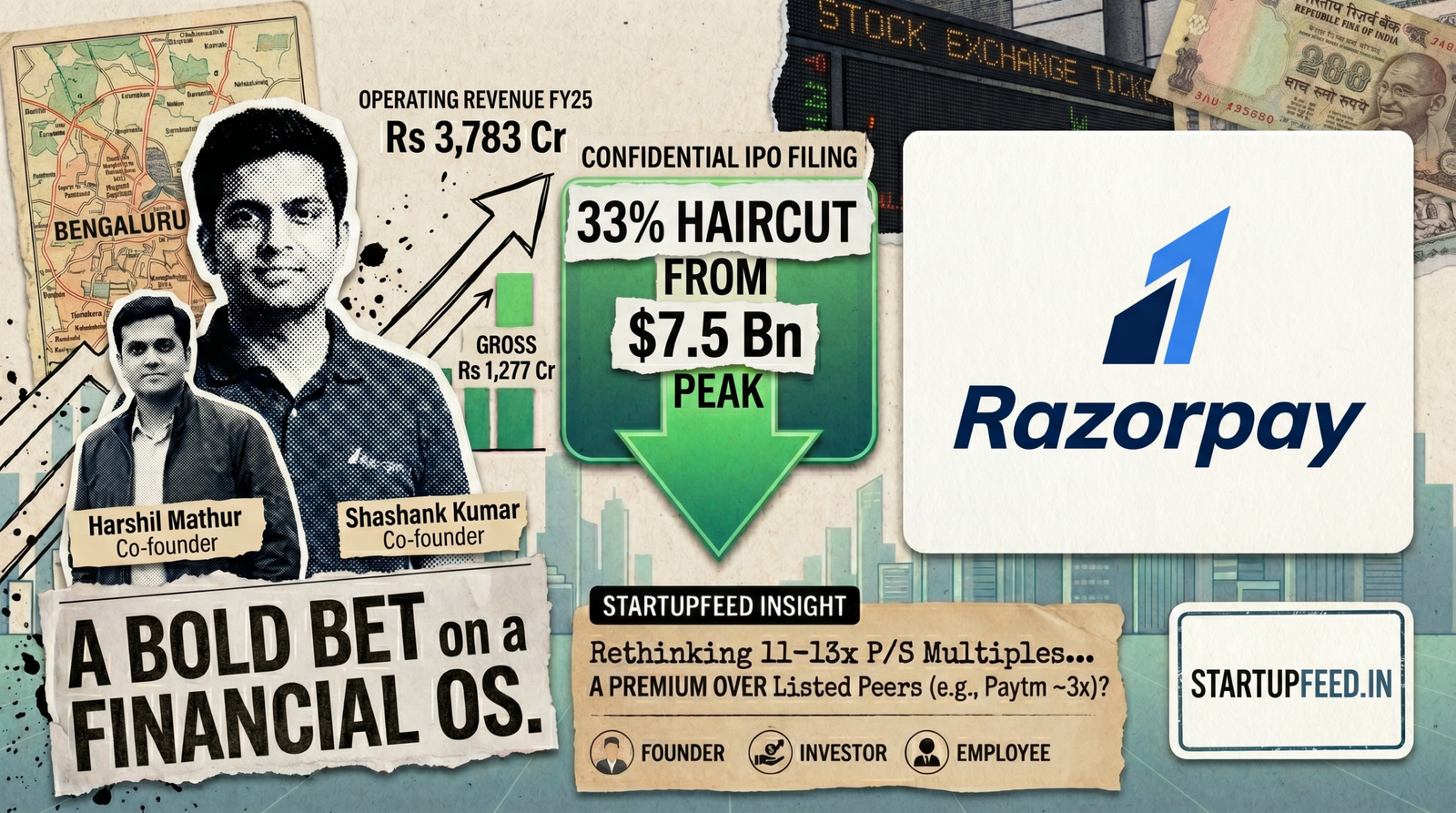
- IPO Size: $600–700 Mn (Rs 5,160–6,020 Cr) — confidential SEBI filing route
- Valuation: $5–6 Bn — a 20–33% markdown from $7.5 Bn peak (December 2021)
- Revenue: Rs 3,783 Cr in FY25 (+65% YoY); gross profit Rs 1,277 Cr (+41% YoY)
- Loss: Rs 1,209 Cr net loss (one-time: ESOP + domicile reversal costs of ~$150 Mn)
- Investors: GIC, Tiger Global, Peak XV, Lightspeed, TCV — $742–800 Mn+ raised to date
- What’s Next: DRHP filing in weeks; listing expected within FY27; PhonePe IPO paused
Fintech unicorn Razorpay has raised $742 Mn (Rs 6,390 Cr) over 11 rounds and is preparing to confidentially file for an initial public offering (IPO) with SEBI within the coming weeks, targeting a raise of $600–700 Mn (Rs 5,160–6,020 Cr) at a valuation of $5–6 Bn — a markdown of 20–33% from the company’s $7.5 Bn peak valuation set at its December 2021 Series F round, according to multiple people familiar with the matter cited by The Economic Times.
The confidential filing route — used recently by Swiggy, Groww, Meesho, and Zepto — allows Razorpay to submit its DRHP to SEBI without immediately making financials public. The move signals the company is ready to list, but the valuation discount sends a sharper message: India’s public markets are recalibrating fintech valuations downward, and even the country’s largest payment infrastructure company is not immune.
StartupFeed Insight
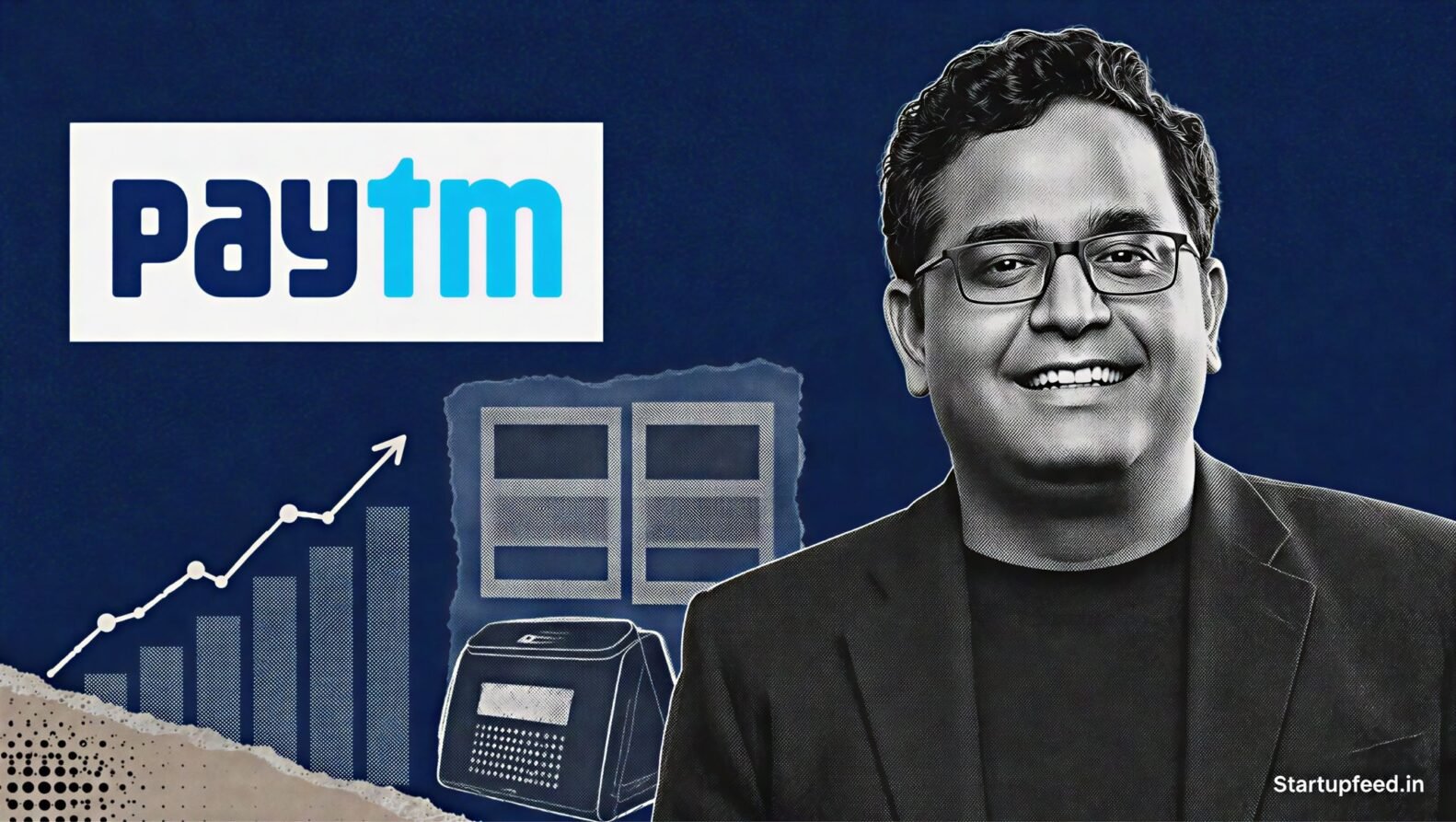
What the numbers say: Razorpay’s Rs 3,783 Cr revenue at an IPO valuation of $5–6 Bn implies a price-to-sales multiple of approximately 11–13x. That is aggressive relative to listed peer Paytm, which trades at roughly 3x revenue. The question public investors will ask: does Razorpay’s 65% revenue growth justify a 3–4x valuation premium over a listed, comparable business?
What this means for you:

- If you’re a founder: Razorpay’s haircut signals the end of private market fantasy valuations for Indian fintech. If your cap table shows a 2021 or 2022 valuation, assume 30–50% recalibration at IPO unless you have exceptional growth AND a clear profitability path.
- If you’re an investor: Watch Razorpay’s IPO pricing as the benchmark for Indian payment infrastructure. If it lists at $5 Bn and trades up, it opens the window for PhonePe and others. If it trades down post-listing (Paytm pattern), the fintech IPO window slams shut through FY28.
- If you’re a Razorpay employee: The ESOP pool just got real. At a $5–6 Bn listing, early-stage ESOP holders from the $1 Bn Series D era (2020) are sitting on 5–6x gains. Series F ESOP holders (2021, $7.5 Bn) are still underwater at $5 Bn — watch the listing price carefully.
Our prediction: Razorpay will list at $5.5 Bn in Q3 FY27, trade up 15–20% on listing day on the back of its 65% revenue growth story, and stabilise at a P/S multiple of 8–10x within 6 months — closer to PayU than Stripe. The EBITDA profitability of its core payments business will be the swing factor. If it can demonstrate path to consolidated breakeven by FY28, the market will re-rate it. If not, the Paytm playbook repeats.
IPO Structure — What We Know
Razorpay has not publicly confirmed the IPO filing, but multiple sources cited by The Economic Times provide the clearest picture to date of the deal’s contours:
| Component | Amount | Notes |
| Total IPO Size | $600–700 Mn (Rs 5,160–6,020 Cr) | Confidential DRHP route — SEBI filing first |
| Valuation Target | $5–6 Bn (Rs 43,000–51,600 Cr) | Down 20–33% from $7.5 Bn peak (Dec 2021) |
| Peak Valuation | $7.5 Bn (Dec 2021) | Series F — 4+ years ago |
| Implied Markdown | ~20–33% from peak | Public markets pricing conservatively |
| Filing Route | Confidential (SEBI) | Same as Swiggy, Groww, Meesho, Zepto |
| Expected Timeline | Within next few weeks (filing); FY27 listing | CFO Arpit Chug confirmed FY27 target |
The confidential filing route is now standard for new-age Indian startups. It allows the company to test SEBI’s response, make adjustments to the DRHP based on regulator feedback, and gauge institutional investor appetite before going fully public. Razorpay has already completed the structural prerequisites: it converted to a public limited company in April 2025 and completed its reverse flip from the US to India in May 2025.
Financial Performance — The IPO Case
Razorpay’s IPO story rests on a compelling top-line trajectory paired with a legitimately explained bottom-line hit: the Rs 1,209 Cr net loss in FY25 is almost entirely attributable to ESOP charges and $150 Mn in taxes incurred during the reverse flip — not operational weakness. The core online payments business turned EBITDA profitable in FY25.
| Metric | FY24 | FY25 | Growth / Notes |
| Operating Revenue | Rs 2,296 Cr | Rs 3,783 Cr | +65% YoY |
| Gross Profit | Rs 906 Cr | Rs 1,277 Cr | +41% YoY |
| Net Loss (Post-ESOP) | Profitable | Rs 1,209 Cr loss | One-time domicile reversal costs |
| Online Payments EBITDA | Loss-making | EBITDA profitable | Core business turned corner |
| Total Payment Volume | N/A (prev.) | ~$45 Bn/qtr | ~1 Bn txns/quarter |
| Merchants Served | 5 Mn+ | 8 Mn+ | +60% in 2 years |
| Reverse Flip Cost | — | ~$150 Mn taxes | Domicile: US → India (May 2025) |
The gross profit trajectory is the number that matters most for IPO pricing. At Rs 1,277 Cr gross profit on Rs 3,783 Cr revenue, Razorpay’s gross margin is approximately 33.8% — respectable for a payment infrastructure business. For context, Stripe targets 30–35% gross margins at scale. The question is whether Razorpay can convert gross profit into operating profitability as it scales newer verticals (RazorpayX, Razorpay Capital, international).
What the Founders Say
The idea is to move from being just a payments provider to becoming a financial operating system for businesses. Agentic platforms exist independently, but nobody has built them directly on top of payments infrastructure.”
— Harshil Mathur, Co-founder & CEO, Razorpay
Mathur’s framing of Razorpay as a “financial operating system” is deliberate IPO positioning — it targets a higher valuation multiple than a pure payment gateway, analogous to how Toast or Block (Square) command premium multiples by embedding financial services into business workflows. The newly launched AI agentic platform — which automates payment reconciliation, dispute resolution, and transaction monitoring — is the product evidence behind this narrative.

Valuation Analysis — Is $5–6 Bn Justified?
| Company | Last Valuation | Revenue (FY25) | P/S Multiple | Status |
| Razorpay (IPO target) | $5–6 Bn | Rs 3,783 Cr | ~11–13x | Confidential DRHP filing |
| Paytm (listed) | ~$2.5 Bn mkt cap | ~Rs 7,000 Cr | ~3x | Listed — trading at deep discount |
| PhonePe | $12 Bn (last priv.) | N/A (pvt) | N/A | IPO paused (West Asia conflict) |
| Cashfree Payments | ~$700 Mn (est.) | N/A (pvt) | N/A | Private; smaller scale |
| PayU India | ~$3 Bn (est.) | Rs 3,100 Cr | ~8x | Prosus-owned; IPO signals watched |
The honest answer: $5–6 Bn is aggressive but defensible if Razorpay can demonstrate a credible path to consolidated EBITDA profitability by FY28. Paytm’s trading at ~3x revenue creates a visible floor for Indian fintech multiples. Razorpay’s 65% revenue growth and 8 million merchant base justify a significant premium — but public market investors who bought Paytm at IPO and watched it fall 70% will apply a high skepticism discount.
“With a number of new-age companies now listed, investors in the public markets are pricing startups more conservatively as the performance of a bunch of them hasn’t been great,” a person familiar with the matter told ET. “But if you show exceptional growth while being loss-making, there is appetite for those assets at a particular price.”
Key Risk Factors
- Growth sustainability risk: Digital payments industry growth has slowed. Razorpay’s 65% FY25 revenue jump partially reflects base effects from its FY24 base of Rs 2,296 Cr. Public investors will scrutinise whether this growth rate holds into FY26-27.
- Profitability timeline: The core payments business is EBITDA profitable, but consolidated profitability — including international operations, RazorpayX, and Razorpay Capital — is targeted 2–3 quarters after Indian business breaks even. The timeline depends on execution.
- Competitive intensity: Razorpay competes directly with Paytm, PayU, Cashfree, Juspay, and indirectly with PhonePe in merchant payments. UPI-led commoditisation of payment rails compresses MDR (merchant discount rates) and margin expansion headroom.
- Market timing: PhonePe paused its $1.3 Bn IPO citing West Asia conflict-linked geopolitical uncertainty. If macro conditions deteriorate further, Razorpay’s listing window may narrow. The confidential filing buys flexibility without forcing a commitment.
- Regulatory risk: RBI’s payment aggregator framework requires ongoing compliance. Any adverse ruling on data localisation, cross-border payments, or TPAP regulations could materially impact Razorpay’s international expansion thesis.
Funding Journey — From $125K to $742 Mn
| Round | Date | Amount | Lead Investor(s) | Valuation |
| Seed | 2015 | $125K | Y Combinator, Z47 | <$10 Mn |
| Series A | Jun 2016 | ~$9 Mn | Tiger Global, Mastercard | ~$50 Mn |
| Series B | 2017 | ~$20 Mn | Tiger Global, Sequoia | ~$100 Mn |
| Series C | Jun 2019 | $75 Mn | Peak XV, Ribbit Capital | ~$400 Mn |
| Series D | Oct 2020 | $100 Mn | GIC, Sequoia India | $1 Bn (Unicorn) |
| Series E | Apr 2021 | $160 Mn | Sequoia, GIC | $3 Bn |
| Series F | Dec 2021 | $375 Mn | Lone Pine, Alkeon, TCV | $7.5 Bn (Peak) |
| Total Raised | — | $742–800 Mn+ | 37 investors total | IPO target: $5–6 Bn |
The contrast between the Series F valuation ($7.5 Bn, December 2021) and the IPO target ($5–6 Bn) is the defining tension of this story. Razorpay’s 37 investors — including GIC, Tiger Global, Peak XV, Lone Pine, Alkeon, and TCV — marked their books at $7.5 Bn. A $5 Bn IPO represents a markdown on paper for the Series F cohort. The real return calculation depends on the public listing price and whether it recovers toward $7 Bn+ over 12–24 months post-IPO.
What’s Next — 5 Questions That Will Decide the IPO
- Will SEBI clear the DRHP without major revisions? Razorpay’s international operations and complex holding structure (post-reverse flip) will face scrutiny.
- Can Razorpay demonstrate consolidated EBITDA breakeven within 2–3 quarters of Indian business profitability? That is the swing factor for public market pricing.
- Will PhonePe re-enter the IPO market before Razorpay lists? A PhonePe listing at $12 Bn would validate large fintech valuations and help Razorpay’s case; a further PhonePe delay signals market caution.
- What is the institutional anchor investor lineup? The quality of QIB participation in the pre-IPO allocation will set the tone for listing day performance.
- How does Razorpay’s AI agentic platform gain traction between now and listing? If it shows meaningful revenue contribution by Q2 FY27, the narrative shifts from ‘payment gateway’ to ‘fintech operating system’ — and the valuation multiple moves with it.
Razorpay’s IPO will be the most consequential fintech listing since Paytm — and for opposite reasons. Where Paytm was overvalued, over-hyped, and under-profitable, Razorpay enters with a more credible growth story, a self-aware valuation, and the benefit of watching multiple peers navigate the post-listing reality. Whether it threads the needle — listing at a price that satisfies Series F investors while leaving upside for public market buyers — will shape Indian fintech’s public market trajectory for the rest of the decade.
Mandatory disclaimer block
Disclaimer: This article is for informational purposes only and does not constitute investment advice. StartupFeed and its authors are not SEBI-registered investment advisors. The analysis above is based on publicly available information and should not be the sole basis for any investment decision. Please consult a SEBI-registered financial advisor before making investment decisions. StartupFeed and its authors may hold positions in the securities discussed. Read the full DRHP/RHP before applying to any IPO.