Quick Take:
|
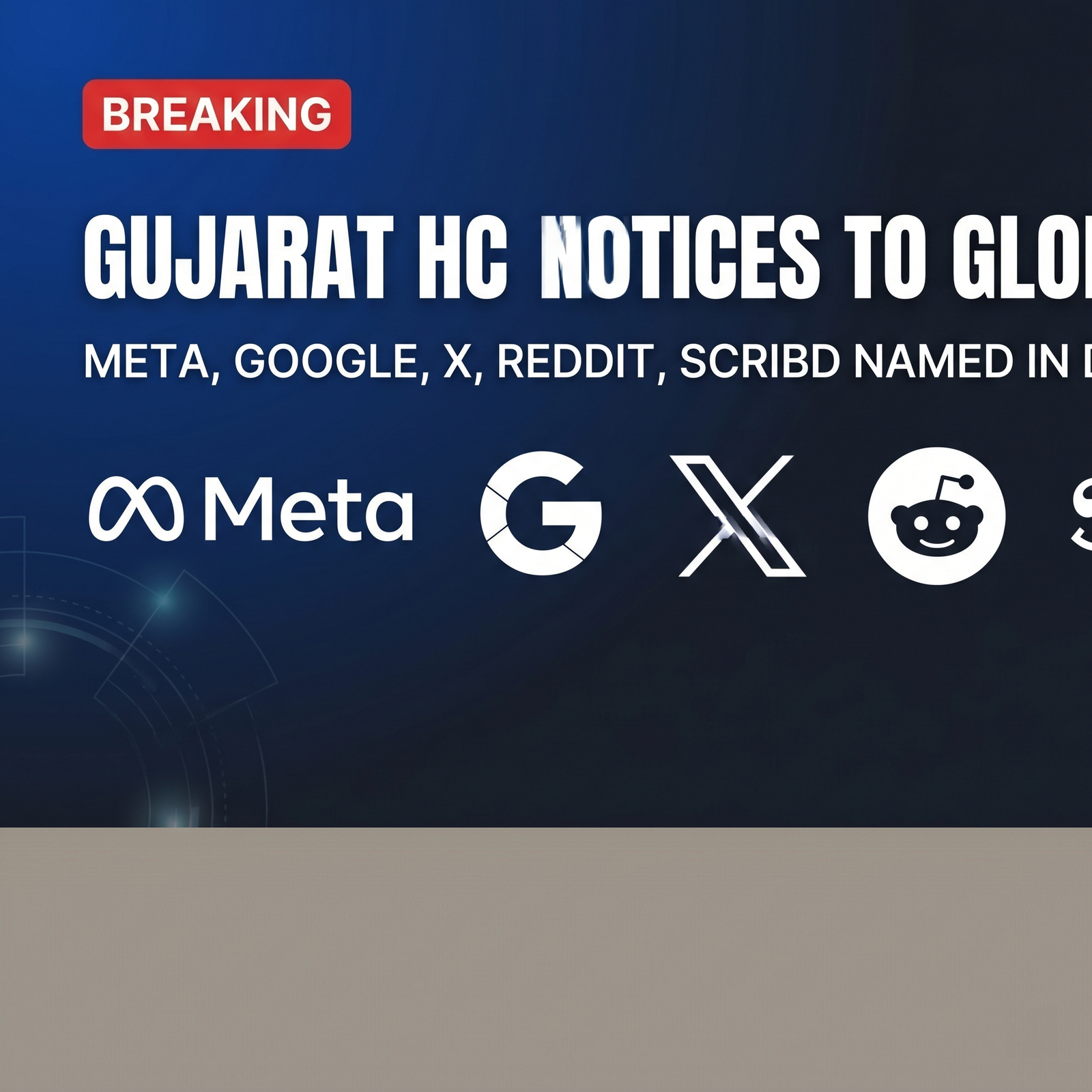
The Gujarat High Court escalated India’s deepfake regulation battle to one of its most consequential judicial confrontations with global tech platforms. A division bench led by Chief Justice Sunita Agarwal and Justice D N Ray issued formal notices to Meta India, Google, X (formerly Twitter), Reddit, and Scribd in a public interest litigation (PIL) filed by advocate Vikas Vijay Nair, directing them to file responses on or before the next hearing on May 8, 2026
The PIL raises an alarm that has been growing louder across India’s courts, government ministries, and civil society: the ‘sharp and alarming rise’ in AI-generated deepfake content circulating on digital platforms poses a ‘serious threat to public order and the functioning of a healthy democracy’ — and the existing legal framework, while present, is being actively flouted by some of the world’s largest technology companies.
The HC’s most pointed observation cuts through the regulatory debate: ‘The core issue lies in implementation rather than the absence of regulation.’ India has laws. India has rules. India has a centralized coordination portal. The problem is that at least one major global platform — X — is systematically not responding to lawfully issued notices.
| StartupFeed Insight — What This Case Means for India’s AI/Tech Ecosystem Three things this judgment signals:
What this means for AI startups and founders in India: If you are building AI tools that generate synthetic media, voice clones, image manipulation, or any content creation capability — this judgment is a direct signal that Indian courts will hold the distribution platforms accountable even when the AI tool itself is built by a third party. The liability chain in India’s deepfake regulation runs from the content → the platform hosting it → the intermediary’s obligation to remove it. Startups building AI content generation tools need to build compliance features — watermarking, provenance tracking, user consent mechanisms — before Indian courts begin tracing liability upstream from platforms to tools. Our prediction: The May 8 hearing will be the decisive moment. If Meta and Google (already on SAHYOG) file substantive compliance affidavits, the HC may narrow its focus to X, Reddit, and Scribd. If X again fails to engage meaningfully, the court could escalate to contempt proceedings — which would make this the most consequential Indian judicial confrontation with a global tech platform since the Supreme Court’s Shreya Singhal judgment on Section 66A in 2015. |
The Case — What the PIL Argues
Petitioner: Vikas Vijay Nair, advocate — filed as a public interest litigation (Case No. R/Writ Petition (PIL) No. 9 of 2026)
The PIL’s core claims:
- Threat to democracy: The ‘widespread creation and circulation of AI-generated videos on digital platforms’ poses a ‘serious threat to public order and the functioning of a healthy democracy’ — deepfakes can penetrate the social fabric and create ‘irreversible situations’
- Inadequate legal framework: The existing framework — IT Act 2000 and Bharatiya Nyaya Sanhita (BNS) — is inadequate to effectively regulate AI-generated content and deepfakes. The rapid evolution of AI outpaces these laws’ drafting assumptions
- Specific concern — women-targeted deepfakes: The petition specifically flags AI-generated derogatory content, particularly deepfake imagery of women — referencing X’s Grok AI chatbot, which MeitY had already pulled up in January 2026 and directed to remove obscene AI-generated imagery
- Relief sought: A comprehensive regulatory mechanism for real-time coordination; expedited response timelines for digital service providers; a legal framework that keeps pace with advancing AI technology
The Government’s Position — Laws Exist, Enforcement Is Failing
Both the Central Government and Gujarat State Government filed affidavits — and both arrived at the same conclusion: the regulatory architecture exists, but platforms are not complying.
| Affidavit | Key Submission | Specific Failure Identified |
| Central Government (MHA/MeitY) | IT Amendment Rules 2026 bring AI-generated content under regulatory ambit; SAHYOG portal (launched October 2024) creates a single-window coordination channel between law enforcement and platforms | X (formerly Twitter) has responded formally to only 13 of 94 intimations issued between 2024–2026; 1,160 URLs flagged remain largely unaddressed; Grok AI-generated derogatory content pulled up by MeitY in January 2026 |
| Gujarat State Government | Lawful notices frequently face delays, repeated procedural obligations, and instances of non-compliance; intermediaries fail to provide substantive responses or remove offending content even after show-cause notices | In several documented cases, unlawful content remained publicly available despite legal grounds for removal being clearly communicated to the platform |
The HC’s synthesis of these submissions: The court noted that the core issue lies in implementation rather than the absence of regulation — a formulation that simultaneously validates the government’s legislative efforts and holds the platforms accountable for systemic non-compliance.
The Platforms — Where Each Stands
| Platform | SAHYOG Status | Compliance Record | HC Direction |
| Meta India | Already onboarded on SAHYOG | MHA affidavit notes improved compliance | Must file response on deepfake/AI content compliance by May 8 |
| Already onboarded on SAHYOG | MHA affidavit notes improved compliance | Must file response on deepfake/AI content compliance by May 8 | |
| X (formerly Twitter) | NOT fully onboarded; described as not yet integrated | 94 intimations sent 2024–2026; formal responses in only 13 cases; 1,160 URLs flagged; MeitY pulled up Grok AI derogatory content in Jan 2026 | Must onboard SAHYOG immediately; must respond to all five platforms’ notices by May 8; formal non-compliance record now part of court record |
| SAHYOG status not specified | Not specifically called out; included in general notice | Must file response by May 8; must onboard SAHYOG | |
| Scribd | SAHYOG status not specified | Not specifically called out; included in general notice | Must file response by May 8; must onboard SAHYOG |
The SAHYOG Portal — India’s Deepfake Enforcement Infrastructure
SAHYOG — launched October 2024 by the Indian Cyber Crime Coordination Centre (I4C), Ministry of Home Affairs — is India’s centralized portal designed to bring law enforcement agencies and internet intermediaries onto a single platform for coordinated, time-bound action on unlawful content including deepfakes.
- Current onboarding: 524 IT intermediaries onboarded as of the latest court data — including Meta and Google
- X: Not fully onboarded / integrated — the central failure the MHA affidavit highlights
- HC directive: All five notified platforms (Meta, Google, X, Reddit, Scribd) must ensure SAHYOG onboarding — this is a specific, judicially mandated compliance step with a deadline
- What SAHYOG does: Enables law enforcement agencies to send takedown intimations directly to platforms through a single authenticated channel; creates a digital trail of notice-and-response; makes non-compliance documentable and actionable
The IT Amendment Rules 2026 — The Regulatory Backbone
The Gujarat HC’s notice is grounded in the Information Technology (Intermediary Guidelines and Digital Media Ethics Code) Amendment Rules, 2026 — the central government’s most recent update to India’s intermediary liability framework, which explicitly brings AI-generated content under regulatory ambit.
Key obligations under the 2026 Amended Rules:
- Enhanced due diligence for AI-generated content: Platforms must demonstrate active monitoring and takedown of AI-generated content that violates the Rules — not just reactive removal after complaints
- SAHYOG integration: Platforms must join and actively use the SAHYOG portal for coordination with law enforcement — not optional
- Response timelines: Platforms must respond to lawful intimations within specified timelines — X’s 13/94 response rate is explicitly a breach of these obligations
- Scope: The amended Rules apply to both native AI tools (like Grok) and AI-generated content uploaded by users to platforms — a broader liability net than the 2021 Rules
What Happens at the May 8 Hearing
Four outcomes are possible at the May 8 hearing:
- Full compliance (best case): All five platforms file substantive affidavits demonstrating SAHYOG onboarding and meaningful deepfake takedown compliance. The HC acknowledges progress and sets a monitoring framework
- Partial compliance: Meta and Google comply; X, Reddit, and Scribd file inadequate or delayed responses. The court separates the non-compliant platforms for further proceedings
- X contempt risk: If X again fails to respond meaningfully — continuing its pattern of ignoring 81 of 94 government intimations — the HC could escalate to contempt of court proceedings against X’s India representative. This would be a historic first for an Indian court vis-à-vis X
- Legislative push: The HC could direct the Central Government to bring a comprehensive deepfake-specific law before Parliament — a legislative mandate from the judiciary that goes beyond the petition’s original relief
The broader context: The Gujarat HC’s action is part of an emerging pattern across India’s judiciary: courts are increasingly unwilling to wait for legislative solutions to technology harms and are using PIL jurisdiction to force real-time compliance with existing rules. The Supreme Court’s notices in the WhatsApp privacy case, the Bombay HC’s social media content cases, and now the Gujarat HC’s deepfake PIL form a de facto judicial AI governance architecture that is developing faster than the legislature can act.

Liked this story? Follow StartupFeed on Google so our reporting reaches you first.