

Quick Take:
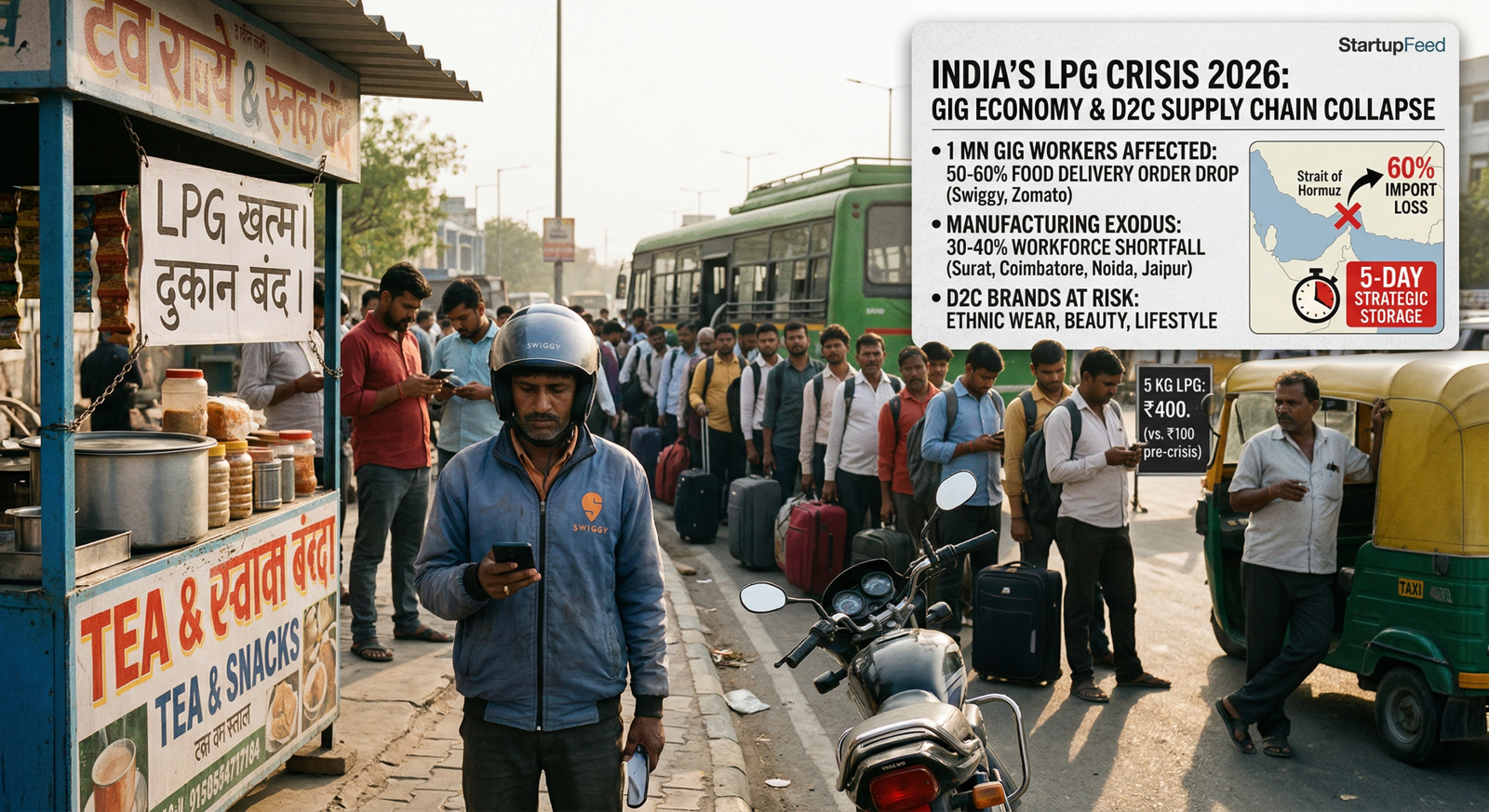
- Crisis: West Asia war → Strait of Hormuz blockade → 60% of India’s LPG supply at risk
- Price Shock: 5 kg LPG cylinder: Rs 100 → Rs 400 on grey market (4x spike in weeks)
- Who’s Affected: ~1 Mn food delivery workers + 3 lakh textile workers in Tamil Nadu alone
- Manufacturing: D2C brand factory workforce down 30–40% in Surat, Ahmedabad, Delhi NCR, Jaipur
- Key Change: Commercial LPG supply slashed 30–50%; household supply prioritised under Essential Commodities ActEffective: Crisis began first week of March 2026; LPG Control Order issued March 8, 2026
- India’s LPG crisis — triggered by the effective closure of the Strait of Hormuz following US-Israeli strikes on Iran in late February 2026 — has pushed the price of a 5 kg LPG cylinder from Rs 100 to Rs 400 on the grey market, sparking a wave of worker departures from major industrial cities that is drawing direct comparisons to the COVID-19 pandemic exodus of 2020.
For India’s startup economy, the ramifications run deeper than cooking gas: the crisis has exposed a structural fragility in the D2C supply chain, with fashion, beauty, and lifestyle brands reporting a 30–40% workforce contraction at manufacturing units in Surat, Ahmedabad, Delhi NCR, and Jaipur — precisely as peak summer inventory season approaches.
StartupFeed Insight
What this means: India’s LPG crisis is the first geopolitical supply shock since COVID to threaten the gig economy and D2C supply chain simultaneously — and it arrived with almost no strategic buffer.
Winners:
– Brands with diversified manufacturing across geographies (less concentration in any one affected hub)
– Induction cooking manufacturers: Tamil Nadu government’s Rs 2/unit electricity subsidy for commercial kitchens will accelerate adoption
Losers:
– D2C fashion/beauty brands sourcing from Surat, Coimbatore, Noida, and Jaipur — already facing 30–40% workforce contraction
– Food delivery platforms: restaurant closures and worker departures have cut order volumes 50–60% in major cities
Action required: D2C founders must audit single-geography manufacturing exposure this week and model 3-month demand scenarios assuming 25–40% workforce shortfall in key hubs.
What Triggered the Crisis
On February 28, 2026, US and Israeli military strikes on Iran prompted Tehran to effectively close the Strait of Hormuz to commercial shipping — described by Union Petroleum Minister Hardeep Singh Puri as the first such closure in recorded history.

The structural vulnerability this exposed is stark: India produces only 1.158 million tonnes of LPG per month domestically against total consumption of approximately 2,700 thousand metric tonnes — meaning over 60% of demand is import-dependent. Critically, more than 90% of those imports pass through the Strait of Hormuz.
Weekly LPG imports fell by nearly 30% in March 2026. India’s strategic LPG storage capacity — even after commissioning the HPCL Mangalore underground cavern in late 2025 — stood at roughly 140,000 tonnes, equivalent to approximately five days of national demand. For context, India maintains around 60 days of crude oil reserves.
Government Response — Key Provisions
| Provision | Action Taken | Impact |
| Essential Commodities Act invoked | Household supply prioritised over commercial | Commercial supply cut 30–50%; restaurants, factories hit first |
| LPG Control Order (March 8, 2026) | Refineries directed to maximise LPG yield; C3/C4 streams channelled to OMCs | LPG production raised 28% in 5 days; still insufficient to offset import loss |
| Commercial allocation: 20% of monthly requirement | OMCs allocating 20% average monthly commercial requirement in coordination with states | Reduces black-market pressure; not sufficient for full operational capacity |
| Kerosene & biomass alternatives | 48,000 kl extra kerosene released; MoEFCC permits biomass/RDF/coal for hospitality 1 month | Partial relief for street food vendors; inadequate for industrial-scale manufacturing |
| Domestic price shield | 14.2 kg cylinder raised Rs 60 to Rs 913 (Delhi); PMUY beneficiaries pay Rs 613 | Government absorbed Rs 74 of Rs 134 required market adjustment; grey market persists |
Impact on Gig Workers — The Food Delivery Domino
The crisis has created a devastating domino effect for India’s gig economy. As LPG supply to commercial kitchens was slashed, restaurants across major cities began scaling back menus, reducing hours, or shutting temporarily. In Tamil Nadu alone, an estimated 10,000 restaurants faced closure. The downstream impact on food delivery platforms has been immediate.
Per a statement from the Gig Workers Association, food delivery order volumes in major cities dropped 50–60% — threatening the livelihoods of an estimated 1 million delivery workers on platforms like Swiggy and Zomato. The association urged platforms not to penalise workers whose earnings and ratings fell due to order volume collapse beyond their control.
Rahul Kumar, a Zomato delivery partner in Delhi, told Inc42 that at least six fellow delivery workers he knew had left for their villages in the past three days — with more ready to follow if the crisis continued. No directive had come from the platform addressing the situation.
App-based auto-rickshaw and cab drivers face a compounding pressure: LPG-run autos are seeing both fuel cost increases and a collapse in ride demand as restaurants close and city footfall drops.
| Platform/Sector | Estimated Impact | Key Risk |
| Food Delivery (Zomato, Swiggy) | 50–60% order drop | Worker income collapse; platform rating system penalises low-order workers |
| Quick Commerce (Blinkit, Zepto, Instamart) | Dark store kitchen ops disrupted | Prepared food SKUs offline; delivery worker earnings down |
| Ride Hailing (LPG autos) | Fuel cost spike + demand drop | Double squeeze: higher opex, lower trips per day |
| Street Food / Tiffin Vendors | Menu prices up 30–50% | Breakfast items at Rs 45 in Sriperumbudur vs Rs 30 earlier; vendor volumes fall |
Manufacturing Exodus — Textile, Ceramic & Fashion Units
The worker displacement is most acute in India’s manufacturing belts. In Gujarat’s Morbi — the world’s second-largest ceramic tile hub — 430 out of 670 ceramic units shut down for at least three weeks as propane and natural gas supplies were exhausted. Morbi Ceramic Manufacturing Association president Manoj Arvadiya confirmed units using propane shut first, followed by those on natural gas.
In Surat’s textile and power loom sector, which employs over 7 lakh Odia migrant workers earning Rs 300–700 per day, hundreds are boarding trains home. Workers who relied on 5 kg black-market cylinders — now priced at Rs 400–500 — found city living mathematically unviable. “Half the workers I know have gone home for this reason,” said Yash Dixit, a labour supervisor sourcing manpower for Noida manufacturers.
Tamil Nadu’s textile mills are facing a shortfall of approximately 3 lakh migrant workers — many of whom left during Holi and Ram Navami and chose not to return amid LPG panic and COVID-lockdown fears. SIMA (Southern India Mills Association), representing over 2,000 mills, is holding weekly coordination meetings with the Tamil Nadu government, which has briefed the Cabinet Secretary in New Delhi, given that further panic could jeopardise more than 60 lakh jobs in the sector.
State-by-State Impact on Manufacturing
| State/City | Sector Hit | Scale of Disruption | Key Data Point |
| Morbi, Gujarat | Ceramic tiles | Severe | 430 of 670 units shut; ~3 weeks closure |
| Surat, Gujarat | Textiles/power loom | Severe | 7 lakh Odia workers; hundreds departing daily |
| Coimbatore, Tamil Nadu | Spinning mills | Severe | 3 lakh worker shortfall; SIMA in emergency coordination |
| Sriperumbudur, Tamil Nadu | Electronics/auto mfg | Moderate | Food inflation: breakfast items up from Rs 30 to Rs 45 |
| Delhi NCR / Noida | Fashion/garments | Moderate–Severe | Workers leaving for villages; black market LPG at Rs 400+ |
| Jaipur | Ethnic wear/handicrafts | Moderate | Supply chain disruption reported by D2C brands |
D2C Brand Impact — Supply Chain at Risk
For D2C and new-age consumer brands, the crisis has arrived at the worst possible time — ahead of the summer inventory cycle. Among brands surveyed by Inc42, manufacturing unit workforces have reduced by a third on average over the past four weeks.
Libas, the ethnic wear brand, is one of the most directly exposed. Founder Sidhant Keshwani told Inc42 the brand’s supply chain has seen disruption particularly in Surat, Ahmedabad, Delhi NCR, and Jaipur. By end-March, many workers at warehouses were waiting for their monthly salaries before deciding whether to return home. Keshwani noted that 30–40% of the workforce has already started departing.
Brands in the beauty and lifestyle categories sourcing from Tamil Nadu face a similar squeeze, with food inflation at manufacturing hubs adding a secondary pressure on workers’ cost of living beyond the LPG shock alone.
“We have already started seeing that 30-40% of the workforce has started already going back. We had some workers at the warehouses at end of March but many of them were waiting for their salaries for the month to take a call.”
— Sidhant Keshwani, Founder, Libas
| D2C Category | Key Manufacturing Hub | Risk |
| Ethnic Wear / Fashion | Surat, Jaipur, Delhi NCR | 30–40% workforce reduction; summer inventory builds at risk |
| Beauty / Personal Care | Tamil Nadu, Gujarat | Manufacturing slowdowns + food inflation reducing worker retention |
| Lifestyle / Home Decor | Morbi (ceramic), Jaipur | Ceramic tile units fully shut; supply for D2C home brands disrupted |
| Food/Gourmet D2C | All major metros | Co-manufacturing kitchens operating at reduced capacity due to commercial LPG cuts |
The Inflation Spiral — Cost of Living in Manufacturing Hubs
The LPG crisis is not only a supply problem — it is feeding a local inflation spiral that makes city life unaffordable for low-wage workers. Street food and tiffin vendors, who power the informal meal economy for factory workers, are paying black-market LPG rates that have forced them to raise prices by 30–50% — or stop operating entirely.
| Item | Pre-Crisis Price | Current Price | Change |
| 5 kg LPG cylinder (grey market) | Rs 100 | Rs 400 | +300% |
| 14.2 kg domestic cylinder (official) | Rs 853 (Delhi) | Rs 913 | +Rs 60 |
| 19 kg commercial cylinder | Rs 1,768 | Rs 1,883 | +Rs 115 |
| Street breakfast (Sriperumbudur) | Rs 30 | Rs 45 | +50% |
| Weekly LPG imports | Baseline | –30% | 30% fall |
Action Checklist — What D2C and Startup Founders Must Do Now
- 1. Audit manufacturing concentration immediately: Map what % of your production capacity is in Surat, Coimbatore, Noida, or Morbi. If any single hub exceeds 40%, you have a single-point-of-failure risk.
- 2. Activate vendor redundancy plans: Identify 1–2 alternate manufacturing partners in non-affected geographies. Negotiate standby agreements even if you don’t activate them immediately.
- 3. Build a 10–12 week inventory buffer: For summer-critical SKUs, begin production runs now using whatever workforce capacity remains. Don’t wait for normalcy.
- 4. Worker retention: pay first, ask later: Brands like Libas are waiting on March salary disbursals before workers decide to stay. Advance salary payments and transport allowances now cost less than a production stoppage in April.
- 5. Monitor Hormuz weekly: US-Iran ceasefire negotiations remain the single variable that will determine resolution timing. Subscribe to shipping intelligence (Drewry, Clarksons) for weekly updates.
- 6. Model a 90-day supply disruption scenario: If the crisis extends through May 2026, what is your revenue impact? Run the numbers. Apply for emergency credit lines before you need them.
What’s Next
The resolution timeline is tied entirely to geopolitics. Union Petroleum Minister Hardeep Singh Puri has confirmed active efforts to diversify LPG import routes — including alternative suppliers from the US, Australia, and Africa. However, building new shipping contracts and redirecting tanker routes takes weeks, not days.
India’s LPG consumption dropped 17.7% in the first half of March 2026 — a sign of demand destruction, not supply recovery. If the Strait of Hormuz remains effectively blocked through April, the manufacturing exodus will deepen, summer D2C collections will face delays, and Swiggy and Zomato will report materially lower GMV in Q1 FY27.
The structural lesson — that India holds only five days of strategic LPG reserves versus 60 days of crude — will drive policy debates about energy security for months after the immediate crisis passes. Watch for a PMUY storage expansion announcement and possible emergency LNG import deals in Q2 2026.