
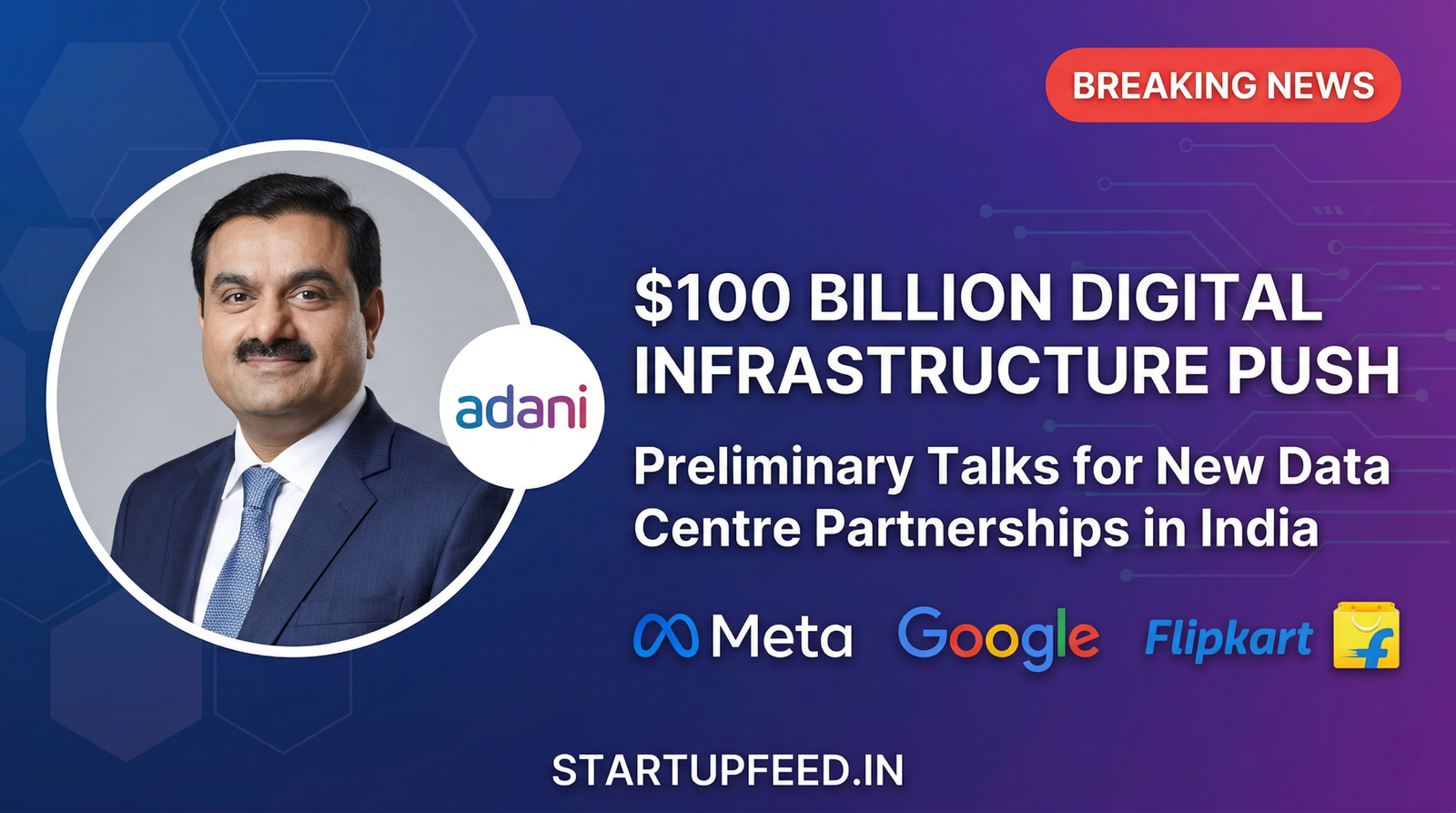
| WHAT | WHO | SCALE |
| Preliminary talks for new data centre partnerships Fresh phase of investment beyond existing AdaniConnex-Google Visakhapatnam pact (Oct 2025). Sites across Indian states being explored. Not yet finalized. | Gautam Adani / AdaniConnex
| $100 Bn digital infrastructure push (by 2035) AdaniConnex current: 2 GW | Target: 5 GW India data centre market: 1.7 GW today → 8 GW by 2030 (KPMG) |
Gautam Adani is in preliminary talks with American technology giants Meta Platforms and Google for new partnerships in his fast-expanding data centre business — with Flipkart also engaged in discussions — as the Adani Group explores sites across Indian states for the next wave of hyperscale facilities, Bloomberg reported on March 25, citing people familiar with the matter.
The discussions are part of a sweeping $100 billion digital infrastructure push by Adani, announced in February 2026, seeking to position his port-to-power conglomerate as the backbone supplier of land and renewable energy for the hyperscale data centre industry — resources that are emerging as the two scarcest inputs in the global AI compute arms race. Specific sites for the new facilities have not yet been finalized, and the discussions remain at a preliminary stage. Representatives for Adani Group, Meta, and Walmart declined to comment. A Google spokesperson said the company had “no new investments to talk about.”
Critically, these talks represent a fresh phase of investment beyond the existing AdaniConnex-Google partnership announced in October 2025, in which Google committed approximately $15 billion to build India’s largest AI infrastructure hub at Visakhapatnam — making any new deal with Google structurally separate from, and additional to, that already landmark commitment.
STARTUPFEED INSIGHT — WHAT THIS SIGNALS
- Adani’s play is infrastructure, not compute: The critical frame: Adani is not building AI. He is building the physical layer that makes AI possible — land, power, cooling, and connectivity. The same way Adani owns ports, airports, and transmission lines, he intends to own the AI infrastructure stack. Land + renewable energy + transmission = the three bottlenecks for every hyperscaler trying to build in India. Adani controls all three at scale, which no pure-play data centre operator can match.
- Why Meta and Google separately from the existing deal: The Visakhapatnam partnership (Oct 2025) was a site-specific, project-specific commitment. The current talks are about a broader, multi-site platform relationship — potentially making Adani a preferred infrastructure landlord for these hyperscalers across India. This mirrors how global REIT models work: the tech company leases long-term; the infrastructure owner builds and operates. At $100 Bn committed capex, Adani is building India’s first true hyperscale real estate investment thesis.
- Flipkart in the mix — an interesting wrinkle: Flipkart’s inclusion alongside Meta and Google in data centre talks is not surprising but is strategically significant. Flipkart is accelerating its pre-IPO governance build (see: 7 senior hires in 60 days, March 2026) and is deepening infrastructure investments, particularly in quick commerce and supply chain. Collocating cloud and compute requirements with Adani — rather than AWS, Google Cloud, or Azure alone — would be a strategic and geopolitical signal, given Walmart’s US-India infrastructure commitments and the Modi government’s push for domestic digital infrastructure.
- India is the only market where this scale is feasible: The $100 Bn thesis rests on India-specific conditions: abundant land at competitive cost, political will for large-scale infrastructure, government incentive frameworks (PLI, state-level MoUs), and a renewable energy pipeline that few other markets can match. India’s data centre capacity is projected to grow 5X by 2030 to 8 GW, requiring $30 Bn+ in capex (KPMG). At the current investment trajectory, Adani is positioning to capture the largest single share of that capex allocation.
- The Reliance rivalry sharpens: With Reliance’s $11 Bn Visakhapatnam pact (Nov 2025) and Adani’s $15 Bn Visakhapatnam deal (Oct 2025), the same city is now the centre of India’s largest infrastructure battle since the telecom wars. If Meta and Google both end up in Adani’s portfolio alongside Flipkart, and Reliance is simultaneously building its own hyperscale ecosystem, India’s AI infrastructure will be contested by two of the world’s largest conglomerates — which is ultimately good for pricing, capacity, and India’s strategic position in the global AI stack.
- The sovereign risk premium is being priced out: Post the Hindenburg report (Jan 2023) and subsequent US DoJ proceedings, Adani’s ability to attract Google and potentially Meta to infrastructure partnerships signals a meaningful de-risking in the eyes of global institutional partners. Hyperscalers do not enter 15-year infrastructure commitments with counterparties they believe carry existential governance risk. The pipeline of partnerships is itself a credit event for Adani Group’s institutional standing.
Deal Anatomy: What Is Being Negotiated

The Bloomberg report, citing people who asked not to be identified, describes the talks as covering data centre partnerships — a term that in hyperscale infrastructure typically encompasses one or more of: (a) long-term land leases for data centre campus development; (b) build-to-suit agreements where Adani constructs and the tech company occupies; (c) power purchase agreements tying renewable energy supply to compute demand; or (d) colocation agreements where Adani operates the facility and the tech company installs its own compute hardware.
Adani’s stated positioning — “supplier of both land and renewable energy” — most closely aligns with a land + power platform model, where Adani provides the two scarcest inputs and tech companies bring their own hardware, software, and network interconnection. This is the model that has made companies like Equinix and Digital Realty structurally valuable over two decades of cloud expansion in the West — and it is the model Adani is now attempting to replicate and exceed at the national scale of a continent-sized country.
| DEAL DETAILS | |
| Breaking Source | Bloomberg, March 25, 2026 — citing people familiar with the matter, asking not to be identified |
| Parties in Talks | Adani Group / AdaniConnex ↔ Meta Platforms | Google (Alphabet) | Flipkart (Walmart Inc.) |
| Nature | Data centre partnerships — land, renewable energy, and hyperscale facility development. Model TBD (land lease / build-to-suit / colocation / PPA) |
| Stage | Preliminary. Sites across Indian states being explored. Not yet finalized. |
| Relationship to Existing Deals | Fresh phase beyond AdaniConnex-Google Visakhapatnam pact (Oct 2025, $15 Bn). Separate from and additional to existing commitments. |
| Official Responses | Adani Group: declined to comment | Meta: declined to comment | Walmart (Flipkart): declined to comment | Google/Alphabet: “no new investments to talk about” |
| Context | Part of Adani’s $100 Bn digital infrastructure commitment (announced Feb 2026) — to build AI-ready, renewable-powered data centres by 2035 |
AdaniConnex: The JV at the Centre of the Play
AdaniConnex is a 50:50 joint venture between Adani Enterprises and EdgeConneX — one of the world’s largest private data centre operators with 50+ edge, hyperscale, and build-to-order facilities globally. Formed with an initial vision of building a 1 GW sustainable data centre platform in India, it has since dramatically expanded its ambitions on the back of surging AI infrastructure demand.
AdaniConnex currently operates a 2 GW national data centre capacity across key Indian cities — with the Visakhapatnam campus (under Google partnership) expected to contribute 1 GW by itself at full build-out. The group is targeting 5 GW total capacity, which would make it one of the largest data centre platforms in Asia by power capacity. Facilities are under development or operational in Noida (1,000 MW potential), Navi Mumbai (150 MW, Phase 1 live January 2025), Pune (250 MW, H2 2025), Hyderabad, and Chennai, with Visakhapatnam being the flagship AI campus.
| ADANICONNEX — SNAPSHOT | |
| Structure | 50:50 JV — Adani Enterprises Ltd. + EdgeConneX (global data centre operator, 50+ facilities globally) |
| Current Capacity | 2 GW (national) | Target: 5 GW |
| Flagship Project | Visakhapatnam AI Data Centre Campus — 1 GW, $15 Bn investment (Google, 2026-2030). Google’s largest AI hub outside the US. Supported by subsea cable + renewable energy. |
| Active / Upcoming Sites | Noida (1,000 MW potential, Dec 2026+) | Navi Mumbai (150 MW, Phase 1 live Jan 2025) | Pune (250 MW, H2 2025) | Hyderabad (48 MW) | Chennai (33 MW) | Visakhapatnam (1 GW, 2026-2030) |
| Sustainability | Up to 100% renewable energy sourcing across facilities | Carbon-neutral footprint target | 99.999% uptime design |
| Broader Vision | $100 Bn committed by Adani Group for AI-ready, renewable-powered data centres by 2035 | Five-layer AI stack strategy | India from consumer to creator of intelligence |
The Anchor Deal: AdaniConnex + Google, Visakhapatnam (Oct 2025)
The current talks build on the October 14, 2025 partnership in which AdaniConnex and Google announced the development of India’s largest AI data centre campus at Visakhapatnam, Andhra Pradesh. Google’s investment commitment of approximately $15 billion over 2026-2030 covers gigawatt-scale data centre operations, a robust subsea cable network, and clean energy infrastructure — designed to handle India’s most demanding AI workloads.


Adani’s own investment through AdaniConnex in this project is estimated at ~$5 billion. The Visakhapatnam campus is designed as Google’s largest AI hub outside the United States — a signal of the strategic weight India carries in global AI infrastructure planning. The facility will be powered by advanced GPUs, TPUs, and specialised AI chips, and supported by Adani Green Energy’s renewable power capacity.
The March 2026 discussions with Google are explicitly separate from this commitment, according to Bloomberg sources — meaning Google may be evaluating additional Adani-facilitated infrastructure beyond Visakhapatnam, potentially in northern or western India where AdaniConnex already has developing capacity.
India’s AI Infrastructure Race: Who Is Building What
The Adani-Meta-Google talks arrive in the context of India’s most competitive infrastructure build-out since the 4G telecom wars. Every major conglomerate and global hyperscaler is staking claims simultaneously, driven by India’s unique combination of land scale, renewable energy potential, government incentives, and the world’s largest digital population.
| Player | Commitment | Location / Model | Status |
| Adani Group(AdaniConnex) | $100 Bn by 2035 (total) | $15 Bn (Google Vizag) | $5 Bn (AdaniConnex stake) | Visakhapatnam (1 GW AI hub) + Noida, Mumbai, Pune, Hyderabad, Chennai | In progress — Vizag 2026-2030; Navi Mumbai Phase 1 live |
| Reliance Industries(Digital Connexion) | $11 Bn pact at Visakhapatnam (Nov 2025) | 6 GW solar for AI ops | Visakhapatnam + Jamnagar; Nvidia Blackwell processors secured | Announced Nov 2025; development underway |
| Amazon (AWS) | $12.7 Bn cloud infrastructure in India through 2030 | Multi-region India expansion; existing AWS regions in Mumbai and Hyderabad | Active; ongoing expansion |
| TCS | $1 Bn from TPG Inc. for AI infrastructure acceleration | Multi-city; leverages TCS’s existing enterprise relationships | Announced; scaling |
| OpenAI | 1 GW data centre target in India | Site under evaluation; discussions with state governments | Preliminary; evaluating |
| Lodha Developers | Rs 30,000 Cr (Maharashtra MoU) + Rs 1 lakh Cr (WEF Davos 2026) | Maharashtra; real estate-anchored data centre model | MoU stage; development pipeline |
Sources: Bloomberg, Business Standard, Trade Brains, Outlook Business, Carbon Credits (compiled by StartupFeed). All figures as reported; some commitments are multi-year targets, not immediate deployments.
The Market: India’s Data Centre Fivefold Expansion by 2030
India’s data centre market is at the centre of the global AI infrastructure build-out for three structural reasons: land scale (the country’s vast geography enables campuses impossible to build in Singapore, Hong Kong, or Tokyo), renewable energy abundance (India’s solar and wind potential is the largest in Asia outside China), and demand trajectory (500 million+ internet users, a $170 Bn retail e-commerce market by 2027, and an AI adoption curve that is accelerating at enterprise, government, and startup levels simultaneously).
According to KPMG, India’s installed data centre capacity is projected to grow fivefold by 2030 — from approximately 1.7 GW today to 8 GW — requiring over $30 billion in capital expenditure. This translates to an $8 billion annual leasing revenue opportunity for operators across the ecosystem. Mumbai currently accounts for 52% of India’s total capacity; Chennai 21%; with Visakhapatnam, Hyderabad, and Noida emerging as the next-generation hubs for AI-specific compute.
“The world is entering an Intelligence Revolution more transformative than previous industrial revolutions. India is poised to move beyond being a consumer of AI technologies to becoming a creator and exporter of intelligence.”
— Gautam Adani, Chairman, Adani Group ( on the $100 Bn digital infrastructure commitment)
What to Watch
Site selection announcements: The most concrete signal of deal progress will be the identification of specific states and cities for new facilities. States with existing Adani Group MoUs — Maharashtra (Rs 50,000 Cr hyperscale MoU), Andhra Pradesh (Visakhapatnam), Telangana (Rs 12,400 Cr+ MoUs) — are the most likely candidates for the first sites disclosed.
Meta’s India data centre debut: Meta has no existing large-scale data centre footprint in India — despite serving India’s largest Facebook, Instagram, and WhatsApp user base (600 million+ across platforms). A deal with Adani would represent Meta’s first major physical infrastructure commitment in the Indian market, potentially triggering a broader push on AI data sovereignty requirements under India’s Digital Personal Data Protection Act.
The Flipkart dimension: Flipkart’s inclusion in data centre talks — reported the same week as its two senior VP appointments — intersects directly with its IPO preparations. A long-term data infrastructure agreement with Adani would be a material disclosure for any DRHP filing, potentially affecting how analysts model Flipkart’s capex trajectory post-IPO.
Adani vs. Reliance: With both conglomerates building competing hyperscale infrastructure ecosystems, the hyperscaler allocation decisions — which tech company goes to Adani, which goes to Reliance — will determine the commercial structure of India’s AI backbone for the next decade. The Visakhapatnam competition is already set: both Adani (Google, $15 Bn) and Reliance ($11 Bn) are building in the same city. How Meta and Flipkart align will be the next chapter.
Liked this story? Follow StartupFeed on Google so our reporting reaches you first.