
QUICK TAKE:
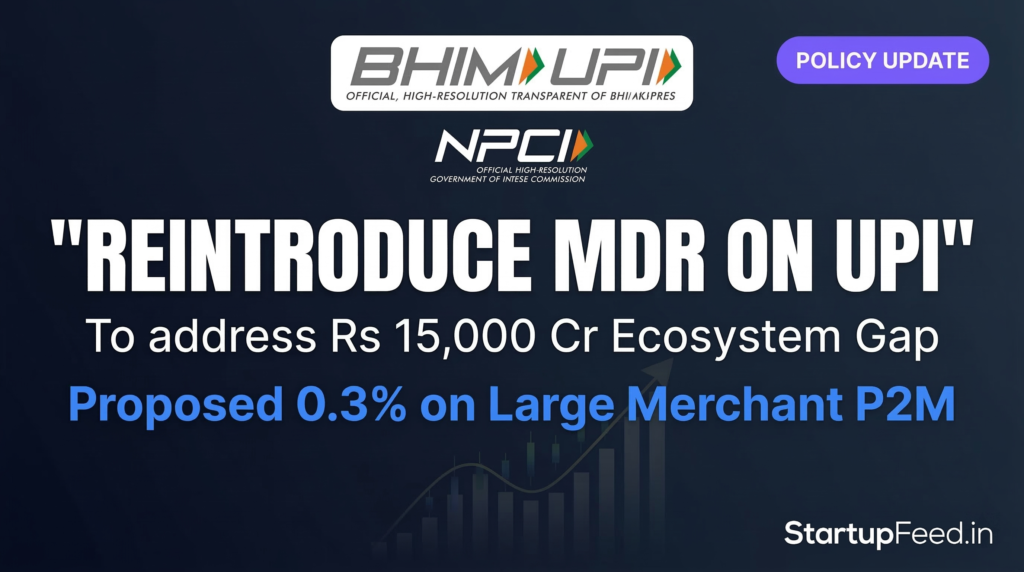
- What happened: India’s Parliamentary Standing Committee on Finance has formally recommended reintroduction of Merchant Discount Rate (MDR) on UPI transactions, citing ecosystem sustainability concerns
- The funding gap: The current government incentive scheme covers only ~11% of the payments sector’s actual costs and approximately 14% of potential MDR collections – a structural underfunding gap
- Budget FY27 allocation: Rs 2,000 Cr allocated under the UPI/RuPay incentive scheme (Union Budget 2026-27) – 5x higher than the Rs 437 Cr budgeted in FY26, but at least 5x lower than the Rs 10,000-15,000 Cr the industry says is needed
- Zero-MDR history: MDR on UPI was abolished via government notification in January 2020, following Finance Minister Nirmala Sitharaman’s Budget 2019 announcement; government compensates banks via incentive scheme instead
- Who it affects: PhonePe, Google Pay (Alphabet), Paytm (One97 Communications), CRED, Amazon Pay, NPCI-regulated banks and PSPs processing India’s 228+ Bn UPI transactions per year
- Scale of UPI today: 228.28 Bn transactions in 2025; panel projects growth to 150 Bn transactions/month at peak (up from ~19 Bn/month current); 600 Mn new users could join the ecosystem
- Industry position: Payments Council of India (PCI), NPCI, and RBI have all independently urged MDR reinstatement at 0.2-0.3% on P2M transactions for large merchants – a position the Parliamentary panel has now formally endorsed
- Government pushback (June 2025): Finance Ministry dismissed MDR reinstatement claims as ‘completely false, baseless, and misleading’ as recently as June 2025 – the Parliamentary panel recommendation creates renewed political pressure
- Proposed structure: PCI recommends 30 basis points (0.3%) MDR only for P2M transactions by merchants with annual turnover above Rs 20 lakh; P2P and small merchant transactions to remain at zero MDR
India’s UPI infrastructure has achieved what few payment systems in the world have managed: mass adoption at zero cost to users and merchants. In 2025, UPI processed 228.28 billion transactions – making it the world’s largest real-time payments network by volume. But behind this extraordinary success story lies a structural financial problem that India’s Parliamentary Standing Committee on Finance has now formally put on the table: the ecosystem that processes every one of those transactions is financially unsustainable.
The Standing Committee on Finance, in a report submitted to Parliament, has recommended reintroducing Merchant Discount Rate (MDR) on UPI transactions. The recommendation is not new as a policy debate – the RBI, NPCI, the Payments Council of India, and the payments industry have been making this argument for years. But the Parliamentary committee’s formal endorsement gives the MDR debate a new institutional weight and creates direct political pressure on the Union government, which has twice – in FY25 and FY26 budgets – chosen to increase the incentive scheme rather than reintroduce MDR.
The committee’s central finding is stark: the government’s incentive scheme, which reimburses banks and PSPs for processing UPI transactions at zero MDR, currently covers only approximately 11% of the payments sector’s actual costs. At Rs 2,000 Cr in Budget FY27 – nearly five times the FY26 budgeted allocation of Rs 437 Cr, but still far below the revised FY26 estimate of Rs 2,196 Cr – the scheme remains structurally insufficient as UPI volume scales. The industry estimates it needs Rs 10,000-15,000 Cr in annual incentives to achieve even partial cost recovery, let alone invest in the infrastructure needed to serve 600 million additional UPI users projected over the next five to seven years.
What Is MDR and How Did Zero-MDR Come About?
Merchant Discount Rate is the fee a merchant pays to their bank (the acquiring bank) for processing a digital payment. This fee – typically a percentage of the transaction value – is then shared among the acquiring bank, the issuing bank, the Payment Service Provider (PSP) bank, and the Third-Party Application Provider (TPAP) such as PhonePe or Google Pay. It is the financial mechanism that makes digital payments infrastructure commercially viable.


| Payment Method | MDR Rate (Current) | Who Pays | Who Receives |
|---|---|---|---|
| Credit cards | ~1.5-2% of transaction value | Merchant | Acquiring bank, issuing bank, network (Visa/Mastercard), PSP |
| Debit cards (non-RuPay) | ~0.4-0.9% of transaction value | Merchant | Acquiring bank, issuing bank, PSP |
| RuPay debit cards | 0% (zero MDR since Jan 2020) | N/A – government compensates banks via incentive scheme | Issuing bank, PSP, TPAP (reimbursed by government incentive) |
| BHIM-UPI (P2M, up to Rs 2,000) | 0% (zero MDR since Jan 2020) | N/A – government compensates banks via incentive scheme | Acquiring bank, PSP, TPAP (reimbursed by government incentive; scheme covers only low-value P2M transactions) |
| UPI (P2M, above Rs 2,000) | 0% – currently no MDR; ongoing debate about whether large-merchant P2M should attract MDR | N/A | No MDR distribution – the structural gap the Parliamentary panel is addressing |
| UPI (P2P – peer-to-peer) | 0% – all stakeholders including industry agree P2P should remain zero MDR permanently | N/A | No MDR distribution |
| UPI (credit card-linked) | ~1.5-2% of transaction value; MDR applies as it is a credit transaction | Merchant | Issuing bank, acquiring bank, NPCI, PSP |
The zero-MDR decision for UPI and RuPay was made in January 2020, following Finance Minister Nirmala Sitharaman’s Union Budget 2019 announcement that RBI and banks should absorb the MDR cost as a contribution to India’s digital payments push. The government’s stated rationale: incentivise merchant adoption by removing transaction cost friction, particularly for small and micro merchants who had previously resisted accepting digital payments because of MDR charges.
The consequence was immediate and predictable. While merchant adoption of UPI accelerated dramatically, the financial model for everyone processing those transactions – banks, PSPs, TPAPs – collapsed overnight. Banks were no longer generating revenue from UPI transactions. PhonePe, Google Pay, and Paytm were processing hundreds of millions of transactions with zero direct revenue from the transaction itself. The government attempted to bridge this gap with an incentive scheme, but the scheme has consistently been insufficient to cover actual industry costs.
The Financial Gap: By the Numbers
| Year | Govt Incentive (Actual/Budget) | UPI Transactions (Annual) | Industry Estimated Requirement | Coverage Gap |
|---|---|---|---|---|
| FY22 | Rs 1,389 Cr (actual) | ~45 Bn transactions | ~Rs 6,000-8,000 Cr (industry estimate) | ~80% underfunded |
| FY23 | Rs 2,210 Cr (actual) | ~83 Bn transactions | ~Rs 8,000-10,000 Cr (industry estimate) | ~78% underfunded |
| FY24 | Rs 3,631 Cr (actual; highest to date) | ~131 Bn transactions | ~Rs 10,000-12,000 Cr (industry estimate) | ~70% underfunded |
| FY25 | Rs 2,196 Cr (revised estimate); Rs 437 Cr originally budgeted; Rs 1,500 Cr Cabinet-approved scheme for low-value UPI | ~185 Bn transactions (FY25 target: 203 Bn; 91% achieved) | ~Rs 12,000-15,000 Cr (industry estimate) | ~85% underfunded at budgeted amount |
| FY26 (current) | Rs 2,000 Cr (Budget 2026-27 allocation) | Target: 230 Bn; 77% achieved as of December 2025 | ~Rs 10,000-15,000 Cr (PCI/Payments Council estimate) | ~87% underfunded at current allocation |
| FY27 projected (at scale) | Unknown – no forward commitment beyond Rs 2,000 Cr | Panel projects 150 Bn/month at peak; ~1.8 Tn annually at scale | Potentially Rs 20,000-30,000+ Cr (extrapolated from current gap) | Structural gap widens with every billion transactions added |
The Parliamentary committee’s finding that the current incentive covers approximately 11% of actual sector costs – and about 14% of what MDR collections would generate – quantifies the structural underfunding in precise terms. For context: if a modest 0.1% MDR were applied to UPI P2M transactions (which represent roughly 60-65% of total UPI volume), the industry would collect an estimated Rs 12,000-15,000 Cr annually at current volumes. The government is currently paying Rs 2,000 Cr to achieve a fraction of that effect.
The Policy Timeline: A Decade of Debate
| Date | Event | Significance |
|---|---|---|
| Budget 2019 (Jul 2019) | Finance Minister Nirmala Sitharaman announces zero MDR on UPI and RuPay; says RBI and banks should bear the cost | The origin of the zero-MDR policy; framed as a digital payments adoption push; payments industry immediately objects via PCI |
| January 2020 | Government formally abolishes MDR on RuPay debit cards and BHIM-UPI transactions via official notification | Zero-MDR takes legal effect; payments ecosystem loses its primary revenue model for the largest and fastest-growing digital payments channel in India |
| July 2021 | Incentive scheme introduced in Union Budget 2021-22 to reimburse banks for processing zero-MDR UPI transactions | Government acknowledges industry cannot absorb the cost; introduces Rs 1,389 Cr in FY22 as compensation – still far below actual costs |
| June 2022 | Parliamentary Standing Committee on Commerce recommends NPCI and MoF undertake stakeholder consultation on MDR reinstatement | First Parliamentary-level call for MDR review; government does not act |
| August 2022 | RBI publishes a report recommending the government reconsider its zero-MDR policy on UPI | RBI – the payments regulator – formally endorses MDR review; still no government action |
| March 2025 | Payments Council of India (PCI) writes to PMO seeking 0.3% MDR for merchants with GST-based turnover above Rs 40 lakh; banking industry also presses for MDR levy | Industry pressure intensifies ahead of Budget 2026-27; reports emerge of PMO-level meetings on MDR framework |
| May 2025 | NPCI, RBI, and payments industry urge 0.2-0.3% MDR on merchant UPI transactions for large merchants | Three key ecosystem stakeholders align on a specific MDR rate – a significant escalation of the pressure campaign |
| June 11, 2025 | Ministry of Finance issues statement: ‘Speculation and claims that MDR will be charged on UPI transactions are completely false, baseless, and misleading. The Government remains fully committed…’ | Government firmly rebuffs MDR reinstatement despite industry and regulatory pressure; reassures zero-MDR for UPI users |
| Union Budget 2026-27 (Feb 1, 2026) | Government allocates Rs 2,000 Cr for UPI/RuPay incentive scheme in FY27 – nearly 5x higher than FY26 budget allocation of Rs 437 Cr, slightly below FY26 revised estimate of Rs 2,196 Cr | Government increases incentive rather than reintroducing MDR; industry describes the allocation as at least 5x lower than requirement |
| March 2026 | Parliamentary Standing Committee on Finance formally recommends reintroduction of MDR on UPI transactions in its report; cites structural underfunding and long-term infrastructure investment needs | Strongest Parliamentary-level endorsement of MDR reinstatement to date; direct institutional pressure on the government to revisit June 2025 position |
UPI Scale Projections: Why the Financial Gap Will Only Widen
The Parliamentary panel’s projections on UPI’s future scale add a critical dimension to the MDR debate. The committee estimates that approximately 600 million new users could join the UPI ecosystem in the coming years, potentially taking India’s total digital payments user base to nearly one billion. At peak, the panel projects UPI could scale to approximately 150 billion transactions per month – compared to roughly 19 billion transactions per month at current volumes.
| Metric | Current (2025-26) | Panel Projection (5-7 Years) | Implication for MDR Debate |
|---|---|---|---|
| Monthly UPI transactions | ~19 Bn/month (228 Bn annualised) | ~150 Bn/month at peak | If the funding gap is approximately Rs 13,000 Cr/year at 228 Bn transactions, it would be approximately Rs 103,000 Cr/year at 1.8 Tn transactions – a government subsidy burden of unmanageable scale under zero-MDR |
| Total UPI users | ~350 Mn active users (est.) | ~1 Bn digital payments users (including 600 Mn new) | Every new user represents additional transaction volume and additional infrastructure requirement – the incentive scheme cannot scale proportionally with users |
| P2M share of UPI volume | ~60-65% of total UPI volume | Expected to grow as merchant acceptance expands; quick commerce, D2C, MSMEs all driving P2M growth | P2M is the segment where MDR would be applied (not P2P); P2M growth makes MDR reinstatement economically more impactful over time |
| Govt incentive as % of actual costs | ~11% (as per Parliamentary panel finding) | Would decline further as volume grows without proportional incentive increase | The structural underfunding compounds with scale – a 0.1% MDR on P2M would generate Rs 12,000-15,000 Cr at current volumes, potentially Rs 90,000-100,000 Cr at projected peak volumes |
| Annual government payout trend | Rs 1,389 Cr (FY22) to Rs 3,631 Cr (FY24); Rs 2,000 Cr budgeted FY27 | Cannot scale to Rs 20,000-30,000+ Cr without significant fiscal strain | Fiscal arithmetic strongly favours MDR over indefinite government subsidisation as UPI approaches 1 Tn+ annual transactions |
Who Benefits and Who Pays: Stakeholder Impact Analysis
| Stakeholder | Under Zero-MDR (Current) | Under Proposed MDR (0.2-0.3% on large-merchant P2M) | Net Position if MDR Reinstated |
|---|---|---|---|
| PhonePe, Google Pay (Alphabet) | Zero transaction revenue from UPI; must monetise through financial services cross-sell (insurance, mutual funds, credit), advertising, and premium features | Would receive a share of MDR on P2M transactions processed through their platform; direct payment revenue for the first time since 2020 | Positive – direct P2M transaction revenue at scale could significantly improve unit economics; PhonePe processed ~48% of UPI P2M volume in recent quarters |
| Paytm (One97 Communications) | Zero direct UPI transaction revenue; complex monetisation through loans, financial services, and merchant solutions | MDR reinstatement would provide direct payment processing revenue to supplement existing financial services revenue | Positive – Paytm CEO and CFO have publicly discussed MDR as a key potential revenue driver in multiple quarterly earnings calls; MobiKwik CEO similarly cited MDR as a transformative revenue event |
| Banks (PSP banks, acquiring banks) | Zero revenue from UPI P2M transactions; receive government incentive that covers ~11% of actual processing costs | Would receive MDR proceeds through existing settlement structure; reduces dependence on government incentive scheme | Significantly positive – banks have been most vocal advocates of MDR reinstatement as they bear the heaviest infrastructure cost burden |
| NPCI (National Payments Corporation of India) | Zero MDR revenue from UPI; NPCI operates on a non-profit model subsidised by member banks | Would receive a share of MDR (NPCI typically receives a small switch fee per transaction); improves sustainability of NPCI’s infrastructure investment capacity | Positive – NPCI has aligned with the MDR position; panel recommends NPCI and MoF undertake comprehensive stakeholder consultation on MDR structure |
| Large merchants (GST turnover above Rs 20-40 lakh) | Pay zero MDR on UPI; lower cost of acceptance than credit card payments | Would pay MDR of 0.2-0.3% on UPI P2M transactions under proposed structure; equivalent to approximately Rs 2-3 on a Rs 1,000 transaction | Mildly negative – cost of acceptance rises, but proposed MDR rates (30 bps) are well below credit card MDR (150-200 bps); large merchants already pay MDR on credit card transactions so this is not a new concept |
| Small and micro merchants (below Rs 20 lakh turnover) | Pay zero MDR on UPI; critical driver of merchant adoption in Tier 2-4 cities and rural India | Would remain at zero MDR under proposed tiered structure; PCI explicitly recommends small merchants be protected from MDR | Neutral – proposed MDR structure specifically carves out small merchants; zero-MDR adoption incentive for grassroots digital payments preserved |
| End consumers (P2P and P2M) | Pay zero MDR; UPI is free for all consumer transactions; bank-to-bank fund transfers are free | Consumer-side MDR is not proposed; MDR would apply only to merchants, not to users making payments | Neutral – zero-cost UPI for consumers is not proposed to change under any MDR scenario; the debate is purely about merchant-side charges |
| Government/MoF | Pays Rs 2,000 Cr annually in incentives (FY27); facing escalating subsidy burden as UPI volume grows | MDR shift moves cost from government to large merchants; reduces annual incentive outlay significantly; incentive can be targeted at small merchants and low-value transactions | Significantly positive from fiscal perspective; the Parliamentary panel’s core argument is that zero-MDR is a fiscal risk at scale |
StartupFeed Insight – Five Non-Obvious Reads on the MDR-UPI Debate
- The Parliamentary panel recommendation does not change government policy – but it changes the political cost of inaction.
The Ministry of Finance dismissed MDR reinstatement claims as ‘completely false, baseless, and misleading’ as recently as June 2025. That statement was made in the context of media speculation. A formal recommendation from the Parliamentary Standing Committee on Finance – a body that reports to both houses of Parliament and includes members from the ruling coalition – is a categorically different kind of pressure. The government can ignore industry lobbying, RBI recommendations, and media reports. Ignoring a Parliamentary committee recommendation without a formal response is politically more difficult. The question is not whether MDR will be reinstated immediately – it almost certainly will not before the next major political calendar event – but whether the Panel report gives Finance Ministry negotiators the institutional cover to begin consultative processes on MDR structure in FY27.
- The Rs 2,000 Cr vs Rs 10,000-15,000 Cr gap is a fiscal time bomb – not a funding shortfall that can be patched annually.
India’s government has increased the UPI incentive from Rs 1,389 Cr (FY22) to Rs 3,631 Cr (FY24) to Rs 2,000 Cr budgeted (FY27). This is not a coherent long-term funding trajectory – it is annual firefighting. The panel’s projection of 150 Bn transactions per month at peak creates a simple fiscal arithmetic problem: if 228 Bn annual transactions (FY25) require Rs 10,000-15,000 Cr to adequately fund the ecosystem, 1.8 Tn annual transactions at peak would require Rs 78,000-118,000 Cr annually. No government incentive scheme can scale to that level. The choice between MDR and an ever-expanding government subsidy is not really a choice – it is a question of timing. The earlier MDR is introduced, the more smoothly the ecosystem transitions; the later it is introduced, the more disruptive the commercial recalibration will be.

- PhonePe’s valuation logic is fundamentally MDR-dependent – and the market knows it.
PhonePe, valued at approximately $12 billion in its last funding round, processes the highest share of UPI P2M volume among TPAPs – approximately 48% of merchant payment volume. At zero MDR, PhonePe’s unit economics on UPI transactions are structurally negative: it pays infrastructure costs to process transactions it earns zero revenue from. PhonePe’s bull case for its valuation rests on financial services cross-sell (insurance, mutual funds, credit) plus the eventual monetisation of transaction flow – which implicitly requires MDR or a equivalent mechanism. The Parliamentary panel recommendation, while not guaranteeing MDR reinstatement, strengthens the long-term monetisation thesis that underpins PhonePe’s current valuation. For India’s pre-IPO fintech companies, the MDR debate is not just a policy story – it is a valuation story.
- The proposed MDR structure (large merchants only, P2M only, 30 bps) is intentionally designed to be politically palatable – which is precisely why it might work.
The Payments Council of India’s proposal – 0.3% MDR only for P2M transactions, only for merchants with annual turnover above Rs 20 lakh, with zero MDR preserved for P2P and small merchants – is a carefully constructed political design. It targets large-format retail, e-commerce, and organised business where UPI adoption is already high and where MDR is already part of the cost model for credit card payments. A Reliance Retail store, a D-Mart, a large restaurant chain already pays 1.5-2% MDR on credit card transactions. Charging 0.3% on UPI P2M is not a new principle for them – it is a reduction in relative cost vs credit cards. The design creates minimal disruption to the grassroots digital payments adoption story that the government has politically invested in, while addressing the ecosystem sustainability problem at scale.
- For Indian fintech startups building on UPI infrastructure, MDR reinstatement is both an opportunity and a competitive filter.
A zero-MDR environment depresses the entire fintech payments ecosystem’s ability to invest in infrastructure, security, and product innovation. Every rupee that PhonePe, Paytm, or a smaller UPI PSP cannot earn from transaction processing is a rupee not available for fraud prevention systems, rural infrastructure expansion, or MSME-facing fintech product development. MDR reinstatement – even at a modest 0.1-0.3% on large-merchant P2M transactions – would inject direct commercial revenue into the payments ecosystem for the first time since 2020. This has a second-order effect on fintech startups building payment-adjacent products: a commercially viable payments infrastructure layer makes it easier to build on top of it, licenses MDR-eligible payment services as a startup go-to-market foundation, and accelerates consolidation among underfunded PSPs. The filter effect: MDR reinstatement will disproportionately benefit scale players (PhonePe, GPay, Paytm) who can capture the largest share of P2M MDR, while potentially making the competitive position of smaller TPAPs less viable without differentiation beyond payment processing.
What Happens Next: Five Signals to Watch
-> Government response to Panel report: Watch for a formal Ministry of Finance response to the Parliamentary Standing Committee on Finance recommendation. Under parliamentary convention, the government is expected to respond to committee reports. The timing and tone of this response will signal whether MDR consultation is entering an active phase.
-> NPCI-MoF stakeholder consultation (as recommended by panel): The committee has specifically recommended that NPCI and Ministry of Finance undertake comprehensive stakeholder consultation on MDR structure. If this consultation is launched, it signals serious policy movement. Watch for NPCI circulars or MoF notifications regarding a payments ecosystem consultation framework.
-> PhonePe and Paytm quarterly earnings commentary: Both companies have addressed MDR in quarterly earnings calls. The Parliamentary panel report will likely prompt analyst questions in the next earnings cycle. Any forward guidance language that more explicitly prices in MDR reinstatement would be a significant market signal.
-> Large merchant associations response: The proposed MDR applies to large merchants (above Rs 20-40 lakh annual turnover). Watch for organised retail associations (RAI, CAIT) and e-commerce platforms to either accept or oppose the proposed structure – their position will significantly influence the political feasibility of implementation.
-> Interim Budget or supplementary estimate: If the government wants to signal MDR consultation without formally committing, it could adjust the FY27 incentive scheme structure in supplementary estimates – for example, reducing the government incentive for large-merchant P2M transactions as a transitional signal toward MDR reinstatement.
Liked this story? Follow StartupFeed on Google so our reporting reaches you first.