
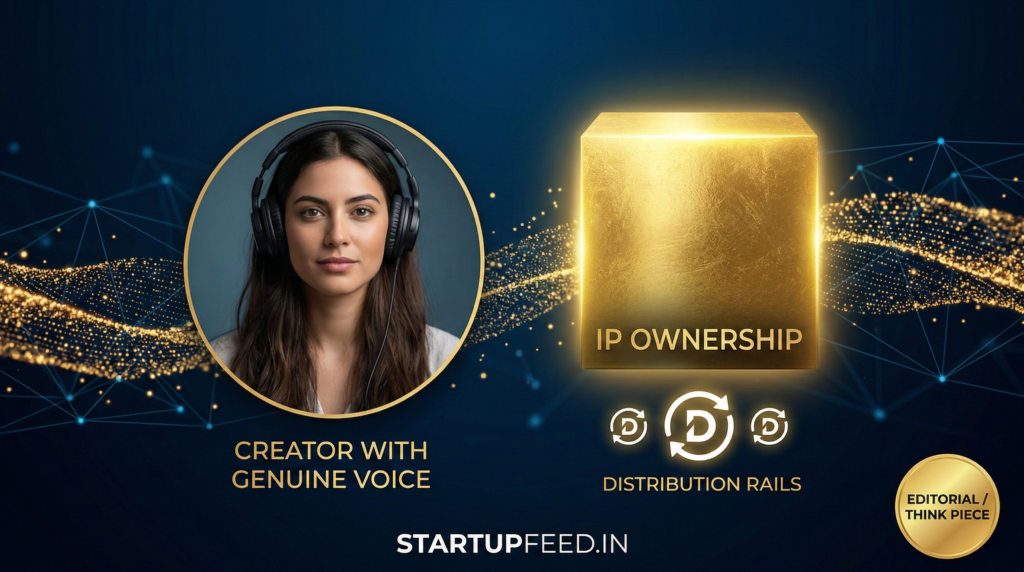
In January 1848, gold was discovered at Sutter’s Mill in Coloma, California. By 1849, 300,000 people had flooded in from across the world, picks in hand, convinced that the ground beneath their feet held a fortune. Most of them went home broke. The people who got rich were not the miners. They were Levi Strauss (who sold durable trousers to miners), Wells Fargo (who transported the gold they found), and the landowners who charged for the right to dig. The ore was everywhere. The value was in the infrastructure around it.
We are living through the closest modern equivalent: the AI Video Gold Rush. As of March 2026, a 19-year-old in Jaipur with a Rs 500/month internet connection can generate a cinematic, photorealistic 60-second video in under 30 minutes using Google Veo 3, Runway Gen-4.5, or Kling 2.6 — for less than the cost of a cup of coffee. The AI video market is projected to hit $18.6 Bn this year, up from $5.1 Bn in 2023 — a 34.2% CAGR that makes most other tech sectors look pedestrian. Video generation volume grew 840% between January 2024 and January 2026. AI reduces production costs by 91% — from $4,500/min (traditional) to roughly $400/min. The average 60-second video that once took 13 days now takes 27 minutes.
The gold is everywhere. Millions of people are mining it. But who is actually getting rich? And more importantly: what does it mean to build lasting value in a media landscape where creation itself has become a commodity?
- The New Media Stack: Five Layers, Five Different Wars
To understand who wins the AI video era, you need to understand the new media stack — the five-layer architecture that has replaced the old broadcast model. Each layer has different competitive dynamics, different moats, and different winners. Most creators are fighting in Layer 3. The real value is accumulating in Layers 4 and 5.
| Layer | Who Owns It | The Real War |
| Layer 1Infrastructure(The Picks & Shovels) | Google (Veo 3.1 — 96.4% market share), OpenAI (Sora 2), Runway (Gen-4.5), Kling (ByteDance), Pika, Luma | NVIDIA (Blackwell chips) | Model quality, cost-per-generation, API distribution. Runway Gen-4.5 just displaced Google at #1 (Elo 1,247). The leaderboard reshuffles monthly. Infrastructure companies are the Levi Strauss of this gold rush — they profit regardless of who “wins” at the content layer. |
| Layer 2Workflow Tools(The Shovels) | Adobe Premiere (AI integration), DaVinci Resolve, CapCut, InVideo AI, HeyGen, ElevenLabs (audio), fal.ai (inference infra — 89.5% of Veo requests) | Speed + integration + price. 75% of studios now use 2-3 AI video platforms simultaneously — no loyalty, just flexibility. The average enterprise uses 3.2 different AI video tools. Winners are multi-model, not single-model. Moat is workflow lock-in, not model quality. |
| Layer 3Content Creation(The Mining) | 300 million+ content creators globally. Everyone. AI has democratised creation to the point of near-zero cost. Volume is exploding. LinkedIn saw 310% increase in AI-generated video content in 2025. | Attention. Creation is free but attention is finite. When anyone can make a cinematic video, cinematic quality alone is no longer a differentiator. The war at this layer is won on voice, angle, narrative — not production value. Only 1-5% of creators earn significantly. AI has not changed that ratio. It has accelerated the divergence. |
| Layer 4Distribution(The Rails) | YouTube (2.7 Bn monthly users), Instagram Reels, TikTok, Shorts, X, LinkedIn Video. Meta’s “Vibes” AI-generated video feed. Algorithm is the gatekeeper. | Algorithm ownership vs. audience ownership. Platform reach is rented, not owned. Every creator who depends entirely on algorithmic distribution is a tenant, not a landlord. The creators who win Layer 4 are building owned channels (newsletters, communities, direct relationships) alongside platform presence. Distribution moat = owned audience that moves with you. |
| Layer 5Ownership & IP(The Land) | IP owners, brand builders, community founders, franchise owners. Disney licensing characters to Sora (Dec 2025). Creators licensing their likeness to AI companies. Podcast IP. Newsletter IP. Format IP. | The only layer that compounds. IP earns while you sleep. Audience relationships survive platform collapses. Brand trust is not fungible. In 2025, creators began licensing their likenesses to AI companies for training — a new asset class that did not exist two years ago. The creator economy’s global value hit $178 Bn in 2025 and is projected to reach $1.35 trillion by 2035 (22.4% CAGR). All the value is here. |
- The critical insight: Most people entering the AI video space are fighting Layer 3 wars (creation). The people extracting the most value are winning Layer 5 battles (ownership). This is not a critique of creators — it is a map. Understanding which layer you are on determines which strategy will compound for you and which will plateau.
- When Creation Becomes a Commodity
Classical economics has a word for what is happening to video production: commoditization. When a good or service becomes widely available, easily replicated, and competitively priced to near-zero, its economic value collapses. The product still exists — often in greater quantity than before — but the margin moves upstream.

This happened to music in the late 1990s. Digitisation made music creation and distribution near-free. The commodity collapsed. The value moved to live performance and merch (IP + experience), to Spotify and Apple Music (distribution rails), and to content ID and licensing systems (ownership infrastructure). The artists who survived built IP empires. The ones who only created became content suppliers to platforms that owned the rails.
The AI video market is accelerating this exact cycle, but on a compressed timeline. The cost per AI-generated video has dropped 73% since 2023. Models that were technically groundbreaking six months ago are now commodity infrastructure. Runway Gen-4.5 displaced Google Veo 3.1 at the top of the benchmark leaderboard in a single release. OpenAI’s Sora 2, despite unmatched brand recognition, captures just 2% of actual market share in real-world usage. The best model today is the second-best model tomorrow. Tool quality is not a moat
What this means practically: the creators who are building strategies around access to the best AI video tool are building on sand. The creators who are building strategies around audience ownership, IP development, and distribution independence are building on rock.
III. The Three Ownership Battles That Actually Matter
- Audience Ownership: The Landlord vs. Tenant Problem
A creator with 2 million YouTube subscribers and zero email subscribers owns nothing. YouTube’s algorithm is their product’s distribution system — and YouTube can change that algorithm, demonetize a channel, or simply decline tomorrow. This is the landlord vs. tenant problem: the creator is building on land they do not own.
The shift that defines the next decade of the creator economy is from platform reach to owned audience. Email newsletters, private communities, direct-purchase relationships, and paid subscription products all represent audiences that travel with the creator across platform changes. The stat that matters here: only 9% of consumers pay for more than one AI subscription — but the ones who pay are deeply loyal. Depth of relationship is the scarce resource, not breadth of reach. Build for the 1,000 who will follow you anywhere, not the 1 million who might tap past your video.
- IP Ownership: The Asset That Earns While You Sleep
Disney’s December 2025 deal with OpenAI — licensing over 200 characters from Disney, Marvel, Pixar, and Star Wars for use in Sora — is the single most important signal in the AI media landscape. Disney’s IP earns whether Disney makes a video or not. The characters are the asset. AI has made IP more valuable, not less, because the cost of producing derivative content has collapsed to near-zero while the value of the original IP has become the scarce input.

For individual creators, IP ownership means: formats, characters, narratives, or methodologies that are proprietary to you. A faceless animation channel has created IP when its characters are recognisable. A business education channel has created IP when its framework has a name people search for. A lifestyle creator has created IP when their aesthetic is a genre. The question every creator should ask is: “If this platform disappeared tomorrow, what would my audience still pay for?” The answer is your IP.
- Distribution Ownership: The Channel vs. The Rail
There is a critical distinction between having distribution and owning distribution. Having distribution means your content reaches an audience through someone else’s system. Owning distribution means your audience comes to you regardless of intermediaries. Email is owned distribution. A newsletter subscriber list is owned distribution. A paid community is owned distribution. An Instagram following is rented distribution.
The creators who built YouTube-only businesses in 2015 and Instagram-only businesses in 2018 learned this lesson expensively when algorithm changes gutted their reach overnight. AI has made this lesson more urgent, not less, because AI-generated content is flooding every algorithmic platform simultaneously. When content supply explodes, algorithmic platforms become more selective — and more extractive. The platform needs you less when it can generate content itself. Meta’s “Vibes” feed — a scrolling feed of AI-generated short videos — is a direct signal that platforms are becoming content competitors, not just content distribution networks.
- What This Means for India’s Creator Economy
India has 150 million+ digital content creators in APAC (a market in which India is the largest single contributor). The Indian creator economy is growing at 22%+ annually — in absolute numbers, one of the fastest growing creator markets on Earth. Asia-Pacific collectively holds 31% of global AI video market share. India is the intersection of both curves.
The structural dynamics in India are different from the West in three important ways, and each creates a distinct strategic opportunity:
Language diversity as moat: India has 22 official languages and hundreds of dialects. AI video with native multilingual audio generation (Kling 2.6, Seedance 1.5, Veo 3.1) changes the addressable audience for every creator dramatically. A Hindi creator who builds a format that can be localised into Tamil, Telugu, and Bengali via AI audio is accessing a 7-8X audience multiplier with marginal cost of near-zero. The multi-language AI video market is used by 34% of global brands but barely penetrated in India’s creator economy. This is the most underexploited opportunity in Indian content right now.
Cultural IP as defensible territory: Indian cultural IP — festival narratives, mythological storytelling, regional cuisine formats, nostalgic 90s childhood content — is deeply resistant to commoditisation because it requires cultural context to produce authentically. A Studio Ghibli-inspired animation of Lohri in a Punjab village is not something a Western AI model produces correctly without specific prompt engineering and cultural knowledge. This context barrier is an early-stage moat for Indian creators who build cultural IP at the intersection of AI production and authentic lived experience.
The distribution gap is still the biggest opportunity: India’s online content penetration is still sub-10% of total media consumption time. The formal creator economy is tiny relative to the total addressable audience. Unlike the US (where creator market share battles are zero-sum), in India the category itself is still being created. Every creator who builds owned distribution now — newsletters, communities, WhatsApp channels, direct subscriptions — is staking territory in a market that is still predominantly offline. The Pronto analogy applies: “I still believe 99.99% of this market is completely offline.”
- Who Actually Gets Rich: The Picks and Shovels Analysis
The California Gold Rush enriched three categories of people: the infrastructure providers (Wells Fargo, Levi Strauss), the landowners (those who held claims), and the service providers (lawyers, doctors, merchants) who catered to the miners. The miners themselves — the ones who came for the gold — mostly broke even or worse. The AI video gold rush will follow the same distribution.
| Category | Who Wins | Why They Win |
| Infrastructure(“Levi Strauss”) | Google, Runway, ByteDance/Kling, NVIDIA, fal.ai | The model and chip providers | Every video generated = revenue for infrastructure. They profit whether the creator succeeds or fails. $4.7 Bn VC into AI video startups in 2025 alone. Infrastructure wins regardless of content market share. |
| IP Owners(“The Landowners”) | Disney (characters licensed to Sora), creators who build recognisable franchises, newsletter operators, community owners, format IP holders | IP compounds. A recognisable character earns licensing revenue forever. An audience that trusts a creator survives algorithm changes. The 2025 creator economy hit $178 Bn and heads to $1.35 trillion by 2035. Essentially all of that value accrues to IP owners. |
| Distribution Rail Owners(“Wells Fargo”) | YouTube, Instagram, TikTok, LinkedIn, but ALSO email service providers, Substack, paid community platforms, direct commerce platforms | Distribution rails extract rent from content volume. Platforms grow more powerful when content supply rises because they can be more selective. Beehiiv, Substack, Circle, and similar owned-distribution infrastructure become more valuable as algorithmic platforms get crowded. |
| Premium Content Creators(“The 1-5%”) | Creators with genuine cultural voice, owned audience, format IP, and multi-channel distribution independence | Not commoditised because they are not just content producers — they are brands. The creator economy has always had a power law distribution: 1-5% earn significantly. AI has not changed this ratio. It has changed the ceiling for the winners and the floor for the losers. |
| Content Volume Producers(“The Miners”) | Creators producing high-volume, algorithm-optimised, AI-generated content without IP ownership or audience ownership | Short-term algorithmic gains, long-term platform dependence. Content supply is infinite; platform attention is finite. When every creator has access to the same tools, volume without voice is noise. The $3.7 Bn in production costs saved globally in 2025 did not translate into creator earnings — it translated into lower CPMs as content supply exploded. |
- The Copyright Question: Who Owns What AI Makes
The legal infrastructure of the AI video economy is still being built, and the current state is simultaneously more permissive and more precarious than most creators understand.
What the law says right now (March 2026): The D.C. Circuit Court affirmed in March 2025 that AI cannot be a copyright author — human authorship is a “bedrock requirement.” Pure AI-generated content has no copyright protection in the US. However, human-AI collaborative works can qualify for copyright if the human contribution is sufficient and specific. The Copyright Office’s 2025 Part 2 report concluded that “some uses will qualify as fair use, and some will not” — unhelpfully precise. The UK’s November 2025 ruling in the Getty v. Stability case favoured the model providers on copyright grounds but found limited trademark infringement.
What this means for creators: All major AI platforms (Google, OpenAI, Runway, Anthropic) now contractually assign output ownership to the user. You own what you generate — but only Microsoft and Anthropic (enterprise) offer IP indemnity if outputs infringe third-party rights. If your AI-generated video happens to be substantially similar to a protected work, you are named in the lawsuit, not the model provider. The tool is not the liability. The publisher is.
The deeper IP question: Pure AI output has no copyright. But your creative direction, your prompt engineering, your editorial selection, your post-production, and your brand identity are all copyrightable human contributions that layer onto AI output. The creator who treats AI video as a tool within a human creative process is building protectable IP. The creator who treats it as a content factory is building nothing that can be owned.
VII. What Creates Lasting Value in the AI Video Era
After surveying the landscape, the evidence converges on four sources of lasting value in a world where creation has been commoditised:
- Proprietary perspective, not proprietary production. When everyone can make a technically competent video, the differentiator is what you see that others don’t and why you see it that way. The editorial voice, cultural angle, or intellectual framework is the scarce input. AI democratises production. It cannot democratise genuine perspective. The creator who has a specific relationship with their audience — built over years, through specific content, on specific themes — has something that no AI tool can replicate because it is human trust, not technical output.
- Compounding audience relationships, not compounding content volume. The metric that matters is not total views — it is repeat engagement rate and median rebooking interval (to borrow Pronto’s language). How quickly does an audience member come back? The creators with a 2-day median rebooking interval (the video equivalent of Pronto’s home services metric) are building fundamentally different businesses from the creators with 0.1% re-engagement rates. Depth of relationship is not achievable at volume — it requires intentional audience architecture: emails, communities, direct touch.
- Format and franchise IP over one-off viral content. A viral video is an event. A franchise is an asset. The distinction is whether the format, characters, or structure of your content is proprietary and recognisable. “The Office Hours” format. “The Deep Dive” brand. A named animation character with a recurring arc. These create format IP that persists beyond individual pieces and generates derivative demand: “I want more of this specific thing.” Viral content creates discovery. Franchise IP creates retention.
- Owned distribution that survives platform changes. Every major platform algorithm change since 2012 — Facebook’s reach collapse, YouTube’s recommendation shift, Instagram’s Reels pivot, TikTok’s volatility — reduced the value of rented distribution and increased the value of owned distribution. AI content flooding is the next version of this dynamic. Build the list. Build the community. Build the direct relationship. These are the only media assets that compound unconditionally, regardless of what any algorithm does next.
The Bottom Line
The AI video gold rush is real. $18.6 Bn in market size. 840% volume growth in 24 months. 91% cost reduction. 27-minute production time for what once took 13 days. The tools are genuinely remarkable. The opportunity is genuinely large.
But the California Gold Rush created $2 billion in extracted gold and $10 billion in economic activity around the gold. The value was not in the ore. It was in the infrastructure, the ownership, the distribution, and the lasting relationships that outlived the rush.
The AI video gold rush will end the same way. When everyone can create, creation is not the advantage. The advantage is:
What you own (IP, audience, format, franchise)
Where you distribute (your rails, not rented rails)
Who keeps coming back (depth of relationship, not breadth of reach)
What compounds (trust, community, brand — not content volume)
The real battle in the AI video era is not about who can make the best video. It is about who builds the business that makes the video matter. That battle has nothing to do with which model won this month’s benchmark. It has everything to do with the oldest questions in media: who do you trust, why do you keep coming back, and who owns the relationship?
Liked this story? Follow StartupFeed on Google so our reporting reaches you first.